Ask a performance team what a customer costs and you will usually get one number: total marketing spend divided by orders, or by customers. It looks precise. It is also an average of two very different things: the cheap repeat orders that email, retargeting and branded search collect from people who already know you, and the expensive first orders that prospecting has to win from people who do not.
Mix the two and every channel that harvests existing customers looks efficient, while the channels that actually grow the customer base look expensive. At ESN and More Nutrition, separating new from existing customers in every budget decision was the largest single lever in their measurement setup, and cost per new customer fell 70%.
Black Week sharpens the problem. Discounts pull existing customers forward, retargeting and email claim a large share of orders, and new customers arrive on a first order with a thinner margin than usual. Unless you separate them, you cannot tell whether Black Friday bought you new customers or sold discounted products to old ones.
This guide covers what CAC includes, how NC-CAC (new-customer CAC) differs, who counts as "new", how to calculate both per channel, how to judge payback on contribution margin rather than revenue, and how to set the most you can pay for a new customer in Black Week.
Admetrics is a marketing measurement and budget platform for ecommerce and DTC brands. We measure what drove each order independently of the ad platforms, separate new from returning customers in every report, and work out the profit left after costs and returns. The guide draws on what we see across more than 100 brands on the platform.
Key takeaways
- Blended CAC flatters the channels that harvest. In our worked example, cost per order is €12, while each genuinely new customer costs €40.
- NC-CAC divides spend by new customers only. It is the number to use for acquisition decisions, and it often reverses the channel ranking: retargeting goes from one of the cheapest channels per order to the most expensive per new customer.
- "New" needs a written definition. Decide the lookback window, match customers across shop and marketplaces, and remember gift buyers.
- Judge payback on contribution margin, not revenue. A customer pays back when their cumulative CM2 exceeds what you paid to win them.
- A Black Friday first order earns less, so the customer must cost less. In our example, a 20% first-order discount cuts the affordable NC-CAC for a 12-month payback from €39.60 to €28.60.
- Check Black Friday cohorts before assuming they are worse. Compare their repeat rate at 90 and 180 days with customers won in other months.
- Better conversion signals lower NC-CAC. Freiluftkind raised new-customer ROAS on native ads by 220% after fixing its conversion signal.
What is customer acquisition cost?
Customer acquisition cost is what you spend to win a customer.
CAC = acquisition costs in a period ÷ customers acquired in that period
The formula is simple. What goes into the top line, and who counts in the bottom line, decide whether the number is useful.
Which costs to include
Teams usually work with two versions. Paid CAC is quick to calculate and good for comparing channels. Fully loaded CAC is what finance means, and the one to use for unit economics and pricing.
Whichever version you choose, use it consistently, and say which one a report shows. A paid CAC compared with last year's fully loaded CAC will always look like an improvement.
CAC, NC-CAC, CPA and blended CAC: four different numbers
The terms are used loosely, which is how a team ends up arguing about a number that means different things to different people.
Why blended CAC lies
Retargeting, email and branded search mostly reach people who already know you. They convert well and look cheap per order, because much of the demand already existed. Prospecting on Meta, TikTok or non-brand search reaches people who do not know you yet. Those orders cost more, but they are the ones that grow the business.
A blended number rewards the first group and penalises the second. A team judged on blended CAC or CPA can hit every target while acquiring very few new customers, and the problem only shows months later, when the returning base stops growing. That is why last-click reporting, which credits whatever touched the customer last, tends to move budget toward branded search, retargeting and email. Our marketing attribution guide covers that bias in detail.
How to calculate NC-CAC
- Fix the period and the cost basis. One month, paid or fully loaded, the same every time.
- Count new customers. Customers whose first order with you falls in the period, by the definition in the next section.
- Divide. Acquisition spend ÷ new customers.
- Split by channel once you have deduplicated attribution, so each new customer is credited once.
Worked example: one month, three answers
An illustrative shop spends €60,000 on paid media in a month. It takes 5,000 orders: 1,500 first orders from new customers, and 3,500 repeat orders from 2,800 returning customers.
Same spend, same month, and the cost of a customer ranges from €12 to €40 depending on what you divide by. If the team plans next month's acquisition budget on €12, it will underestimate the cost of growth by more than three times.
This version charges all spend to new customers, which is the conservative reading: it assumes the returning orders would have happened anyway. Some teams subtract spend on retention campaigns (email, loyalty retargeting) before dividing. That is fine, as long as the split is stated and stays the same from month to month.
Who counts as a new customer?
NC-CAC is only as good as the definition of "new". Four decisions matter.
Marketplaces: new to the shop, not new to you
Many brands sell a large share through Amazon. Naturtreu runs roughly 50/50 between Amazon and its own shop. A shopper who has bought on Amazon for a year and places a first shop order is new to the shop's records but not new to the brand. Counting them as new makes NC-CAC look lower than it is, and gives the campaign credit for a customer the brand already had. Matching customers across both channels is how Naturtreu judges whether a new customer really is new.
Gifts
At Nyfter, a gaming-accessories brand, up to 30% of purchases in a normal month are gifts from parents or grandparents who never saw the ad. With Christmas shopping starting in Black Week, the share of gift buyers is likely to be higher. They are real new customers by any definition, but they are less likely to come back for themselves, which matters for payback.
Admetrics separates new and returning customers in every report, and Cross Matching links customers across your shop and marketplaces so one buyer is never counted as new twice. See Customer Intelligence.
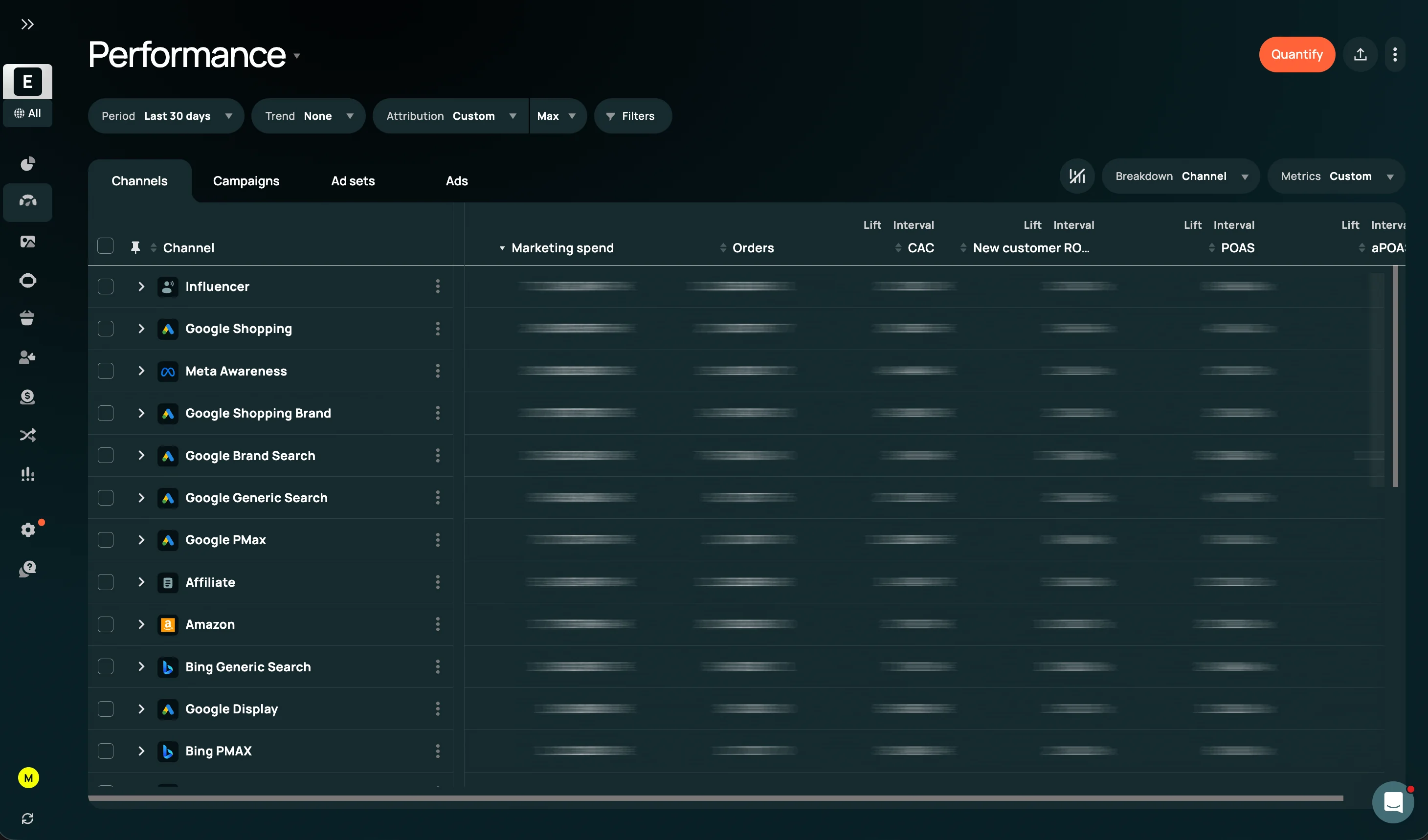
NC-CAC by channel: the ranking flips
The same €60,000 month, split by channel. Each new customer is credited to one channel only, using deduplicated attribution anchored to shop orders.
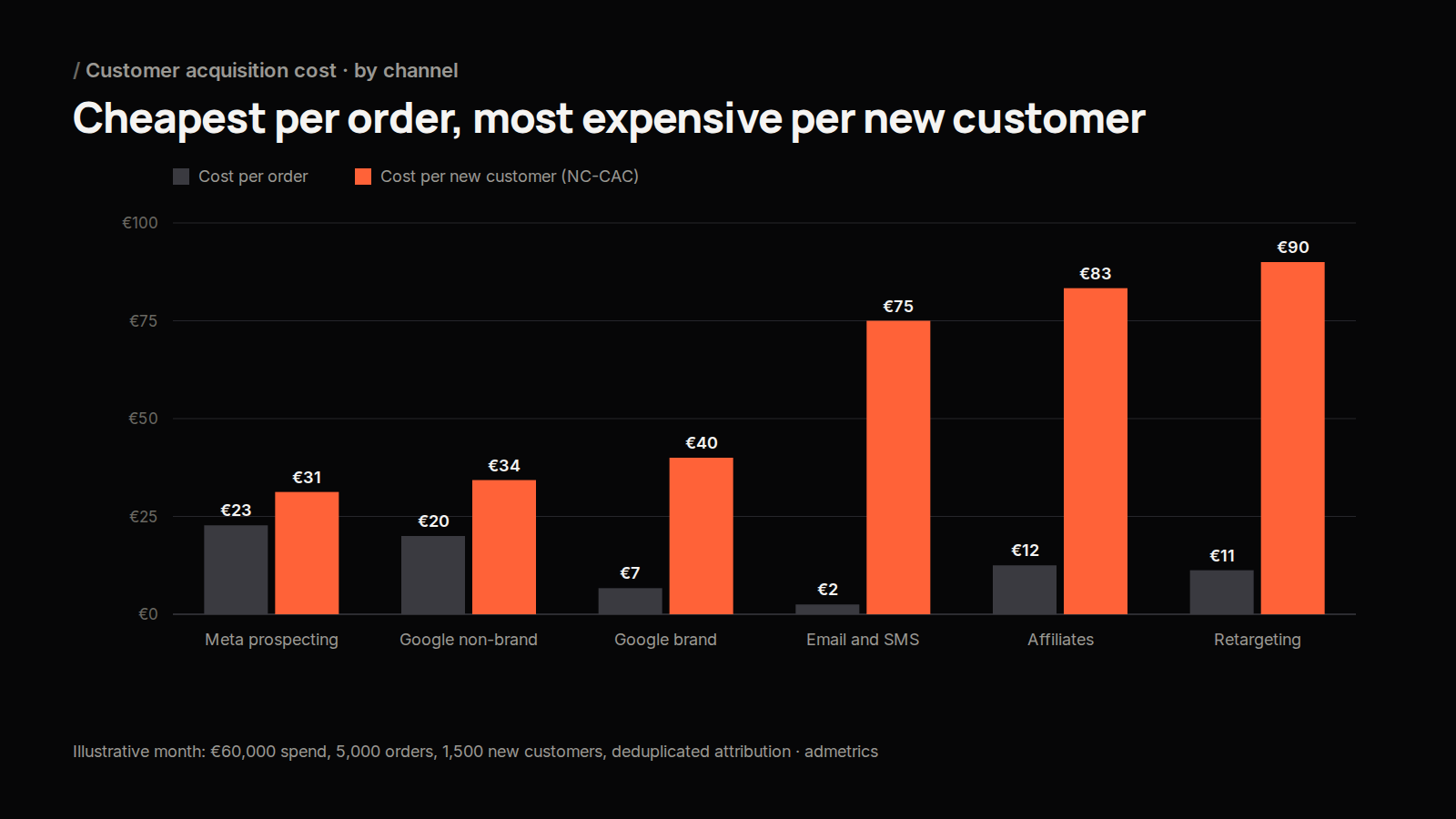
Cost per order vs cost per new customer by channel: retargeting, affiliates and email are cheap per order and the most expensive per new customer
Ranked by cost per order, email, branded search and retargeting are the stars and Meta prospecting is the most expensive channel. Ranked by NC-CAC, the order reverses: Meta prospecting and non-brand search acquire new customers at the lowest cost, and retargeting costs almost three times as much per new customer.
Neither ranking says retargeting is useless. Retention has value of its own. The point is that the two jobs need two numbers, and acquisition budget should follow NC-CAC.
What ESN and More Nutrition changed
The Quality Group, the company behind ESN and More Nutrition, processes more than 200,000 orders on a Black Friday. It replaced last-click reporting with a U-shaped model that weights new-customer, existing-customer and influencer touchpoints differently, and separated new from existing customers in every budget decision. That split was the largest single lever: cost per new customer fell 70%.
Payback and CLV to CAC, measured on contribution margin
NC-CAC on its own says what a customer cost. Whether that was worth it depends on what the customer earns you afterwards.
Payback period
Payback = the time until a customer's cumulative contribution margin exceeds their NC-CAC
Use CM2 (after product, fulfilment, shipping, payment and returns), not revenue. A customer who has spent €80 with you has not paid back a €40 acquisition cost if their orders left only €30 of margin.
An illustrative customer: €55 AOV, €22 CM2 on a full-price first order, with repeat orders adding up over the following year.
At Meta prospecting's €31.25 NC-CAC, this customer pays back in about four months. At the store-wide €40.00, they have not paid back after a year. At retargeting's €90, they never will.
CLV to CAC
CLV to CAC = contribution margin per customer over a period ÷ NC-CAC
A frequently quoted rule of thumb is a ratio of 3:1, but it is usually calculated on revenue. On contribution margin the ratios are lower and more honest. In the example, 12-month CM2 of €39.60 against an NC-CAC of €31.25 gives 1.3:1: profitable within the year, with every later order adding to it.
Two cautions. Use a fixed horizon (12 or 24 months) rather than an open-ended lifetime, because lifetime estimates are where optimism hides. And compare cohorts by acquisition month and channel, because customers won by different campaigns rarely behave alike. Tales & Tails, a subscription-led pet food brand, deliberately keeps some campaigns with weaker first-order ROAS live because they produce subscribers later.
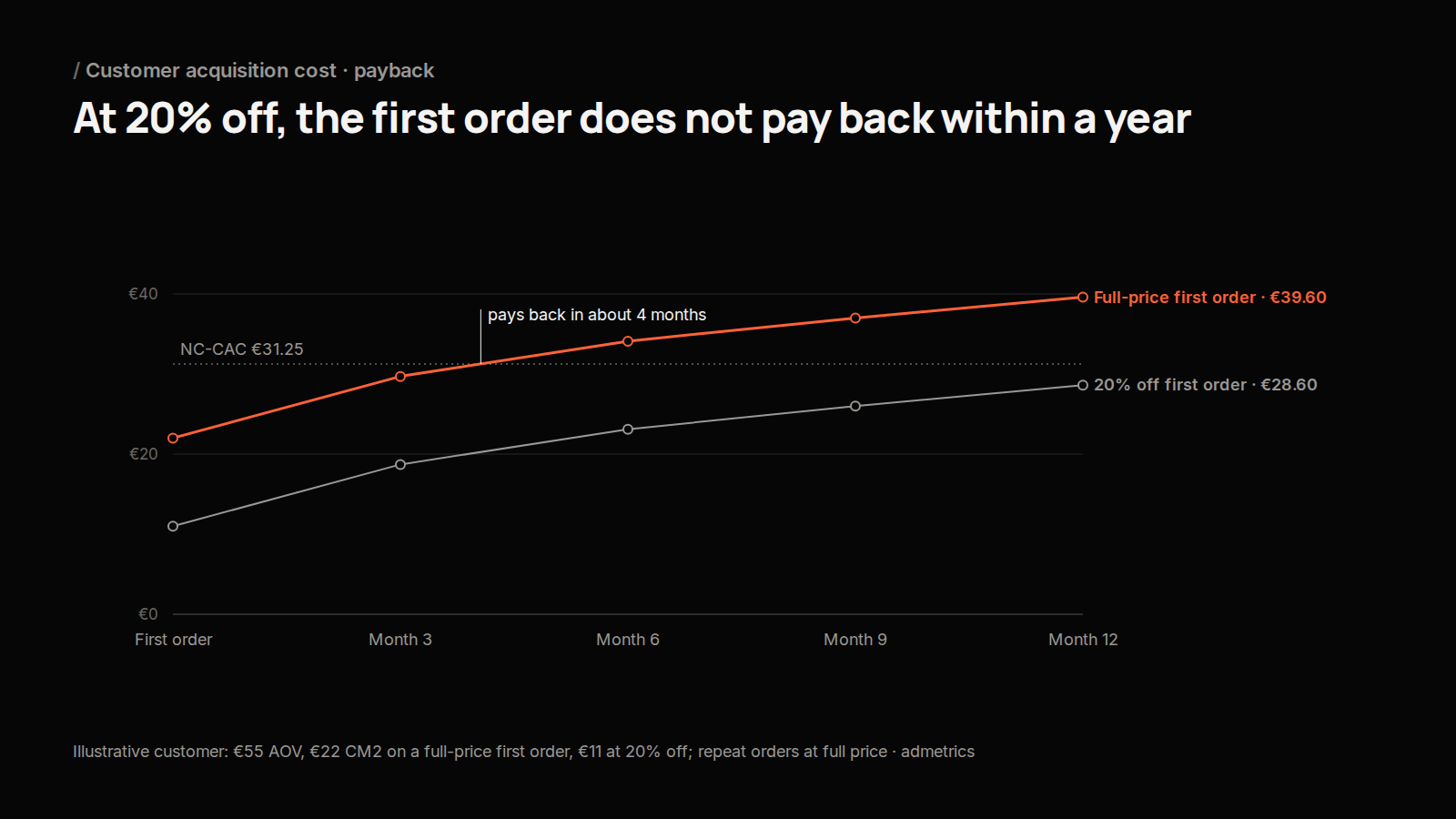
Cumulative CM2 per customer over 12 months against an NC-CAC of €31.25: a full-price first order pays back in about four months, a 20% off first order not within a year
What a Black Friday customer is worth
A new customer won on Black Friday usually starts with a discounted first order, so their first CM2 is lower. If they then behave like any other customer, they still pay back later than one won at full price. If they behave worse, they may not pay back at all.
The most you can pay for a new customer in Black Week
Maximum NC-CAC = first-order CM2 at the Black Friday price + expected CM2 from repeat orders within your payback target
The same illustrative customer, with a 12-month payback target:
A 20% first-order discount lowers what you can afford to pay for the customer by 28%, from €39.60 to €28.60, and that assumes Black Friday customers reorder as often as everyone else. Set the Black Week NC-CAC ceiling per campaign from this calculation, before the week, so nobody has to work it out at midnight on Black Friday.
Check your Black Friday cohorts instead of assuming
Black Friday customers are often described as one-time deal hunters. Some are; some become your best customers. Your own data answers it better than any rule of thumb:
- Compare the repeat rate of customers acquired in last year's Black Week with customers acquired in October and January, at 90 and 180 days.
- Split the comparison by channel and by entry product. A Black Friday cohort from a starter bundle often behaves differently from one that came for a single discounted item.
- Use the result to set this year's ceilings: if Black Friday cohorts repeat half as often, halve the repeat-order CM2 in the formula above.
How to lower NC-CAC
The first two levers do the most. Splitting new from existing customers changes what you optimise for; better signals change what the platforms optimise for.
NC-CAC before, during and after Black Week
Common mistakes
- Reporting CPA as CAC. Cost per order is not cost per customer, and neither is cost per new customer.
- Counting marketplace or gift customers as new without checking. It makes NC-CAC look better than it is.
- Judging payback on revenue. Use contribution margin, after returns.
- Using one NC-CAC ceiling all year. A discounted Black Friday first order needs a lower ceiling than a full-price one.
- Reading Black Friday cohorts after two weeks. Repeat behaviour shows in months, not days.
CAC and NC-CAC calculator
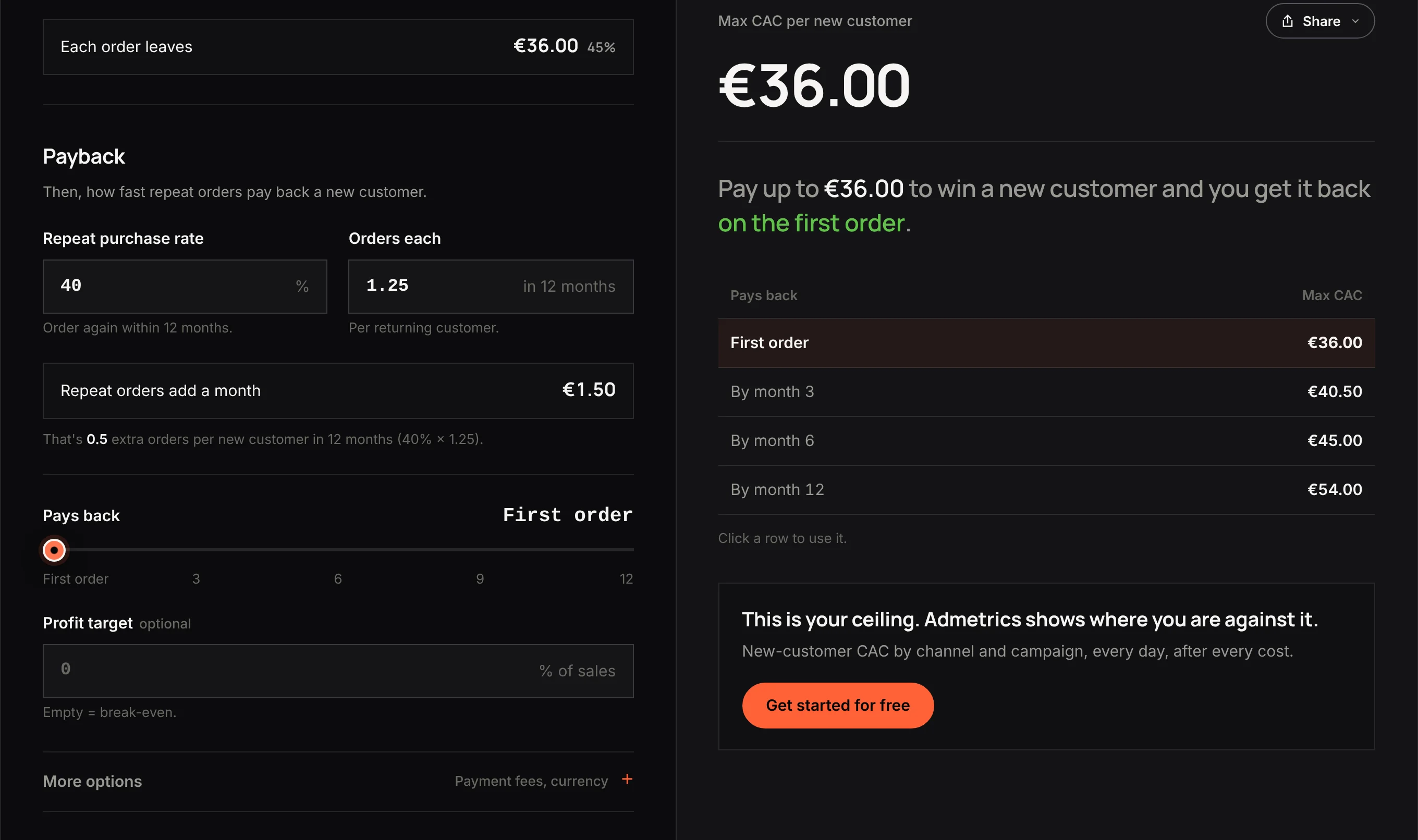
Try it with your own numbers: the free customer acquisition cost calculator shows your CAC, how many months a customer takes to pay it back, and the most you can spend to win one.
For the margin inputs, use the contribution margin calculator.
FAQ
What is customer acquisition cost?
What you spend to win a customer: acquisition costs in a period divided by the customers acquired in that period.
How do you calculate CAC?
Add up acquisition spend for a period (paid media only, or fully loaded with agency, tools and team), then divide by the number of customers acquired in the same period.
What is NC-CAC?
New-customer CAC: acquisition spend divided by genuinely new customers only. It removes the repeat orders that make channels such as retargeting and email look cheap.
What is the difference between CAC and CPA?
CPA divides spend by orders, including repeat orders. CAC divides it by customers, and NC-CAC by new customers only. For acquisition decisions, use NC-CAC.
What is a good CLV to CAC ratio?
3:1 is a commonly quoted target, usually on revenue. On contribution margin, judge it by payback instead: how many months until a customer's cumulative margin covers what you paid for them, and whether that fits your cash position.
Are Black Friday customers less valuable?
Sometimes, not always. Compare your own Black Friday cohorts with customers acquired in other months at 90 and 180 days, by channel and entry product, before setting this year's ceilings.
How much should I pay for a new customer in Black Week?
At most the first-order CM2 at the Black Friday price plus the CM2 you expect from repeat orders within your payback target. A discounted first order lowers that ceiling.
See NC-CAC live, on your real data
Admetrics separates new and returning customers in every report, matches customers across shop and marketplaces, and shows NC-CAC, payback and contribution margin by channel and campaign. In Black Week you see which campaigns win new customers you can afford, while you can still move the budget.
Run your biggest week free: Admetrics is free until 1 December. No credit card, no commitment. Get started for free