Ask what a new customer costs and two answers usually come back: the CPA next to every campaign in Meta Ads Manager, and an LTV:CAC ratio on revenue in the agency's deck.
Both look like a customer acquisition cost. Neither says what a new customer may cost your store, or in which month that money comes back, which is what finance asks before anyone pushes spend.
This customer acquisition cost calculator settles three decisions: the CAC to put in front of finance, the most a new customer may cost, and the payback month that ceiling depends on.
The calculator does the arithmetic. The guide below covers which numbers to feed it and the mistakes that make a CAC look affordable on paper.
Free, no email, and it runs in your browser.
How to use the customer acquisition cost calculator
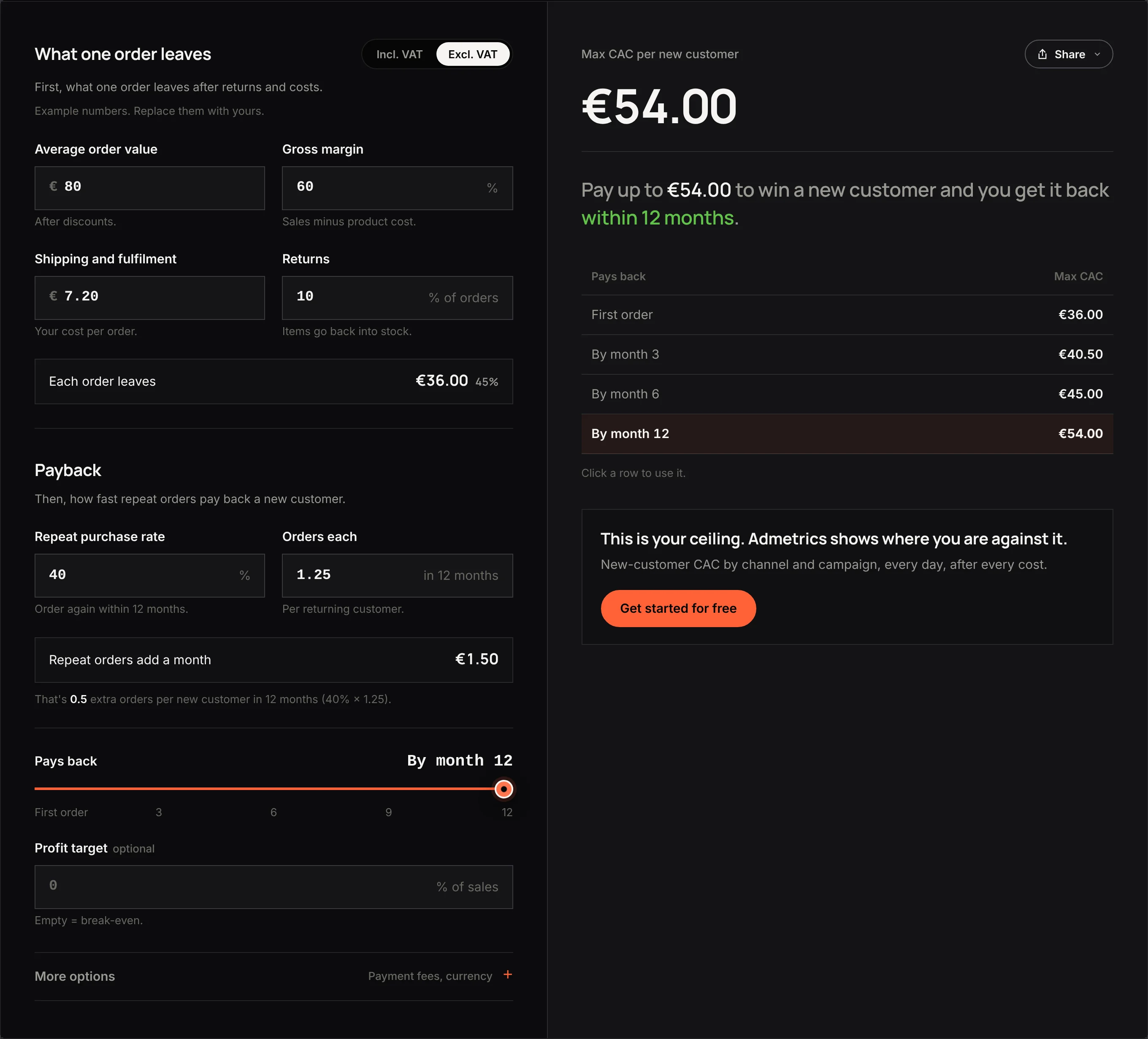
The calculator works in two steps: "What one order leaves," after product cost, returns and shipping, and "Payback," for the repeat orders that pay a new customer back over the following year.
Both open on example numbers. Replace them with yours:
- Average order value, after discounts and without VAT, from Shopify Analytics. If yours includes VAT, switch the step heading to Incl. VAT and pick the country.
- Gross margin, from your P&L or the product costs in Shopify.
- Shipping and fulfilment per order: the 3PL invoice divided by orders shipped, with pick-and-pack, packaging and return labels in.
- Returns, the share of orders sent back, from Shopify Analytics.
- Repeat purchase rate: in a cohort of first-time customers at least a year old, the share who ordered again within a year.
- Orders each: that cohort's repeat orders divided by the customers who came back.
Set the Pays back slider to the month the money has to be back, and leave Profit target empty for break-even. More options holds the Shopify plan, the payment method (which fills in a fee you can edit) and the currency. The Share pill copies the result as text or as an image.
How to calculate customer acquisition cost
The first three steps build the CAC you actually pay, and the rest decide what it may be. The judgment calls are yours.
1. Count first-time customers only
The customer acquisition cost formula takes what you spend to win new customers in a period and divides it by the new customers won in the same period:
CAC = all acquisition costs ÷ first-time customers
Shopify defines it the same way. Most arguments between CAC numbers start below the line: divide by every customer who ordered, new and returning, and the result falls whenever more existing customers order, even in a month when new ones got more expensive. Taken over all channels like this, the formula gives what's often called blended CAC; channel CAC (step 3) splits it up.
| One illustrative month: €60,000 of acquisition costs divided by | Result | What it is |
|---|---|---|
| 2,500 orders | €24 | Marketing per order |
| 1,500 customers who ordered, new and returning | €40 | Spend per customer who ordered |
| 1,000 first-time customers | €60 | CAC |
Only the last row can be held against what a new customer pays back, and it's the one we'd put in front of finance. Take first-time customers from Shopify Analytics for the same dates as the costs.
2. Put every acquisition cost in
A CAC built from ad spend alone improves every time work moves from an ad account to an invoice, while the customer costs the same.
Collect each cost where it's billed: ad spend from Meta Ads Manager, Google Ads and every other ad account; agency, freelancer and creator fees from their invoices; affiliate commissions from the network's statement; tools from the subscriptions.
We'd always add the in-house team's share: the salaries of the people who buy media or make ads, times the share of their time spent on acquisition. Leave it out and bringing media buying in-house looks like a drop in CAC when you pay roughly the same under another line of the P&L.
Retention spend, such as email to existing customers and the loyalty program, stays out. First-order discounts go in the order value instead: the calculator asks for order value after discounts, and counting a welcome code in CAC as well takes the same euro off twice.
3. Build channel CAC from your own data
The CPA in Meta Ads Manager or Google Ads is one platform's ad spend divided by the conversions it credits to itself. Those can include returning customers and orders another platform also claims. Keep platform CPA for choosing between ads inside one platform, and build channel CAC yourself:
Channel CAC = (channel ad spend + its share of agency, creative and tools) ÷ first-time customers your store attributes to that channel
In our view an agency retainer follows the channel the agency works on, and one covering several channels is split by spend share: crude, but consistent from month to month.
Customers come from your own order data: read each first-time customer's channel from the UTM parameters on the first order (in Shopify's order details or your analytics tool) and count every customer once.
Customers with no tracked source get an unattributed row, which stays in the store total. Our default is to spread them across channels in proportion to the customers each already has, and to say so next to the numbers, because leaving them out makes every channel look more expensive than it is. Then check that channel costs add up to the total, and channel customers plus the unattributed row to all first-time customers.
4. Judge it against what an order leaves, not gross margin
Gross margin is the quick answer to what a customer is worth, and it flatters every CAC: a returned order is refunded, but the parcel went out and came back and the shipping was paid either way.
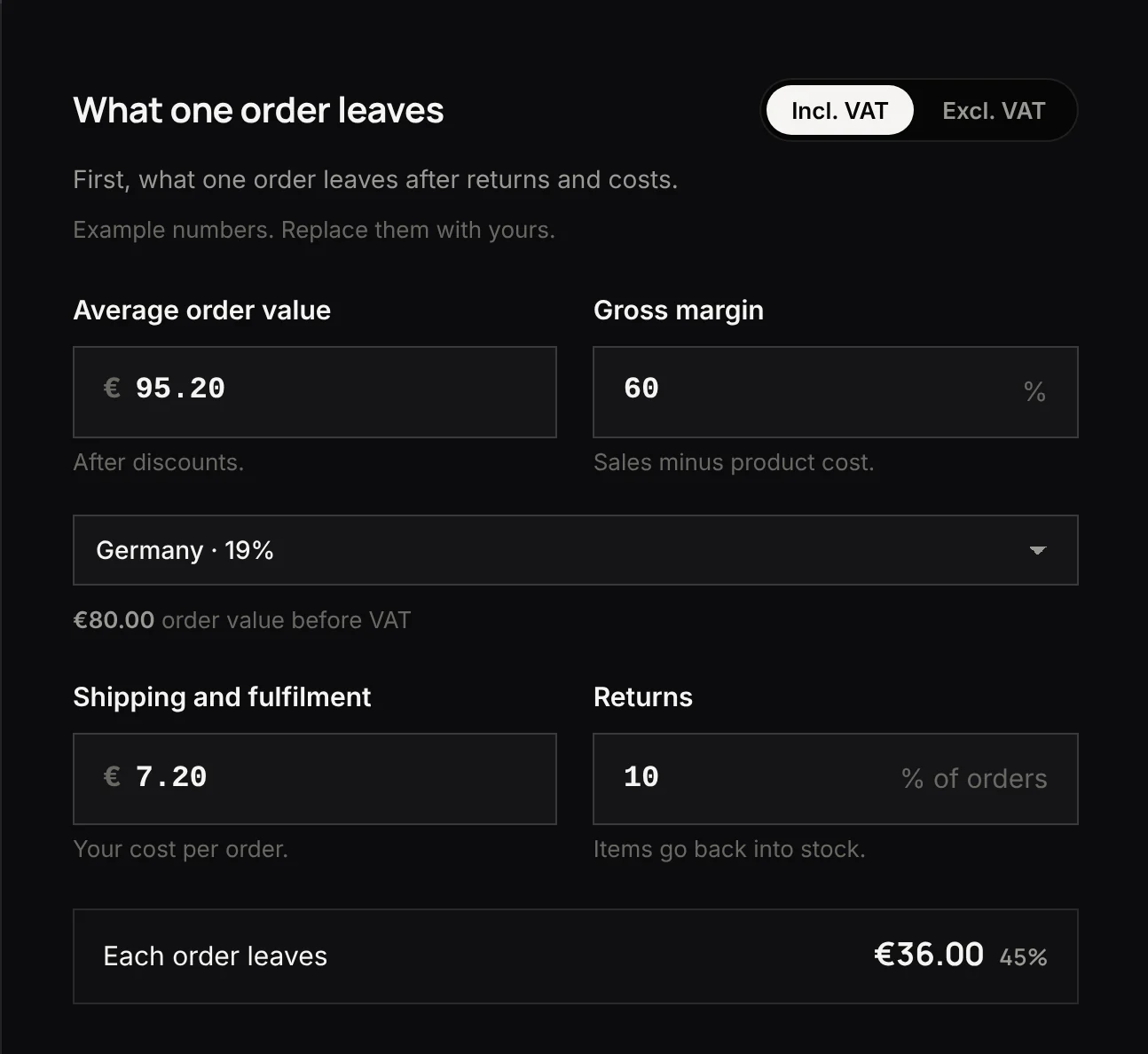
The calculator's example store sells an €80 order before VAT at a 60% gross margin, pays €7.20 to ship and fulfill it, gets 10% of orders back, and sees 40% of new customers order again within a year, 1.25 times each.
| Per new customer | On gross margin | After returns and shipping |
|---|---|---|
| First order | €48 | €36 |
| First 12 months | €72 | €54 |
Payment fees and VAT come off too. The fee, from your payment provider's statement, is charged on the price including VAT and lost on a returned order. A VAT-inclusive price typed as net lifts every ceiling the calculator gives, and when countries differ a lot in VAT or shipping cost, each main market deserves its own run. Switzerland, outside EU VAT and usually more expensive to ship to, is the obvious candidate.
5. Pick the payback month before the CAC target
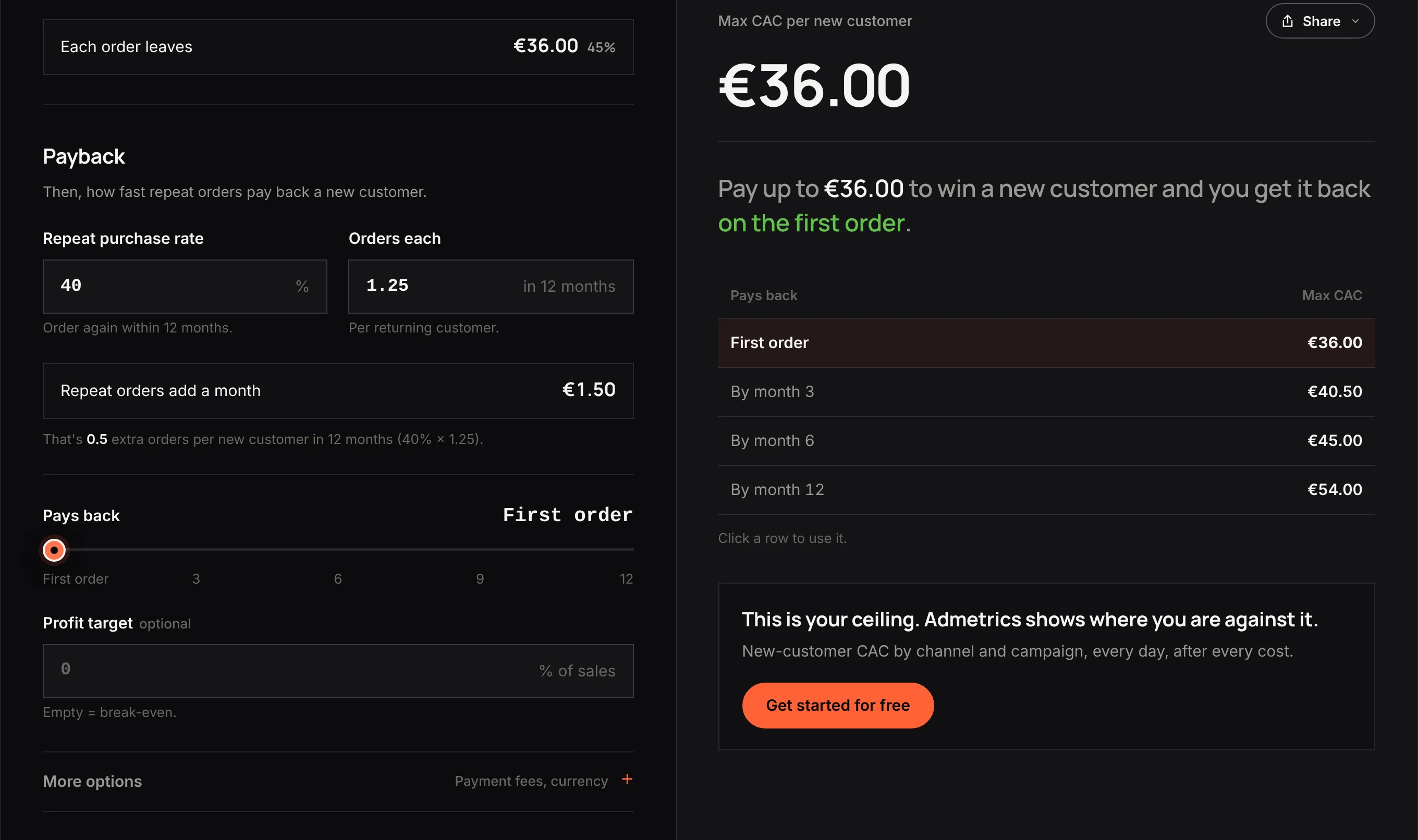
Every month between paying for a customer and getting the money back is a month someone funds, from the bank balance, a credit line or an investor. The payback month is a cash decision, and the CAC target follows from it.
Check your cash calendar first. When the supplier invoice, payroll and the VAT payment land in the same few weeks, the slider belongs at the first order. Before BFCM, ad spend competes with the stock order, and the slider goes where the cash has to be back. With investor money or a credit line covering the gap, the end of the year is reasonable.
A later month buys a higher ceiling, and the store pays for it in cash. If the example store pays its 12-month ceiling for a thousand new customers in one month, €18,000 is still out after their first orders, and it comes back at €1,500 a month.
Agree the payback month with whoever funds the gap, then read the CAC target off the table.
The calculator spreads repeat orders evenly across the year. If yours cluster, correct the short months by hand: that month's ceiling is what the first order leaves plus extra orders per new customer × the share of a year's repeat orders in by then × what an order leaves.
6. Set a ceiling per channel, and check what the extra customers cost
A store-wide repeat rate averages customers who behave differently, and buyers won through a discount-heavy channel or a cheap entry product often come back at another rate.
From a customer export, keep those whose first order is at least a year old, tag each with that order's channel, and work out the repeat rate and orders each per channel. Then run the calculator once per channel.
In the example store, a channel whose new customers come back at 20% supports €45 by month 12, and one at 60% supports €63. Your brief to an agency or a media buyer should carry one target per channel for that reason.
The ceiling is also what the last customer may cost, and an average hides it. A channel's average CAC can sit below its ceiling while the last part of its budget buys customers well above it. Before adding budget, compare two months or two budget levels and hold the result against the ceiling:
Marginal CAC = extra spend ÷ extra first-time customers
7. Plan discounted first orders and smaller repeat orders separately
The calculator assumes every repeat order leaves the same as the first. A welcome discount shrinks the first order, and a refill often makes the repeat order smaller than the one that won the customer.
For a discounted first order, enter the discounted order value and work out the margin on the discounted price, since product cost doesn't fall with it. For a smaller repeat order, enter the average value of second and later orders from your order export, with its margin. Read each from the "Each order leaves" strip, then:
Ceiling by month 12 = first order leaves + extra orders per new customer × repeat order leaves
| Example store | What goes into the calculator | Result |
|---|---|---|
| 25% welcome discount on the first order | Discounted order value, margin on the discounted price | First order leaves €18 |
| €40 refill as the repeat order | €40 and the refill's margin (60% here) | Refill leaves about €14; ceiling by month 12 about €43 |
BFCM buyers rarely come with a year of history. Our view is to plan their ceiling on the first order alone, with the repeat purchase rate at zero, unless last year's BFCM customers show how often they came back. The store's average repeat rate assumes discount buyers behave like everyone else.
8. Recheck when the month closes
Rerun the calculator with the month's actuals and put each channel's CAC next to its own ceiling.
Watch two numbers that change without anyone touching them. The unattributed row tends to grow after consent and tracking changes, and every channel figure gets less certain when it does, while the repeat rate moves as cohorts age.
What is a good customer acquisition cost?
One below the ceiling for the payback month your business can fund, after a profit target that covers what break-even leaves out. That ceiling comes from your own orders, which is why this page gives no average customer acquisition cost.
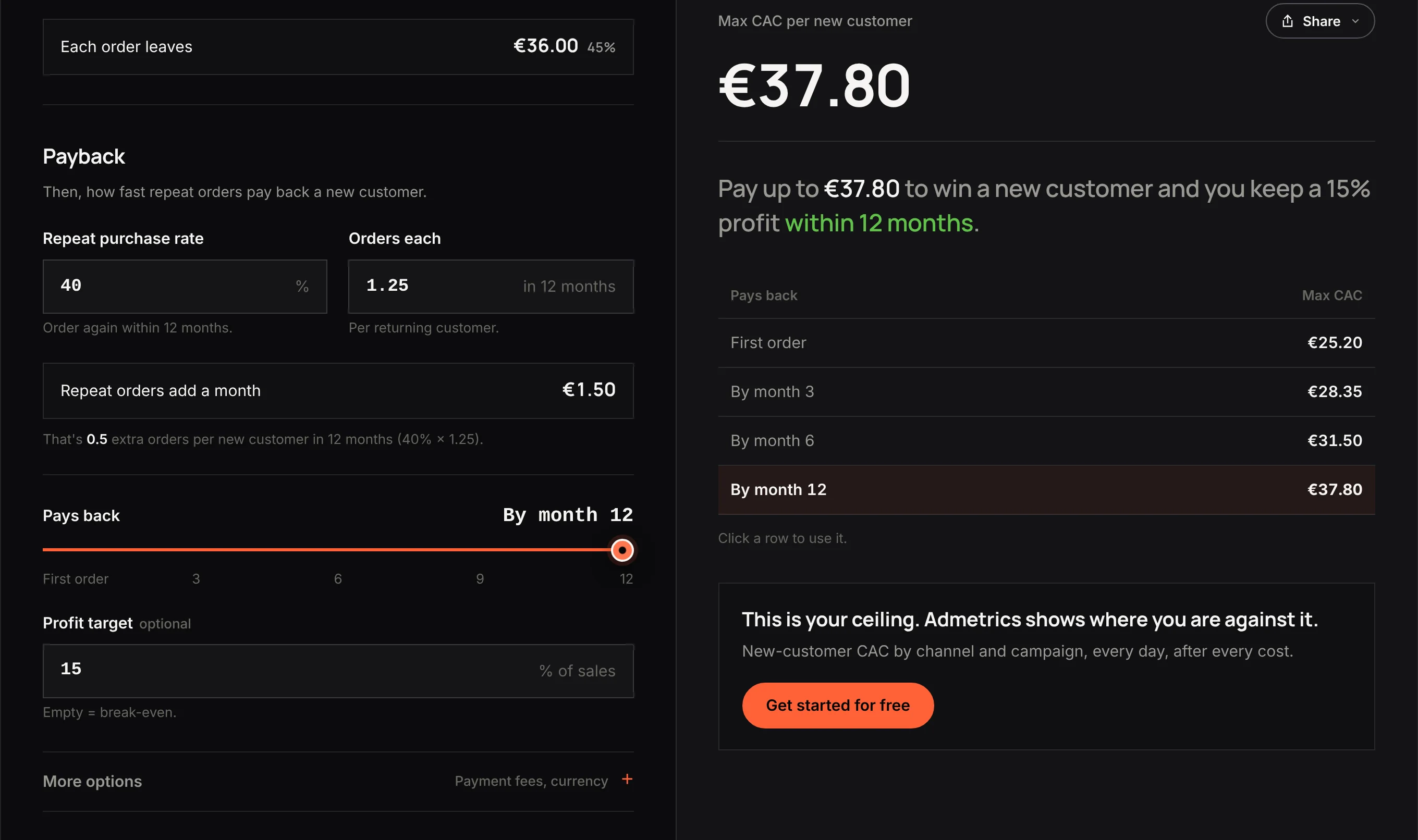
With Profit target empty, the calculator solves for contribution break-even. Rent, salaries outside acquisition and software are paid from what's left, and a store running every channel at break-even would have nothing left for them.
To set the target, divide the year's overheads from your P&L by sales kept after returns and add the profit margin you want. If overheads take 10% and the plan asks for 5% on top, the target is 15%, and the example store's ceiling by month 12 drops to about €38.
The 3:1 LTV:CAC ratio is the other answer you'll hear. A rule of thumb from SaaS investing, it has no time frame, and its answer moves with whatever counts as lifetime value. For comparing two channels measured on the same basis, a ratio works fine. As a ceiling, it says nothing about when the money comes back.
What this calculator can't tell you
- Your actual CAC. Steps 1 to 3 build it.
- Several channels in one run. Channels, discounted cohorts and refills each need their own.
- Repeat timing. Repeat orders are spread evenly over the year; if yours come early or late, the short-month ceilings are off.
- Anything past the first year. The LTV calculator covers lifetime value, and the contribution margin calculator walks through every cost an order carries.
- Whether the spend caused the customer. Some first-time customers would have ordered without the ad.
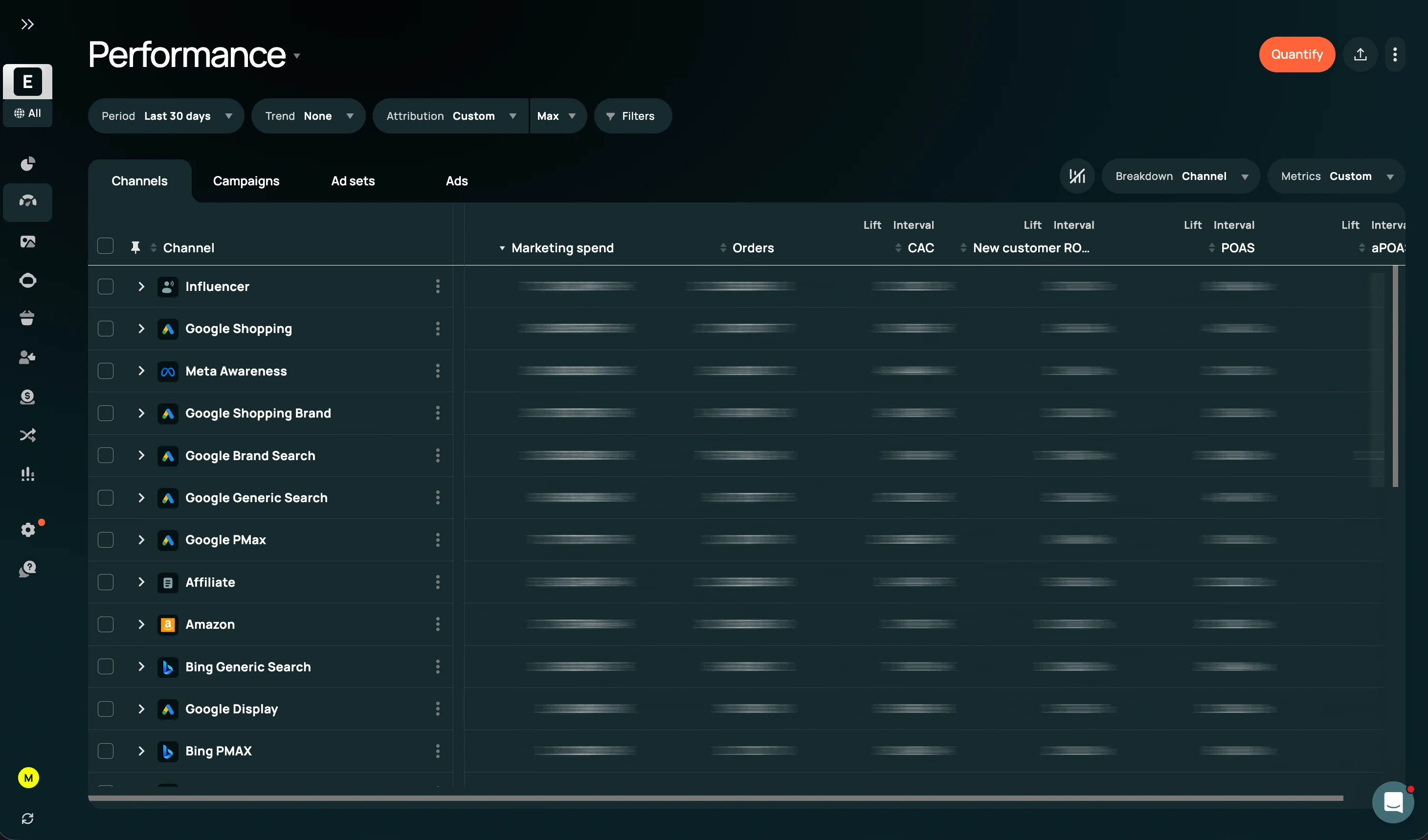
Admetrics shows new-customer CAC by channel and campaign every day, after every cost, with CAC payback per channel, which covers the first two gaps without the spreadsheet. To see it on your own orders, book a demo; Admetrics pricing shows what each plan includes.
FAQ
How do you calculate customer acquisition cost?
Add up every cost of winning new customers in a period: ad spend on all channels, agency and freelancer fees, creator fees, affiliate commissions, acquisition tools and the in-house team's acquisition share. Divide the total by the first-time customers Shopify Analytics counts for the same dates. Leave retention spend out, and keep first-order discounts in the order value instead of the costs.
What's the difference between CAC and CPA?
CPA in Meta Ads Manager or Google Ads divides one platform's ad spend by the conversions that platform credits to itself, which can include returning customers and orders another channel also claims. CAC divides every acquisition cost by the first-time customers in the store's own order data. Use CPA to choose between ads inside one platform, and CAC for budgets and for finance.
What is blended CAC?
Blended CAC divides all acquisition costs, across every channel, by all first-time customers, including those who found the store without an ad. It's the store-wide number from the formula above. Paid CAC puts ad spend over the new customers the ads brought in, and channel CAC splits it further. A healthy blended CAC can hide a channel running above its ceiling, so finance gets the blended number and each channel its own target.
Should CAC include salaries and agency fees?
Yes for both, to the extent they work on acquisition. Agency and freelancer fees go in from their invoices. For the in-house team, take the salaries of the people who buy media or make ads, times the share of their time spent on acquisition. Leave salaries out and bringing media buying in-house looks like a fall in CAC while the store pays about the same.
What is CAC payback period?
The time until what a new customer's orders leave, after product cost, returns, shipping and payment fees, covers what the store paid to win them. Choose it from the cash position first, because someone funds the months in between, then read the maximum CAC for that month off the calculator's Pays back table, which runs to month 12.
What is a good LTV to CAC ratio?
3:1 is the usual answer, a rule of thumb from SaaS investing with no time frame. Its result moves with what counts as lifetime value: revenue, gross margin or contribution after returns and shipping. A ratio works for comparing channels measured the same way over the same period. For a maximum CAC, pick a payback month and read the ceiling instead.