"We have a 50% margin" is one of the most repeated sentences in ecommerce, and one of the least precise. Sometimes it means a 50% markup, which is a 33% margin. Sometimes it means gross margin before shipping, payment fees and returns. Almost never does it mean what's left of an order after everything it costs to deliver.
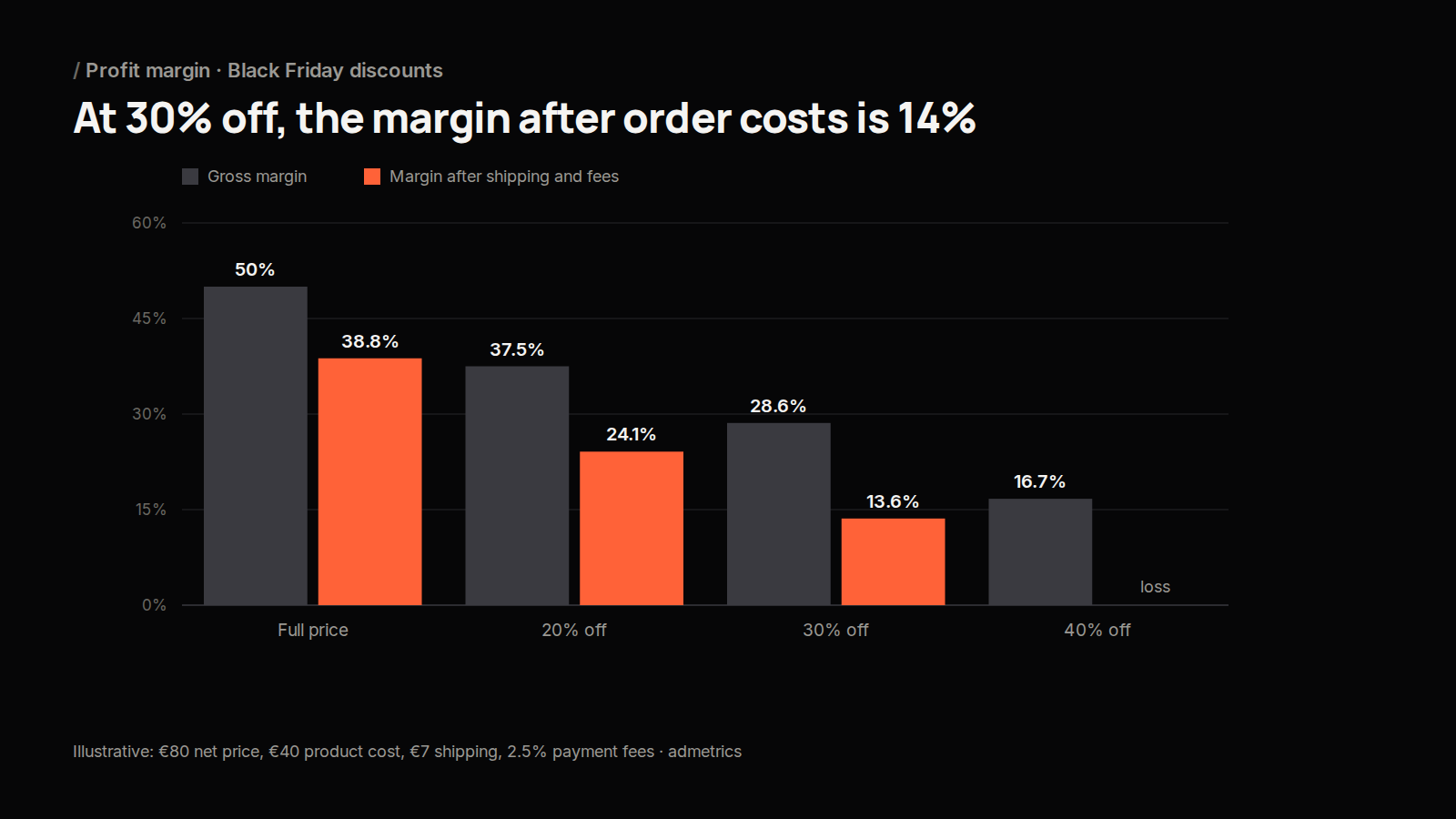
The gap matters most when you discount. A product with a 50% gross margin keeps about 39% of its net revenue after shipping and fees. At 30% off, that falls to about 14%, and at 40% off, the order loses money before a single ad.
This guide covers margin vs markup, the three levels of margin and when to use each, a worked example of profit per order, how to price for a target margin, and what Black Friday discounts leave.
Admetrics is a marketing measurement and budget platform for ecommerce and DTC brands. We work out the profit left on every order after costs and returns, by product, channel and campaign.
Key takeaways
- Margin and markup are not the same. Margin = profit ÷ price; markup = profit ÷ cost. A 100% markup is a 50% margin.
- Use the right level. Gross margin for pricing; contribution margin for marketing decisions; net margin for the business as a whole.
- Always work from net revenue. Take VAT out of the price before calculating any margin.
- Order costs come off every order. In our example, a 50% gross margin becomes 38.75% after shipping and payment fees.
- Price from cost with: price = cost ÷ (1 − target margin). A €40 product with a 50% target margin needs an €80 net price.
- Discounts cut margin far faster than price. At 30% off, our example keeps 13.6% after shipping and fees; at 40% off, it loses money.
Margin vs markup
Both compare the same profit, against different bases.
Margin = (net price − cost) ÷ net price
Markup = (net price − cost) ÷ cost
A product that costs €40 and sells for €80 net has a profit of €40: a 50% margin, and a 100% markup.
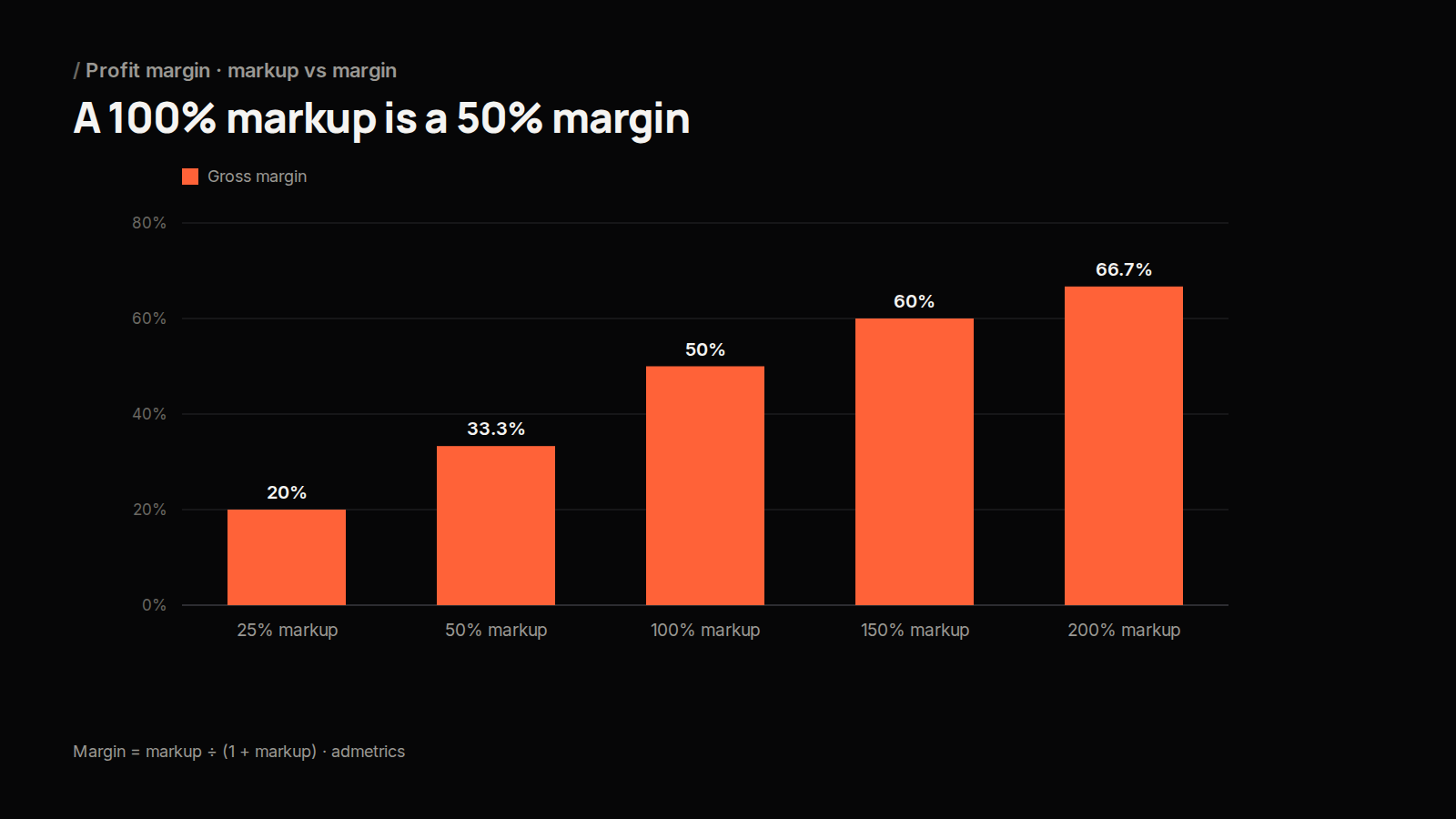
To convert: margin = markup ÷ (1 + markup) and markup = margin ÷ (1 − margin).
Margin can never reach 100%; markup has no limit. That's why discounts are easier to reason about in margin: on a product with a 50% margin, a 30% discount takes 60% of the gross profit.
Gross, contribution and net margin
For marketing decisions, contribution margin is the one that matters: it's what each extra order adds to the business. Our contribution margin guide covers CM1 to CM3 in detail.
Profit per order, after every cost
The same product, followed through every cost an order carries:
A product sold as "50% margin" keeps €14.80, or 18.5% of net revenue, once it's delivered, paid for, partly returned and advertised. That €14.80 is what has to cover fixed costs and leave a profit.
The VAT trap
Calculate the margin on the VAT-inclusive price and the same product appears to have a 58% margin: (€95.20 − €40) ÷ €95.20. VAT isn't yours to keep, so always take it out first.
Pricing for a target margin
For a target gross margin: net price = product cost ÷ (1 − target margin)
A €40 product with a 50% target margin needs an €80 net price, or €95.20 including 19% VAT.
For a target margin after order costs: net price = (product cost + shipping per order) ÷ (1 − target margin − payment fee %)
This version prices in the costs every order carries, so the target holds once the order ships:
Same product: €40 product cost, €7 shipping, 2.5% payment fees.
If you plan to discount for Black Friday, price for the margin you need at the discount, not at full price. The next section shows how quickly it disappears.
Profit margin in Black Week
A discount comes off the price, but the product cost, the shipping label and most of the payment fee stay the same. So margin falls much faster than the price.
Three things to check for every product you plan to discount:
- What's left after order costs at the discount. If it's below what you pay per order in ads, the discount loses money on every sale.
- How many more orders the discount needs. At a 50% gross margin, 30% off needs 150% more orders to earn the same gross profit. See the discount section of our contribution margin guide.
- Whether a threshold, bundle or gift would work instead. They cost margin only when the basket grows, or at a fixed amount. See our AOV guide.
Common mistakes
- Treating markup as margin. A 50% markup is a 33% margin; pricing on the wrong one overstates profit by half.
- Calculating on the price incl. VAT. It makes a 50% margin look like 58%.
- Stopping at gross margin. Shipping, fees and returns come off every order; in our example they take 13 points.
- Using one margin for every product. Bestsellers, bundles and clearance items differ; check the margin of the products you actually promote.
- Discounting from full-price margins. Recalculate at the discount, and compare it with your cost per order in ads.
Profit margin calculator

Try it with your own numbers: the free profit margin calculator shows your margin and markup. For what's left after shipping, fees, returns and ads, use the contribution margin calculator; for a discount, the discount profit calculator.
FAQ
How do you calculate profit margin?
Subtract product cost from the net price (excluding VAT) and divide by the net price. A product that costs €40 and sells for €80 net has a 50% margin.
What is the difference between margin and markup?
Margin divides profit by the price; markup divides it by the cost. A 100% markup is a 50% margin.
How do you convert markup to margin?
Margin = markup ÷ (1 + markup). A 50% markup is 0.5 ÷ 1.5 = 33.3% margin.
What is a good profit margin for ecommerce?
It depends on the category and on which margin you mean. More useful than a benchmark: make sure the margin after shipping, fees and returns is higher than what you pay per order in ads.
Should I calculate margin with or without VAT?
Without. VAT is collected for the tax office, so margin is always calculated on the net price.
How does a discount change my margin?
It comes off the price but not the costs, so margin falls faster than price. In our example, 30% off cuts the margin after shipping and fees from 38.8% to 13.6%.
See margin on every order, automatically
Admetrics calculates gross margin and contribution margin for every order, product, channel and campaign, with shipping, fees and returns included. During Black Week you see which discounts still earn while you can still change them.
Run your biggest week free: Admetrics is free until 1 December. No credit card, no commitment. Get started for free