Customer lifetime value is the number that justifies almost every acquisition budget. "They'll come back" is how a team explains a campaign that loses money on the first order. Sometimes it's true. Often the LTV in the deck is revenue over an open-ended lifetime, set against a CAC that was paid in cash last month.
A useful LTV answers two questions instead: how much profit does a new customer leave over a fixed period, after product, shipping, fees and returns, and in which month have they paid back what you spent to win them? Those two numbers decide how much you can afford to pay for a customer, and how long your cash is tied up in each one.
This guide covers why LTV matters more now than it did a few years ago, the main ways to calculate it and why profit LTV is the one to use, how to read payback against CAC, why the time range matters, the four levers that move LTV and what each is worth, how to use LTV to set your acquisition budget, how LTV differs by channel, and what a customer won on a Black Friday discount is really worth.
Admetrics is a marketing measurement and budget platform for ecommerce and DTC brands. We separate new from returning customers in every report and work out the profit each customer leaves after costs and returns.
Key takeaways
- Calculate LTV in profit, not revenue. In our example, an order of €95.20 including VAT is €80 of net revenue and leaves €36 after product, shipping and fees.
- Use a fixed time range. Over 12 months, the example customer is worth €54 in profit; over 24 months, €63 if half of them keep buying.
- Read LTV against CAC as a payback month. At a €45 CAC, the example customer pays back in month 6, with an LTV:CAC of 1.2 after a year.
- Know which lever moves your LTV. In the example, €4 more on the first order brings payback forward by two months; €3 more in returns pushes it back by three.
- Compare channels on LTV, not only on the first order. A channel that loses money on the first order can overtake a cheaper one within months.
- A discounted first order lowers LTV. At 20% off, the same customer leaves €20 on the first order and €38 over 12 months, so a €45 CAC no longer pays back within the year.
- Check your own cohorts. Just 11% of 2024 Black Friday shoppers came back for Black Friday 2025 (Ometria).
Why LTV matters more than it used to
When winning a customer was cheap, a rough LTV did little harm: most campaigns paid back on the first order anyway. That margin for error has shrunk.
- Acquisition keeps getting more expensive. In Cyber Week 2025, one agency saw Meta spend rise 54% across its clients while Meta revenue rose 50%, and cost per click rose 11% on Cyber Monday (Logical Position). CPMs rose on most major platforms (Power Digital).
- More first orders don't pay back on their own. As cost per new customer rises, more of it has to be earned back by the second, third and fourth order. That makes the accuracy of LTV a budget question, not a reporting one.
- Retention is where the profit is. Bain & Company's often-quoted finding is that a 5% increase in retention can raise profit by 25 to 95%. And peak-season customers are the hardest to keep: just 11% of 2024 Black Friday shoppers came back the following year (Ometria).
An LTV that overstates what a customer is worth leads straight to overspending on acquisition. An honest one tells you how much you can pay, where, and for how long you'll wait for the money.
What is customer lifetime value?
Customer lifetime value is what a customer is worth to you over a period, from their first order on. The same customer gives three very different numbers depending on what you count:
| Version | What it counts | Use it for |
|---|---|---|
| Revenue LTV | All revenue a customer brings, often including VAT | Rarely the right choice; it overstates what you can spend |
| Gross-margin LTV | Revenue minus product cost | Range and pricing questions |
| Profit LTV (contribution margin) | Revenue minus product, shipping, payment fees and returns | How much you can pay for a customer, and when they pay back |
LTV in profit = contribution margin of the first order + contribution margin of repeat orders over the period
For acquisition decisions, profit LTV is the one to use. Our contribution margin guide covers how each cost layer comes off.
Three ways to calculate it
| Method | How it works | Strength | Watch out for |
|---|---|---|---|
| Historical (cohort) | Add up the actual profit a group of customers, won in the same month, left over a fixed period | Based on what really happened; the most reliable for decisions | Needs at least as much history as the period you measure |
| Formula | Average order value × orders per year × margin × years as a customer | Quick, works without much data | Averages hide very different customers; the number of years is usually a guess |
| Predictive | A model forecasts future orders from a customer's first weeks of behaviour | Gives an estimate for cohorts that are still young | Needs enough data to train, and should be checked against what actually happens |
Use historical cohorts wherever you have the data, the formula as a first estimate when you don't, and a predictive model to read young cohorts, such as the customers you won last Black Friday, before they have a full year behind them.
One customer, three very different numbers
The example customer from the free LTV calculator places 1.5 orders in their first year, at €95.20 each including VAT.
| How LTV is counted | Value |
|---|---|
| Revenue incl. VAT over 12 months | €142.80 |
| Net revenue over 12 months | €120.00 |
| Net revenue over an assumed three-year "lifetime" | €360.00 |
| Profit over 12 months | €54.00 |
All four numbers describe the same customer. The first three are up to almost seven times the last one, and only the last one tells you what you can afford to spend to win them.
How to calculate LTV in profit
The example store from the free LTV calculator: an order of €95.20 including 19% VAT.
| Step | Per customer |
|---|---|
| Price paid incl. 19% VAT | €95.20 |
| Net order value | €80.00 |
| Left after product, shipping and fees (first order) | €36.00 |
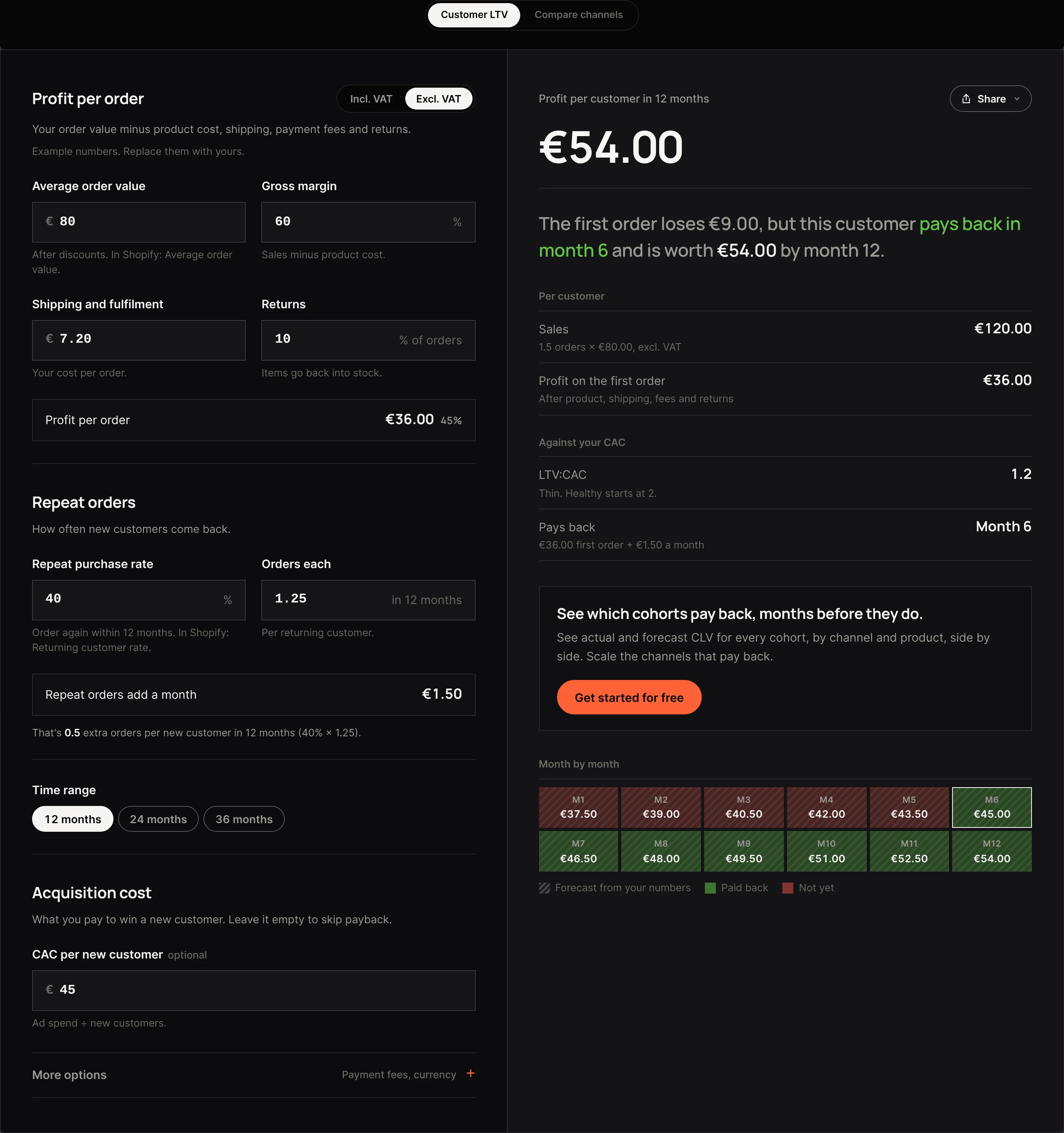
| Repeat orders add, on average | €1.50 a month |
| Profit LTV over 12 months | €54.00 |
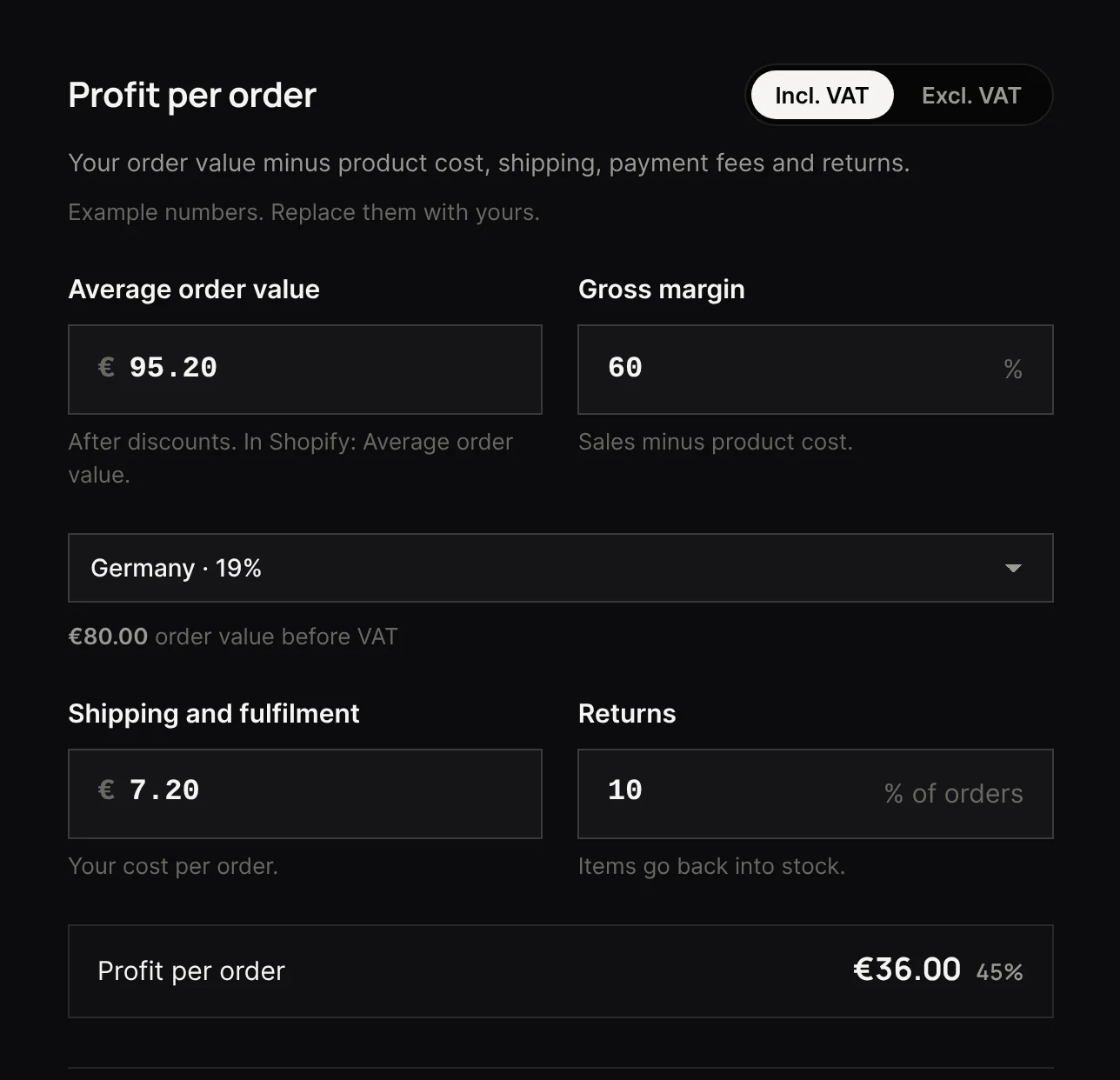
Two common shortcuts inflate the number. Counting revenue including VAT adds 19% that was never yours. And dividing average revenue per customer by a churn rate assumes customers keep buying forever, which few ecommerce customers do. A fixed time range with the margin each order actually leaves is both simpler and more honest.
"Repeat orders add €1.50 a month" is an average across all customers, including the majority who never order again. In the example, it comes from half an extra order per customer in the first year (0.5 × €36 = €18, or €1.50 a month). In your own data, it's the profit from all repeat orders of a cohort, divided by the number of customers in it and the number of months.
Payback: reading LTV against CAC
LTV on its own says what a customer is worth. Set against what you paid to win them, it says when that money comes back.
Payback month = the month in which cumulative profit per customer passes your CAC
| Point in time | Cumulative profit per customer | Against a €45 CAC |
|---|---|---|
| First order | €36.00 | −€9.00 |
| Month 3 | €40.50 | −€4.50 |
| Month 6 | €45.00 | Paid back |
| Month 12 | €54.00 | +€9.00 |
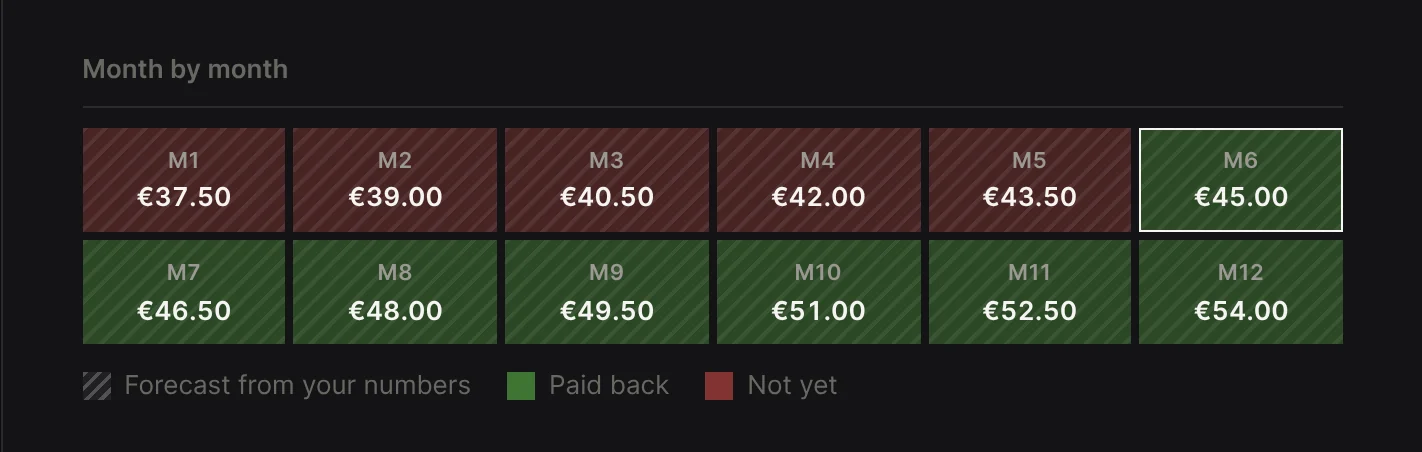
After 12 months, LTV:CAC is €54 ÷ €45 = 1.2. A commonly quoted target is 3:1, but that rule of thumb is usually calculated on revenue. On profit, a lower ratio with a short payback can be healthier than a high ratio that takes three years to arrive, because the cash comes back sooner.
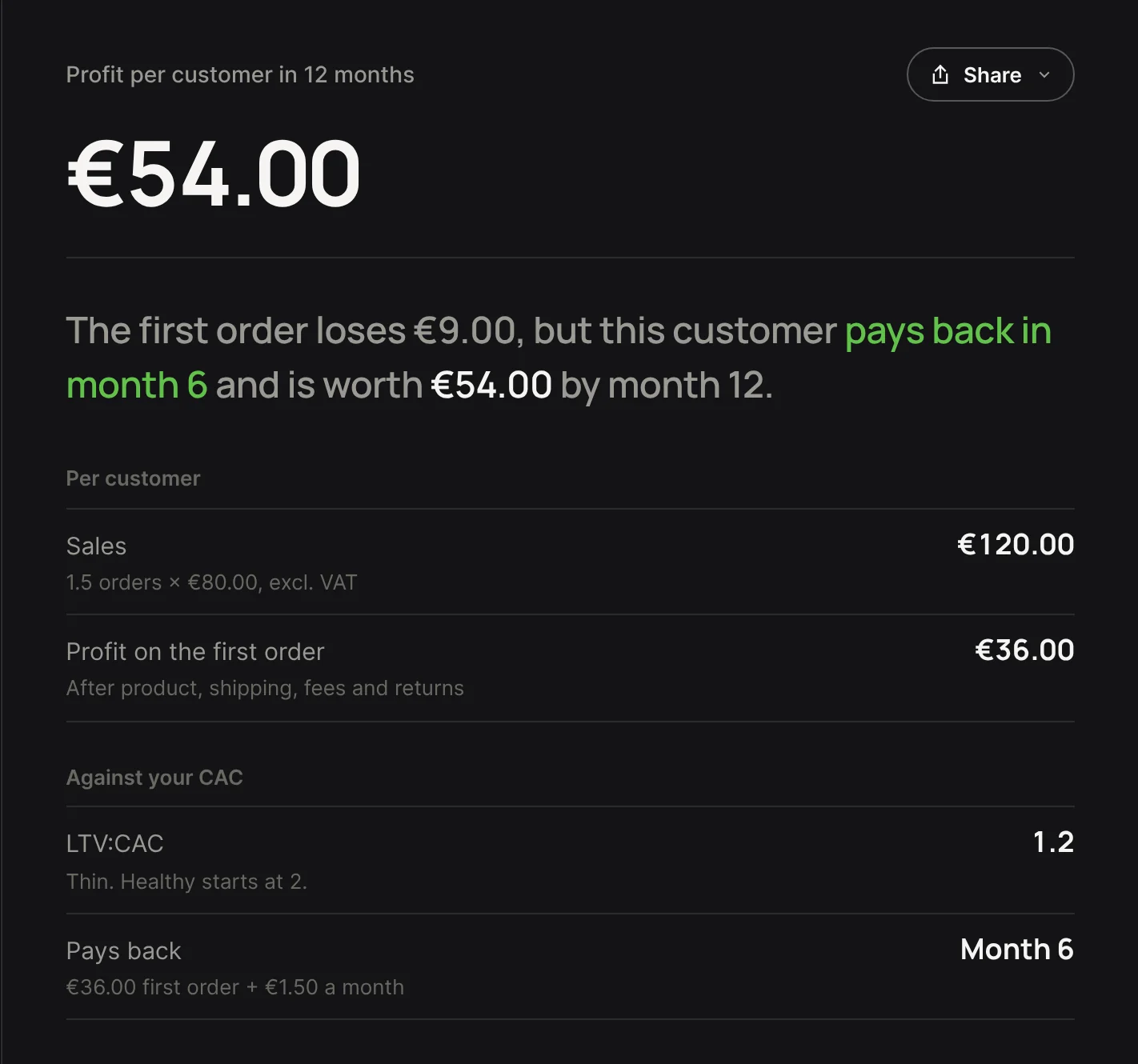
The other side of the same calculation, the most you can pay for a new customer, is in our CAC and NC-CAC guide.
Why the time range matters
LTV grows with the period you choose, so a number without a period means little. In the example, stretching the range from 12 to 24 months, with half of the customers still buying in the second year, raises LTV from €54 to €63.
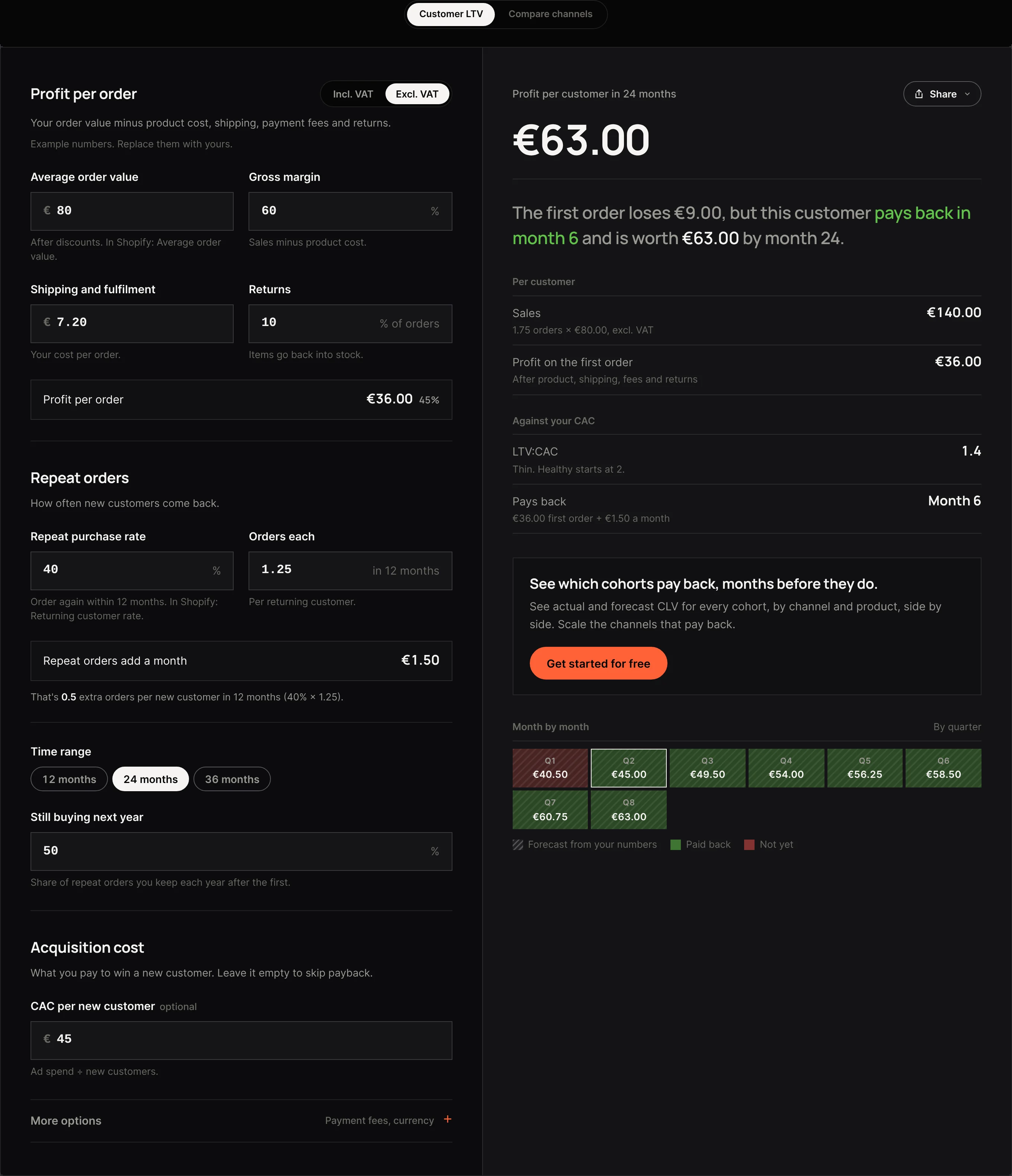
Pick the range that matches how long you can wait for cash. Twelve months suits most ecommerce brands; subscription brands with strong retention can justify 24 or 36. Whatever you choose, use the same range when you compare channels, campaigns or cohorts.
There's a second reason to keep the range short: money that comes back in year three is worth less than money that comes back in month six. It's less certain, because customers, products and channels change, and until it arrives, it isn't available to fund the next campaign.
The four levers that drive LTV
Profit LTV comes down to four things. Each one can be measured, and each one has its own fixes:
| Lever | What it is | What moves it |
|---|---|---|
| First-order margin | What the first order leaves after product, shipping, fees and returns | Bundles, free-shipping thresholds, fewer discounts on the first order, cheaper fulfilment |
| Repeat rate | The share of new customers who order again | Product quality, post-purchase emails, subscriptions, a reason to come back |
| Time to the next order | How soon repeat orders come, which decides how fast payback arrives | Replenishment reminders timed to when the product runs out, a well-timed second-order offer |
| Returns | What returned orders cost in refunds, shipping, handling and write-offs | Size guides, better product pages, accurate photos and descriptions |
What a small change in each lever is worth
The same example customer, against a €45 CAC, with one lever changed at a time:
| Scenario | First order | Repeat profit a month | 12-month LTV | Pays back a €45 CAC |
|---|---|---|---|---|
| Today | €36.00 | €1.50 | €54.00 | Month 6 |
| €4 more on the first order (a bundle or threshold) | €40.00 | €1.50 | €58.00 | Month 4 |
| Repeat profit up by a third | €36.00 | €2.00 | €60.00 | Month 5 |
| Returns cost €3 more per order | €33.00 | €1.38 | €49.50 | Month 9 |
Two things stand out. Small changes to the first order move payback the most, because every customer places one, while only some place a second. And returns work against you twice: they cut the first order and every repeat order after it. Our AOV guide shows how to raise first-order value without a deeper discount.
How to raise LTV
- Earn the second order early. The longer a new customer goes without a second order, the less likely it becomes. Plan the first weeks after a purchase: a useful post-purchase sequence, help with getting the most from the product, and a reason to come back that fits how long the product lasts.
- Time replenishment to the product. For anything that runs out, such as supplements, food, cosmetics or pet food, a reminder sent when the product is nearly used up does more than any discount.
- Offer a subscription where it fits. Subscriptions turn repeat orders into a plan. Tales & Tails, a subscription-led pet food brand, accepts weaker first-order ROAS on some campaigns because those customers become subscribers.
- Raise first-order margin, not first-order discounts. A starter bundle or a free-shipping threshold raises what the first order leaves; a deep welcome discount lowers it and trains customers to wait for the next one.
- Cut avoidable returns. Size guides, honest photos and clear product details reduce returns on every order a customer places.
- Acquire from channels with better cohorts. Two channels with the same cost per new customer can win customers with very different LTVs. Compare them on 6- or 12-month profit before shifting budget.
- Make loyalty rewards margin-safe. Points worth a fixed amount, early access or free shipping cost less than a percentage off every future order.
Using LTV to set your acquisition budget
LTV becomes useful when it turns into a number your team can bid against: the most you'll pay for a new customer. That ceiling depends on how long you're willing to wait for the money.
| Payback target | Maximum CAC in the example | Suits |
|---|---|---|
| First order | €36.00 | Tight cash, or products people rarely buy twice |
| Month 3 | €40.50 | Most brands in a cautious year |
| Month 6 | €45.00 | Brands with steady repeat purchases |
| Month 12 | €54.00 | Strong retention and the cash to wait |
Set the payback target first, from your cash position, then read the maximum CAC off your LTV curve. Do it per channel where you can, because each channel's customers have their own curve. During the year, compare actual cost per new customer against that ceiling every week, not just at the end of the quarter. Our CAC and NC-CAC guide shows how to measure the cost side correctly.
LTV by channel
Customers from different channels rarely behave alike. A channel that looks expensive on the first order can win customers who come back more often.
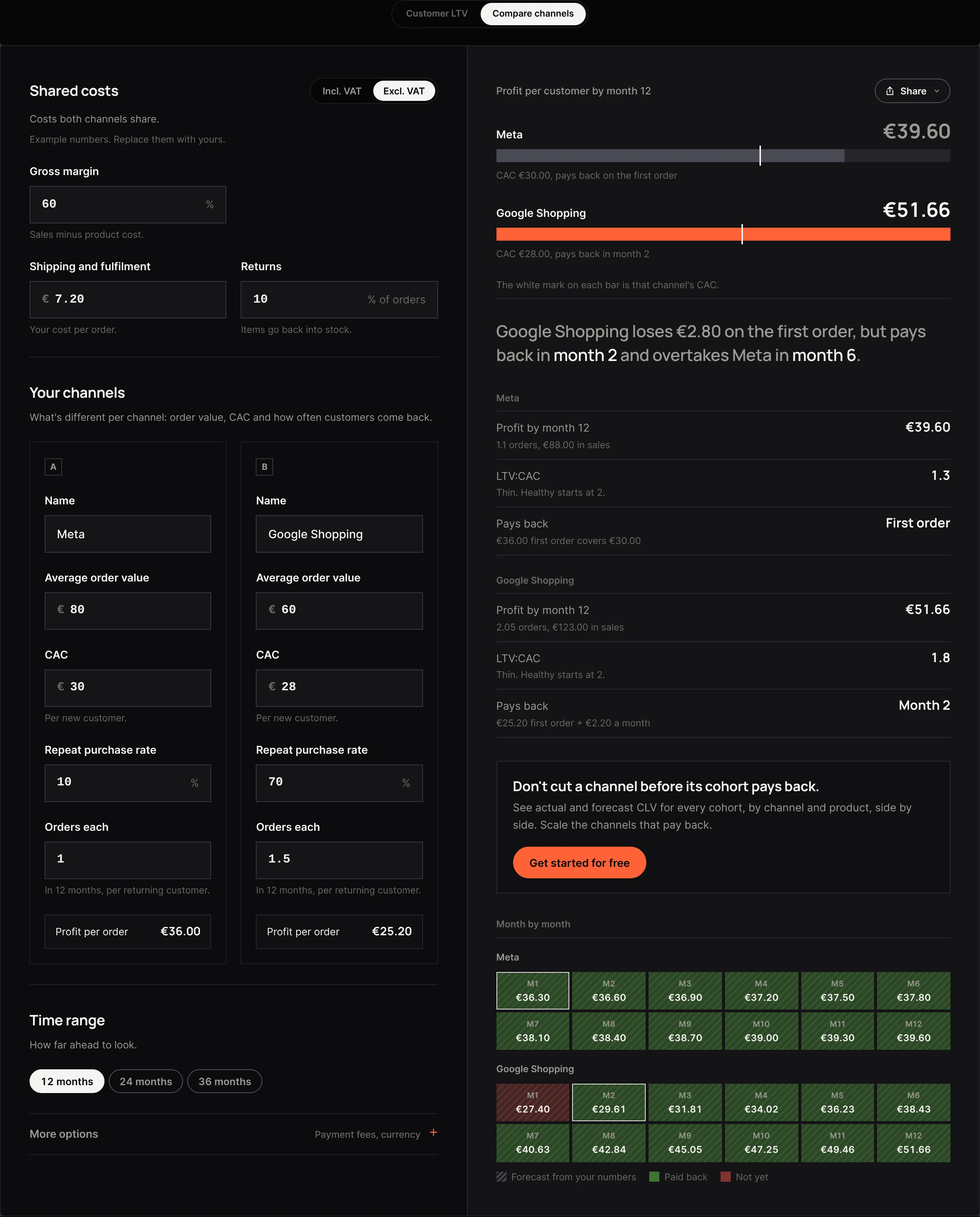
Judged on first-order ROAS alone, the Google Shopping campaign in this example would be cut. Judged on profit over six months, it's the better channel. Tales & Tails, a subscription-led pet food brand, works the same way: it keeps some campaigns with weaker first-order ROAS live on purpose, because the customers they win become subscribers.
Channel is only one way to split LTV. Three others often show bigger differences:
- First product bought. Customers who start with a starter set or a consumable often come back more than those who start with a one-off item.
- Discount on the first order. Customers won with a deep discount often reorder less and wait for the next sale.
- Buyer vs gift. At Nyfter, a gaming-accessories brand, up to 30% of purchases in a normal month are gifts. Gift buyers rarely come back for themselves, which lowers the LTV of any campaign that wins many of them.
What a Black Friday customer is worth
A customer won on a Black Friday discount starts with a thinner first order. In the example, 20% off takes the net order from €80 to €64, but product, shipping and fees cost the same, so the first order leaves €20 instead of €36.
| Full-price first order | 20% off first order | |
|---|---|---|
| First-order profit | €36.00 | €20.00 |
| Repeat orders over 12 months | €18.00 | €18.00 |
| Profit LTV over 12 months | €54.00 | €38.00 |
| Pays back a €45 CAC | Month 6 | Not within 12 months |
And that assumes Black Friday customers reorder as often as everyone else. Many don't: just 11% of 2024 Black Friday shoppers came back for Black Friday 2025 (Ometria). Before Black Week, check last year's Black Friday cohort against customers won in October and January, at 90 and 180 days, and set this year's CAC ceilings from what you find.
Plan the second order before the first one ships
The Black Friday cohort is large, arrives all at once, and goes quiet quickly. Brands that get value from it plan retention before the week, not in January:
- Tag the cohort. Mark every customer whose first order fell in Black Week, so their behaviour can be compared with other months.
- Plan a second-order moment within 30 to 60 days, timed to the product, not to the next sale. A full-price reason to return, such as a refill, an accessory or a guide, is worth more than another discount.
- Keep gift buyers separate. Many Black Week orders are Christmas gifts; message the buyer about their own needs, not the gift they bought.
- Read the cohort at 90 and 180 days, and use what you find to set next year's Black Week CAC ceilings.
Our Black Friday preparation guide covers the rest of the plan.
LTV and cohorts in Admetrics
A calculator works with averages. In Admetrics, LTV is calculated for every monthly cohort of new customers, by channel and campaign, from the orders they actually placed, with returns included.

See Customer Intelligence, and our guide to predictive CLV in Admetrics for forecasting cohorts that are still young.
Common mistakes
- Calculating LTV on revenue. It overstates what a customer is worth by the product cost, shipping, fees and returns.
- Including VAT. It adds 19% that goes to the tax office.
- Using an open-ended lifetime. Use 12, 24 or 36 months, and say which.
- One LTV for every channel. Channels win different customers; compare them separately.
- Counting the same customer twice. A customer who buys in your shop and on a marketplace, or with two email addresses, looks like two smaller customers. Match them first.
- Forgetting returns on repeat orders. Returns cut every order, not just the first one.
- Assuming Black Friday customers behave like everyone else. Check the cohort before setting next year's CAC ceilings.
LTV calculator
Try it with your own numbers: the free customer lifetime value (LTV) calculator shows what a new customer is worth in profit over 12, 24 or 36 months, and the month they pay back. For the most you can spend to win one, use the customer acquisition cost calculator.
FAQ
How do you calculate customer lifetime value?
Add the profit of a customer's first order to the profit of their repeat orders over a fixed period, after product, shipping, payment fees and returns. In our example, €36 on the first order plus €18 of repeat orders is €54 over 12 months.
What is the difference between LTV and CLV?
None in practice: both stand for customer lifetime value. What matters is whether the number is calculated on revenue or on profit, and over which period.
What is a good LTV to CAC ratio?
3:1 is often quoted, usually on revenue. On profit, look at the payback month as well: a ratio of 1.2 that pays back in month 6 can be healthier than a higher ratio that takes years.
Should LTV be calculated on revenue or profit?
On profit, for any decision about how much to spend on acquiring customers. Revenue LTV overstates what you can afford.
What time range should I use for LTV?
Usually 12 months for ecommerce, and 24 or 36 for subscription brands with strong retention. Use the same range everywhere you compare.
How often should I recalculate LTV?
Monthly, per cohort, so each new month of orders updates the curve. Recalculate it before every budget round, and before Black Week.
What is predictive LTV?
A forecast of a customer's future value from their early behaviour, such as what they bought first and how soon they came back. It's most useful for cohorts that don't yet have a full year of history.
Are Black Friday customers worth less?
Their first order is worth less because of the discount, and many don't come back. In our example, a 20% first-order discount cuts 12-month LTV from €54 to €38. Check your own cohorts before assuming either way.
See LTV for every cohort
Admetrics shows LTV and payback for every cohort of new customers, by channel and campaign, with returns included, so you can see which channels win customers worth keeping.
Run your biggest week free: Admetrics is free until 1 December. No credit card, no commitment. Get started for free