The landscape of digital shopping is undergoing a massive transformation. Consumer behavior is shifting from manually browsing desktop and mobile websites toward agentic commerce—where AI agents (like Google’s Gemini) manage product discovery, price comparison, and checkout on the user’s behalf.
However, for an AI agent to execute these tasks, it needs a standardized, secure way to communicate with millions of diverse merchant back-ends. To solve this, Google, alongside industry leaders like Shopify, Stripe, Walmart, and Target, developed the Universal Commerce Protocol (UCP).
Here is a complete breakdown of how UCP bridges the gap between AI surfaces and retailers, the newly released March 2026 capabilities, and a technical guide on how to implement it.
1. The Core Problem: Solving the N x N Bottleneck
Historically, if a new digital surface (like a chatbot or social platform) wanted to connect to a merchant’s backend, it required a custom, point-to-point API integration. As the number of AI agents and retail platforms grows, this creates an unsustainable N x N integration bottleneck.
UCP acts as a single, universal abstraction layer. It establishes a shared language that standardizes the entire commerce lifecycle.
- For AI Developers: It provides standardized schemas to plug into thousands of retailers without wrangling bespoke APIs.
- For Merchants: It offers instant interoperability with emerging AI platforms through a single integration, ensuring they remain visible when consumers prompt AI for shopping recommendations.
Crucially, retailers remain the Merchant of Record. UCP simply facilitates the communication handshake; businesses maintain complete ownership of their customer data, logic, and transactional authority.
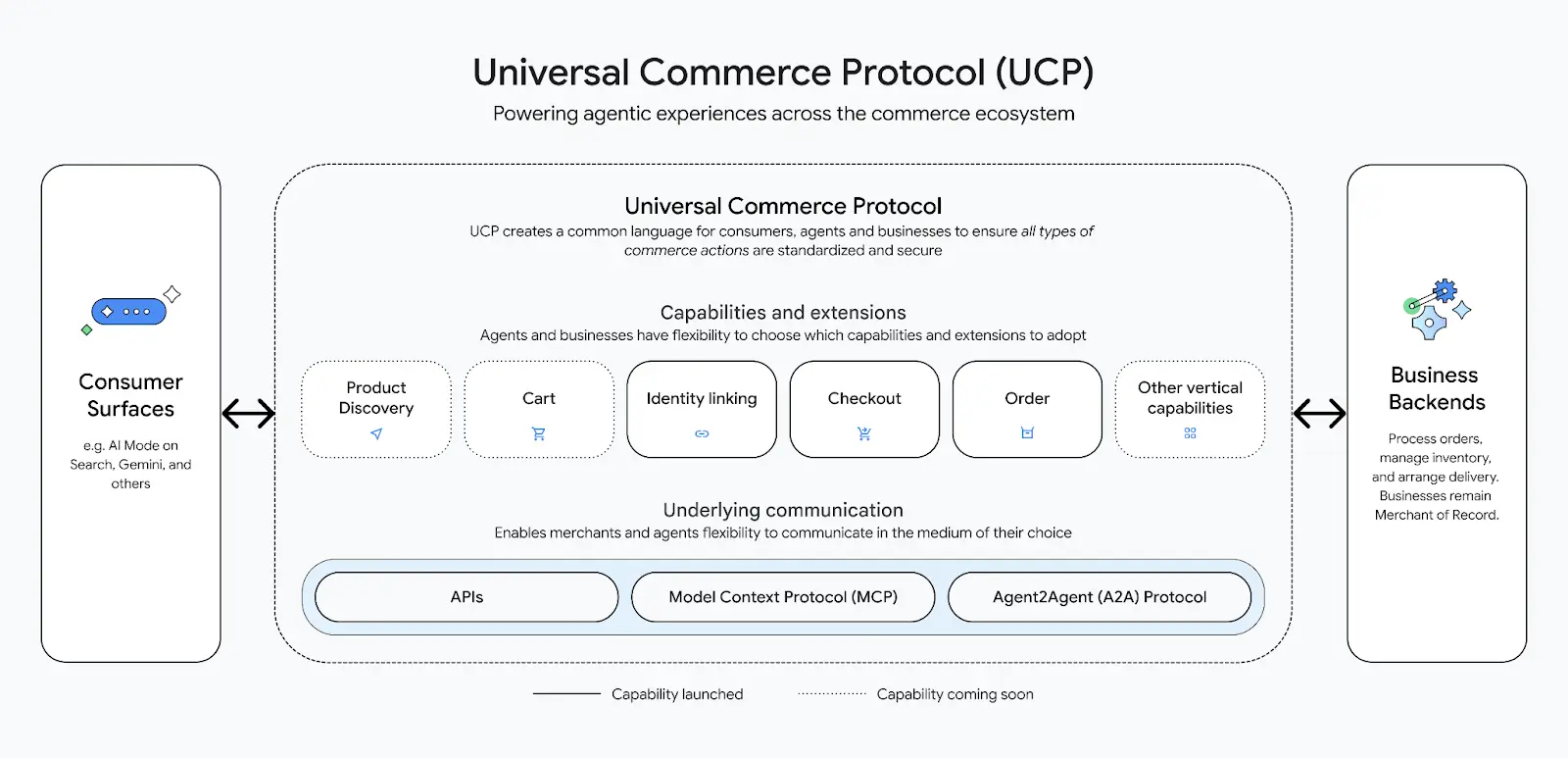
2. The 5 Core Capabilities & March 2026 Updates
While UCP launched with robust foundational features in January 2026, a major March 2026 update transformed it from a basic purchasing tool into a comprehensive shopping engine. Retailers can now expose up to five distinct capabilities to AI agents:
- Checkout (Expanded): Permits the agent to securely initiate and finalize transactions. While initially limited to single-item guest checkouts, the March update introduces complex, multi-item transaction flows.
- Identity Linking: Allows users to connect their store accounts to the AI agent to access loyalty points, member-only pricing, and saved preferences.
- Order Management: Grants the AI agent access to post-purchase data, allowing users to ask their AI for shipping updates or return statuses.
- Cart (New in March 2026): Enables agents to compile multiple different items into a single, unified shopping cart across an extended session.
- Product Discovery & Catalog (New in March 2026): Allows agents to directly query a merchant's real-time database to pull highly accurate, up-to-the-second data on product variants, dynamic pricing, and current stock levels.
Note: UCP-powered checkouts are currently active for eligible U.S. businesses using Google Pay, with native PayPal support and global expansion rolling out through the rest of 2026.
3. System Architecture and Flexibility
UCP is fundamentally vendor and payment agnostic. It operates flawlessly with existing web standards, preventing businesses from having to rebuild their tech stacks.
- Integration Flexibility: Businesses can integrate via traditional REST APIs, Agent-to-Agent (A2A) communication, or the Model Context Protocol (MCP).
- Decoupled Payments: UCP separates the payment instrument (e.g., a stored card in Google Wallet) from the payment handler (the processor). This relies on the secure Agent Payments Protocol (AP2) and cryptographically verifiable user consent.
- Checkout UI: Retailers can opt for a native checkout (the AI interface manages the UI) or an embedded checkout to retain their custom branding.
4. Technical Deep Dive: Building a UCP Integration
Let’s simulate a complete UCP interaction between an AI agent and a merchant backend using the official Python SDK.
Step 1: Initialize the Merchant Server Environment
For this demo, we will spin up a local SQLite database populated with dummy inventory for a botanical shop.
Bash
Clone the UCP SDK and Sample repositories and generate the local database following the official quickstart guide.
Step 2: Boot the Application
Start the API server on port 8182 to accept incoming agent requests.
Step 3: Capability Discovery
UCP utilizes a dynamic discovery mechanism. Instead of guessing endpoints, the AI agent pings a standardized JSON manifest (/.well-known/ucp) to understand what the merchant supports.
The JSON Response: Outlines supported specs and payment handlers, including checkout, discount extension capabilities, and cart support alongside a Google Pay payment handler.
Step 4: Instantiating a Checkout Session
The AI agent constructs a POST request to build the user's cart, passing line items, buyer details, and payment constraints. The server will reply with a unique session id and calculate the current subtotals.
Step 5: Applying Extensibility (Discounts)
Because the merchant manifest advertised the discount capability, the agent can issue a PUT request to update the active session. The server recalculates the ledger, returning the updated totals with the discount mapped to the payload.
5. Going Live: Platform Support and Next Steps
To accelerate merchant onboarding, major platforms including Salesforce, Stripe, and Commerce Inc. have committed to native UCP support, lowering the technical barrier for their users.
For brands looking to integrate natively with Google’s UCP implementation (powering Gemini and AI Overviews), the process has been streamlined via Google Merchant Center.
To get started:
- Ensure your Google Merchant Center account is active with a validated product catalog.
- Complete the conversational commerce interest form.
- Map your existing backend infrastructure to UCP specifications using the integration guides to ensure AI agents can accurately read your inventory and push order payloads.
If your store isn't structurally set up to communicate with AI agents, you risk becoming invisible to the next generation of shoppers. Implementing UCP is the definitive step toward securing your position in the agentic commerce era.
Navigating the Transition: How Admetrics Can Help
As commerce shifts heavily toward AI-driven discovery and UCP-powered checkouts, tracking attribution and understanding the true customer journey becomes significantly more complex. This is where Admetrics bridges the gap. By providing advanced, privacy-first tracking and unified analytics, Admetrics helps e-commerce brands seamlessly adapt to agentic commerce without losing visibility into their profitability.
Whether you are running automated Meta Ads creative loops to feed top-of-funnel demand or analyzing multi-channel touchpoints that culminate in an AI checkout session, Admetrics ensures you have the precise, real-time data required. It empowers you to confidently scale winning strategies, eliminate underperforming campaigns, and maintain absolute clarity over your true ROAS in an increasingly automated landscape.
Ready to future-proof your e-commerce tracking? Start your free trial of Admetrics today and take control of your attribution in the agentic era.
Frequently Asked Questions (FAQs)
1. What is the N x N integration bottleneck, and how does UCP resolve it?
Before UCP, connecting every new AI interface or consumer surface to every merchant's backend required building custom, point-to-point API integrations. As AI platforms and e-commerce stores multiply, this creates an unsustainable matrix. UCP acts as a universal abstraction layer, standardizing the communication schema, completely eliminating the bottleneck.
2. When an AI agent completes a purchase via UCP, who acts as the Merchant of Record?
The retailer strictly remains the Merchant of Record for all UCP transactions. As a merchant, you maintain complete ownership of your business logic, transactional authority, customer relationships, post-purchase experience, and first-party data.
3. How does UCP ensure secure transactions and protect user payment data?
UCP relies on a decoupled architecture that separates the payment instrument from the payment handler. It operates in tandem with the Agent Payments Protocol and leverages standard OAuth 2.0 for account linking.
4. What new features were introduced in the March 2026 UCP update?
The March 2026 expansion introduced Cart capabilities and Product Discovery and Catalog capabilities, and paved the way for broader payment ecosystem support, with PayPal integration rolling out alongside Google Pay.
5. How do AI agents know what specific features or capabilities my store supports?
UCP utilizes a dynamic discovery mechanism rather than relying on hard-coded rules, allowing the agent to configure its actions and responses on the fly.
6. Is UCP exclusive to Google, or can other AI platforms and payment providers use it?
UCP is entirely vendor, platform, and payment agnostic, and is an open-source standard co-developed with industry leaders like Shopify, Walmart, Etsy, and Stripe.
7. Do merchants need to completely rebuild their existing tech stacks to support UCP?
No. Developers can build UCP integrations using traditional REST APIs, the Model Context Protocol, or Agent-to-Agent frameworks without overhauling their underlying infrastructure.
8. Does UCP force merchants to use a generic, AI-controlled checkout interface?
Retailers retain complete control over the checkout experience, choosing between a native checkout and an embedded checkout that preserves brand identity.
9. How can development teams test UCP integrations before deploying them to production?
The UCP ecosystem provides robust open-source tools for local testing, including a Python SDK and dedicated sample repositories.
10. What are the first steps for U.S.-based merchants to enable UCP on Google surfaces?
Retailers must ensure their Merchant Center account is active with a validated product catalog, then complete the conversational commerce interest form and implement the technical API mappings.