

ProfitMetrics is a Danish profit analytics and profit bidding tool for online shops. It tracks orders server-side, sends gross profit per order to Google Ads and Meta as the conversion value so both platforms bid on POAS®, and reports revenue down to contribution margin and net profit in a real-time dashboard.
Like most tools in the category, ProfitMetrics stops at the bid. Each platform credits the profit to itself with its own attribution, and the budget between campaigns and channels still moves by hand, on numbers Meta and Google each report for themselves. This list ranks ten ProfitMetrics alternatives on tracking accuracy, data foundation, profit over revenue, what happens after attribution and whether profit reaches the bidding.
Key Takeaways
Why ecommerce brands leave ProfitMetrics
Profit bidding fixes what Google and Meta optimize toward inside each campaign. The reasons to leave show up one level higher, where the budget is split between them.
Each ad platform credits the profit to itself. ProfitMetrics sends gross profit per order to Google Ads and Meta and leaves the crediting to them: each platform bids on the profit value it receives, inside its own campaigns, under its own attribution. A shopper who clicks a Meta ad on Monday and a Shopping ad on Thursday shows up as a profitable order in both accounts.
Add up the profit Meta and Google each report, and the total can run higher than the gross profit the shop actually made. Moving budget from Google to Meta because Meta's POAS looks better means moving it on an order both platforms already claimed.
Its own attribution is a click-based add-on. Profit Attribution matches clicks to backend orders every hour and splits the credit by first click, last click, linear or position-based rules. Existing customers get a three-month free trial, after which it's a paid add-on. There's no data-driven model, no marketing mix model and no incrementality testing. With click rules alone, the budget call rests on whichever rule someone picked.
No budget management. Shopping Booster splits products by profitability into separate Google Shopping and Performance Max campaigns with their own bids and budgets, and the user sets those budgets. There's no budget plan, no forecasting and no tool that moves spend between campaigns or channels.
Moving money from a Meta campaign to a Performance Max campaign still happens by hand, on platform numbers that count some orders twice.
Returns enter as an average rate. Return costs go in as an average rate added to payment costs, with no return deducted from the order it belongs to. A campaign selling often-returned products gets the same deduction as one selling items that rarely come back, and its contribution margin in the dashboard looks better than it is.
Profit values reach Google and Meta only. TikTok, Snapchat, Pinterest and Bing are listed as paid-ads integrations, but Conversion Boosters exist only for Google Ads, Meta and OpenAI. TikTok's and Snapchat's bidding keep learning from their own pixels, on revenue.
How we ranked ProfitMetrics alternatives
We scored every tool on five criteria. Prices and features are as of November 2026.
ProfitMetrics alternatives compared
Admetrics
★5.0Best for: ecommerce and DTC brands advertising across Meta, Google and TikTok that want profit values in the bidding and their own attribution on every order before budget moves between channels.
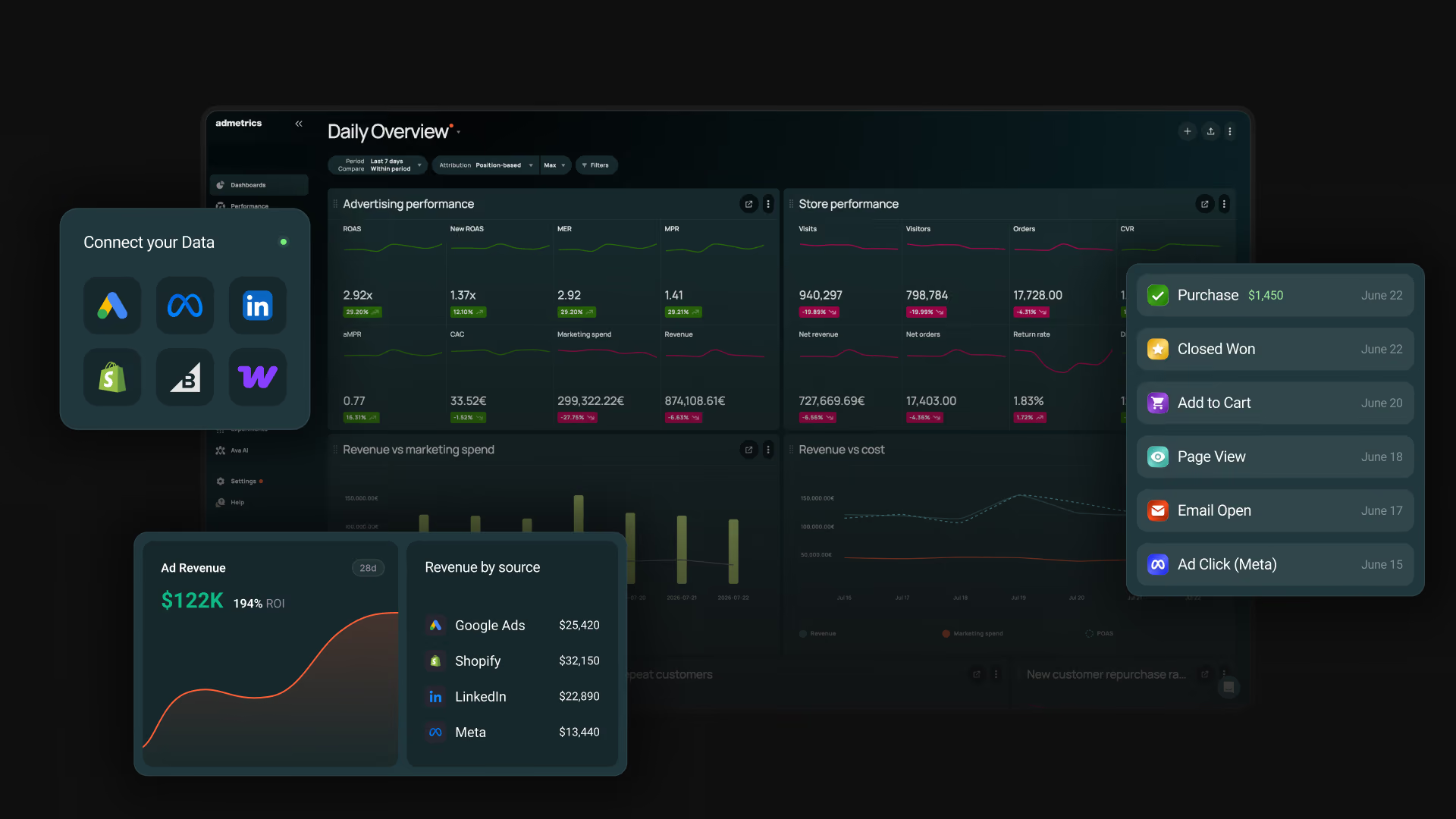
Admetrics credits each order with its own attribution, on the brand's own order data, and shows that number next to what Meta, Google Ads and TikTok report for themselves. Underneath, it tracks every order first-party and server-side, sends margin values and new-customer flags server-to-server to six ad platforms, and prices each campaign down to CM3 and POAS. Ad Pilot then moves Meta budgets toward a CAC, POAS or new-customer ROAS target inside the caps you set. For a team coming from ProfitMetrics, the bidding keeps its profit signal, and the budget call between Meta and Google stops depending on two platforms that each count the same order as their own.
Key features
Strengths
Limitations
Pricing
Growth: $399/month, including the first $20,000 of monthly ad spend, then 1.5% above that. Business: $899/month, including $70,000, then 1% above. Ad Pilot is an add-on from this plan. Custom: quoted, for brands spending $100,000 a month or more. The marketing mix model and Budget Optimizer are add-ons here. Annual billing saves 15% with 12 months paid upfront, and the 21-day free trial needs no card.Reviews
Admetrics holds 5.0 on the Shopify App Store and 4.8 on G2. Reviewers point to the onboarding help and reports that are easy to read.Bottom line
If ProfitMetrics already has Google and Meta bidding on profit and the open question is how much budget each of them should get, Admetrics answers it with attribution of its own, on the shop's orders, next to each platform's figures. The bidding keeps a margin value per order on six platforms instead of two, contribution margin shows up per campaign and SKU, and Meta budgets move on a profit target inside your caps. Data stays in the EU, and Shopify, Shopware, WooCommerce, Magento and custom stores all connect. Admetrics vs ProfitMetrics puts the two side by side.Product Metrics
Best for: Google Shopping and Performance Max advertisers who want every product sorted by profitability into Merchant Center labels, with profit values kept in the Google Ads and Meta bidding.
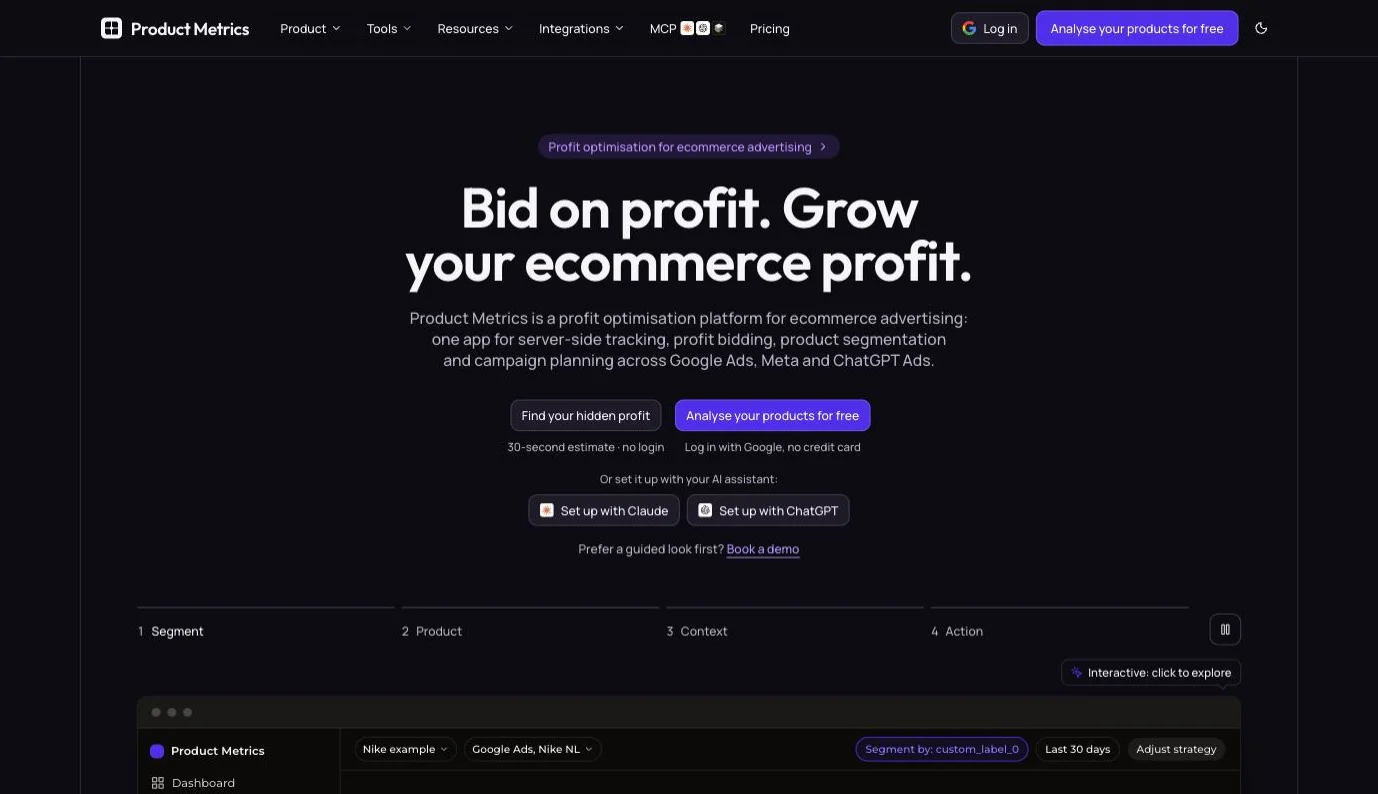
Product Metrics is a Dutch profit-optimization tool for ecommerce advertising, built around Google Shopping and Performance Max. It keeps profit bidding going: Full Signal Tracking sends revenue, profit, a new or returning customer flag and lifetime value per order to Google Ads and Meta, from an endpoint on the shop's own domain. Machine learning then sorts each product into one of six segments and writes them to Merchant Center custom labels. Shopify, WooCommerce, Magento, Lightspeed C-Series and Shopware 6 connect natively, and headless shops use an SDK. Product Metrics isn't an attribution tool, and it doesn't change budgets, bids, targets or prices: the merchant sets budgets and target ROAS per segment.
Key features
Strengths
Limitations
Pricing
Prices are in euros, excluding VAT, and a free analysis comes first. Pro is priced on rolling 30-day Google Shopping spend: the first €10,000 a month is free, then 0.65% applies between €10,000 and €25,000 and 0.60% between €25,000 and €100,000, with lower bands above that. At €50,000 of monthly Shopping spend, Pro costs €247.50 a month. Price Monitoring adds €0.004 per product check, and the 30-day trial needs a card.Reviews
Product Metrics has no ratings on G2, Capterra or the Shopify App Store yet.Bottom line
Product Metrics suits a Shopping-heavy store that wants profit values in Google Ads and Meta and its catalog sorted by profitability in Merchant Center. It stops at the label: there's no attribution, and every budget and target per segment is still set by hand.Triple Whale
★4.5Best for: Shopify brands that want pixel, attribution, mix modeling and an AI agent from one vendor, with order profit passed to Meta and Google.
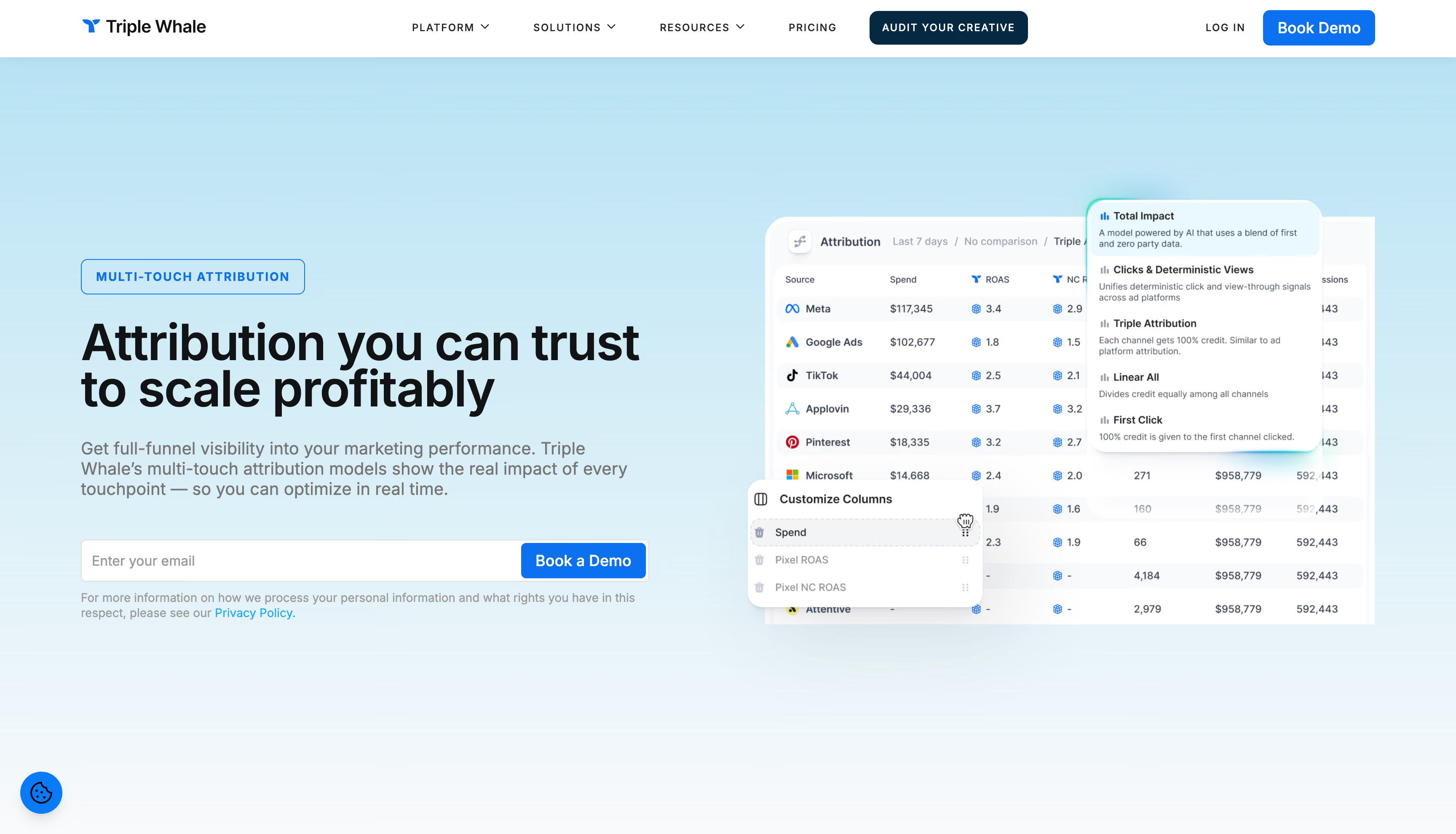
Triple Whale is a Shopify-centered analytics and attribution suite. Triple Pixel tracks first-party with an identity graph, eight attribution models credit the sale, and Compass lets attribution, a marketing mix model and GeoLift tests calibrate each other. Profit bidding continues on Meta and Google, because Sonar Optimize enriches conversion events server-side for ten ad platforms and passes order profit to those two on every paid plan. Profit reporting ends at net profit and a store-level POAS. From the Automate plan, Moby Actions raise or cut Meta and Google budgets automatically within rules. Shopify is the native store; WooCommerce and BigCommerce are in beta, and Magento runs through a custom or API connection.
Key features
Strengths
Limitations
Pricing
Triple Whale prices by annual GMV tier plus package, on 12-month terms, and the pricing page no longer shows figures. A free plan covers first- and last-click attribution, and there's no free trial.Reviews
Triple Whale holds 4.5 from 482 reviews on G2.Bottom line
Triple Whale suits a Shopify brand that wants a pixel, attribution, mix modeling and AI actions from one vendor and can keep its data in the US. Off Shopify the setup runs through beta connectors or the API, and profit stays at store level.Polar Analytics
★4.7Best for: Shopify brands with an analyst who want a dedicated Snowflake database, a semantic layer and contribution margin from CM1 to CM4.
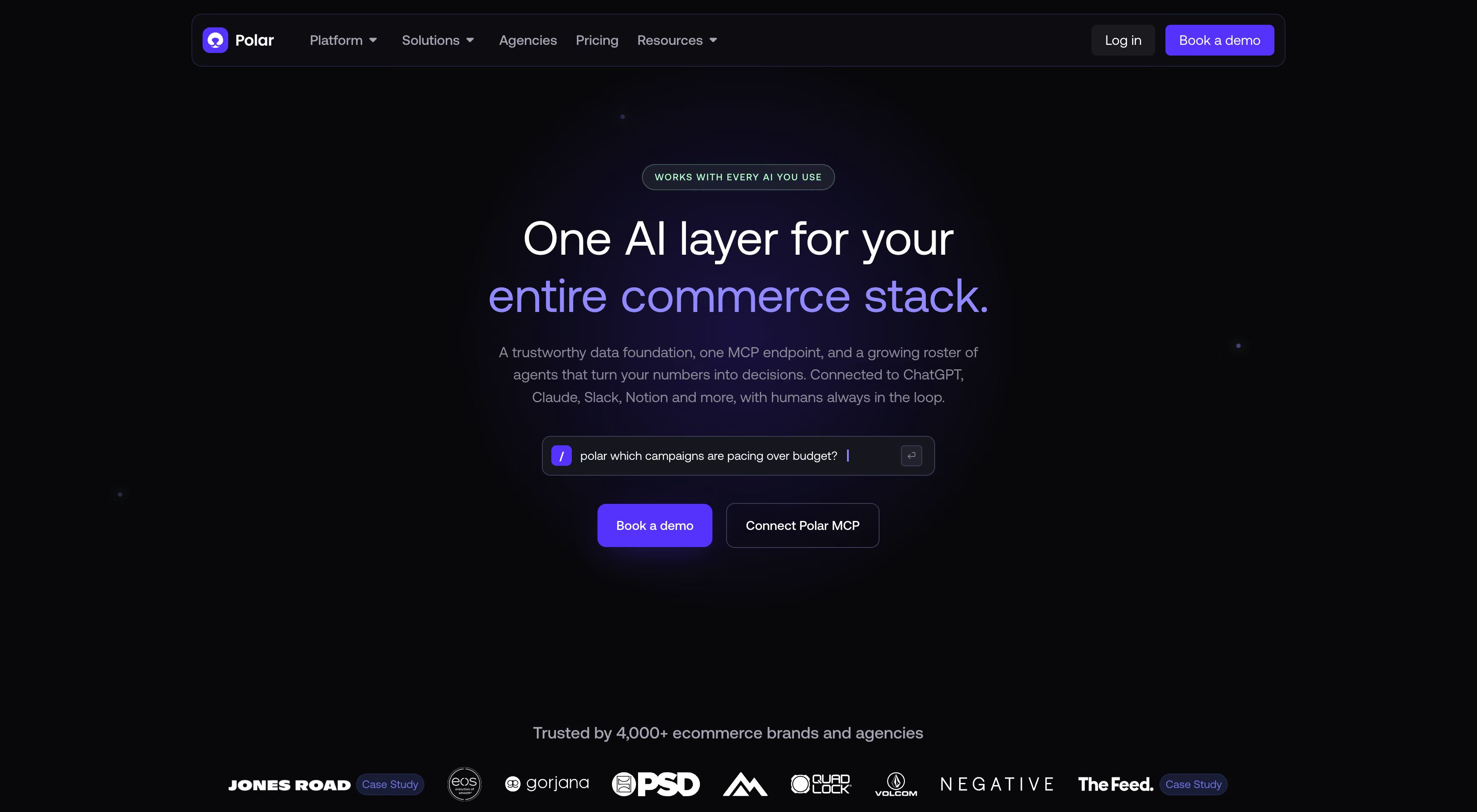
Polar Analytics is ecommerce analytics on a dedicated Snowflake database per customer, with a semantic layer on top. Ten attribution models include Full Impact, built on Shapley values, and Causal Lift geo tests come with the Custom plan. CM1 to CM4 are built-in metrics, per SKU and per order, next to a blended POAS. Advertising Signals adds CAPI enrichment for Meta and Google, priced on request. Polar's agents recommend scale, pause and fix moves, and nothing changes in an ad account until someone sets up and approves the action. Polar is Shopify-first, with Amazon connectors, and hosts in the US by default.
Key features
Strengths
Limitations
Pricing
Polar prices on GMV, with a Core and a Custom plan and no figures on the pricing page. Advertising Signals is priced on request, and there's no free plan.Reviews
Polar holds 4.9 from 116 reviews on the Shopify App Store. On G2, it scores 4.7 from 23.Bottom line
Polar suits a Shopify brand with an analyst who wants to query its own Snowflake data and read margin from CM1 to CM4. Profit stays in the reports, and every agent move waits for approval.Klar
★4.9Best for: brands on Shopware, JTL-Wawi or Centra that want a P&L down to EBITDA, a marketing mix model and geo-lift tests, with data hosted in Europe.
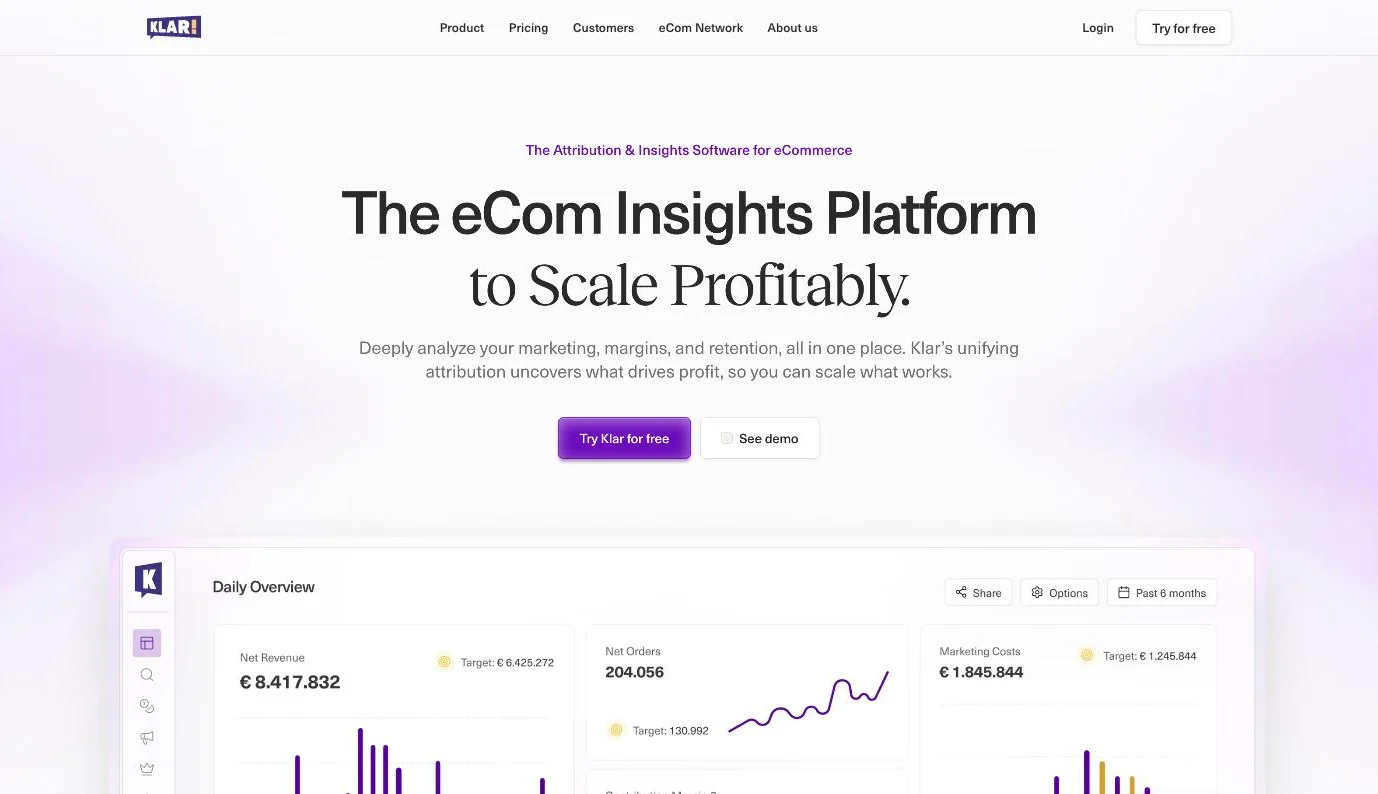
Klar is an ecommerce analytics platform from Munich. It combines multi-touch and data-driven attribution, a marketing mix model calibrated by geo-lift incrementality tests, and a P&L that runs from GMV through discounts, returns, COGS, logistics, fees and marketing to EBITDA, with CM3 per SKU. Retention, CLV, cohort, creative and influencer reports sit alongside. Klar sends no conversions back to the ad platforms, which means Google Ads and Meta get no profit value from it, and budgets aren't automated either. Shop coverage is wide: Shopify, Shopware 6 and 5, WooCommerce, Magento, Centra, Amazon Seller and JTL-Wawi, plus an open API.
Key features
Strengths
Limitations
Pricing
Core starts at €200/month and Core + Attribution at €400/month. Both are priced on the last 12 months of net revenue, after returns and taxes, and recalculated every three months. The 14-day trial starts after setup, and there's no long-term contract or setup fee.Reviews
Klar scores 4.9 on G2. On OMR Reviews, it holds 4.8.Bottom line
Klar suits a team that wants a P&L to EBITDA, an MMM and lift tests on EU-hosted data, across Shopware, JTL-Wawi and Centra as well as Shopify. It stops at the report: no profit value reaches the bidding, and budgets move by hand.Northbeam
★4.5Best for: brands with large multi-channel budgets and analysts on staff who want click-plus-view attribution, with MMM and incrementality tests from the same vendor.
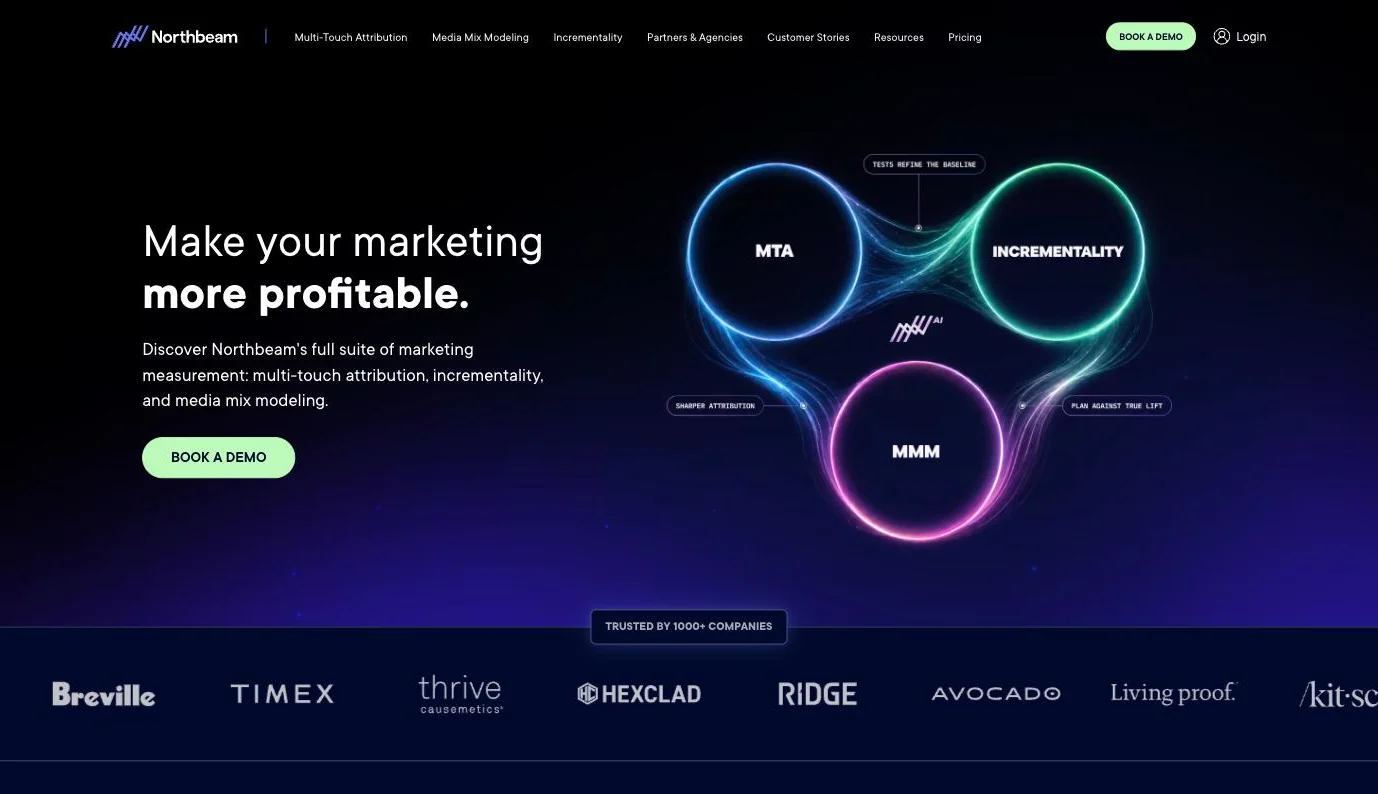
Northbeam is a multi-touch attribution platform for brands with large multi-channel budgets. A pixel on a first-party subdomain collects events, orders arrive server-to-server from Shopify or the Orders API, and seven models credit them, with Clicks + Deterministic Views and a choice of cash snapshot or accrual accounting. Apex sends Northbeam's attributed results to Meta and AppLovin for their algorithms to optimize on, with Snap in closed beta. No profit value goes to the bidding, and Google Ads isn't an Apex destination. Profit appears only as benchmarks: break-even ROAS, MER and CAC targets built from COGS. Budgets still change in each ad account.
Key features
Strengths
Limitations
Pricing
Starter costs $1,500/month for Shopify brands under $1.5M a year in ad spend, month-to-month. Professional is $3,500/month on annual terms, Enterprise is custom, and a Growth tier runs through agency partners. Price depends on pageviews, and there's no free trial.Reviews
Northbeam holds 4.5 from 16 reviews on G2.Bottom line
Northbeam suits a brand with large multi-channel budgets and analysts who want attributed results fed back to Meta, with mix modeling and lift tests on top. For a ProfitMetrics user it stops short of profit bidding: nothing goes to Google Ads, there's no profit metric, and budgets move by hand.TrueProfit
★4.9Best for: Shopify merchants who want net profit per order, product and ad across all their stores.
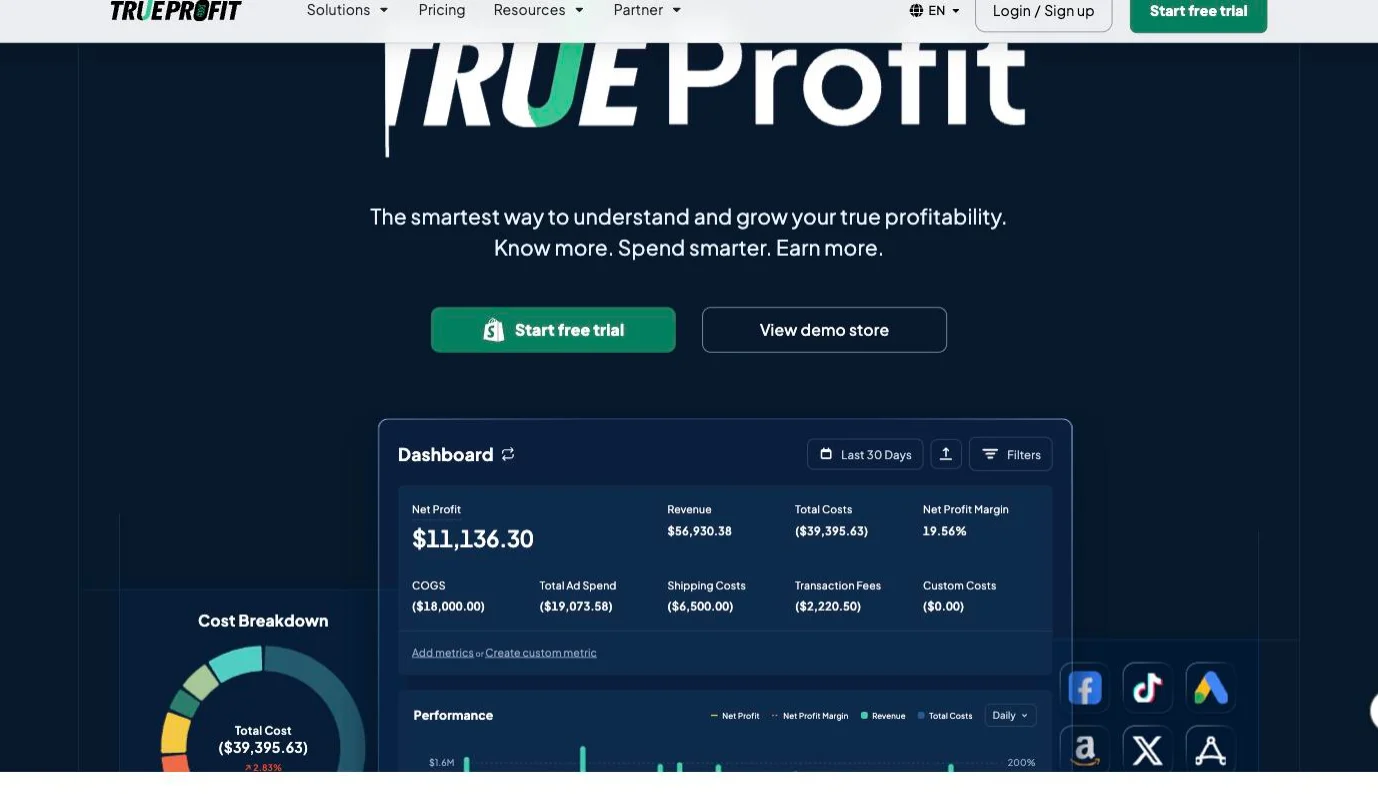
TrueProfit is a Shopify app for net-profit analytics. It tracks COGS, shipping, transaction fees, taxes and custom costs automatically, syncs ad spend from Meta, Google, TikTok and other ad platforms, and shows profit in a real-time dashboard, a P&L report and a mobile app. Attribution comes only with Enterprise, where the TrueProfit Pixel and URL parameters give last-click purchases and net profit per ad. TrueProfit sends no conversions to the ad platforms, which ends profit bidding, and it has no budget automation. Shopify is the only shop system it supports.
Key features
Strengths
Limitations
Pricing
Prices are in USD per month, with a 14-day trial and no annual plan. Basic costs $35 for 300 orders, then $0.30 per extra order, capped at $300. Advanced is $60 (600 orders), Ultimate $100 (1,500) and Enterprise $200 (3,500), with $0.07 per extra order on Enterprise, capped at $1,000.Reviews
TrueProfit holds 4.9 from 929 reviews on the Shopify App Store.Bottom line
TrueProfit suits a Shopify merchant who wants net profit tracked automatically and checked on a phone. It stops at the dashboard: no profit value reaches the bidding, attribution waits for Enterprise, and budgets move by hand.BeProfit
★4.5Best for: Shopify, WooCommerce and Amazon sellers who want contribution profit per order and product, with POAS next to ROAS, at an order-based price.
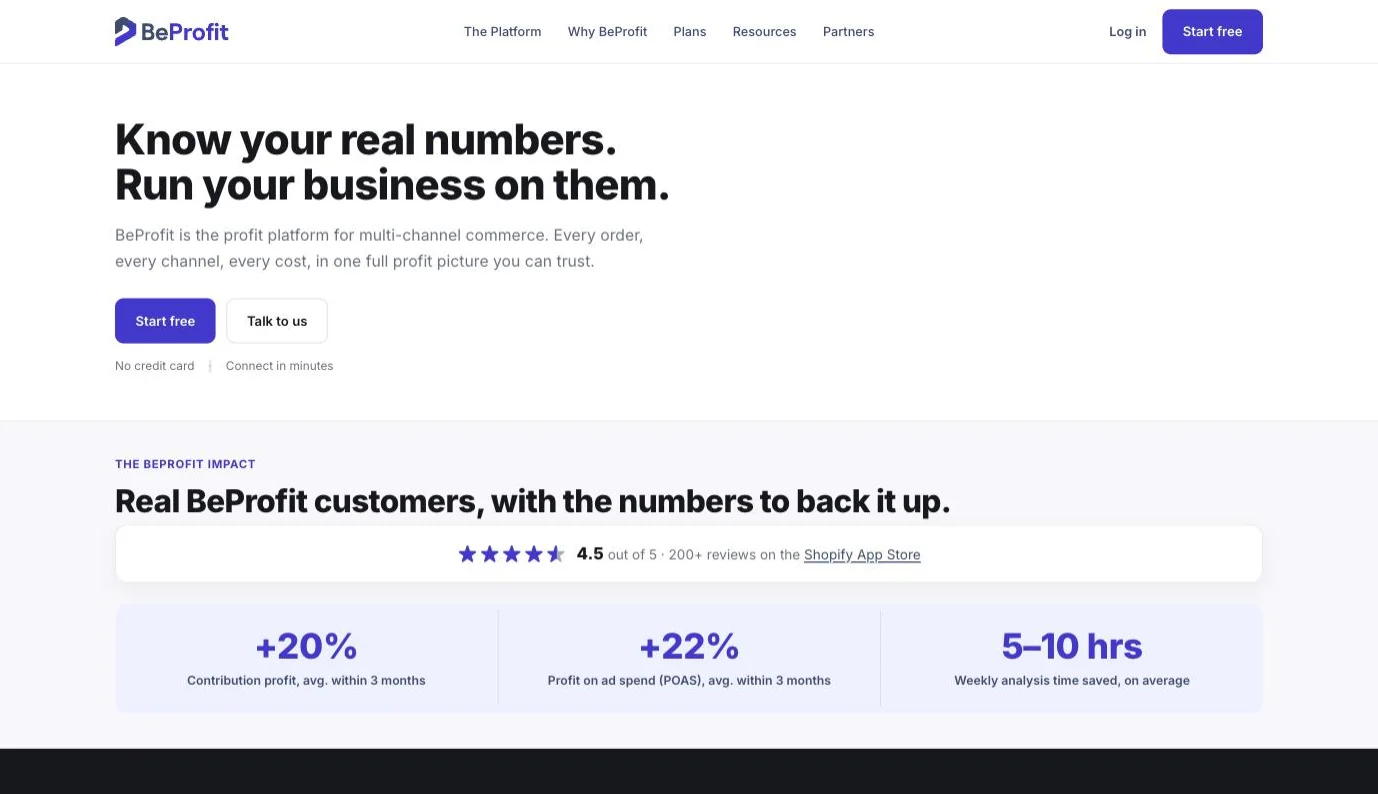
BeProfit is profit and expense analytics for Shopify, WooCommerce and Amazon. It reports order and product profit, contribution profit per order and product, POAS next to ROAS, net shipping per order and a gross P&L, with a daily profit email and profit questions answered in Claude or ChatGPT. Integrations include Google Ads, Meta, Klaviyo, ShipStation, UPS and Amazon. Attribution is UTM-based and comes with the Scale plan. BeProfit sends no conversions to the ad platforms, which ends profit bidding for a ProfitMetrics user, and it doesn't automate budgets.
Key features
Strengths
Limitations
Pricing
The Shopify listing shows a free plan (150 orders), Basic at $29/month (450 orders), Pro at $99 (900) and Scale at $149 (1,700). Extra orders cost $0.30 each, up to $500 a month, and each plan covers one shop. Enterprise starts at $249/month, paid plans include a 14-day trial, and annual plans are available.Reviews
BeProfit holds 4.5 from 203 reviews on the Shopify App Store.Bottom line
BeProfit suits a Shopify, WooCommerce or Amazon seller who wants contribution profit per order and product on a low monthly bill. It stops at the report: nothing goes back to the bidding, and attribution is UTM-only, on the Scale plan.Lebesgue
★4.9Best for: Shopify and WooCommerce stores that want automated ad audits for Meta, Google and TikTok, competitor intelligence and an AI assistant, starting from a free plan.
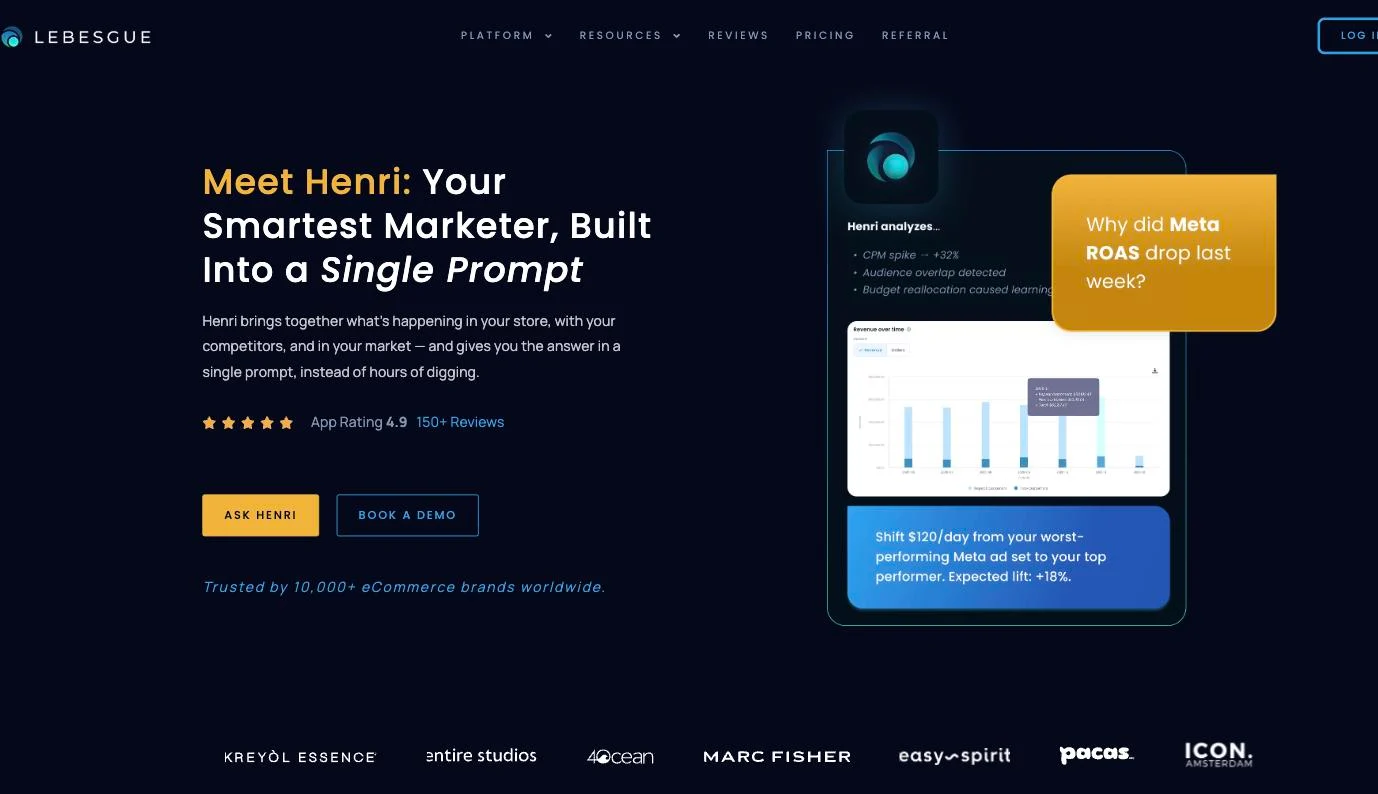
Lebesgue is "AI CMO" analytics for Shopify and WooCommerce. It covers store performance and profit tracking with COGS and a P&L, ad analytics with automated audits for Meta, Google and TikTok, LTV, cohorts and retention, competitor intelligence, product and inventory intelligence, and the Henri AI assistant. The Ultimate AI plan adds AI bid management through Henri AI and recommendations for ad budget allocation. Attribution sits in the Le Pixel tier at $749/month: a first-party pixel, several models including a game-theory one, customer journeys, server-side tracking and a Meta CAPI integration.
Key features
Strengths
Limitations
Pricing
The Shopify listing shows a free plan, Ultimate at $79/month, Ultimate AI at $149/month and Le Pixel at $749/month, in USD. Paid plans include a 14-day trial.Reviews
Lebesgue holds 4.9 from 132 reviews on the Shopify App Store. Software Advice shows the same 4.9, from 44 reviews.Bottom line
Lebesgue suits a Shopify or WooCommerce store that wants ad audits, competitor views and an AI assistant on top of profit tracking. It stops short of a full measurement setup: attribution and the server-side feed to Meta sit in a $749/month tier.wetracked
★4.8Best for: Shopify stores and funnel sellers on checkouts such as Funnelish, Checkify or CheckoutChamp that want purchases sent server-side to six ad platforms, priced by order volume.
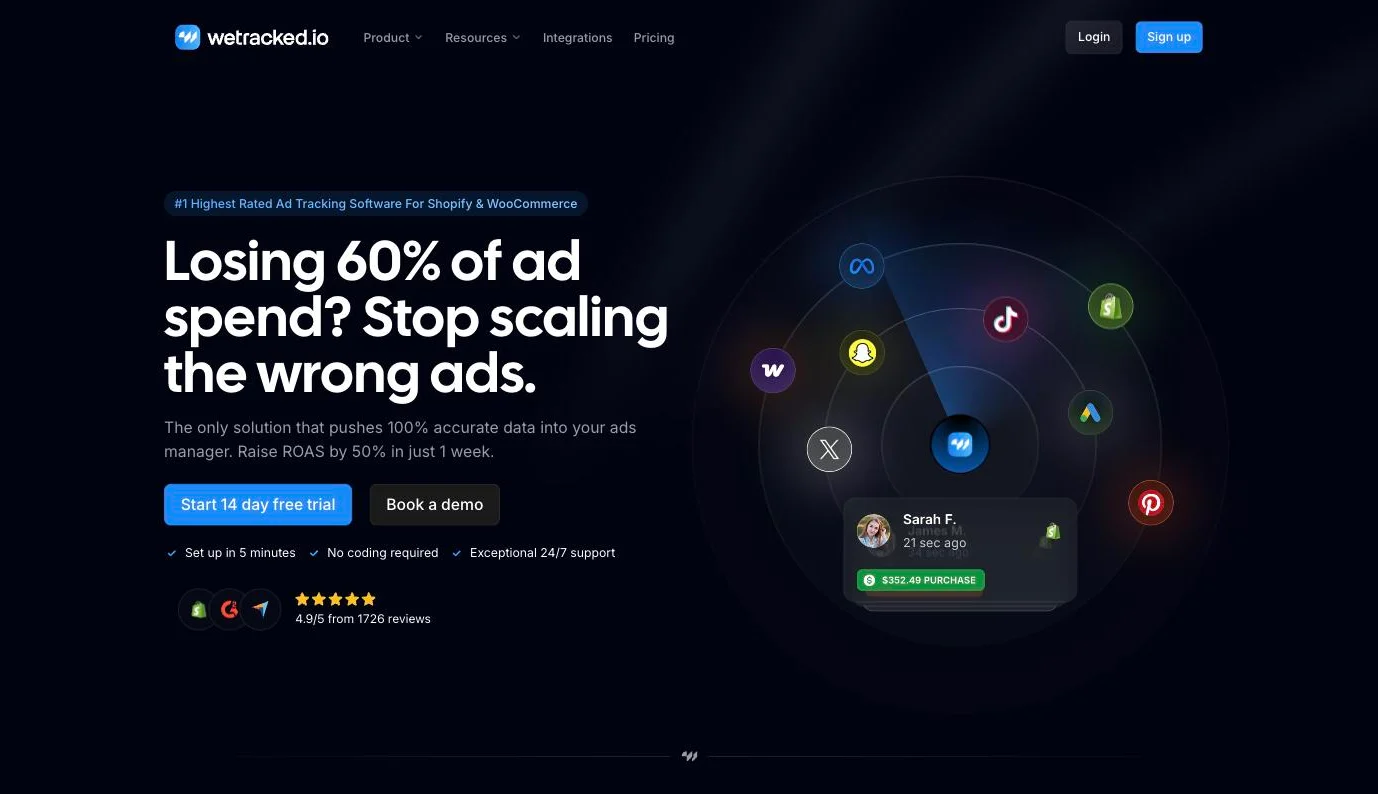
wetracked is a Shopify ad-tracking app. It tracks server-side, recognizes returning visitors through a digital fingerprint, and sends purchases back through each platform's conversion API to Meta, TikTok, Google Ads, Snapchat, Pinterest and X. Shopify, WooCommerce and funnel checkouts connect, and tracked events also feed Klaviyo. The purchases carry no profit value, since wetracked has no COGS, contribution margin or POAS, and that leaves Google Ads and Meta without a profit figure to bid on. Attribution is last click on UTM parameters, there's no budget automation, and data is transferred to and processed in the US.
Key features
Strengths
Limitations
Pricing
Starter costs $49/month for 500 orders and three stores. Business is $149 (3,000 orders), Scale-up $249 (7,500) and Enterprise quoted. Annual billing saves 20%, and there's a 14-day trial and no free plan.Reviews
wetracked holds 4.8 from 362 reviews on G2. On Capterra, it scores 5.0 from 197.Bottom line
wetracked suits a Shopify or funnel seller who mostly needs purchases back in six ad platforms through their conversion APIs. It stops at revenue events: there's no profit value for the bidding, no margin and no budget automation.Best ProfitMetrics alternative: final verdict
Admetrics is the best ProfitMetrics alternative for ecommerce brands that want tracking, profit values for the bidding, attribution, contribution margin and budget moves on one set of order data. Coming from ProfitMetrics, you keep server-side tracking and a profit value on every order in Google's and Meta's bidding, and add what ProfitMetrics leaves to the platforms: one attribution model that credits each order once across Meta, Google and TikTok, CM3 and POAS by campaign down to the SKU, and Ad Pilot moving Meta budgets inside the caps you set. Plans start at $399/month, and the 21-day free trial needs no card.
Book a demo