
Adverity is enterprise marketing ETL. Its 600+ connectors pull data from ad platforms, analytics tools and stores, a transformation layer maps it into one schema, and the result lands in your own warehouse or in Adverity-managed hosting. Then it stops: the conversions in that warehouse are the ones each ad platform reported about itself, and attribution, product costs, the signal Meta and Google bid on and every budget move are left to your data team and the ad accounts.

This list compares nine Adverity alternatives for ecommerce brands, from marketing data hubs and warehouse-first ELT to ecommerce analytics platforms, on tracking and attribution accuracy, data foundation, profit and what happens once the data has landed.

Key Takeaways

Admetrics is the best Adverity alternative for ecommerce brands that want their marketing data to show which campaigns made money. First-party tracking, managed data storage with warehouse exports, a Data API and MCP, multi-touch attribution, contribution margin down to the SKU, conversions sent back to the ad platforms server-to-server and budget automation run on one set of order data, from $399/month.
Most tools on this list don't track a single visitor themselves. They load the conversions each ad platform reports about itself. Meta credits purchases to itself, view-through and modeled conversions included, Google does the same inside its own windows, and the channel totals add up to more orders than the store recorded. Admetrics tracks first-party and server-side, ties every journey to a real order and attributes on that order data.
Only three of the nine tools report contribution margin. In most reports a purchase arrives at full order value, before product cost, shipping, payment fees and returns, and a campaign selling discounted, often-returned products ranks next to one selling full-price bestsellers. Admetrics reports CM2, CM3 and POAS by campaign, down to the SKU.
Most tools deliver the data and leave the answer to your team. Spend, clicks and platform-reported conversions arrive normalized in a warehouse or BI tool, and joining them to orders, product costs and returns stays a model your data team builds and maintains. Admetrics stores the data for you, defines each metric once and sends the same numbers out through warehouse exports, Google Sheets sync, a Data API and MCP.
Most tools don't move budget by themselves. A budget change starts as a pacing alert, a draft waiting for approval or a prompt typed into an AI chat, and spend keeps flowing to whatever the ad platforms credit until someone moves it. Admetrics' Ad Pilot moves Meta budgets toward a CAC, POAS or new-customer ROAS target inside the caps you set.

Why ecommerce brands leave Adverity

For an ecommerce team, Adverity falls short in four places.

No attribution. Adverity loads each platform's self-reported conversions and keeps them as reported. Meta's numbers include view-through and modeled conversions it credits to itself, Google's include its own, and the warehouse ends up holding more attributed orders than the store ever recorded. There's no attribution model in Adverity to settle which channel earned the sale, which leaves that model for your team to build or buy.

No profit reporting. Adverity has no COGS, shipping costs, payment fees or contribution margin. Store revenue and ad spend can sit side by side in the same warehouse, and margin per campaign is still a model your team writes in SQL and keeps current every time a product cost changes. Until that model exists, campaigns get judged on ROAS.

No conversions sent back to Meta or Google server-to-server. Adverity's ad-platform destinations are audience syncs for Meta, Google, LinkedIn and Snapchat, plus LinkedIn Offline Conversions. Meta's and Google's bidding keeps learning from whatever the browser pixel still catches after ad blockers, consent banners and signal loss, and closing that gap takes a separate CAPI setup. Nothing in Adverity moves budget either.

Running it takes a data team. Adverity Connect gives you seven no-code transformation tools, 80+ Python functions and dbt, and enterprise onboarding takes 30 to 60 days. Reviewers describe a steep learning curve, connections that are tricky to set up and pipelines that take a long time to build and schedule. Every new source, mapping fix and schedule change is work for whoever owns the pipeline.

How we ranked the tools

We scored every tool on four criteria. Prices and features are as of November 2026.

▪Attribution and tracking accuracy. Whether the tool tracks visitors first-party and server-side and matches conversions to real store orders, or loads what each ad platform reports, and whether attribution goes beyond a single model.
▪Data foundation. Which sources connect, store and cost data included; where the data is stored, by the vendor or in your own warehouse; how often it refreshes; whether it leaves through exports, an API or MCP; and whether it can be hosted in the EU.
▪Profit over revenue. Whether product cost, shipping, payment fees and returns reach campaign reports, or the tool stops at revenue and ROAS.
▪What happens after attribution. Whether conversions go back to the ad platforms server-to-server, and whether anything moves budget inside limits you set.

Adverity alternatives compared

#
PLATFORM
ATTRIBUTION
PROFIT CONTROL
S2S PUSHBACK
ACTION
1
Admetrics
Multi-touch, 8 models; MMM add-on
CM2, CM3, POAS to SKU
Yes, 6 platforms (paid add-on)
Budget Optimizer, Ad Pilot
2
Funnel
MTA + MMM (Measure add-on)
No
Meta, Google, TikTok, LinkedIn, Microsoft
Pacing alerts, Measure recommendations
3
Improvado
Rule-based MTA; MMM add-on
No
Audience syncs only
AI agent drafts changes for approval
4
Fivetran
No
No
Google Ads conversions (Activations)
No
5
Supermetrics
No, platform-reported
No
Meta, LinkedIn (Sheets add-on)
Budget edits via AI chat
6
Windsor.ai
Multi-touch
No
No
Budget edits via AI assistant
7
Daasity
8 models: GA, survey, discount code
Contribution margin
No, audience syncs
No
8
Polar Analytics
Pixel MTA, 9 models + geo-lift
CM by product and channel
Meta, Google (paid add-on)
Slack Operator, approval needed
9
SegmentStream
First-click model + geo-holdout tests
No
Predicted LTV to Meta, Google, TikTok
One-click budget reallocation

Admetrics

★5.0

Best for: ecommerce and DTC brands that want marketing and order data stored for them in one governed layer, with attribution, contribution margin and budget moves running on it.
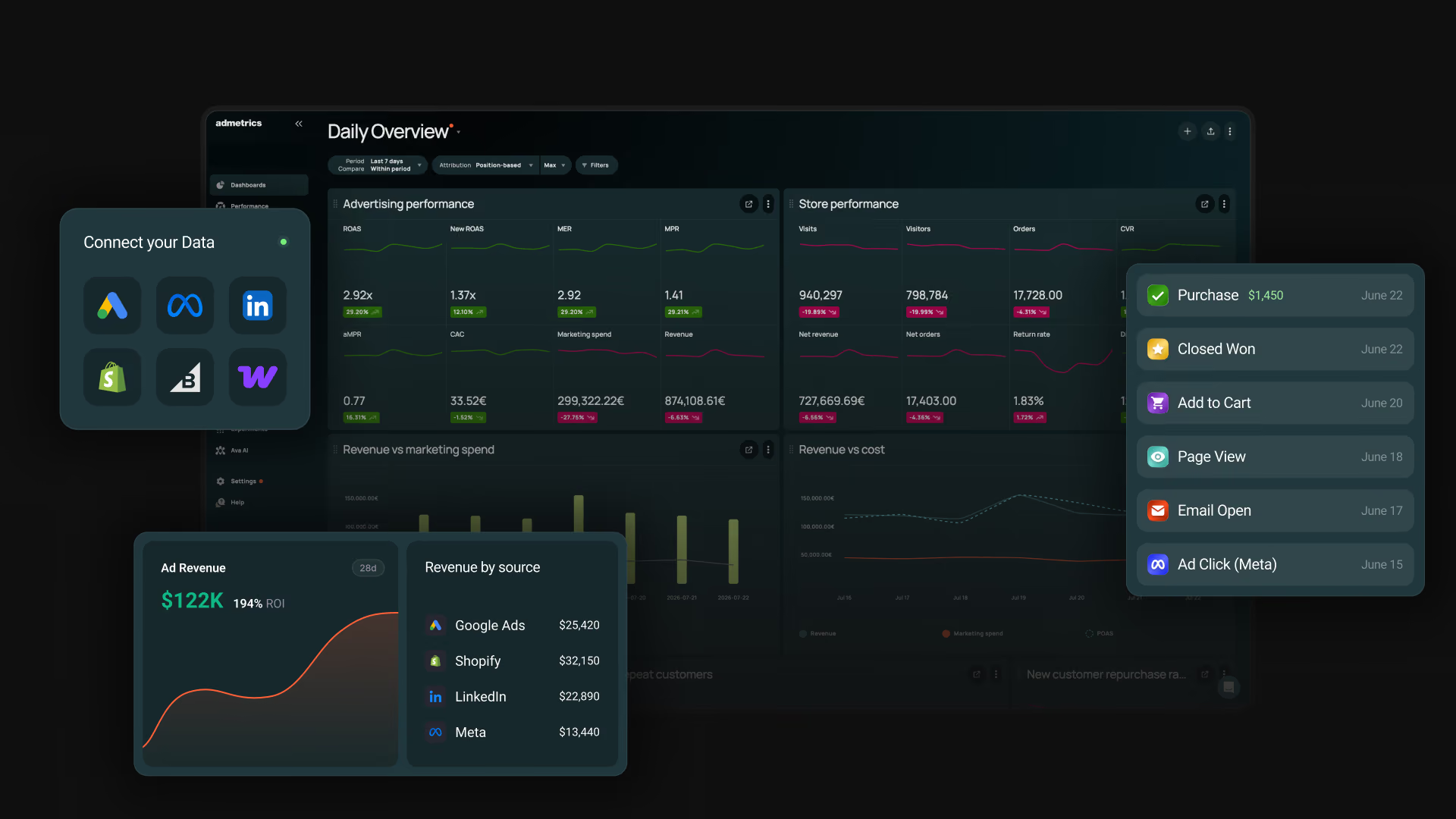
Admetrics dashboard showing marketing data, attribution and profit reporting for ecommerce brands

Admetrics is a measurement and budget allocation platform with its own data layer. Orders, ad spend, costs and customers live in one place, processed and stored in the EU with one definition per metric, and the same numbers reach your warehouse, Google Sheets, the Data API and AI tools through MCP. On that data, every click and order is tracked first-party and matched to the real shop order, conversions go back to the ad platforms server-to-server, Admetrics' own attribution credits the channels, contribution margin prices each campaign and budget moves toward the campaigns that earned it. Admetrics runs the connectors and the storage, and no developer is needed on your side.

Key features

▪Open data layer. 30+ native integrations, including Shopify, Amazon, Shopware, Magento and WooCommerce, with custom shops connected through Google Sheets or Amazon S3. Data storage is included, each metric has one definition, and the data leaves through warehouse exports, Google Sheets sync, a Data API with 150+ KPIs down to the ad and order, and a read-only MCP server.
▪Tracking. First-party, server-side tracking on your own domain stitches sessions and devices into one journey and anchors it to a real shop order, with the visitor's consent state on every event.
▪Conversion Signals. Conversions sent back server-to-server to Meta, Google, TikTok, Snapchat, Outbrain and Taboola, deduplicated before delivery.
▪Multi-Touch Attribution. Eight attribution models, Adaptive among them, side by side on your own order data, with custom data-driven attribution on Custom. The Chrome extension shows Admetrics numbers inside the Meta, Google and TikTok ad managers, and the PRISMA marketing mix model is a Custom-plan add-on.
▪Profit Intelligence. A P&L from GMV through CM1, CM2 and CM3 to EBITDA, with CM2, CM3 and POAS by campaign and product down to the SKU, built from COGS, shipping, payment fees and returns per order.
▪Budget Optimizer and Ad Pilot. Budget Optimizer proposes budget moves across channels. Ad Pilot adjusts Meta budgets inside the caps you set and logs every move.

Strengths

Single source of truth. Tracking, attribution, profit and budget moves read the same stored order data, and an exported CM2 matches the CM2 in the app, with no second dataset to reconcile before a budget call.
Managed data storage, no warehouse required. Data storage is included, and most stores are connected in under an hour without a developer.
Contribution margin per campaign and SKU. Profit Intelligence shows which campaigns and products made money after product cost, shipping, fees and returns.
Independent attribution next to the platforms' numbers. Multi-Touch Attribution credits each channel on your own order data, and the Chrome extension puts that number inside the ad managers.
Budget automation on Meta. Ad Pilot moves Meta budgets toward a CAC, POAS or new-customer ROAS target, with every change logged.
EU data hosting. Data is processed and stored in the EU, with a DPA.

Limitations

Fewer connectors than an ETL tool. 30+ native integrations against the hundreds an ETL platform offers, because Admetrics is built around ecommerce data rather than every marketing source.
S2S pushback is a paid add-on on every plan.
Ad Pilot executes on Meta only. Google and TikTok budgets don't change automatically.

Pricing

Growth: $399/month, including the first $20,000 of monthly ad spend, then 1.5% above that. Data refreshes every 4 hours. Business: $899/month, including $70,000, then 1% above, with data refreshed every 4 hours. Ad Pilot is an add-on from this plan. Custom: quoted, from $100,000 of monthly ad spend, with data refreshed every 2 hours. PRISMA and Budget Optimizer are add-ons here. Data storage is included, along with unlimited shops, integrations and users. S2S pushback and faster data refresh are add-ons. Annual billing saves 15%, and the 21-day free trial needs no card.

Reviews

Admetrics holds 5.0 on the Shopify App Store and 4.8 on G2. Reviewers point to the onboarding help and reports that are easy to read.

Bottom line

An ETL tool is the way to get every marketing source into a warehouse your data team runs and models. Admetrics is for the ecommerce brand that wants its order and marketing data stored and kept consistent for it, and wants that same data to show which campaigns made money after costs and to move budget toward them.
Book a demo

Funnel

★4.5

Best for: marketing and data teams at brands and agencies that want hundreds of marketing sources stored and modeled in one hosted hub, with mix modeling as a paid add-on.
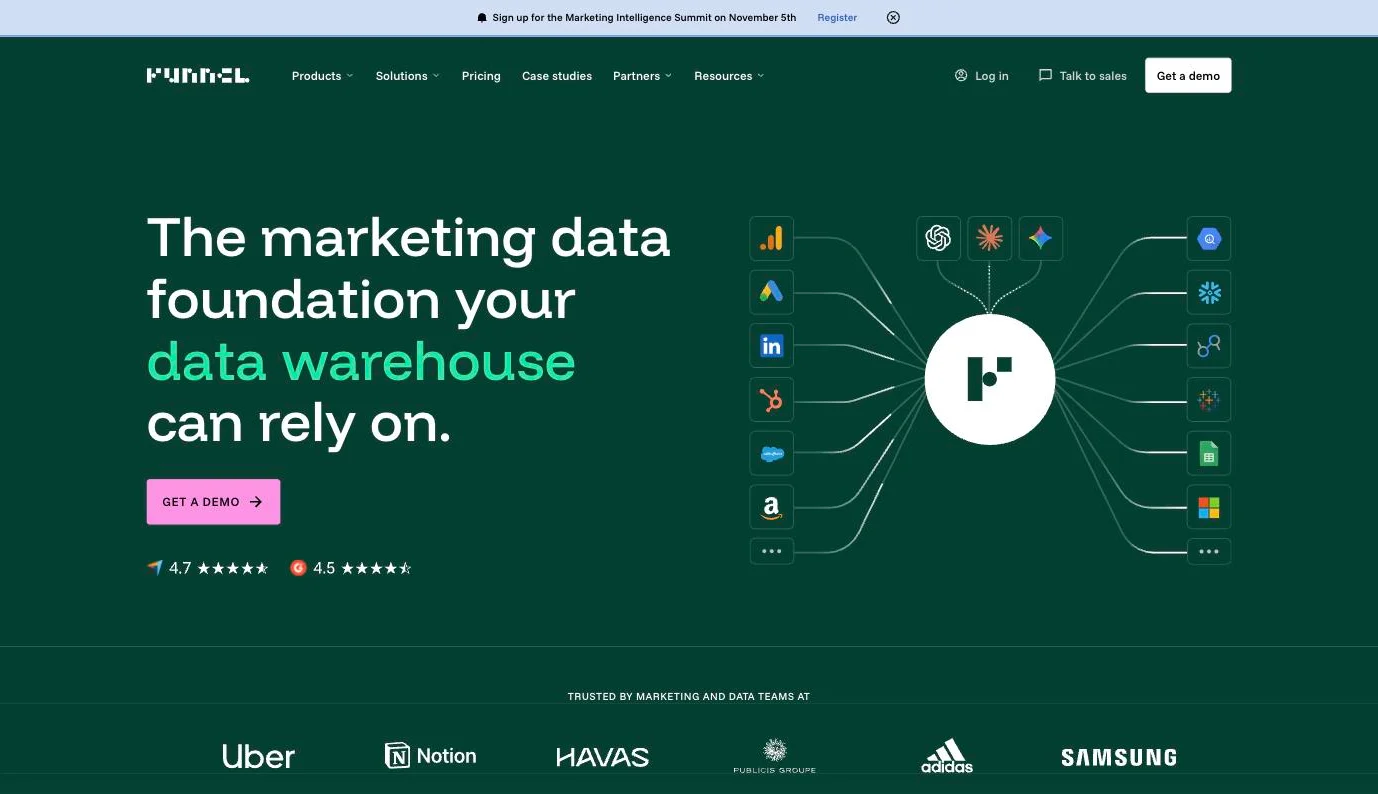
Funnel homepage presenting its marketing data hub and connectors

Funnel is a managed marketing data hub. It collects data from 600+ connectors, keeps the original data, normalizes it and sends it on to BI tools, warehouses, AI tools and ad platforms, including conversion uploads to five ad platforms server-to-server. Funnel Measure adds MMM, multi-touch attribution and incrementality tests for an extra fee, and product costs and margin don't appear anywhere in it.

Key features

▪Data Hub with stored history. Funnel keeps the raw data, so a changed transformation applies to everything already imported.
▪600+ connectors. Shopify, Amazon Seller and Vendor Central and WooCommerce on every plan, with custom connectors built for Business and Enterprise.
▪Conversion uploads. Events sent server-to-server to Meta's Conversions API, Google Ads, TikTok's Events API, LinkedIn and Microsoft Ads.
▪Funnel Measure. Daily MMM at channel and campaign level, calibrated with MTA; geo tests sit in the Advanced tier.
▪Budgets and Funnel MCP. Pacing alerts against planned spend, and external LLMs querying Funnel data with your business definitions.

Strengths

Hosted marketing history. No warehouse of your own needed, with exports every 2 hours on Business and Enterprise.
S2S conversion uploads on every plan.
EU data center on Enterprise, with ISO 27001 and SOC 2 Type 2.

Limitations

No tracking of its own. No pixel or server-side tracking; MTA runs on GA4's raw export, Segment, Tealium or CRM data you already have.
No profit layer. No COGS, shipping, fees, returns, contribution margin or POAS.
No budget automation. Budgets flags overspend and Measure recommends reallocations, and a marketer makes every change.
Measurement costs extra. Digital Measurement is $2,250/month billed annually at a $500K–$1M monthly ad-spend band.

Pricing

Starter starts from $300/month and Business from $600/month, both billed annually, and Enterprise is quoted. Connectors, accounts, destinations and conversion APIs each use flexpoints from the contract. Starter has 117 connectors. There's a 14-day Data Hub trial with no card and no free plan.

Reviews

Funnel scores 4.5 on G2 and 4.7 on Capterra. Reviewers praise knowledgeable support and the time saved standardizing data, and complain about price and a setup that can take one to three months.

Bottom line

Funnel suits teams that want many marketing sources stored, modeled and uploaded back to the ad platforms by one vendor, with MMM bought on top. It stops before profit. There's no contribution margin, and budget changes stay manual.

Improvado

★4.4

Best for: large enterprises, multi-brand groups and agencies whose data team wants marketing data modeled into its own warehouse, with an AI agent working on top.
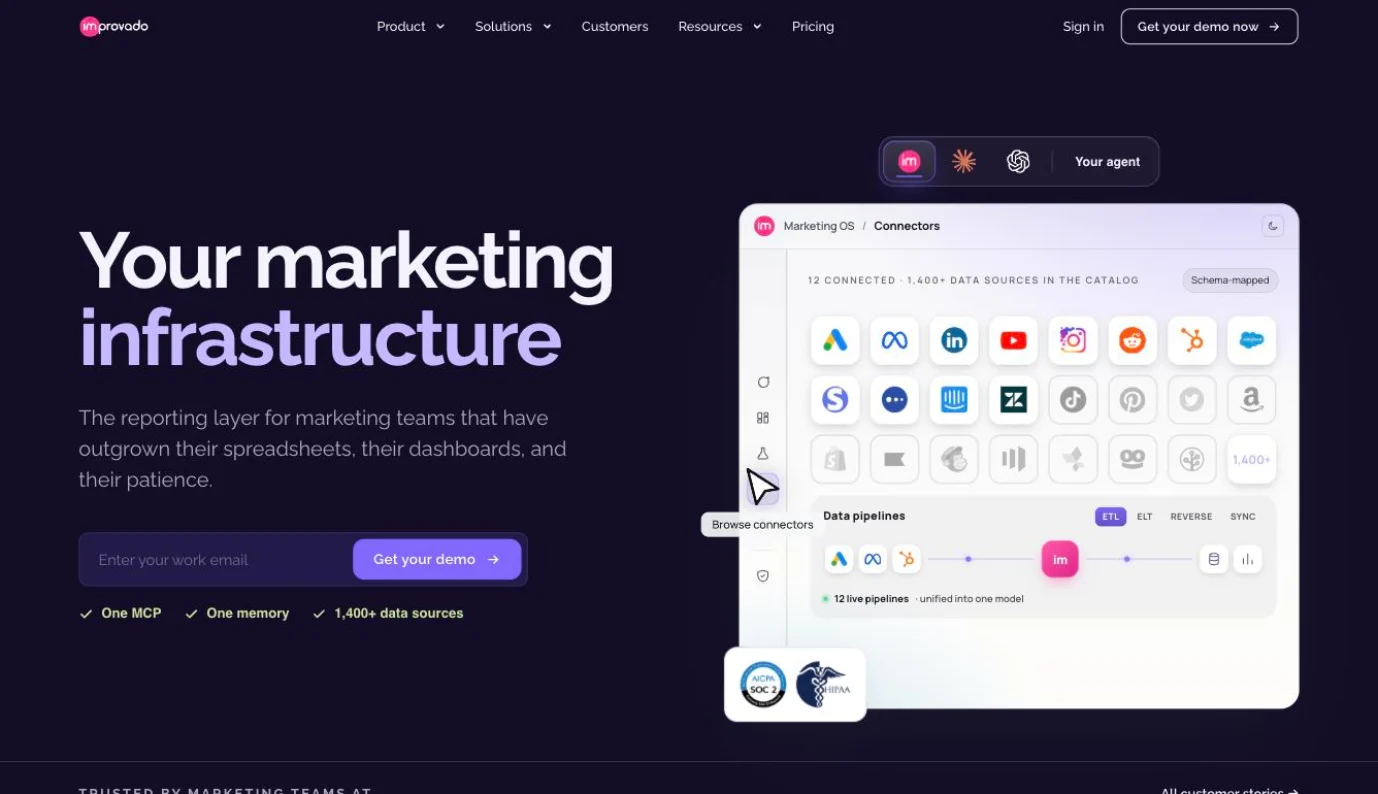
Improvado homepage presenting its marketing data platform and AI agent

Improvado is enterprise marketing ETL with an AI agent and governance rules. It pulls from 1,400+ data sources, maps them into one shared model and loads analysis-ready tables into a warehouse you control or a BigQuery instance Improvado manages. Attribution, MMM and incrementality testing come as an add-on, and the agent drafts budget and bid changes for someone to approve.

Key features

▪1,400+ sources, all included. No per-connector fees; Shopify, Amazon, Walmart Marketplace and Brightpearl among the ecommerce sources.
▪Your warehouse or managed BigQuery. Snowflake, BigQuery, Databricks, Redshift, Microsoft Fabric and others.
▪Governed data model. 46K+ metrics unified and 250+ pre-built validation rules.
▪Marketing Attribution. First touch, last touch, linear, position-based and time decay, run in your warehouse.
▪AI agent and MCP. An MCP and OpenAPI surface for Claude, ChatGPT and Cursor, plus pipelines that pause overspending campaigns.

Strengths

Connector upkeep handled by the vendor, with every source included on every plan.
Built with you. A solutions engineer sets up the platform, and Growth and Enterprise include professional services credits.

Limitations

No tracking of its own. No pixel or server-side tracking, and attribution is rule-based.
No profit layer. No COGS, shipping, fees, returns, contribution margin or POAS.
No conversions sent back. Reverse pipelines push audience segments to Meta, Google Ads, TikTok and LinkedIn, with no CAPI upload.
No budget optimizer. The agent drafts changes for approval.
Setup takes weeks. A typical deployment takes 4–8 weeks from kickoff to first production dashboards.

Pricing

MCP Only costs $100/month for 2M rows a year and runs inside your own AI assistant. The full platform starts at $20,000/year on Starter, Growth is from $41,700/year and Enterprise is quoted, billed on rows, agent and MCP actions, workspaces and governance rules. Advanced Analytics (MMM, incrementality, MTA) adds from $20,000/year. The pricing page has no free plan and leads to a demo.

Reviews

Improvado scores 4.4 on G2 and 4.5 on Capterra. Reviewers praise responsive onboarding and support, and complain about a steep learning curve and a cost that's high for smaller organizations.

Bottom line

Improvado suits enterprises and agencies with a data team, many systems and a warehouse of their own. It stops before profit. Only audiences go back to the ad platforms.

Fivetran

★4.3

Best for: data teams that own a warehouse or data lake and want managed ELT for every system in the company, marketing included, billed on usage.
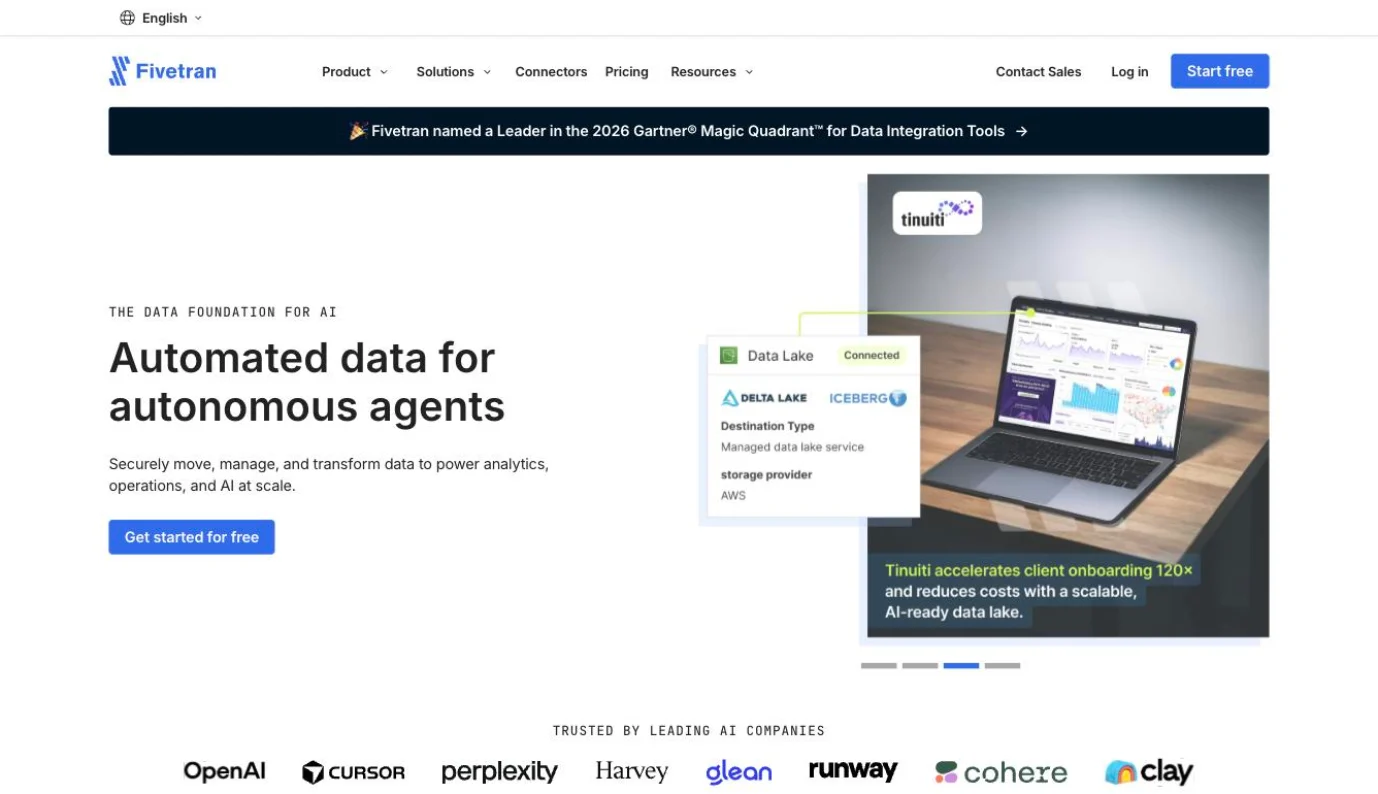
Fivetran homepage presenting its managed data pipelines into the warehouse

Fivetran is general-purpose managed ELT, merged with dbt Labs since 1 June 2026. It moves data from 700+ managed connectors into a warehouse or lake the customer owns, models it with dbt and, through Activations, syncs it back out to business tools and ad platforms. Fivetran doesn't keep a copy of the data. Attribution, profit and budget decisions live in whatever the data team builds on top.

Key features

▪Managed connectors. Shopify, Amazon Selling Partner, WooCommerce, Shopware and Adobe Commerce, plus Meta Ads, Google Ads, TikTok Ads and eight more ad sources.
▪dbt and Quickstart models. Ad Reporting rolls 11 ad connectors into campaign and ad reports; Shopify Holistic Reporting joins Shopify with Klaviyo.
▪Activations. Reverse ETL to 200+ destinations, including Google Ads offline, call and enhanced conversions.
▪Fast syncs. Every 15 minutes on Standard, every minute on Enterprise.
▪Agent Context MCP. Read-only SQL against your destination, in public preview.

Strengths

Low-maintenance pipelines. Automatic schema handling keeps connectors running as sources change.
Control over processing region, EU-only processing among the options.

Limitations

No attribution. No pixel or server-side tracking, and the one attribution model is a last-touch dbt model tying Shopify orders to Klaviyo.
No profit layer. No COGS, fees, contribution margin or POAS.
Conversion pushback built around Google Ads. For Meta, Activations sync Custom Audiences and offline conversion data.
No budget actions. Nothing in Fivetran pauses ads or moves spend.
Needs a warehouse and a data team to model the data and build every report.

Pricing

Free covers 500,000 MAR and 5,000 model runs a month. Standard, Enterprise and Business Critical have no list prices: each connection is billed on Monthly Active Rows at declining per-million rates, plus a $5 base charge per standard connection. Billing is monthly pay-as-you-go or annual with up to 22% off, and new connections get 14 days free.

Reviews

Fivetran scores 4.3 on G2 and 4.4 on Capterra. Reviewers like the easy setup and reliable prebuilt connectors, and complain that MAR bills climb steeply with volume and are hard to predict.

Bottom line

Fivetran suits a data team that runs its own warehouse and wants pipelines for every system, marketing among them. It stops at data movement. Attribution, profit per campaign and budget calls are left to what the team builds in dbt and BI.

Supermetrics

★4.4

Best for: marketers and agencies that report in Google Sheets, Looker Studio or an AI chat and want to edit campaigns from that same chat.
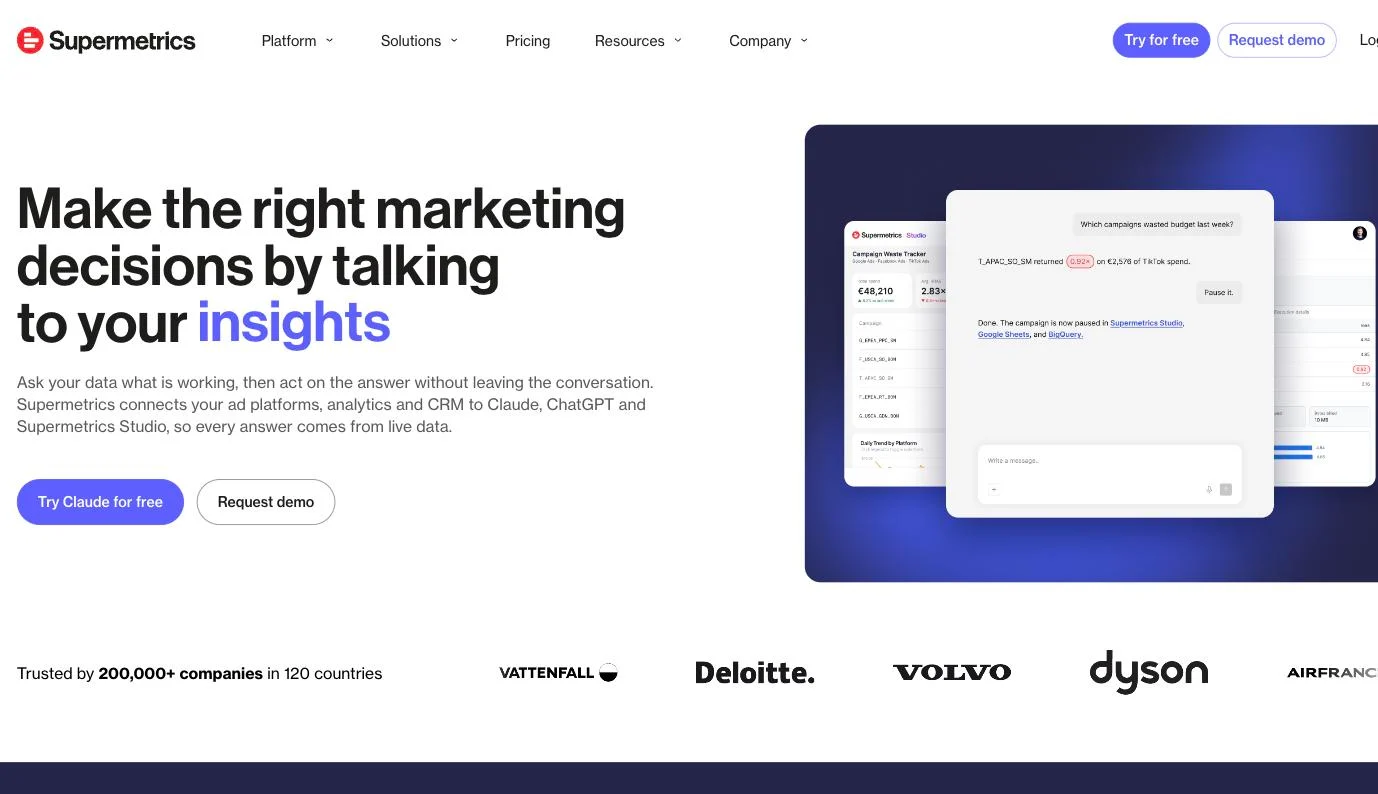
Supermetrics homepage presenting its marketing data connectors and AI chat for marketing data

Supermetrics is a marketing data connector. It pulls ad, analytics and store data into AI chats, spreadsheets, BI tools and its own Studio dashboards, and on Enterprise into data warehouses. It mostly moves data without keeping it, and Supermetrics Storage, its managed store, is Enterprise-only. Campaign Management lets users change bids and budgets, pause ads and launch campaigns from a chat, while attribution and modeling are left to partners.

Key features

▪Ad, analytics and store connectors. Shopify, WooCommerce, Amazon Seller Central, Shopware, Adobe Commerce, BigCommerce and TikTok Shop among 150+ online sources.
▪Destinations by plan. Starter and Growth get one AI chat plus Looker Studio, Google Sheets, Excel and Power BI; Enterprise adds BigQuery, Snowflake and other warehouses.
▪Campaign Management. Bid, budget and campaign changes on Google Ads, Meta, Microsoft Ads, TikTok, LinkedIn, Snapchat and ChatGPT Ads, with approval modes and a change log.
▪Conversion Uploader. A separate free Google Sheets add-on that uploads conversions to Meta's and LinkedIn's Conversion APIs.

Strengths

Self-serve at a low entry price. Setup takes minutes without IT.
Campaign edits from the chat, with every change logged.
EU processing on AWS and GCP servers, with a DPA in the terms.

Limitations

No attribution. Reports carry each platform's own numbers, with no pixel, server-side tracking or model.
No profit layer. No COGS, shipping, fees, returns, contribution margin or POAS.
Conversion pushback through Sheets only, for Meta and LinkedIn.
No budget automation. Every change starts with a prompt.
Warehousing is Enterprise-only, along with Storage, Transformations and the API.

Pricing

Starter costs $55/month, or $44/month billed yearly, for 3 sources and 1 user. Growth is $222, or $177 billed yearly, for 6 sources and 2 users, and Enterprise is quoted. The bill follows sources, accounts, users and destinations. There's a 14-day trial with no card and no free plan. The Shopify App Store listing shows different plans, with Starter at $37/month and a Pro plan at $499/month that the website doesn't list.

Reviews

Supermetrics scores 4.4 on G2 and 4.3 on Capterra. Reviewers praise ease of use and the hours saved on manual reporting, and complain about cost as accounts add up and about connections that drop or need re-authenticating.

Bottom line

Supermetrics suits marketers and agencies that build reports in Sheets, Looker Studio or an AI chat and want to adjust campaigns from there. It stops at platform-reported numbers. There's no attribution of its own and no product cost, and conversions go back only through a Sheets add-on.

Windsor.ai

★4.4

Best for: analysts and agencies that want a self-serve connector tool piping ad and store data into Sheets, BI tools, warehouses and AI assistants.
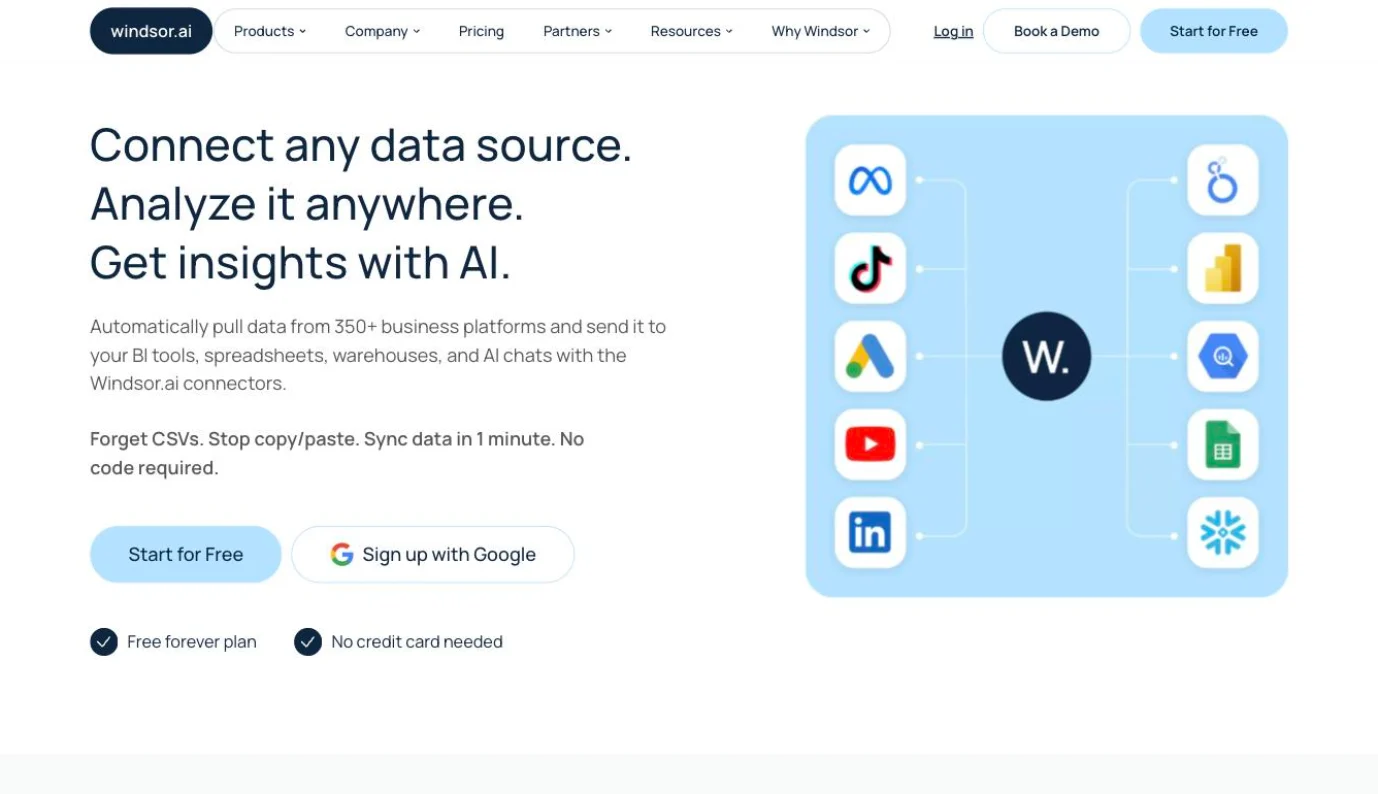
Windsor.ai homepage presenting its no-code marketing data connectors

Windsor.ai is a no-code data integration tool from Switzerland. It pulls from 350+ sources, maps and blends the fields and delivers them to spreadsheets, BI tools, warehouses or an AI assistant through Windsor MCP, which can also pause campaigns and set budgets when someone asks. Windsor moves and caches the data instead of storing it.

Key features

▪350+ sources. Shopify, Amazon, WooCommerce, Magento, BigCommerce and Stripe next to the ad platforms, with custom connectors on Enterprise.
▪Destinations from Sheets to warehouses. Google Sheets, Looker Studio, Power BI, BigQuery, Snowflake and more, with field mapping, blending and custom SQL on the way.
▪Windsor MCP on every plan. AI assistants read the data and can pause ads or set budgets on Meta, Google, TikTok, LinkedIn and Microsoft Ads, with a confirmation step before spend goes up.
▪Attribution connector. Multi-touch attributed conversions and revenue in Looker Studio, built on a Google Analytics account.

Strengths

Live in minutes. OAuth connections and a three-step setup.
Every connector on every plan. Price follows sources and accounts, and users are unlimited from Basic.
SOC 2 Type II. Audited, with encryption at rest and in transit.

Limitations

No storage of its own. Data is only cached, and cancelling a paid plan deletes the history pulled in.
No first-party tracking. Attribution reads Google Analytics data instead of a pixel matched to store orders.
No profit layer. No contribution margin or POAS by campaign.
No conversions sent back to the ad platforms. No CAPI or conversion upload.
No budget automation. Budgets change only when someone asks the assistant.

Pricing

Basic costs $19 a month billed annually ($23 monthly), Standard $99, Plus $249 and Professional $499, with Enterprise quoted. Billing runs on data sources and accounts, and all sales are final. A new account gets 30 days free, then drops to a Forever Free plan with one source.

Reviews

Windsor.ai scores 4.4 on G2. Reviewers praise the ease of use and the hours saved on manual reporting, and complain about connector issues that delay fresh data and about billing.

Bottom line

Windsor.ai suits analysts and agencies that need ad and store data in Sheets or a warehouse without building pipelines. It stops at moving the data: no tracking of its own, no contribution margin and no conversions sent back to the ad platforms.

Daasity

★4.7

Best for: multimillion-dollar consumer brands selling through DTC, Amazon, retail and wholesale that want one managed warehouse with prebuilt data models and Looker dashboards.
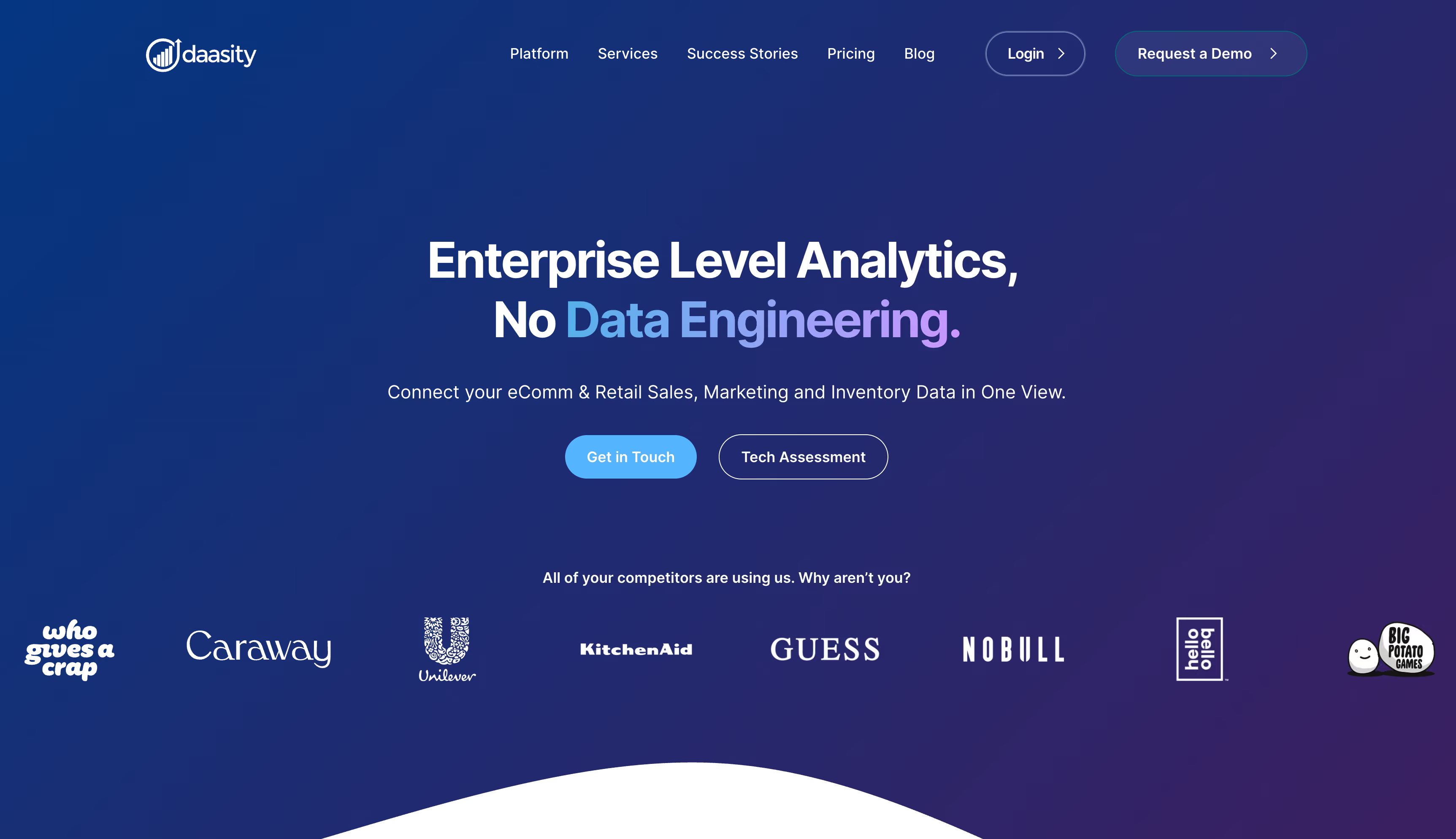
Daasity homepage presenting its managed ELT, warehouse and analytics platform for consumer brands

Daasity is managed ELT, warehouse, data models and BI for omnichannel consumer brands. Extractors replicate each source into Daasity's warehouse (or the brand's own Snowflake), prebuilt models unify the schemas and Looker-based dashboards sit on top. Attribution comes from Google Analytics, surveys and discount codes, and the only ad-platform output is audiences.

Key features

▪Managed warehouse. A replica of every source in Snowflake, BigQuery or Redshift, refreshed daily by default and up to hourly.
▪Commerce and ad sources. Shopify, BigCommerce, Magento, Salesforce Commerce Cloud, Walmart Marketplace and Amazon, plus Meta, Google Ads, TikTok and other ad platforms.
▪Contribution margin in the model. Net sales minus COGS and variable costs such as shipping and transaction fees.
▪Eight attribution models. Survey-based, discount code, GA first and last click, assisted, last ad click, custom waterfall and vendor-reported.
▪Audiences and MCP. Reverse ETL audiences to Meta, Google, TikTok and Klaviyo, and an MCP server for ChatGPT and Claude.

Strengths

One set of metric definitions. DTC, Amazon, retail and subscription data report the same way.
Prebuilt LTV, cohort and retention models. With SQL and Snowflake access underneath.
Contribution margin from day one. Essentials ships with it.

Limitations

No first-party tracking. Attribution leans on GA, surveys, discount codes and the platforms' own numbers.
No conversions sent back to the ad platforms. The Meta target is a Custom Audience; there's no CAPI.
No budget automation. Dashboards and audience syncs only.
Shipping as averages. Shipping and fulfillment enter as one average cost each.
US-hosted. Daasity runs on AWS in US West (Oregon).

Pricing

Starter Essentials costs $1,499 a month, Essentials $1,999 and Enterprise is custom. The Shopify App Store listing shows $1,899 a month instead, plus usage charges based on a rolling three-month average of revenue. There's a free 14-day trial with a business email and no free plan.

Reviews

Daasity scores 4.7 on G2 and 4.6 on the Shopify App Store. Reviewers value one source of truth across Shopify, Amazon and subscriptions and helpful strategists, while others describe a steep learning curve for non-technical users.

Bottom line

Daasity suits consumer brands with retail, wholesale and Amazon revenue next to DTC, and an analyst who'll work in Looker and SQL. It stops at reporting: attribution rests on GA and surveys, conversions don't go back to the ad platforms and budgets move by hand.

Polar Analytics

★4.9

Best for: Shopify brands that want BI on a dedicated Snowflake database, with pre-built ecommerce metrics, custom dashboards and AI agents in Slack.
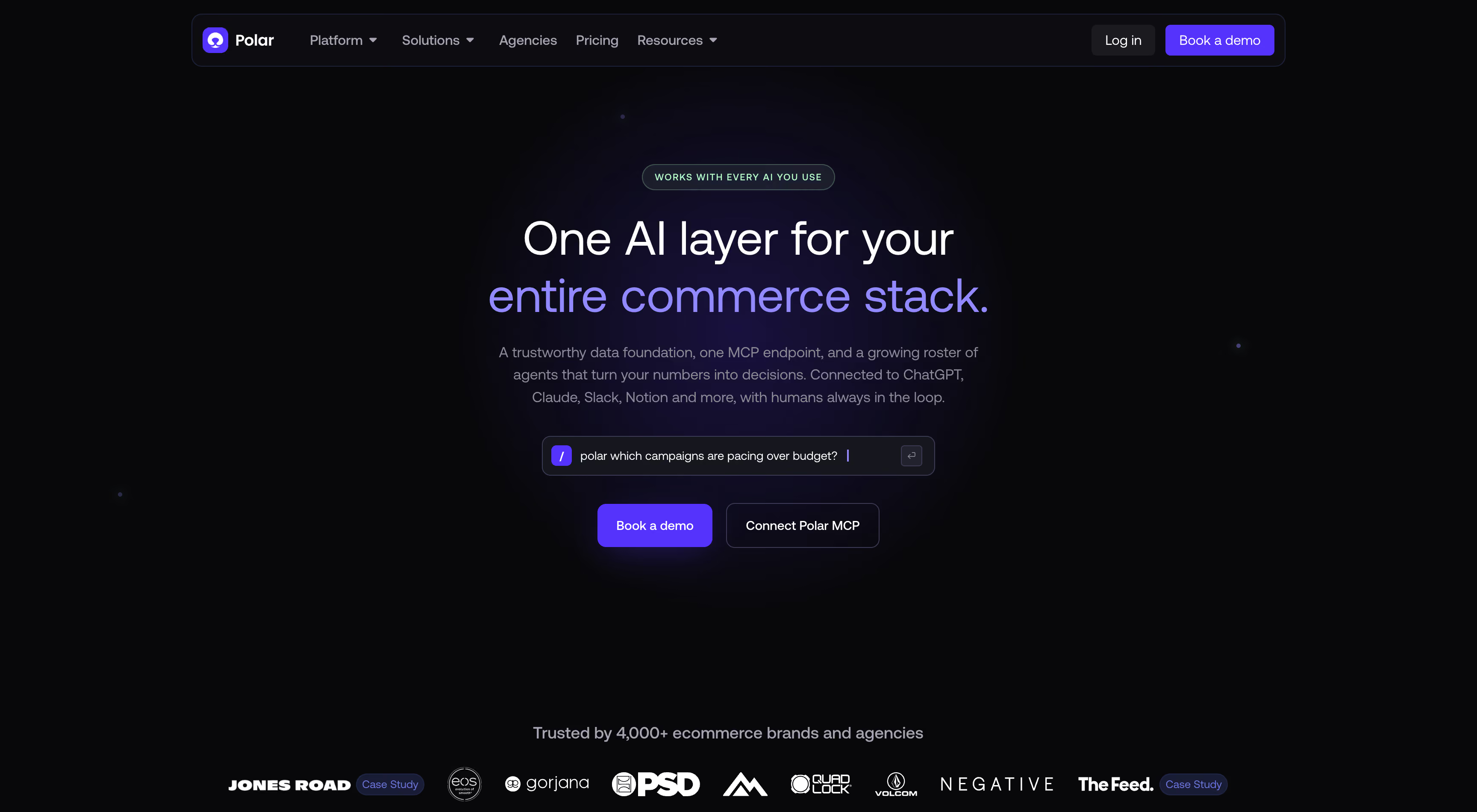
Polar Analytics homepage presenting its Shopify data stack and margin reporting platform

Polar Analytics is Shopify-first ecommerce BI. Each brand gets its own Snowflake database on AWS with a semantic layer of 400+ metrics on top, a first-party pixel feeds nine attribution models, geo-lift tests run with a Polar data scientist, and Polar Operator proposes budget shifts and pauses in Slack that wait for approval.

Key features

▪Dedicated Snowflake database. Included on every plan, with SQL access and Google Sheets mirroring as BI add-ons.
▪Ecommerce semantic layer. 400+ pre-built metrics plus custom ones, fed by one-click Shopify, Amazon and NetSuite.
▪Polar Pixel. First-party with a lifetime ID across devices, collected through Shopify's App Pixel.
▪Causal Lift tests. Geo-lift incrementality on Meta, Google, TikTok or TV, priced per test or quarterly.
▪Advertising Signals. Conversions sent to Meta and Google server-to-server, priced separately.
▪Polar Operator. A Slack agent that shifts ad budgets and pauses ads once you approve.

Strengths

A warehouse without building one. A dedicated Snowflake database per brand.
Contribution margin by product and channel. Pre-computed from net sales, COGS, shipping, ad spend and agency fees.
Custom dashboards. Reviewers find them easy to build.

Limitations

US-hosted by default. EU hosting is available on request.
Conversions go back to Meta and Google only. Advertising Signals sits outside the Core plan.
No budget automation. Every Operator action outside Polar waits for human confirmation, in Slack only.
Shopify and Amazon as native store sources. Custom connectors are a BI add-on.

Pricing

Core and Custom plans are sold through a demo and priced on annual GMV. On the Shopify App Store, Core starts at $750 a month, billed every 30 days, with discounts for annual terms. A help-center article still lists tiers from $300. There's no free plan.

Reviews

Polar Analytics scores 4.9 on the Shopify App Store and 4.7 on G2. Reviewers praise easy custom dashboards and having store, ad and email data in one place, and the complaints center on connector breakages and data latency.

Bottom line

Polar suits Shopify brands that want a BI stack on their own Snowflake and build their own dashboards. It stops short of budget automation: the Operator waits for approval on every change, conversions go back to Meta and Google only, and data sits in the US unless you ask for the EU.
Compare to Admetrics →

SegmentStream

★4.7

Best for: marketing teams and agencies that want geo-holdout tests and predicted LTV feeding one-click budget reallocation, set up by SegmentStream's experts.
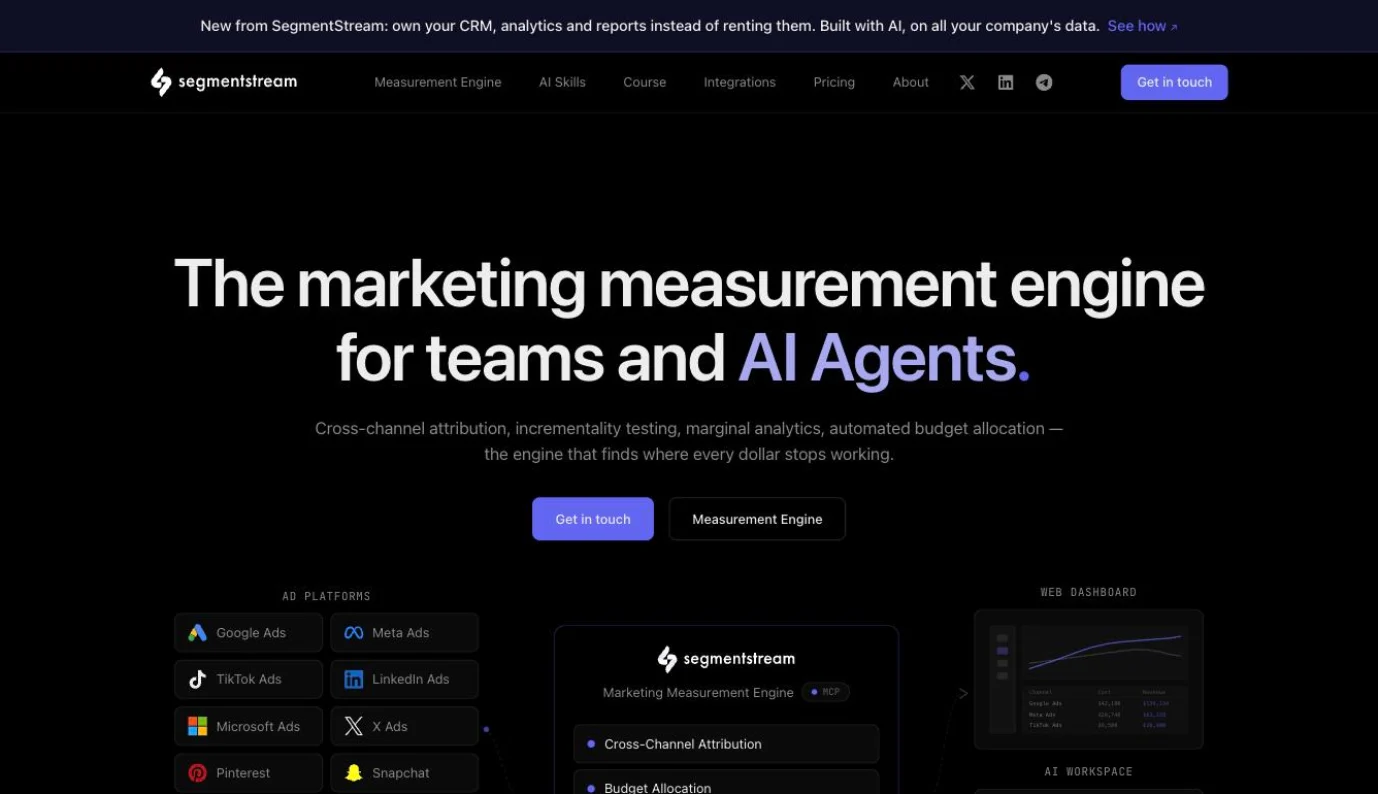
SegmentStream homepage presenting its marketing measurement engine and budget allocation

SegmentStream is a marketing measurement engine. Events arrive through a first-party endpoint on your domain, an identity graph stitches users across devices, and geo-holdout tests measure what each channel adds, while Marginal Analytics turns diminishing-returns curves into budget recommendations that execute in one click. Data lives in an isolated Google Cloud dataset in the EU or US, or in your own BigQuery.

Key features

▪First-party endpoint and identity graph. Deterministic stitching across devices and touchpoints.
▪Cross-channel attribution. First-click with predictive conversion maturation, plus survey-based re-attribution and CRM funnel attribution.
▪Geo-holdout experiments. Synthetic control groups with A/A validation.
▪Predicted LTV. A 12-month LTV sent to Google, Meta and TikTok through CAPI as weighted conversion values.
▪Automated Budget Allocation. Reallocation recommendations and scenario planning, executed in one click across ad platforms.

Strengths

Incrementality next to attribution. Geo-holdout tests check what the model credits.
One-click budget reallocation. Recommendations execute across ad platforms, with prediction accuracy tracked.
Managed onboarding. A dedicated expert handles setup, and ongoing consulting is included.
Choice of data region. EU or US on Google Cloud, or your own BigQuery.

Limitations

No profit layer. No COGS, contribution margin or POAS reach the budget recommendations.
Conversion pushback is partly yours. Predicted LTV goes to Meta, Google and TikTok, while each platform's server-side endpoint is meant to run from a pipeline the customer owns.
Store data from Shopify and Stripe. Other stores come in through custom connectors, Sheets or webhooks.
Built for measurement. Its 79 integrations feed attribution and budget models, with no general ETL for the rest of a team's reporting.

Pricing

There are no public prices. Each engagement is scoped after discovery and priced per project with no seat cap, scaling with channels, data volume and expert time. Every engagement includes the full platform.

Reviews

SegmentStream scores 4.7 on G2. Reviewers call the team helpful and like the integrations, and the few complaints mention connection issues and a learning curve.

Bottom line

SegmentStream suits marketing teams that want modeled attribution and incrementality tests to drive budget reallocation, with experts running the setup. It stops before profit: no product costs or margin reach the recommendations, and store data covers Shopify and Stripe.
Compare to Admetrics →

Best Adverity alternative: final verdict

Admetrics is the best Adverity alternative for ecommerce brands that want their marketing data to show which campaigns made money. It covers the part of Adverity's job an ecommerce team needs: ad spend, orders, costs and customers are connected without a developer, stored for you in the EU with one definition per metric, and sent on to your warehouse, Google Sheets, the Data API and AI tools through MCP. Then it does the work Adverity leaves to your data team: first-party, server-side tracking tied to real shop orders, conversions sent back to six ad platforms server-to-server, attribution on your own order data, contribution margin and POAS by campaign down to the SKU, and Ad Pilot moving Meta budgets inside the caps you set.

Prices are published, from $399/month with data storage included, and Ad Pilot is an add-on from the $899 Business plan. Start the 21-day trial on your own orders, with no card needed, and put the contribution margin per campaign next to the numbers in your current reports. Where the two disagree is where your budget needs a second look.

Book a demo