Mission control
for e‑commerceFrom independent measurement to governed allocation. One closed loop, open to your entire stack.See how the system works →
Most ad tracking software stops once the conversion reaches the ad platforms. We compared 11 tools on tracking, attribution, profit and what happens next.
Silvana Chirita·Updated October 29, 2026·24 min read
Ad tracking software records which ad brought each visitor and order, then sends those conversions back to Meta, Google and TikTok so their bidding learns from real purchases. Most tools stop there. Channel credit, profit per campaign and budget changes are left to the ad platforms' own reports, a spreadsheet and the media buyer.
This list compares 11 ad tracking tools, from click and affiliate trackers to Shopify apps and attribution platforms, on tracking accuracy, data foundation, profit and what happens once the conversion reaches the ad platforms.
Key Takeaways
Admetrics is the best ad tracking software for ecommerce brands that judge ads on profit. First-party tracking, conversions sent back to the ad platforms server-to-server, multi-touch attribution, contribution margin down to the SKU and budget automation run on one set of order data, from $399/month.
Most ad tracking tools stop once the conversion reaches the ad platforms. Their reports run on revenue, ROAS and the credit each platform gives itself, which can include view-through and modeled conversions. A campaign can look profitable there and still lose money after product costs and returns.
Only four tools report product costs, and only one reports contribution margin. The others report on revenue, which credits a campaign selling discounted, often-returned products as highly as one selling full-price bestsellers. Admetrics reports CM2, CM3 and POAS by campaign, down to the SKU.
Only four tools have budget or campaign automation. In the other seven, every pause and budget move is made or approved by hand. Admetrics' Ad Pilot moves Meta budgets toward a CAC, POAS or new-customer ROAS target.
Three tools attribute on last click only. wetracked, Voluum and TrackBee give the whole order to the final click, which hands branded search the credit for the TikTok ad that started the journey. Admetrics compares several attribution models on its own order data.
How we ranked the tools
We scored every tool on four criteria. Prices and features are as of October 2026.
▪Attribution and tracking accuracy. How the click is captured (redirect, pixel, server-side collection, a first-party domain), whether conversions are matched to real store orders, and whether attribution goes beyond last click.
▪Data foundation. Which store platforms connect, Shopify ad tracking included but also custom stores, where the data is hosted, and whether it can leave through an API or MCP.
▪Profit over revenue. Whether product cost, shipping, payment fees and returns reach campaign reports, or the tool stops at revenue and ROAS.
▪What happens after the conversion is tracked. Whether conversions go back to the ad platforms server-to-server, and whether anything pauses ads or moves budget inside limits you set.
Ad tracking software compared
#
PLATFORM
ATTRIBUTION
PROFIT CONTROL
S2S PUSHBACK
ACTION
1
Admetrics
Multi-touch + PRISMA mix model
CM2, CM3, POAS to SKU
Yes, 7 platforms (paid add-on)
Budget Optimizer, Ad Pilot
2
Hyros
Custom models, windows to 1 year
COGS, profit per ad
Meta, Google, TikTok
AI assistant, applies on approval
3
RedTrack
Multi-touch on Brand, Agency
No
Yes, 8+ platforms
Stop Rules; Scale Rules add-on
4
wetracked
Last click, UTM-based
No
Yes, 6 platforms
No
5
Cometly
8 models incl. custom
No
Yes, 7 platforms
Manual and bulk controls
6
AnyTrack
First or last click
No
Yes, 7 platforms (paid plans)
No
7
Triple Whale
7 models; Compass MMM add-on
Net profit, no CM
Yes, Sonar, 8 platforms
Moby Actions on Automate
8
Voluum
Last click
Revenue minus ad cost
Meta, Google, Microsoft, TikTok (plan-dependent)
Automizer: pause, bids, lists
9
Northbeam
7 models; MMM add-on
COGS-based targets only
Meta, AppLovin, Snap (beta)
No
10
TrackBee
Last click
Profit value to Meta
Yes, 8 platforms
No
11
ClickMagick
Last click plus 3 multi-touch
COGS, net profit, ROI
Meta and Google
No
Admetrics
★5.0
Best for: ecommerce and DTC brands advertising across Meta, Google and TikTok that want ad tracking, attribution, contribution margin and budget moves on the same order data.
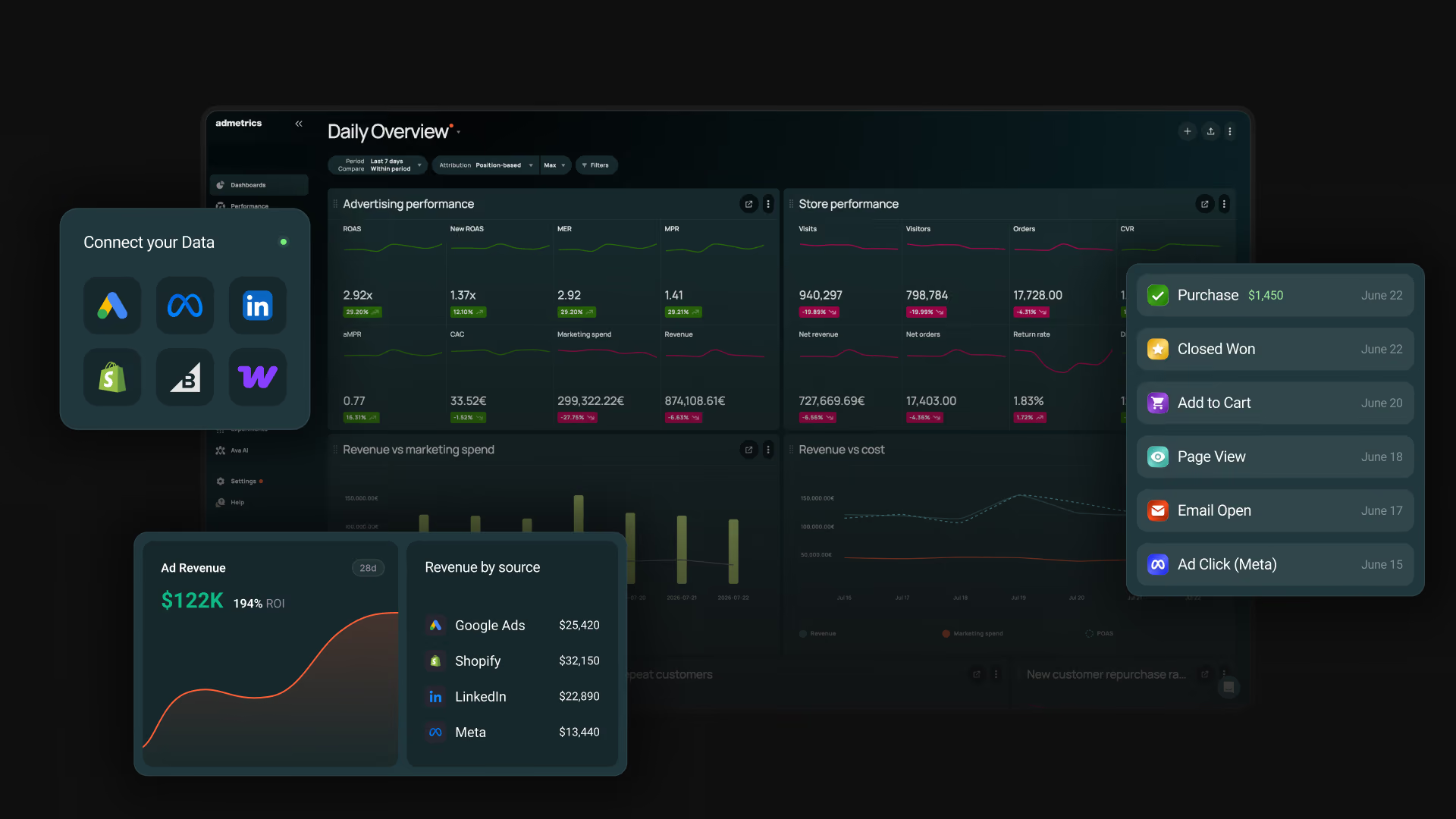
Admetrics is a measurement and budget allocation platform. Every click and order is tracked first-party and matched to the real shop order, conversions go back to the ad platforms server-to-server, Admetrics' own attribution credits the channels, contribution margin prices each campaign, and budget moves toward the campaigns that earned it. The ROAS a media buyer reads and the CM3 a founder reads come from the same purchases.
Key features
▪Tracking. First-party, server-side tracking on your own domain stitches sessions and devices into one journey and anchors it to a real shop order, with the visitor's consent state on every event.
▪Conversion Signals. Conversions sent back server-to-server to Meta, Google, TikTok and other ad platforms, deduplicated against the browser pixel.
▪Multi-Touch Attribution. Attribution models side by side on your own order data, with Admetrics numbers shown inside the Meta, Google and TikTok ad managers through the Chrome extension. The PRISMA marketing mix model is a Custom-plan add-on.
▪Profit Intelligence. CM2, CM3 and POAS by campaign and product, down to the SKU, with COGS, shipping, payment fees and returns per order.
▪Budget Optimizer and Ad Pilot. Budget Optimizer proposes budget moves across channels. Ad Pilot adjusts Meta budgets inside the caps you set and logs every move.
Strengths
Single source of truth. Tracking, attribution, profit and budget moves read the same order data, with no second dataset to reconcile before a budget call.
Contribution margin per campaign and SKU. Profit Intelligence shows which campaigns and products made money after product cost, shipping, fees and returns.
Independent attribution next to the platforms' numbers. Multi-Touch Attribution credits each channel with Admetrics' own model, and the Chrome extension puts that number inside Ads Manager.
Budget automation on Meta. Ad Pilot moves Meta budgets toward a CAC, POAS or new-customer ROAS target, with every change logged.
EU data hosting. Data is processed and stored in the EU, with a DPA and records of processing.
Limitations
S2S pushback is a paid add-on on every plan.
Ad Pilot executes on Meta only. Google and TikTok budgets don't change automatically.
No call tracking. Sales that close on the phone don't tie back to the ad.
Pricing
Growth: $399/month, including the first $20,000 of monthly ad spend, then 1.5% above that. Business: $899/month, including $70,000, then 1% above. Ad Pilot is an add-on from this plan. Custom: quoted, for brands spending more than $100,000 a month. PRISMA and Budget Optimizer are add-ons here. Annual billing saves 15%, and the 21-day free trial needs no card.
Reviews
Admetrics holds 5.0 on the Shopify App Store and 4.8 on G2. Reviewers point to the onboarding help and reports that are easy to read.
Bottom line
A click tracker or a Shopify CAPI app is the cheaper way to get more conversions into the ad platforms. Admetrics is for the brand that also needs to know which campaigns made money after costs and wants budget to follow that answer, all from one set of order data.
Best for: info-product, coaching and call-based businesses whose sales close days or weeks after the first click, often on the phone.
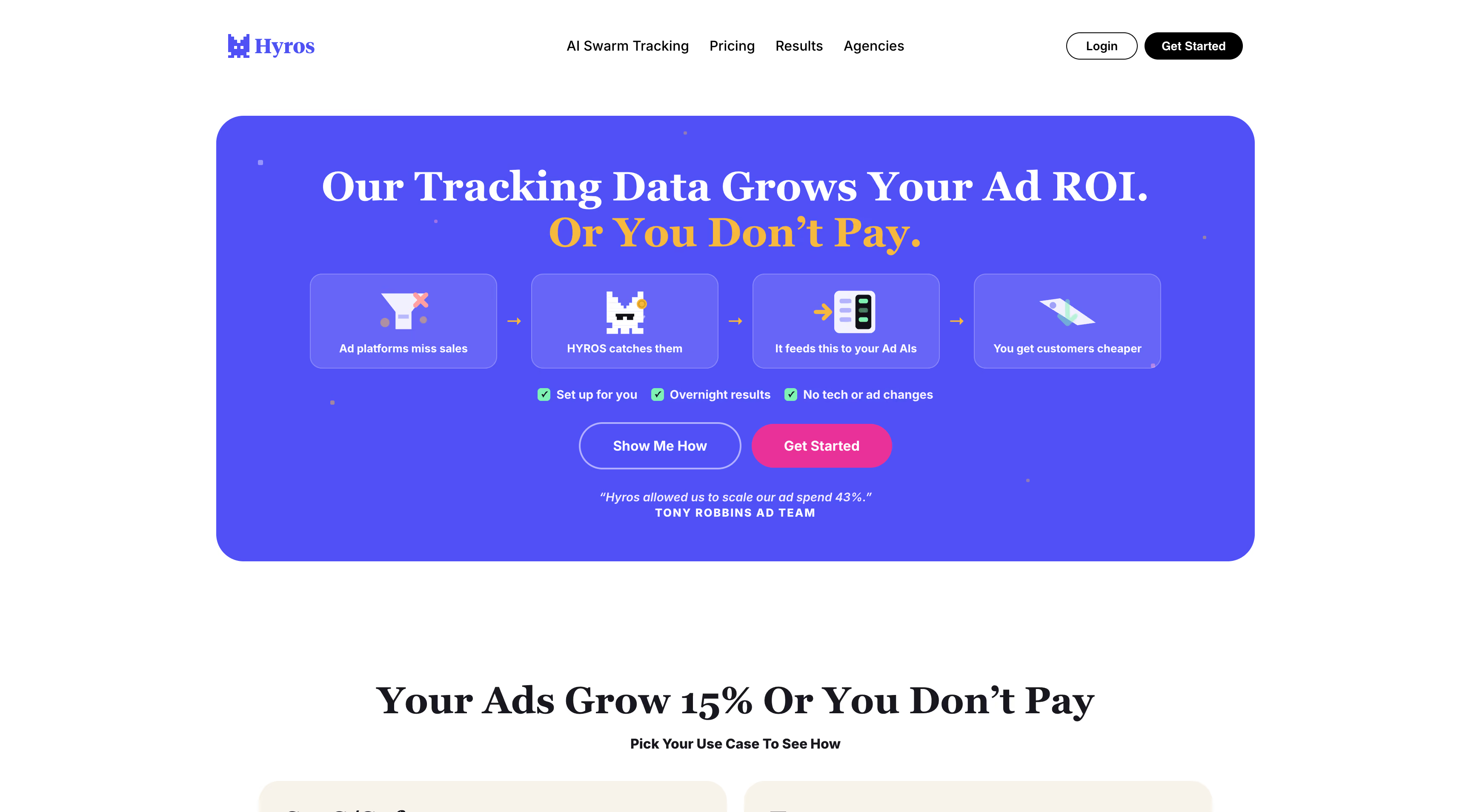
Hyros tracks each buyer first-party across visits and devices, takes in sales server-side from checkouts and CRMs, and sends verified conversions back to Meta, Google and TikTok. Attribution follows a buyer for up to a year, cost of goods reaches the reports, and a newer AI assistant applies ad changes once someone approves them.
Key features
▪Print Tracking. Server-side, first-party tracking that builds one profile per buyer.
▪Verified conversions to the platforms. Meta's Conversions API, Google offline conversions and TikTok's Events API.
▪Custom models, long windows. Credit splits your way over journeys of up to a year, with LTV cohorts per ad.
▪Call tracking. Booked calls and closed deals tie back to the ad through Calendly, CallRail, iClosed and HubSpot.
▪COGS and profit per ad. Product costs sit next to ad spend for a "true profit" figure.
Strengths
The long, offline sale. A deal closed on a call two weeks later still ties back to the ad that started it.
Setup done with you. Every plan includes a setup team and an account AI analyst.
Limitations
No contribution margin. Profit stops at cost of goods, with no CM2, CM3 or POAS by campaign.
No budget automation. The assistant proposes changes and applies them after approval, and no rule moves spend by itself.
US-hosted. Servers and data centers are in the United States.
Pricing
The main pricing page shows one plan, "Quoted on your call", sized by tracked monthly revenue. Other Hyros pages conflict with it and with each other: one still lists $69 a month, the Shopify page says from $199, and Hyros's AI summary file gives $230 on annual billing. There's a 90-day money-back guarantee and no free plan or trial.
Reviews
Hyros scores 4.9 on Trustpilot and has no G2 score. Reviewers keep naming the analysts who helped them, and the main complaint is an interface that takes a while to learn.
Bottom line
Hyros suits funnels, high-ticket offers and sales that close on the phone, where a deal has to tie back to an ad weeks later. It stops at cost of goods. There's no contribution margin by campaign and no budget automation.
Best for: affiliate media buyers and agencies running paid traffic across many networks, and stores that want free CAPI for a single shop.
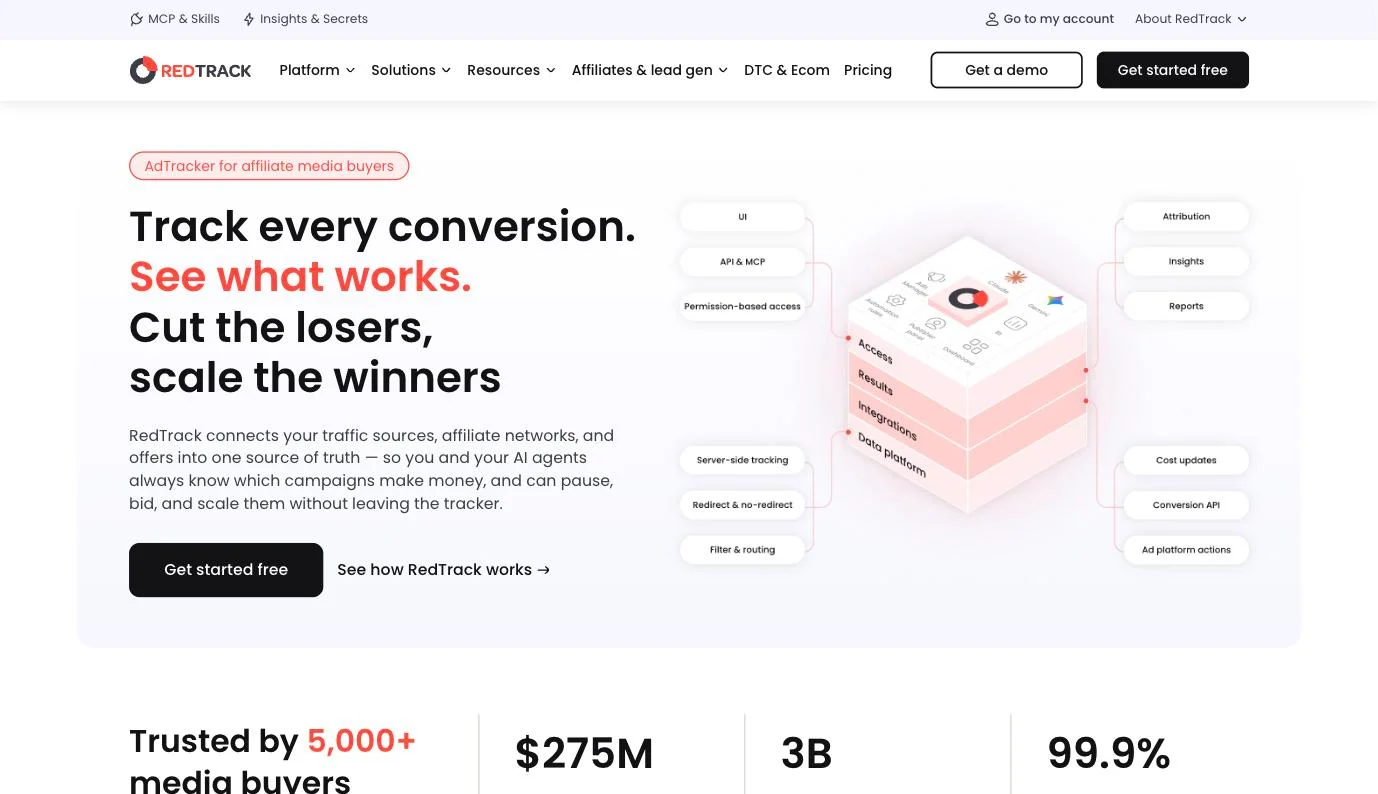
RedTrack began as an ad tracker for affiliates and now sells a second line to DTC brands. It tracks with redirects or directly on your own domain, sends conversions to eight platforms through native CAPI, and pauses ads or raises budgets by rule. Attribution is last click on the free Relay plan and multi-touch from Brand. Product costs and margin aren't part of it.
Key features
▪Two ways to track. Redirect links for affiliate offers, or direct tracking on your own domain, with S2S postbacks carrying conversions.
▪Native CAPI. Meta, Google, TikTok, Snapchat, Microsoft, X, Pinterest and OpenAI Ads, plus S2S postbacks to Taboola, Outbrain and other networks.
▪Multi-touch on Brand and Agency. First-touch, last-touch, linear and U-shaped, with a report that sets models side by side.
▪Rules on spend. Stop Rules pause ads at set thresholds on every paid plan; Scale Rules raise budgets on winners.
▪Order sync. A Shopify app, plus API sync for WooCommerce, BigCommerce, Magento/Adobe Commerce, PrestaShop and CartPanda.
Strengths
It acts on spend. A Stop Rule can pause a losing ad at 3 a.m. without anyone opening Meta Ads Manager.
EEA servers. RedTrack, a Cyprus company, stores personal data on servers in the European Economic Area.
Limitations
No contribution margin. Reports run on ROAS, CAC and LTV, with no product costs, margin or POAS.
Last click only on Relay. The free plan has no attribution modeling.
Budget scaling costs extra. Outside Affiliates Enterprise, Scale Rules and Ads Manager are paid add-ons.
Pricing
Relay is the free ad tracker here: one store, one user, last click and CAPI. At the $250K tracked-revenue tier, Brand costs $99 a month and Agency $599. The affiliate line starts with Solo at $169 a month. A Black Friday offer takes 30% off annual plans, and paid plans come with a 14-day trial.
Reviews
RedTrack scores 4.5 on G2. Reviewers credit quick support and good value next to pricier trackers, and several call the dashboard and setup complex.
Bottom line
RedTrack suits affiliate buyers and agencies running many traffic sources, and stores that want CAPI on a small budget. Its reports stop at ROAS, CAC and LTV. Product costs and contribution margin aren't in them.
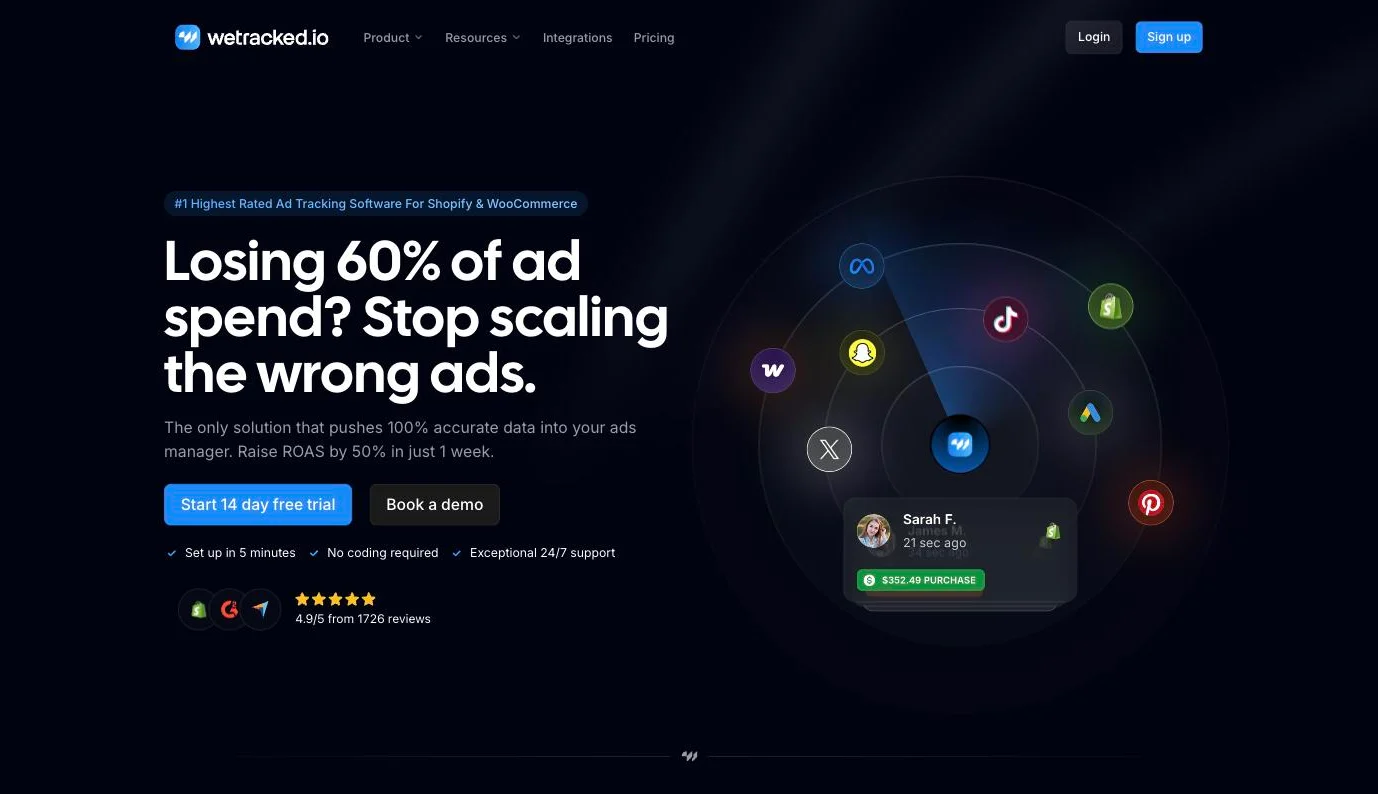
wetracked
★4.9
Best for: Shopify and WooCommerce stores that want server-side purchase events in Meta and TikTok this week, priced by order volume.
wetracked is a Shopify ad tracking app. It catches events server-side, recognizes returning visitors through a digital fingerprint and sends purchases back through each platform's conversion API in real time. The in-app report is last click on UTM parameters, and there's no profit reporting or budget automation.
Key features
▪Server-side tracking with a fingerprint. First-party events that get past ad blockers and match returning visitors.
▪Six CAPI destinations. Meta, TikTok, Google Ads, Snapchat, Pinterest and X.
▪Funnel checkouts. Shopify and WooCommerce, plus Funnelish, Checkify, CheckoutChamp, BetterCart, UnifyCheckout and Sticky.io.
▪Klaviyo Revenue Booster. Tracked events feed Klaviyo as well as the ad platforms.
▪Pulse Dashboard and Creative Analytics. Newer views of which campaigns to scale, with Creative Analytics still in beta.
▪No caps on spend or pixels. Every plan includes unlimited ad spend, revenue and pixels.
Strengths
Support that answers in minutes. Fast replies, close to round the clock, are the most common praise in reviews.
Quick install. A free Shopify connector app and no code, followed by a check of each store by the wetracked team.
Price follows orders. A bigger ad budget doesn't push you up a tier.
Limitations
Last click only. The UTM-based report is the only attribution.
No profit metrics. No COGS, contribution margin or POAS.
No budget automation. Spend changes happen by hand in each ad account.
US processing. Data is transferred to the United States and processed there.
Pricing
Starter costs $49 a month, or $39.20 billed annually, for up to 500 orders and three stores. Business is $149 (3,000 orders) and Scale-up $249 (7,500), with Enterprise quoted above that. There's a 14-day trial and no free plan.
Reviews
wetracked scores 4.9 on G2. Fast support dominates the praise, and price is the most frequent complaint.
Bottom line
wetracked suits a Shopify or WooCommerce store that mostly needs purchases back in Meta and TikTok. It stops there: last-click UTMs can't show which channel brought a profitable customer.
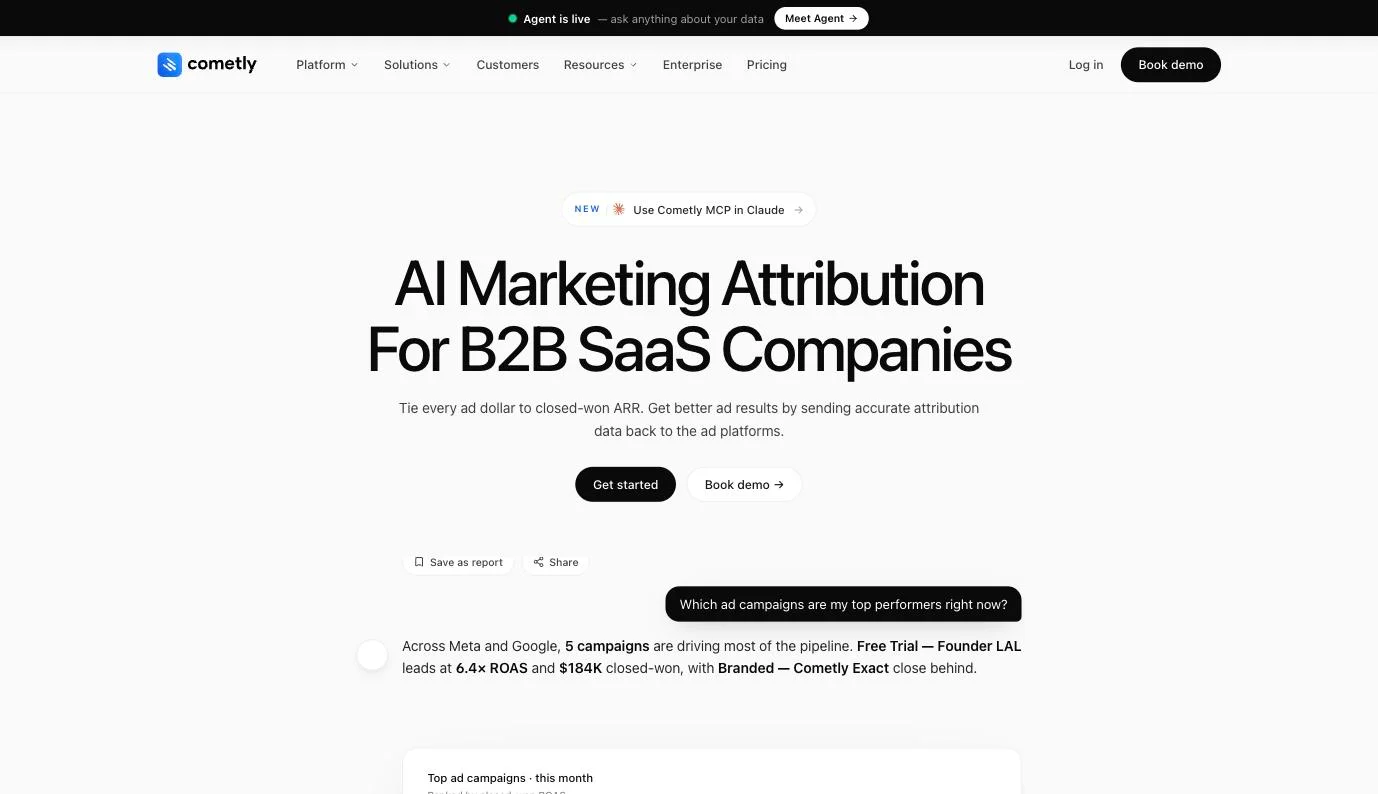
Cometly
★4.8
Best for: B2B SaaS and lead-generation teams that attribute pipeline and revenue from a CRM and Stripe.
Cometly is a marketing attribution platform built for B2B SaaS and lead businesses. It tracks with a first-party server-side pixel, sends conversions to seven ad platforms and offers eight attribution models, with budget and pause controls a person triggers inside Cometly. There's no product cost or margin in the model.
Key features
▪First-party server-side pixel. A one-line install built to hold up against ad blockers and Safari's tracking limits.
▪CAPI on both plans. Meta, Google, LinkedIn, TikTok, Microsoft, Reddit and Snapchat.
▪Eight attribution models. From first-touch and U-shaped to full-path and custom, with windows from one day to lifetime.
▪CRM revenue attribution. HubSpot, Salesforce, Pipedrive, Close and Attio, with Stripe and Chargebee feeding MRR and ARR reports.
▪Ads Manager. Change budgets, pause losers and scale winners in bulk by ROAS threshold across Meta, TikTok and other networks.
Strengths
Pipeline-grade attribution. A closed deal in the CRM traces back through the booked meeting to the ad.
Bulk budget changes in one screen. Pausing everything under a ROAS line takes one move across several networks.
Limitations
No product costs. No COGS, SKU analytics or contribution margin.
No budget automation. Moves are manual or bulk, AI suggestions wait for a click, and Google Ads gets tracking only.
US-hosted. Data sits in US regions on Laravel Cloud, AWS and SingleStore.
Shopify through a webhook. The App Store app is unavailable, and Shopify orders without an email can't be tracked.
Pricing
The pricing page shows two plans, Core and Enterprise, and no dollar figures. Both are sized on monthly pageviews, annual billing saves 20%, and there's no annual commitment. There's no free plan and no trial.
Reviews
Cometly scores 4.8 on G2. Reviewers say its numbers beat Meta's own reporting and praise hands-on support, while others describe a long setup and tracking that broke after changes.
Bottom line
Cometly suits SaaS and lead businesses that close through a CRM. For a store selling products it stops short: there's no cost or margin in the model and no budget automation.
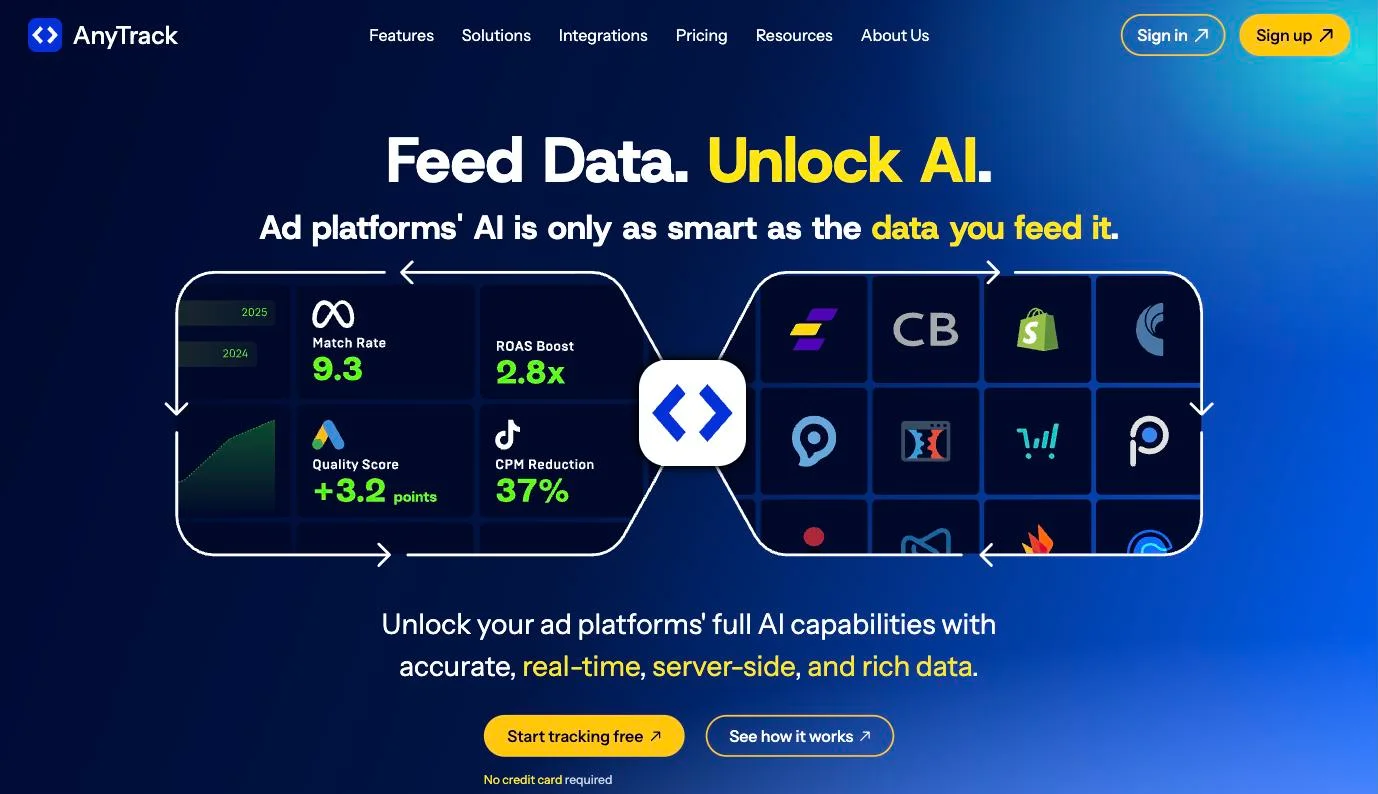
AnyTrack
★3.4
Best for: affiliate marketers, funnel sellers and small stores that want server-side conversions and CAPI pushback at a low published price.
AnyTrack tracks clicks and conversions and sends them back to the ad platforms. A browser tag collects click IDs, page views and form fills, while sales and leads arrive server-side through postbacks, webhooks and APIs on every plan. Paid plans push conversions to seven ad platforms. Attribution is first or last ad click, and the reports never reach profit or budget.
Key features
▪Tag plus server-side postbacks. Click data from the browser joins sales from checkouts, affiliate networks and CRMs.
▪CAPI to seven platforms from Starter. Meta, Google, TikTok, Microsoft, Outbrain, Taboola and ChatGPT Ads.
▪About 91 affiliate networks. Awin, CJ, ClickBank and Impact among them, plus checkouts such as SamCart and ThriveCart.
▪First or last ad click. Switchable in the Campaign Report, with 1-, 7- or 30-day windows editable from Personal up.
▪Setup wizards. AutoTrack and AutoTag put tracking in place without a developer.
Strengths
Built for affiliate and funnel sales. Networks, checkouts and CRMs report sales server-side with no code.
Native Outbrain and Taboola. Native ad buyers get CAPI there too.
No hard stop. Tracking keeps running past the session limit, billed as overage.
Limitations
First or last click only. Windows top out at 30 days and are locked on Free and Starter.
No profit metrics. Reports show spend, revenue, ROAS, CPA and EPC, with no COGS or margin.
No budget automation. Automation covers tracking setup only.
No CAPI on Free. The free plan tracks but sends nothing back to the platforms.
Pricing
The free plan works as a free ad tracker for testing: 5,000 sessions, one property and no CAPI. Starter is $100 a month for 100,000 sessions, Personal $150 and Advance $300, with Custom through sales. Paid plans start with a 14-day trial that needs payment details, and there's no way back to Free afterwards.
Reviews
AnyTrack scores 3.4 on Trustpilot. Reviewers like the easy setup and the price for what it does, and the complaints are about billing disputes and slow support.
Bottom line
AnyTrack suits affiliate and funnel sellers who mostly need conversions back in the ad platforms. A store looking for an AnyTrack alternative usually wants what comes after the pushback: multi-touch attribution, margin per campaign and budget moves, none of which AnyTrack has.
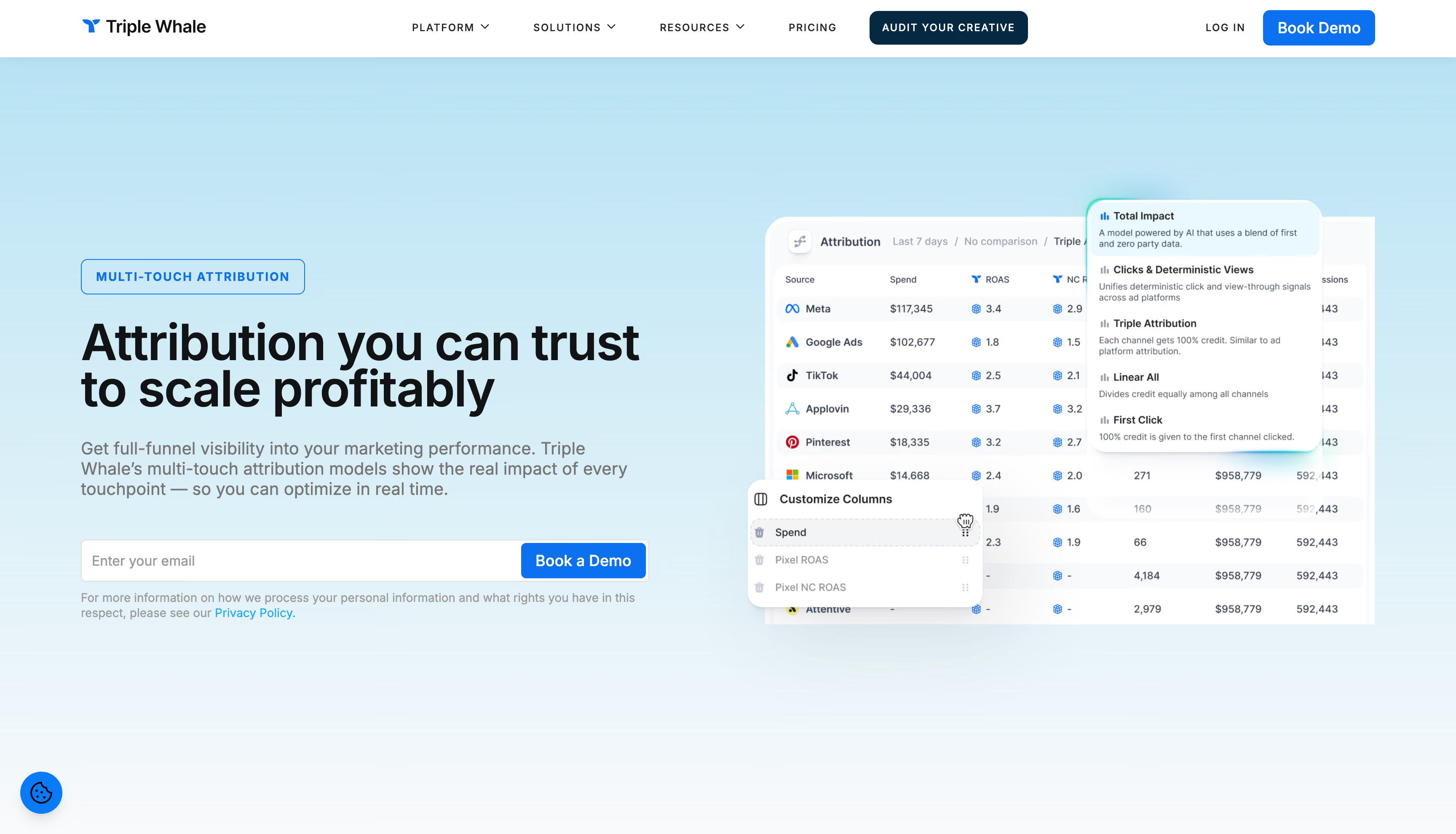
Triple Whale
★4.5
Best for: Shopify brands that want attribution, an AI analyst and automated ad actions in one suite, with a free plan to start.
Triple Whale bundles tracking, server-side sending, attribution and AI actions. Triple Pixel tracks first-party, Sonar Optimize sends enriched events to eight platforms, seven attribution models handle credit, and Moby can pause and scale ads within guardrails on the Automate plan. Profit stops at net profit, with no contribution margin.
Key features
▪Triple Pixel. A first-party pixel that builds an anonymous identity per visitor across sessions and devices.
▪Sonar Optimize. Server-side events to Meta, Google Ads, TikTok, Reddit, X, AppLovin, Realize and ChatGPT Ads.
▪Profit Optimization. A per-order net revenue value, after COGS, shipping and fees, goes to Meta through CAPI.
▪Seven attribution models. Triple Attribution and Total Impact among them, with windows from 1 day to lifetime, plus a Clicks & Views model in beta.
▪Compass. Multi-touch, mix modeling and GeoLift tests in one view, included on Enterprise.
▪Moby Automations and Actions. Workflows that pause, scale or change budgets, with approval settings and limits.
Strengths
Tracking, sending, attribution and AI actions in one product. One vendor covers the pixel, the server-side feed and the attribution models.
Actions with guardrails. Moby can execute budget and status changes in connected ad platforms.
A real free plan. Triple Pixel with first- and last-click attribution, no card needed.
Limitations
No contribution margin. Net profit after COGS, shipping and fees, with no CM2, CM3 or POAS.
Automation from $749. Foundation has no Automations or Actions.
Shopify first. WooCommerce, BigCommerce, headless and custom stores may need a developer, Sonar included.
US-hosted. The sub-processor list puts storage on Google Cloud in the US.
Pricing
The free plan is a free ad tracker with first and last click. Foundation costs $219 a month and Automate $749 a month, with Enterprise quoted. Prices scale with annual GMV on a 12-month commitment, though the FAQ also offers month-to-month pricing.
Reviews
Triple Whale scores 4.5 on G2. Reviewers like having store and ad data in one place and rate Moby highly, and the complaints center on support that's hard to reach after onboarding and on billing disputes.
Bottom line
Triple Whale suits a Shopify brand that wants a broad suite with AI on top. It stops at net profit. Contribution margin by campaign has to be built outside it.
Best for: affiliate and performance media buyers running native, push and pop campaigns across many traffic sources.
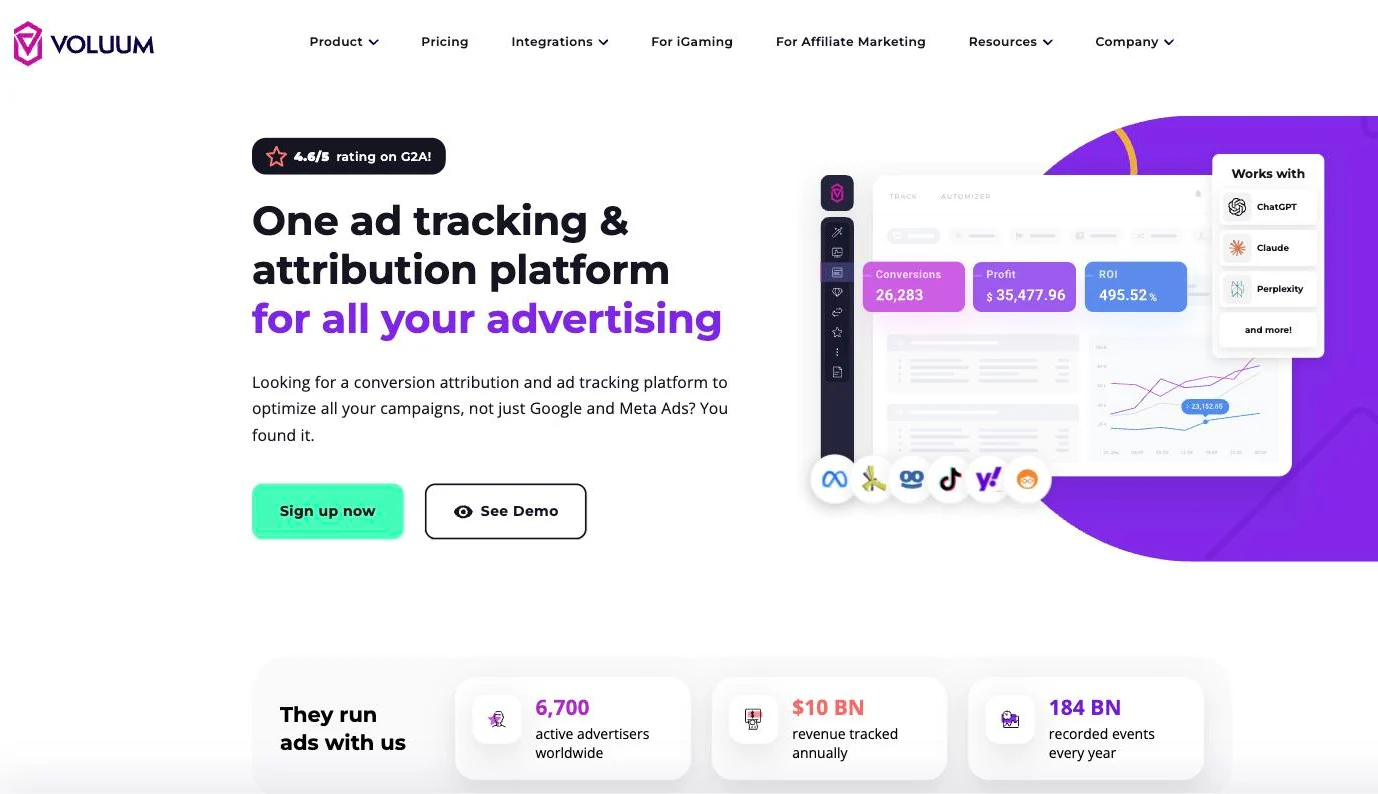
Voluum is an ad tracker for affiliate and performance media buyers, built around automation rules. Automizer rules pause and resume campaigns, change bids and maintain placement lists across 22 API-integrated traffic sources. Tracking runs through redirects or a redirectless script (Voluum recommends a custom tracking domain), and conversions arrive by S2S postback. CAPI postbacks are an add-on on Agency and included from Enterprise, attribution is last click, and profit means revenue minus ad cost.
Key features
▪Redirect and redirectless tracking. A custom tracking domain, first-party cookies on the direct method and a 180-day click ID.
▪Automizer. Cost sync, pause and resume, bid changes, white and blacklists, and rules that run every 15 minutes to 48 hours.
▪22 full API integrations. Google Ads, Meta, TikTok, Taboola, Outbrain, MGID, Zeropark, PropellerAds and more.
▪Conversions to the platforms. Meta through the Conversions API, Google through conversion import and Enhanced Conversions, plus Microsoft and TikTok uploads.
▪Traffic Distribution AI. Routes visitors to the best-performing paths.
▪Voluum MCP. Query the tracker from ChatGPT, Claude or Perplexity.
Strengths
Built for arbitrage speed. Rules that check every 15 minutes suit campaigns where an hour of bad traffic costs real money.
Reliable postbacks. Reviewers single out its S2S tracking.
Deep traffic-source coverage. Native, push and pop networks connect by API.
Limitations
Last click only. No multi-touch models or configurable windows.
No product costs. No COGS input, contribution margin or POAS.
No budget action. Rules change status and bids; budgets stay manual.
CAPI postbacks cost extra. An add-on on Agency, included from Enterprise.
Pricing
The Profit plan costs $119 a month billed annually for 1 million events, rising through Scale ($299) and Agency ($799) to Enterprise ($1,599). Automizer is priced by tracked ad spend: free up to $1,000 a month, then $375 up to $50,000. A 14-day platform preview needs no card, and there's no free plan.
Reviews
Voluum scores 4.6 on G2. Account managers and reliable S2S tracking get the praise, and a steep learning curve and add-on pricing get the complaints.
Bottom line
Voluum suits affiliate and arbitrage buyers working native, push and pop networks, where rules that check placements every 15 minutes matter more than multi-touch credit or product margins. Attribution is last click. Its rules don't move budgets.
Northbeam
★4.5
Best for: mid-market and enterprise DTC brands with analysts on staff, large media budgets and room for a multi-week implementation.
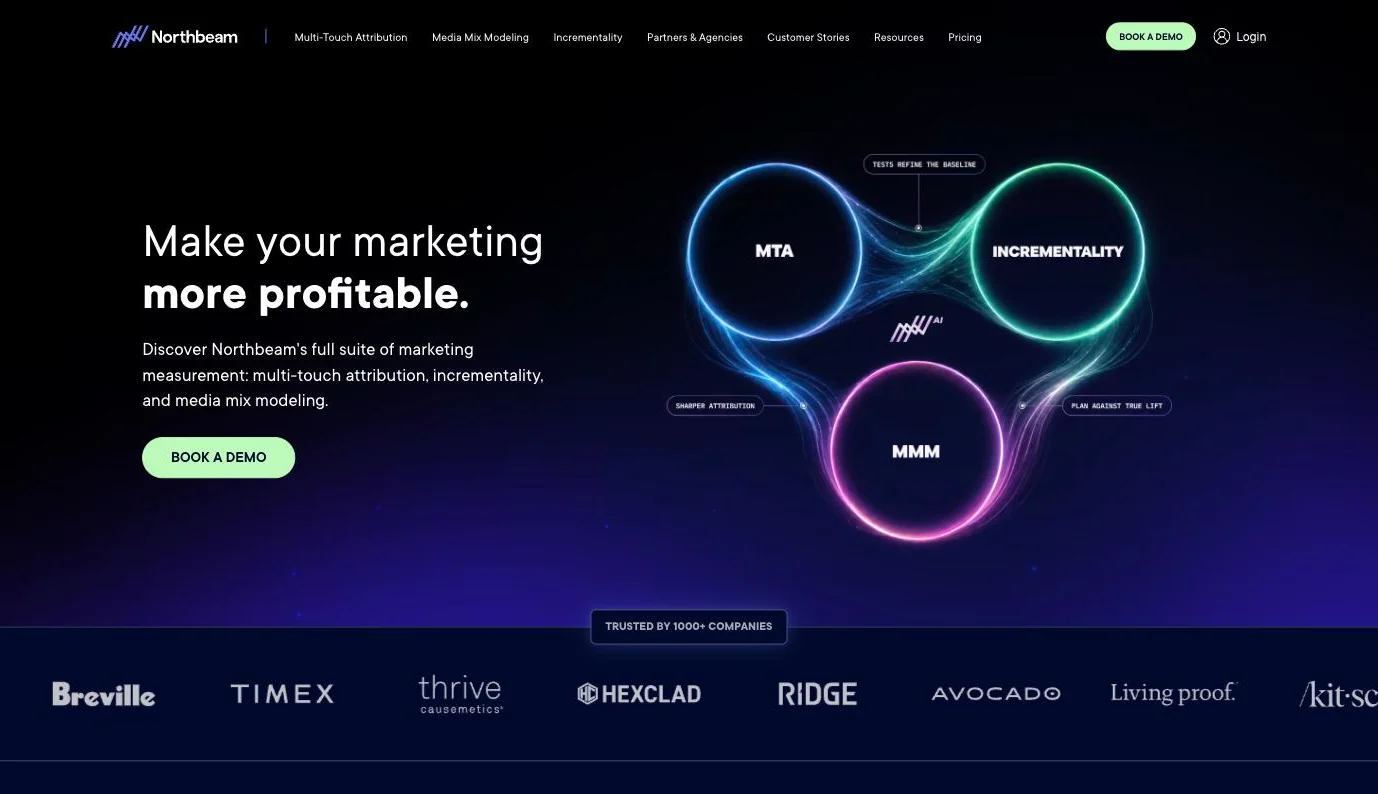
Northbeam is a measurement platform first. Its first-party pixel on your own subdomain feeds seven attribution models, with mix modeling and incrementality tests as add-ons. Apex shares attributed data with Meta, profit shows up as COGS-based targets rather than a margin report, and Northbeam's AI reads the data without touching spend. Implementation takes about 2–4 weeks on Shopify and 4–8 weeks elsewhere.
Key features
▪First-party pixel on a subdomain. Paired with Shopify order sync, an Orders API or SFTP upload for other stores.
▪Seven attribution models. First touch, last touch, last non-direct, linear, clicks-only, clicks plus modeled views and clicks plus deterministic views.
▪Mix modeling and incrementality. Media Mix Modeling+ on Enterprise and geo or holdout tests on Professional and Enterprise, both as add-ons.
▪Apex. Attributed data shared with Meta, AppLovin and Snap (beta).
▪Profit Benchmarks. COGS turned into target ROAS, MER and CAC per campaign.
▪Northbeam MCP. Included from Starter.
Strengths
Depth of measurement. View-based models plus MMM and lift tests from one vendor.
Consistent models. Reviewers say the numbers hold up when they switch models.
Hands-on onboarding. Professional and Enterprise get a data review with a strategist and a customer success manager.
Limitations
No conversions to Google or TikTok. Apex shares data with Meta, AppLovin and Snap (beta).
No contribution margin. Targets built from COGS, with no CM2, CM3 or POAS reporting.
No budget automation. Northbeam's AI doesn't edit spend.
US-hosted. Servers are in the United States.
Pricing
Starter is $1,500, month-to-month and usage-based for Shopify brands. Professional costs $3,500 a month on annual terms, Growth and Enterprise are quoted, and every tier is priced on pageviews, with overage charged per thousand above the allowance. There's no free plan or trial.
Reviews
Northbeam scores 4.5 on G2. Reviewers praise the depth of its attribution and its knowledgeable support, and the same reviews describe a platform that feels overwhelming at first and is priced for mid-market and enterprise budgets.
Bottom line
Northbeam suits a large brand whose analysts want attribution models, mix modeling and lift tests from one vendor, have time for a multi-week implementation and will act on the numbers themselves. It stops at COGS-based targets. There's no contribution margin by campaign and no budget automation.
Best for: Shopify brands that want server-side events in eight ad platforms, set up in minutes, with a profit signal for Meta.
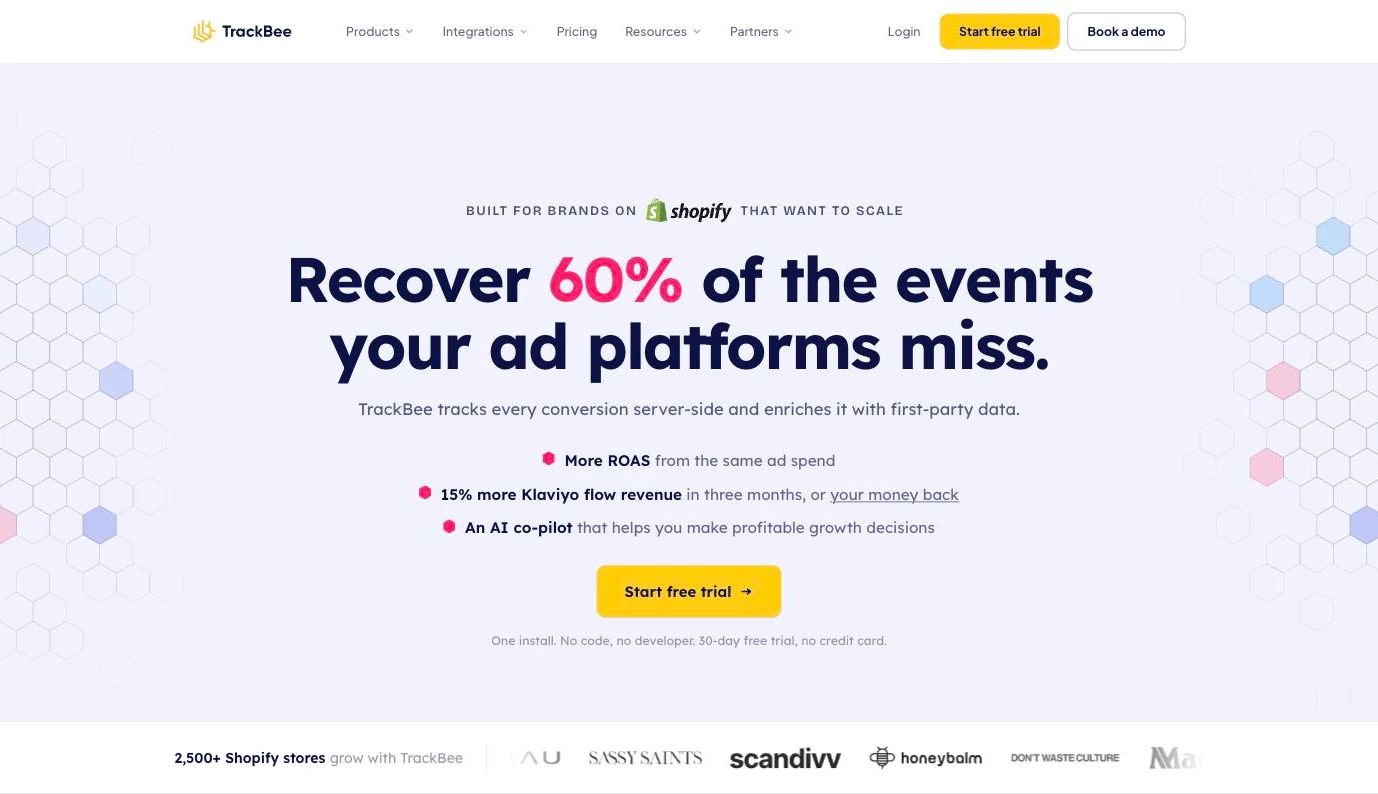
TrackBee is a Shopify ad tracking app. It reads events through Shopify's own APIs and webhooks, enriches sessions into a shopper profile and sends conversions to eight ad platforms alongside your browser pixels. Attribution is last click. A profit event goes to Meta and POAS to Snapchat, and budget moves stay manual.
Key features
▪Server-side from Shopify. Events leave the store directly and are deduplicated against existing pixels.
▪Session enrichment. Email, phone, address and click IDs stitched into one persistent shopper profile.
▪Eight destinations. Meta, Google Ads, TikTok, Pinterest, Snapchat, Microsoft, ChatGPT Ads and Whop Ads, plus GA4 and Klaviyo.
▪New and returning signals. Sent as separate signals to Meta, TikTok and Snapchat.
▪Profit Optimization for Meta. Order revenue minus Shopify's cost per item, sent as an extra event next to the purchase.
▪TrackBee Insights. Questions about your data answered inside Claude or ChatGPT.
Strengths
Eight ad platforms. ChatGPT Ads and Whop Ads included.
Profit as a signal. Meta can optimize on profit after product cost.
Support in minutes. Chat and WhatsApp replies get the most praise.
Limitations
Shopify only. Other store platforms aren't supported.
Last click only. Each order goes to the last click before it.
No contribution margin. Profit is revenue minus COGS, without shipping, fees or returns.
No budget automation. Insights suggests what to scale or cut, and the move is yours.
Pricing
Start costs $79 a month on its Shopify listing (€79 excl. VAT on trackbee.ai), with €25K of monthly tracked revenue included and €6 per extra €1K. Pro is €199 and Scale €449. Insights adds €19.99 a month. There's a 30-day trial with no card.
Reviews
TrackBee scores 4.8 on Capterra. Fast support and more accurate tracking come up most, and cost for small shops after the move to a new subscription model is the main complaint.
Bottom line
TrackBee suits a Shopify brand that wants server-side events in many ad platforms, with a profit event for Meta. It stops at last click and revenue minus COGS, and it works on Shopify only.
ClickMagick
★4.1
Best for: funnel builders, info-product sellers and affiliates who want click tracking with multi-touch attribution and net profit per campaign.
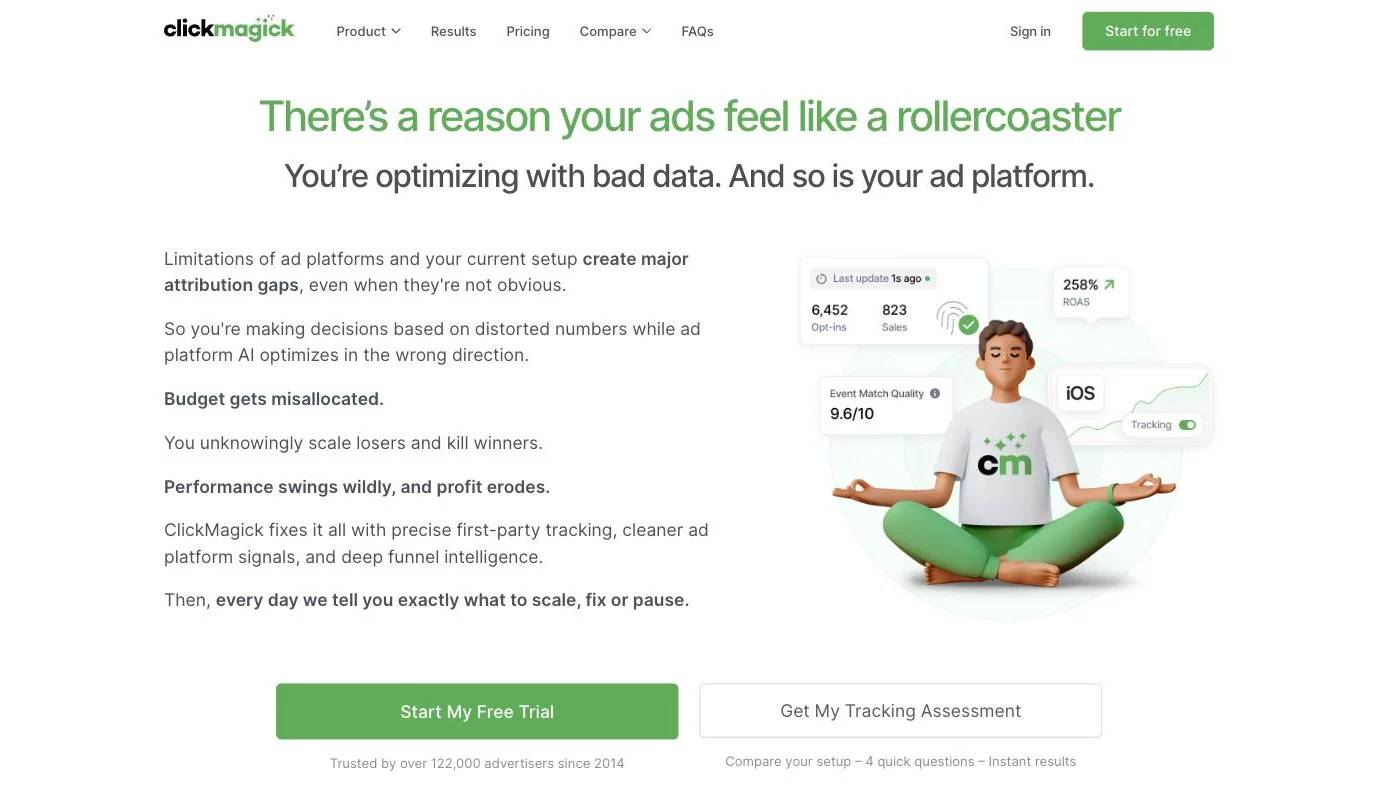
ClickMagick started in 2014 as a link tracker and is now an ad tracking and attribution platform for affiliates, coaches, agencies and info-product sellers. It tracks clicks on your own domain without redirects, takes in affiliate S2S postbacks and adds multi-touch models from the Standard plan. CAPI is spelled out for Meta and Google, profit stops at net, and recommendations arrive by email each morning.
Key features
▪TrueTracking. First-party cookies on a custom domain, server-side tracking and no redirects.
▪CAPI from Starter. Meta's Conversions API and Google conversions, with ChatGPT Ads, LinkedIn, Microsoft, TikTok and X listed as integrated platforms.
▪Multi-touch on Standard. Last click plus linear, position-based and time decay.
▪Net profit in the stats. Ad cost and COGS, refunds, net profit, ROAS and ROI per campaign.
▪LTV report. Customer acquisition cost and time to break even.
▪Morning Magick. A daily email on what to scale, pause or fix.
Strengths
Funnel and affiliate fit. More than 100 affiliate networks connect, along with ClickFunnels, GoHighLevel and Kajabi.
Refunds next to profit. Refunds and COGS sit in the same campaign stats as revenue.
Hands-on onboarding. A one-on-one call from Standard up.
Limitations
No contribution margin. Net profit, with no CM2, CM3 or POAS.
No budget automation. The daily email recommends, and the moves are manual.
Multi-touch from $199. Starter has no advanced models.
Starter is single-site. One user, one site and six months of data; Admetrics includes unlimited shops and users.
Pricing
Starter costs $79 a month for 10,000 visitors, Standard $199 for 100,000 and Pro $349 for 1 million. Annual billing adds two months free, and extra sites cost $40 a month on Standard and Pro. There's a 14-day trial and no free plan.
Reviews
ClickMagick scores 4.1 on Trustpilot. Reviewers praise step-by-step support and complain about hidden fees, and ClickMagick disputes many recent 1-star reviews as fake.
Bottom line
ClickMagick suits funnel and affiliate sellers who want clicks, multi-touch attribution and net profit in one tracker. It stops at net profit. No contribution margin, no budget automation.
Best ad tracking software: final verdict
Admetrics is the best ad tracking software for ecommerce brands that want tracking, attribution, contribution margin and budget moves on one set of order data. The other ten fit narrower needs:
▪Hyros: funnels and sales that close on calls, tracked over long journeys; profit stops at cost of goods, no budget automation.
▪RedTrack: affiliate buyers and agencies across many traffic sources; no product costs or margin.
▪wetracked: Shopify and WooCommerce stores that need purchases back in the ad platforms; last click only.
▪Cometly: B2B SaaS and lead businesses closing through a CRM; no product costs.
▪AnyTrack: affiliate and funnel sellers on a small budget; first or last click, no profit reporting.
▪Triple Whale: Shopify brands that want a suite with AI actions; no contribution margin.
▪Voluum: affiliate and arbitrage buyers on native, push and pop networks; last click, no budget moves.
▪Northbeam: large brands with analysts who want models and MMM; no budget automation.
▪TrackBee: Shopify-only brands that want server-side events in many ad platforms; last click.
▪ClickMagick: funnel and info-product sellers; net profit, no contribution margin.
Admetrics is the best ad tracking software for ecommerce brands that judge ads on profit. It tracks first-party and server-side, sends conversions back to the ad platforms, attributes on your own order data, reports contribution margin and POAS by campaign, and moves Meta budgets with Ad Pilot, from $399/month.
What is ad tracking software, and what else is it called?+
Ad tracking software records which ad brought each visitor and sale, then reports it to you and sends it back to the ad platforms. It also goes by ad tracker, click tracker, conversion tracking software and, once it credits several touchpoints, attribution software. Affiliate media buyers usually mean a redirect tracker, Shopify brands a CAPI app, and larger teams an attribution platform.
Is there free ad tracking software?+
Some ad trackers have free tiers, capped by sessions, stores or features, and most leave server-side sending, multi-touch attribution or profit reporting to the paid plans. Meta's and Google's own pixels are free and report each platform's view of its own conversions. Admetrics has a 21-day free trial with no card.
How much does ad tracking software cost?+
Paid entry plans on this list run from about $50 to $1,500 a month. Check what the bill scales with, because it differs by tool: orders, sessions, events, tracked revenue, GMV or ad spend. Admetrics starts at $399/month with the first $20,000 of monthly ad spend included.
Do I need ad tracking software if Meta and Google already report conversions?+
On a single channel, platform reporting can be enough. Across several, Meta and Google each credit themselves with the same orders, through view-through credit, their own attribution windows and modeled conversions, and the totals run past what your store recorded. Ad tracking software counts against real orders and sends that cleaner signal back. The best software for tracking ad performance also attributes on your own data and shows profit per campaign.
Can ad tracking software track online and offline sales?+
Some tools take in sales from CRMs, call tracking or other systems by server-side postback and tie them back to the ad. Ad tracking software for online and offline sales needs those integrations on top of the web tracking. Admetrics matches every journey to a real order in your online stores and doesn't track calls.
Is ad tracking software GDPR-compliant?+
The setup decides that more than the label. Tracking needs a legal basis, usually consent, whether it runs in the browser or on a server. Check whether consent travels with each event, where the vendor hosts data and whether it offers a DPA. Hyros, Northbeam and Cometly host in the US and wetracked processes data there. Admetrics processes and stores data in the EU, carries the consent state on every event and provides a DPA.