Mission control
for e‑commerceFrom independent measurement to governed allocation. One closed loop, open to your entire stack.See how the system works →
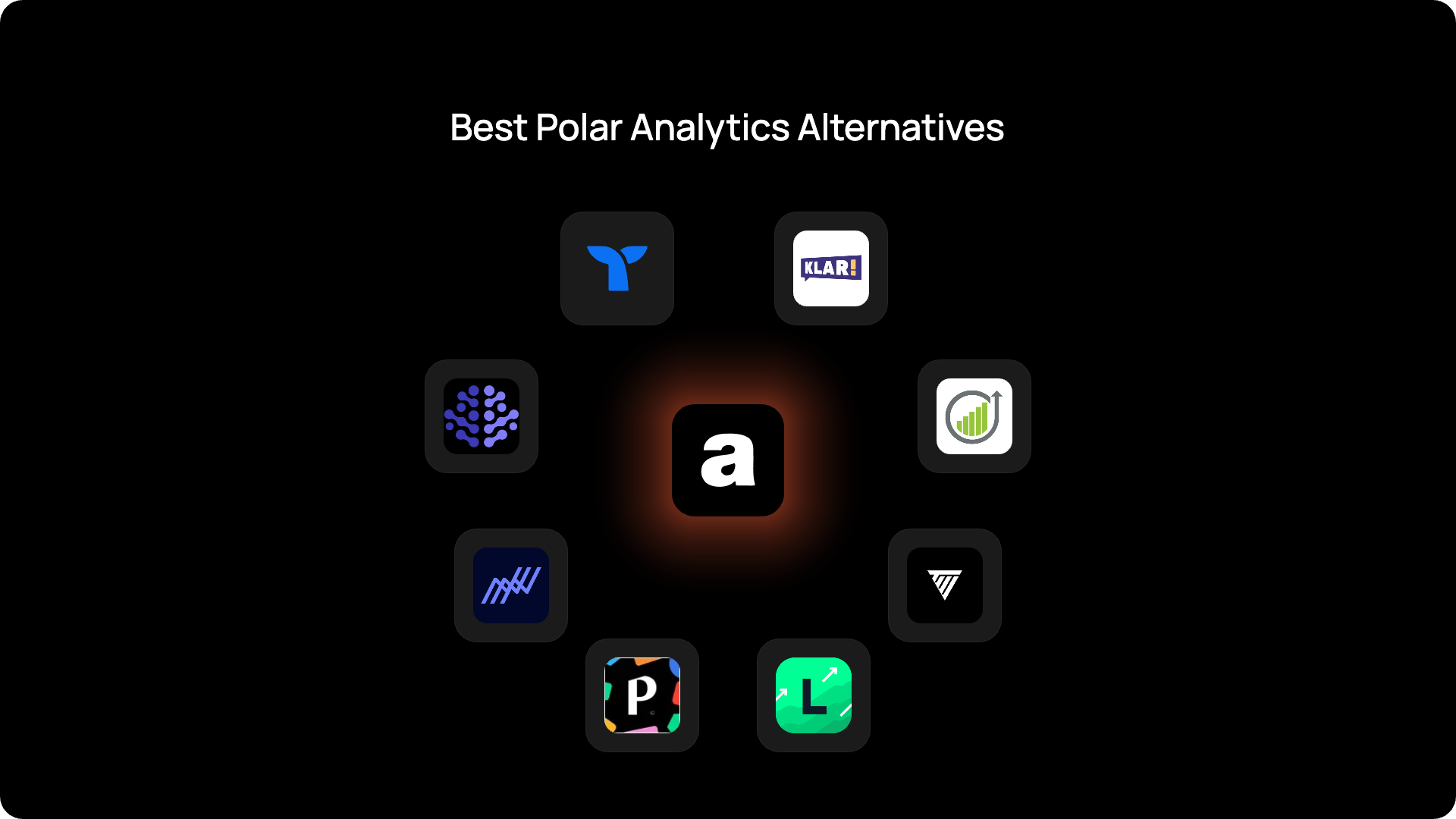
9 best Polar Analytics alternatives for ecommerce brands in 2026
Polar Analytics builds the warehouse and runs thin after the dashboard. We compared 9 Polar Analytics alternatives on tracking accuracy, data foundation, profit and budget automation. Pricing, limitations and review patterns included.
Silvana Chirita·Updated October 22, 2026·25 min read
Admetrics is the most complete Polar alternative. Server-side tracking, CAPI enrichment to six ad platforms, POAS down to the SKU and Ad Pilot budget automation in one stack, from $399/month.
Brands leave Polar for four reasons. Signal enrichment stops at Meta and Google, incrementality is a paid geo-lift service with no MMM alongside it, the bill scales with GMV, and the stack is Shopify-first with no stated hosting region.
The list splits into three camps. Attribution and measurement (Triple Whale, Northbeam, Klar, Tracify, ThoughtMetric), profit and LTV apps (Lifetimely, Peel Insights) and a managed warehouse (Daasity).
Budget automation is rare. Admetrics' Ad Pilot, Triple Whale's Moby Actions (Automate plan and up) and Polar's Slack operator change budgets. Everything else leaves the budget move to the media buyer.
EU data residency narrows the field. Admetrics, Klar and Tracify state EU or German hosting. Polar, Triple Whale and Northbeam don't state a region.
Why ecommerce brands leave Polar Analytics
Polar's data layer is solid: a dedicated Snowflake database on every plan, unlimited users and history, and a success manager. The reasons brands switch sit downstream of reporting.
CAPI enrichment stops at Meta and Google. Polar's Advertising Signals push conversions to Meta CAPI and Google Ads only. Spend on TikTok, Snapchat, Taboola or Outbrain keeps optimizing on browser-pixel data, with all the signal loss that comes with it.
Incrementality is a service, not a model. Causal Lift runs geo-lift tests with a dedicated Polar data scientist, priced per test or quarterly on the Custom plan. Polar has no MMM, which leaves no always-on read of channel contribution or diminishing returns between tests.
The bill scales with GMV. Polar prices on annual GMV, with Core at $750/month on the Shopify App Store. SQL access, intraday refresh and custom connectors are paid add-ons on top. A brand that grows revenue pays more even when ad spend and the way it uses the tool stay the same.
Shopify-first, with no stated data residency. Polar calls itself purpose-built for Shopify, and it has no native connector for Shopware, WooCommerce or Magento. GDPR and a DPA are covered, but the hosting region isn't stated, which is the first question an EU brand's DPO will ask.
How we ranked Polar Analytics alternatives
We scored every tool on four criteria, the same ones we use across our comparison pages.
▪Attribution and tracking accuracy. Whether orders are captured first-party and server-side, which models you can compare, and how the tool handles cross-device journeys.
▪Data foundation. How much of your store, ad and cost data comes in without manual work, and whether you can get it back out through an API or warehouse export.
▪Profit over revenue. Whether the tool takes COGS, shipping, fees and returns per order and reports contribution margin, or stops at ROAS.
▪What happens after attribution. Whether the tool sends enriched conversions back to ad platforms and whether anything moves budget, or the number just sits in a dashboard.
Polar Analytics alternatives comparison 2026
#
PLATFORM
ATTRIBUTION
PROFIT CONTROL
S2S PUSHBACK
ACTION
1
Admetrics
Server-side, 9 models + custom
CM2, CM3, POAS to SKU
6 platforms (add-on)
Ad Pilot executes on Meta
2
Triple Whale
Triple Pixel, all models on paid plans
Net profit, no CM metric
Sonar: Meta, Google, TikTok and more
Moby Actions (Automate and up)
3
Northbeam
First-party MTA, clicks + views
No COGS or margin input
Apex, Meta only
No
4
Klar
ML MTA, MMM, geo tests
Full profit reporting
No
No
5
Tracify
Hybrid server-side, AI attribution
P&L view, no COGS detail
Meta only
No
6
ThoughtMetric
Pixel + survey, 5 models
No profit view
Meta, Google
No
7
Lifetimely
UTM and ad-platform data
Daily P&L, LTV cohorts
No
Profit Agent, on approval
8
Daasity
GA, survey, discount code
Contribution margin (Essentials)
Audiences only (Meta, Google)
No
9
Peel Insights
Shopify UTM, first order only
Revenue and cost, with COGS
No
No
Admetrics
★5.0
Best for: ecommerce brands spending across several ad platforms that want profit-based answers and budget moves without hiring a data team.
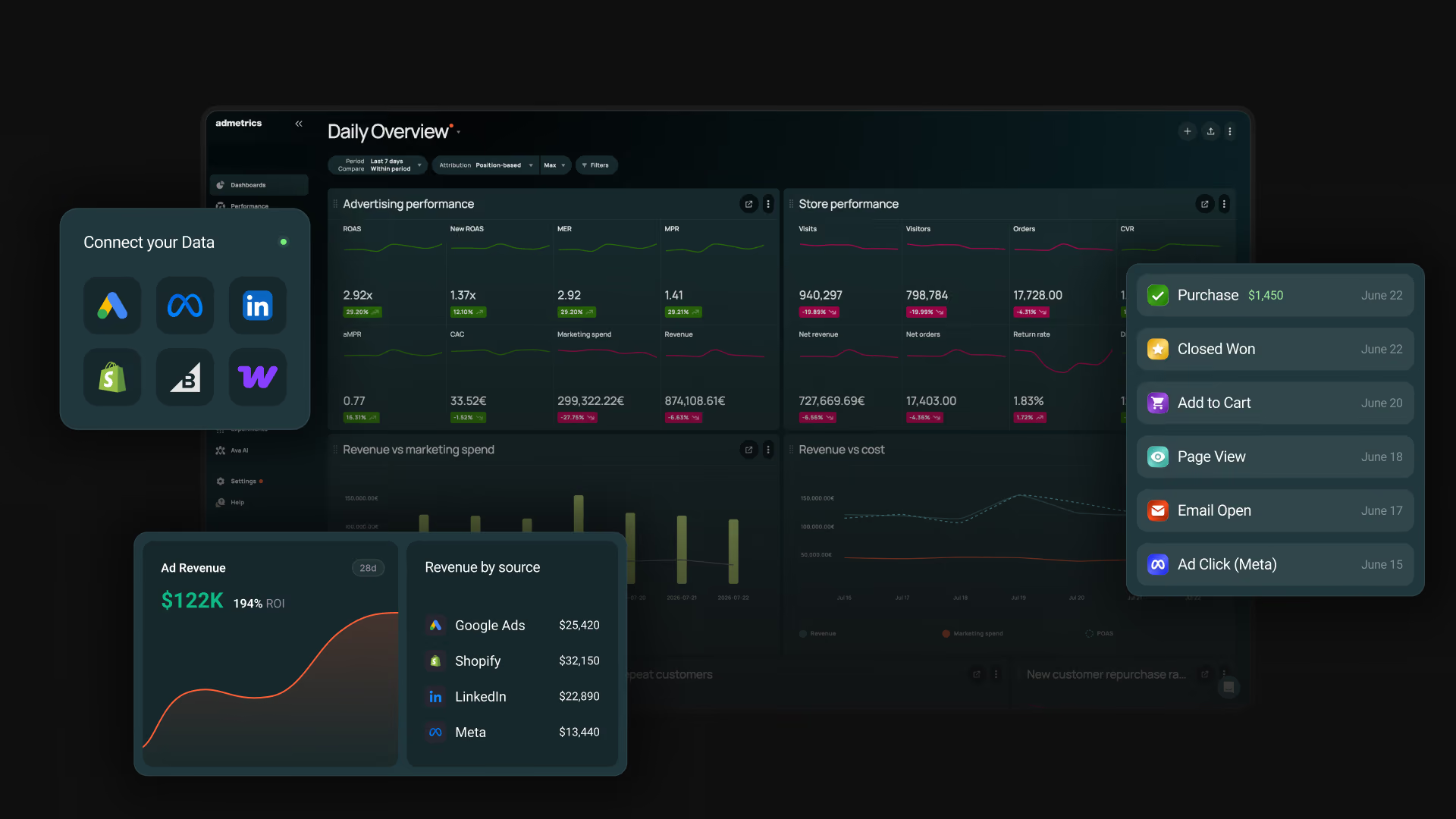
Admetrics picks up where Polar hands off. It tracks each order server-side, prices it down to the SKU, sends the enriched conversion back to six ad platforms, and can move Meta budgets toward a profit target you set. Setup takes under an hour.
Key features
▪First-party server-side tracking. Orders are captured server-side with cross-device journeys, unlimited lookback windows and a view of every touchpoint behind a single order.
▪Nine attribution models plus custom rules. Compare models side by side, then check the numbers inside Meta, Google and TikTok ad managers through the Chrome extension.
▪Enriched conversions to six platforms.Server-to-server pushback to Meta, Google, TikTok, Snapchat, Taboola and Outbrain, so each algorithm learns from real buyers.
▪Profit per order, down to the SKU. COGS per SKU and variant over time, pick-pack, packaging, carrier rates by country and weight, return shipping and payment fees roll into CM2, CM3, POAS and MER, with returns by campaign and product.
▪PRISMA, Budget Optimizer and Ad Pilot. The marketing mix model retrains nightly on new-customer revenue or profit and gives you response curves and scenarios. Ad Pilot adjusts budgets and switches ads on or off every hour inside the limits you set.
▪Ava, MCP and open data. Ask Ava in plain English, or connect Claude, ChatGPT and other agents through the MCP server, which can act as well as read. The REST API and exports to BigQuery, S3, Google Drive and Sheets keep the data yours.
Strengths
Answers come ready-made. CM3 per campaign, POAS per SKU and new versus returning versus reactivated customers sit in the dashboard from day one, with no SQL and no analyst in between.
Ad Pilot goes further than an approve-in-Slack flow. It works hourly on campaign and ad set budgets and on single ads, toward a CAC, POAS or new-customer ROAS target, with capped moves. Every action is logged with its reason, the limit it respected, the before and after, and the outcome, and you can override, roll back or stop it.
The data foundation reaches past Shopify: Shopware, WooCommerce, Magento, JTL, Amazon and custom stores connect, with 30+ integrations and unlimited shops, users and integrations on every plan.
Data sits on German servers, covered by GDPR and a DPA, which settles the hosting question Polar leaves open.
Limitations
The marketing mix model and Budget Optimizer are Custom-plan add-ons. Smaller brands get attribution, profit and budget management, but not PRISMA.
Ad Pilot runs on Meta only for now. Google is next.
There's no self-serve signup. The free trial starts with a demo booking.
Pricing
Growth costs $399/month and includes the first $20,000 of monthly ad spend, with 1.5% above that. Business costs $899/month with $70,000 included and 1% above, while Custom is quoted for brands spending more than $100,000. Annual billing saves 15%, and there's a 21-day free trial with no card required. Business and Custom add a free e-com data audit and a dedicated customer success manager. S2S conversion pushback is an add-on on every plan, Ad Pilot from Business, and PRISMA and the Budget Optimizer on Custom, which also includes customer matching across sales channels. Budget management across Meta, Google, TikTok and Microsoft is included on all plans.
Reviews
Admetrics holds 5.0 from 15 reviews on the Shopify App Store and 4.8 from 3 on G2 (checked October 2026). Both samples are small. The trial on your own data will tell you more.
Bottom line
If Polar gave you clean data and you now want the profit answer and the budget move without building either, Admetrics covers the whole path from order to action.
Best for: Shopify brands that want a free starting point, a wide range of ad integrations and an AI agent that can take actions, and that can live without a contribution-margin view.
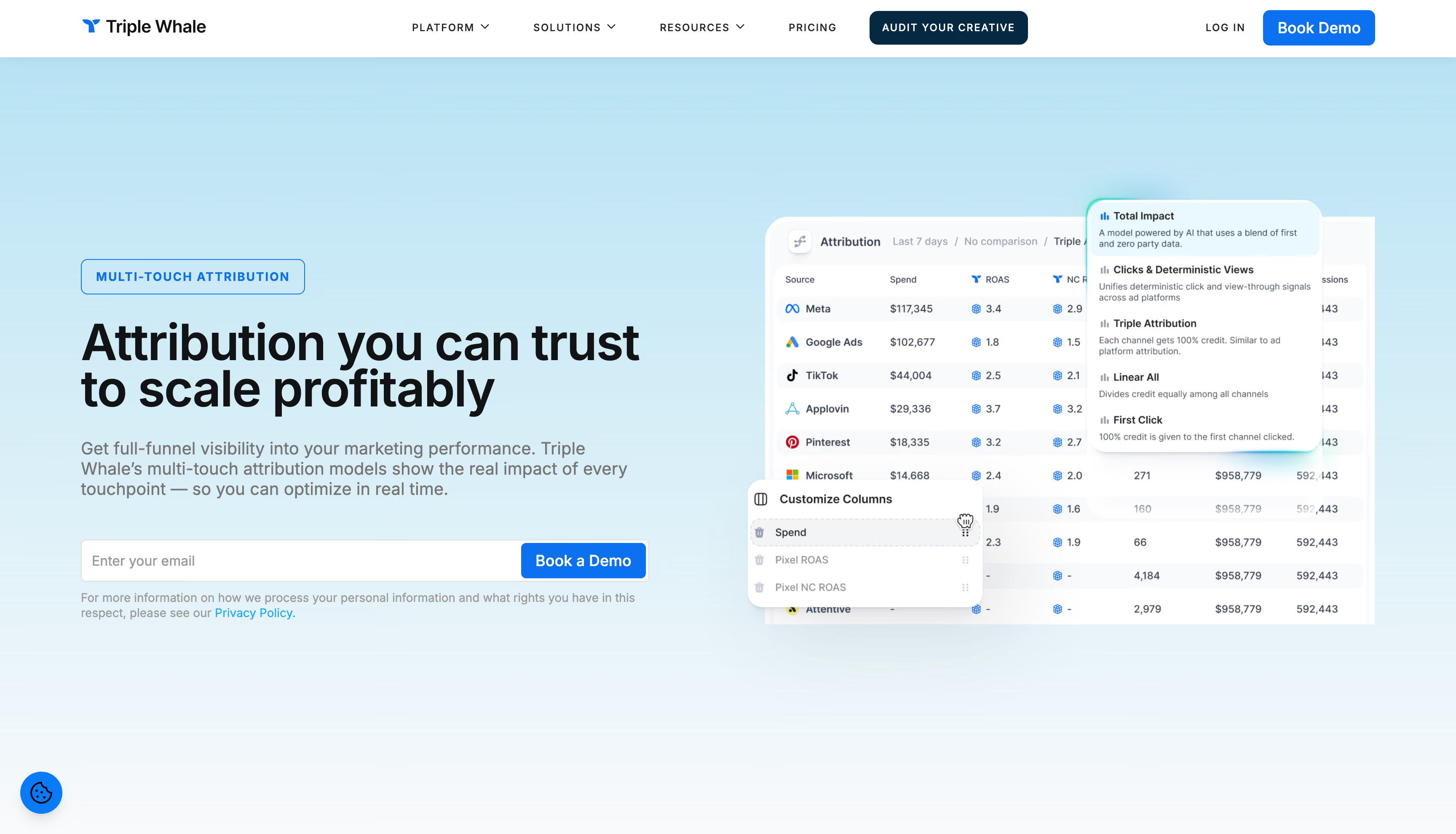
Triple Whale is a dashboard-first platform where Polar is warehouse-first. It combines its own pixel, attribution, MMM, signal enrichment and the Moby agent in one interface, with a free plan to start.
Key features
▪Triple Pixel and all attribution models. Paid plans get every model. The free plan is limited to first and last click and only partial pixel coverage.
▪Sonar signal enrichment. Enriched events go to Meta, Google Ads and TikTok, with knowledge-base guides for Pinterest, AppLovin and X as well.
▪Compass MMM and incrementality. Marketing mix modeling and GeoLift-based incrementality tests are add-ons on Foundation and Automate and included on Enterprise.
▪Moby agent. Moby answers questions on every plan. Moby Automations and Actions, which carry out tasks, are reserved for Automate and Enterprise.
▪Net profit reporting. COGS, shipping, payment gateway fees and custom expenses feed a net profit figure, alongside cohort and LTV views.
▪60+ integrations. Shopify, WooCommerce and BigCommerce stores, a long list of ad platforms, and a paid Data Warehouse Sync to BigQuery or Snowflake.
Strengths
The free plan lets a smaller brand try the dashboard before paying anything, with 10 users and 12 months of data.
Sonar reaches more ad platforms than Polar's Meta-and-Google signals, which helps brands spending on TikTok or Pinterest.
Moby Actions give Triple Whale a real action layer on its upper plans, something most tools on this list don't have.
Security paperwork is strong: GDPR, CCPA and SOC 2 Type II.
Limitations
Profit stops at net profit. There's no contribution-margin metric, so CM2 and CM3 per campaign aren't available out of the box.
Measurement depth costs extra below Enterprise. MMM and incrementality are add-ons on Foundation and Automate, and Retention is a paid add-on too.
Paid plans run for 12 months. Foundation, Automate and Enterprise are annual subscriptions, billed monthly or yearly.
EU hosting isn't stated. Brands that need data residency in Europe will have to ask.
Triple Whale pricing
Pricing combines annual GMV with the package you choose. The Shopify App Store lists Foundation at $219/month or $2,190/year and Automate at $749/month or $7,490/year. Enterprise is quoted, and the free plan costs nothing.
Triple Whale reviews
Triple Whale holds 4.1 from 93 reviews on the Shopify App Store and 4.5 from 482 on G2 (checked October 2026). The larger G2 sample rates it higher than the Shopify listing does.
Bottom line
Triple Whale suits a Shopify brand that wants to start free and grow into an agent that acts. If your decisions run on contribution margin, you'll still be doing that math elsewhere.
Best for: brands spending seven figures a year on paid media that want first-party multi-touch attribution with view-through, and a path to MMM and incrementality on the upper plans.
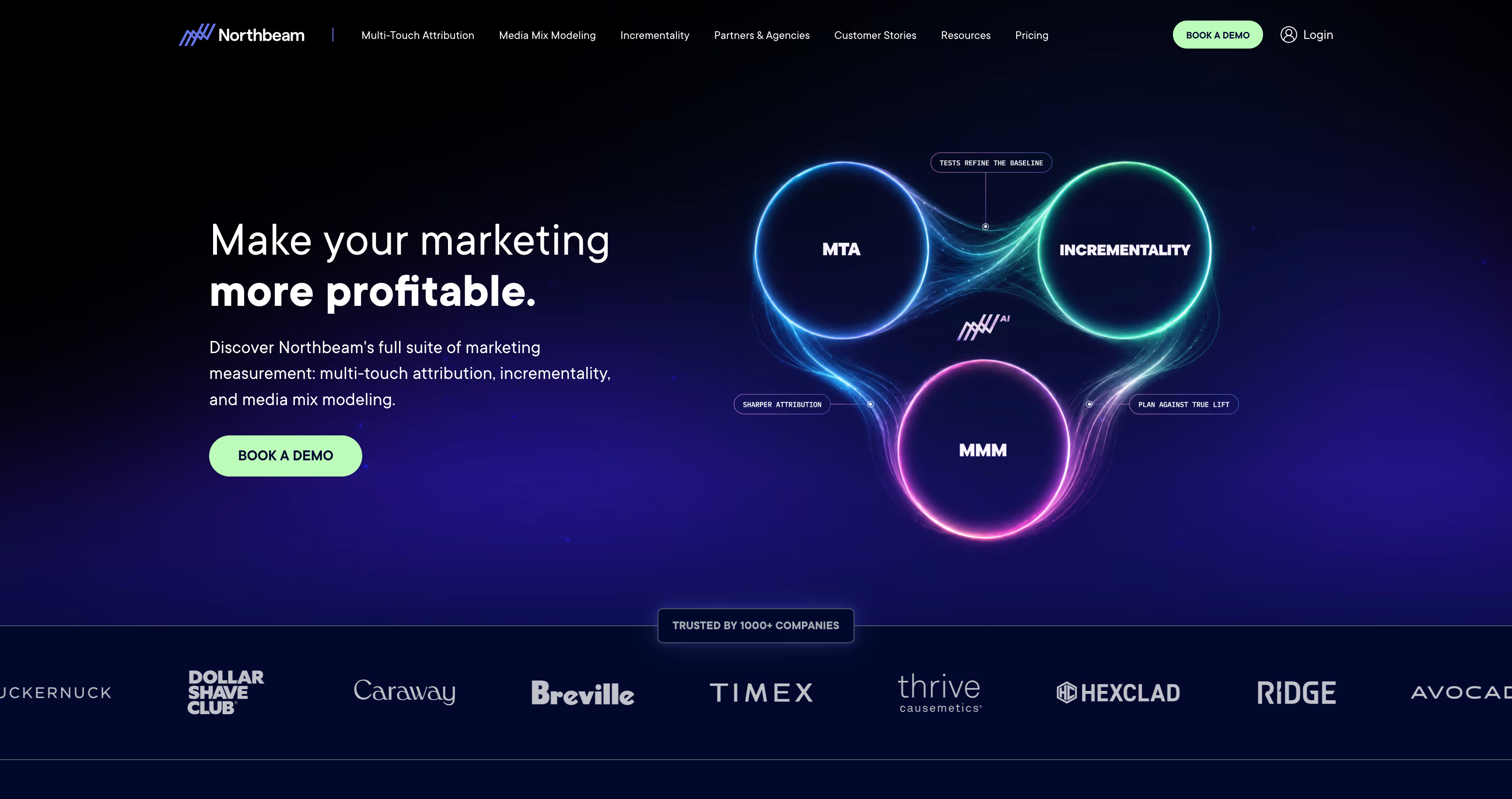
Northbeam is a paid-media measurement platform where Polar is a data stack. It goes deep on attribution and shallow on store economics, and it prices on pageviews instead of GMV.
Key features
▪First-party MTA with deterministic views. Attribution runs across ad channels on clicks plus deterministic views, with Sales Attribution alongside. Northbeam doesn't publish a list of named models.
▪Northbeam Apex for Meta. Apex sends ad-level attributed performance to Meta as custom Passback and AppendAttribution events, next to your existing pixel and CAPI. Live optimization is an invite-only beta.
▪MMM+ and incrementality. Incrementality is optional on Professional and Enterprise, and MMM+ is optional on Enterprise.
▪Creative and product analytics. Customizable omnichannel dashboards, Metrics Explorer, Product Analytics and Creative Analytics.
▪MCP access. Northbeam MCP is listed on the Growth and Starter plans.
▪Exports to your own cloud. The API exports CSV to GCS or S3, with granular touchpoint exports on Enterprise.
Strengths
Counting deterministic views next to clicks gives upper-funnel, view-driven spend credit that a click-only model drops.
The measurement stack builds in steps: MTA at the base, incrementality from Professional, MMM+ on Enterprise, so you add methods as spend grows.
Pageview-based pricing tracks traffic, not GMV, and Starter runs month-to-month.
On sites with a consent banner, the pixel doesn't send data until the visitor agrees, and a DPA and SCCs are available on request.
Limitations
No profit layer. "Profit Benchmarks" sets targets, but there's no COGS or contribution-margin input, so POAS and CM3 aren't native.
Apex covers Meta only. Other platforms are "on the roadmap", and Apex events aren't Purchase events.
Non-Shopify setup takes more work. Other stores need both the Server API and the Pixel API, and missed pixel data can't be recovered.
Data residency isn't disclosed. Northbeam doesn't state a hosting region.
Northbeam pricing
Price is set by pageviews, with plans framed by ad spend. Starter shows $1,500 next to "Contact us for a quote" for brands spending under $1.5M a year on ads. Professional shows $3,500/month on an annual contract, for up to $500K a month in spend. Growth and Enterprise are custom. No free plan or trial is mentioned (checked October 2026).
Northbeam reviews
Northbeam holds 5.0 from 2 reviews on the Shopify App Store and 4.5 from 16 on G2 (checked October 2026). Two reviews is too few to read anything into, which makes the G2 figure the more useful one.
Bottom line
Northbeam fits a high-spend team that wants view-through MTA with incrementality and MMM+ to grow into. You'll still calculate CM3 and POAS somewhere else.
Best for: EU brands above €1M in annual net revenue that want profit, retention and attribution reporting from one EU-hosted tool, and don't need conversions sent back to ad platforms.
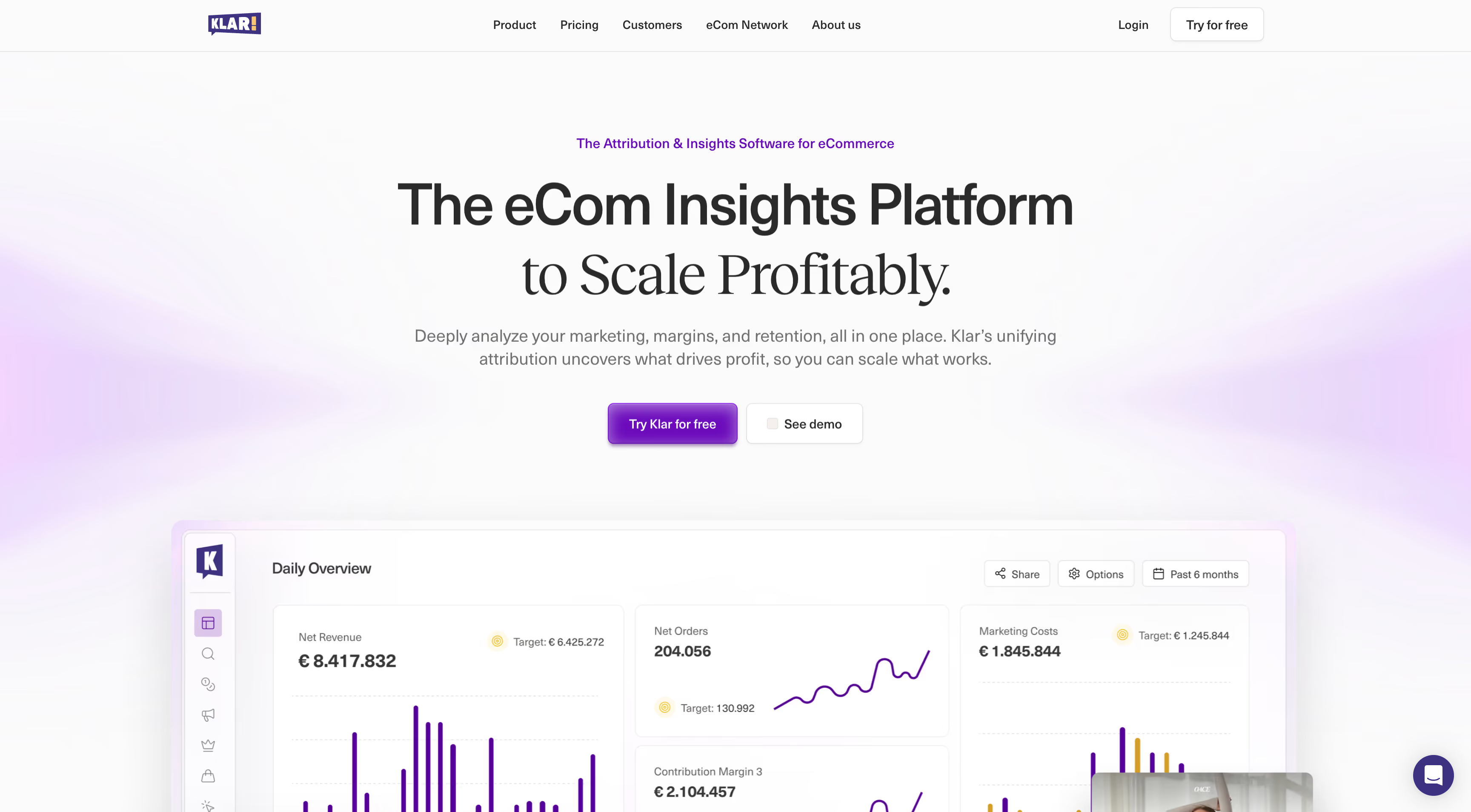
Klar covers the reports you'd build on Polar's semantic layer (profit, retention, acquisition) as ready-made views, then adds its own measurement engine. Klar Insights is based in Munich, hosts data in Europe and prices on trailing 12-month net revenue instead of GMV.
Key features
▪Unified Measurement Engine. Deterministic MTA from first-party tracking and ML, plus MMM, geo tests and self-reported touchpoints in one engine.
▪First-party pixel with two modes. Domain Validated serves the script from your own subdomain, Basic runs third-party, and server-side events post straight to Klar's endpoint.
▪Full profitability reporting. Margin analysis across your cost structure, plus CLV, repurchase rates, order time lags and CLV/CAC ratios.
▪Stores beyond Shopify. Shopify, Shopware, Magento, WooCommerce and Amazon Seller connect natively, and anything else through the Open API.
▪Klar MCP and APIs. Klar MCP is live, next to an Open API for orders and shop data and a Public API for attribution, marketing and revenue.
Strengths
Data residency is settled: Klar says data is "100% hosted in Europe", with GDPR and ISO 27001 stated.
MMM and geo tests sit inside the same engine as MTA. Polar has no MMM, and its geo-lift service is a Custom-plan extra.
Shopware, WooCommerce and Magento connect natively, which Polar doesn't offer.
Implementation is stated at 1–2 hours, and the 14-day trial starts only once your account is fully set up.
Limitations
No conversion pushback. There's no CAPI or server-to-server feed to Meta, Google or TikTok, so their algorithms keep learning from their own pixels.
Attribution costs extra. The pixel and the attribution and measurement suite need Core + Attribution, which starts at double the Core price.
Nothing acts on the number. There's no budget automation and no in-app AI assistant.
The easy pixel is the weaker one. Klar says Basic mode is "simpler to set up but less accurate" than Domain Validated.
Klar pricing
Core starts at €200/month and Core + Attribution at €400/month, both based on the last 12 months of net revenue after returns and taxes. Monthly plans are re-priced every 3 months and annual plans every 12, with no setup fees and custom quotes for larger brands (checked October 2026).
Klar reviews
Klar's Shopify App Store listing has no reviews yet, and its G2 page shows 5.0 from 5 reviews (checked October 2026). With so few public reviews to go on, ask for customer references during the trial.
Bottom line
Klar is the closest EU-hosted match for Polar, with MMM and geo tests in the same tool. Plan on a separate CAPI setup if you want those conversions to reach your ad platforms.
Best for: brands whose main problem is signal loss on Meta and that want hybrid server-side tracking hosted in Germany, with profit reporting kept in another tool.
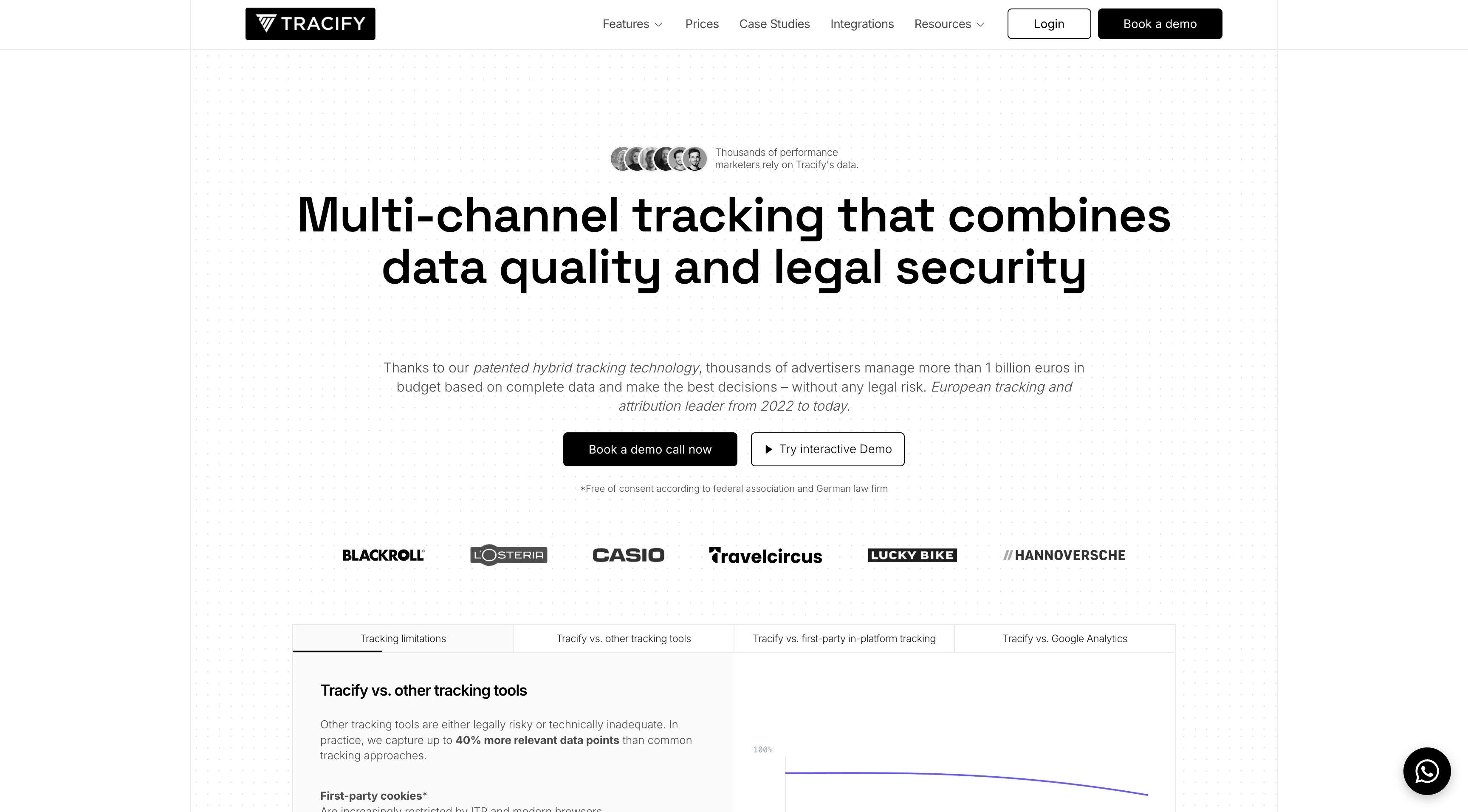
Tracify replaces Polar's pixel and attribution layer, not its warehouse. It runs hybrid client- and server-side tracking on servers in Germany and sends the conversions it detects back to Meta.
Key features
▪Hybrid server-side tracking. Client- and server-side tracking that resists ad blockers, which Tracify describes as cookie-free and consent-independent.
▪Behavior-based AI attribution. AI matching across devices and sessions, an unlimited attribution window and a new versus returning split.
▪Meta conversion pushback. Conversions Tracify detects go back to Meta Ads through a dedicated Meta dataset.
▪Chrome extension in the ad managers. Tracify data shows inside Meta, Google and TikTok ad managers.
▪Creative and influencer views. Real-time dashboard, channel dashboards, customer journeys, creative analysis and influencer tracking.
▪Wide store coverage. Shopify, Shopify Plus, WooCommerce, Shopware 6 and Adobe Commerce, plus ad platforms from Google and Meta to Taboola, Outbrain and Criteo.
Strengths
Every system runs on servers in Germany, which answers the data residency question before procurement asks it.
Tracking is built to survive ad blockers, and the Meta feed comes from that data, which means Meta optimizes on Tracify's conversions instead of its pixel's alone.
Shopware 6 and Magento connect natively, two store systems Polar doesn't cover.
The unlimited attribution window and cross-device matching suit longer, higher-AOV purchase cycles.
Limitations
Pushback reaches Meta only. There's no Google or TikTok pushback, and the TikTok integration imports costs and clicks once a day.
Profit is a menu item. A "Profit & Loss" dashboard appears in the navigation, but there's no COGS handling, so CM2, CM3 and POAS aren't covered.
No MMM or geo tests. Tracify says its AI scores touchpoints on incrementality, but there's no holdout or geo-lift testing.
No trial or Shopify listing. Testing runs as a custom pilot agreed in a demo, and the Shopify App Store listing is currently unavailable.
Tracify pricing
Tracify starts at €500/month. There's one entry price, with no named plans, no annual prices and no stated pricing basis; the final price is set in a demo (checked October 2026).
Tracify reviews
Tracify's Shopify App Store listing isn't available, and it holds 4.9 from 13 reviews on G2 (checked October 2026). G2 is its only public rating.
Bottom line
Tracify fits a brand that needs cleaner Meta signal and data kept in Germany, while profit and budget decisions still happen in another tool.
ThoughtMetric
★3.8
Best for: smaller ecommerce brands that want multi-touch attribution with post-purchase surveys and a server-side CAPI feed to Meta and Google, on pageview-based pricing.
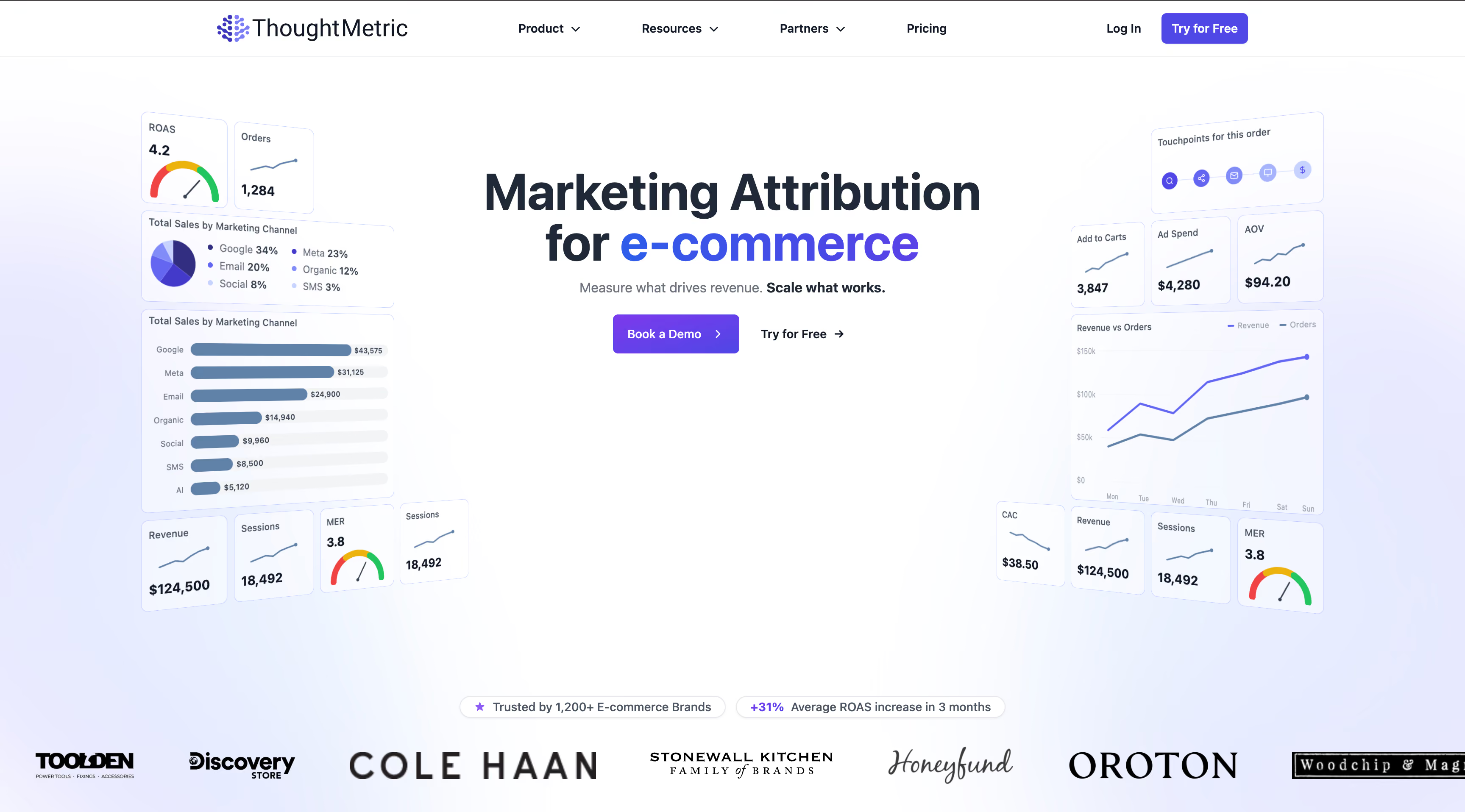
ThoughtMetric is lightweight attribution rather than BI. It covers the pixel and the Meta-and-Google signals Polar sells, for a fraction of the entry price, but none of the warehouse.
Key features
▪Five attribution models. First Touch, Last Touch, Linear Paid, Position Based and Multi-touch, with lookback windows from 7 to 90 days.
▪Pixel plus post-purchase survey. The recommended multi-touch model blends pixel data with "How did you hear about us?" answers.
▪Server-side CAPI. Events go straight from your store to Meta and Google.
▪Customer and creative analytics. Lifetime value, new versus returning customers and path to purchase, plus campaign, creative, product and custom reports.
▪AI Connectors. Claude and ChatGPT can query your ThoughtMetric data, through MCP according to the homepage.
▪Store and ad coverage. Shopify, WooCommerce, BigCommerce and Magento, with Meta, Google Ads, TikTok, Pinterest, Snapchat, AppLovin, LinkedIn and others.
Strengths
At $99/month, it's the cheapest tool on this list that sends server-side conversions to Meta and Google, the same two platforms Polar's Advertising Signals reach.
Survey answers add self-reported data for channels a pixel can't track, such as word of mouth.
Every feature is in every plan, with no add-ons, and going over your pageview limit during the holiday season costs nothing extra.
WooCommerce, BigCommerce and Magento stores connect natively.
Limitations
No profit view. There's no COGS, contribution margin or POAS. Decisions run on revenue and ROAS.
No MMM or incrementality tests. Neither is part of the product.
Data residency isn't stated. The DPA names Google and DataDog as sub-processors and covers transfers with SCCs, without a hosting region.
Pricing climbs with traffic. Outside the holidays, ThoughtMetric reaches out to prompt an upgrade once you're more than 10% over your pageview limit.
ThoughtMetric pricing
Pricing is set by monthly pageviews. The Shopify App Store lists $99/month for up to 50,000 ($990/year), $199 for 100,000, $299 for 200,000 and $399 for 300,000. The website shows no tier figures but says annual billing includes two free months. There's a two-week trial with no card (checked October 2026).
ThoughtMetric reviews
ThoughtMetric holds 3.8 on the Shopify App Store from 14 reviews (the reviews page shows 13) and 4.7 from 41 on G2 (checked October 2026). The larger G2 sample rates it noticeably higher.
Bottom line
ThoughtMetric is the budget pick for attribution with a Meta and Google CAPI feed, while profit, MMM and anything that moves budget sit outside the product.
Lifetimely
★4.9
Best for: Shopify brands, subscription brands in particular, that want a daily P&L, LTV cohorts and CAC payback without a data team, and can work with UTM-based attribution.
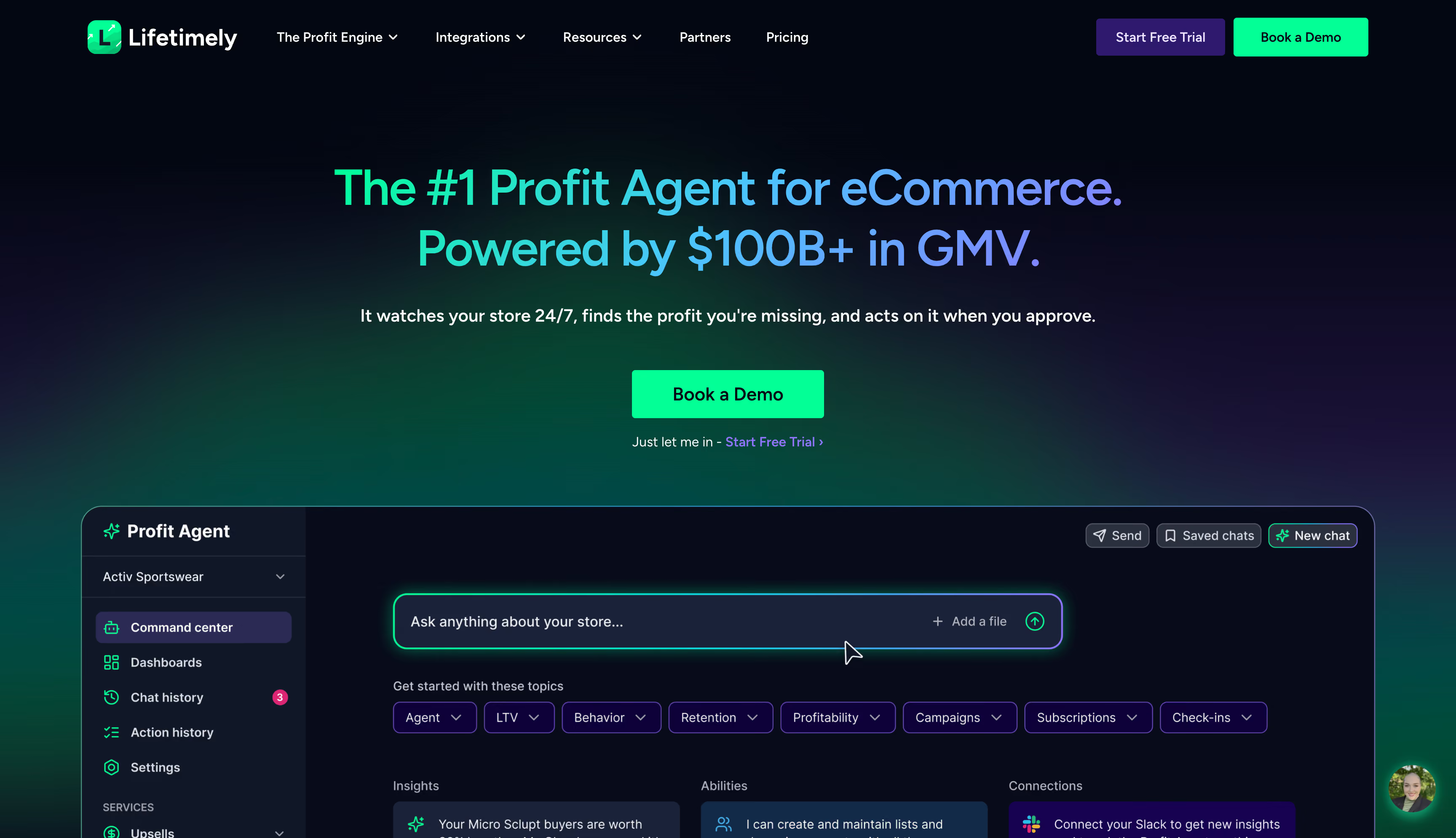
Lifetimely covers the profit and LTV side of Polar as ready-made reports, starting free. Its Profit Agent acts once you approve, the same approval model as Polar's Slack operator.
Key features
▪Daily P&L. Real-time profit after COGS, refunds and fees, with sales forecasting across Shopify and Amazon.
▪LTV and cohorts. A predictive LTV model and cohort reports on CAC, revenue and profit by segment and channel, with CAC payback on paid plans.
▪Profit Agent. The agent flags missed profit, acts when you approve, and measures lift against a control for the actions it takes. Paid plans include 5,000 credits a month.
▪UTM and ad-platform attribution. First- and last-touch UTM attribution, ad-platform drill-downs, a post-purchase survey and anomaly detection.
▪Lifetimely MCP. Included on paid plans, with ChatGPT, Claude and Microsoft Copilot Studio listed as clients.
▪Retention stack integrations. Recharge, Skio, Klaviyo, ShipBob, QuickBooks Online and more.
Strengths
The free plan covers up to 50 orders a month with the daily P&L and predictive LTV included.
Cohort profit and CAC payback are the numbers a subscription brand budgets on, and they're built in.
The Profit Agent tests its own actions against a control, which few tools on this list do.
Pricing is published by order volume across seven tiers, and Lifetimely says it won't block features or raise your bill without warning if you go over.
Limitations
Attribution stops at UTMs. There's no pixel or server-side tracking, attribution supports Facebook, Google and TikTok only, and UTM capture depends on your theme and cookie banner.
No CAPI pushback or MMM. Ad platforms keep optimizing on their own data.
No contribution-margin metric. The P&L reports profit, but there's no CM2 or CM3 split.
Shopify only, Amazon extra. Amazon data costs $75/month, and there's no WooCommerce or Shopware connector.
Lifetimely pricing
Pricing follows monthly Shopify orders. Free covers up to 50 orders. Paid plans run $49 (500 orders), $149 (3,000), $299 (7,000), $499 (15,000), $749 (25,000) and $999/month for unlimited. The pricing page's meta description says "from $79", while the pricing file and Shopify listing say $49. Paid tiers up to 25,000 orders get a 14-day trial (checked October 2026).
Lifetimely reviews
Lifetimely holds 4.9 from 565 reviews on the Shopify App Store (checked October 2026), the largest Shopify sample of any tool on this list.
Bottom line
Lifetimely is the strongest low-cost pick for P&L and LTV on Shopify. Its attribution runs on UTMs; pair it with something else for server-side tracking.
Daasity
★4.6
Best for: omnichannel consumer brands selling DTC, on marketplaces and in retail that want a managed warehouse and BI without hiring data engineers.
Daasity is the closest model on this list to Polar: a managed ELT pipeline, a warehouse and BI on top. Where Polar is Shopify-first, Daasity also connects Amazon Vendor Central, Walmart Marketplace and Salesforce Commerce Cloud.
Key features
▪Managed ELT and warehouse. Daasity runs a Snowflake warehouse for you, or you bring your own, with Snowflake, BigQuery and Redshift supported.
▪Eight attribution models. Daasity's options include survey-based, discount code, GA-based first and last click, custom waterfall and vendor-reported.
▪Contribution margin built in. The Essentials plan includes contribution margin from day one.
▪Template library. Flash, cohort analysis, marketing attribution, inventory and promotional analysis, plus drag-and-drop Explore.
▪Audiences reverse ETL. Customer segments push to Meta and Google.
▪Omnichannel connectors. Shopify, Shopify Plus and B2B, BigCommerce, Magento, Salesforce Commerce Cloud, Walmart and Amazon.
Strengths
The data model covers DTC, marketplaces, retail and wholesale in one place, which Polar's Shopify-first stack doesn't aim to do.
Contribution margin comes built in on Essentials, which means you start from CM instead of revenue.
Bring-your-own-warehouse means the data can sit in the Snowflake, BigQuery or Redshift account your team already runs.
Every plan carries a 30-day onboarding guarantee.
Limitations
Attribution leans on GA, surveys and discount codes. There's no first-party pixel or server-side tracking, and the GA-based models use a 30-day lookback.
Audiences, not conversions. Segments go to Meta and Google, but there's no CAPI feed of conversion events.
Data is hosted in the US. Daasity runs on AWS in US West (Oregon). EU brands need to check the transfer terms before data leaves the EU.
No MMM or incrementality. Measurement stops at the attribution models above.
Daasity pricing
The pricing page lists Starter Essentials at $1,499/month, Essentials at $1,999/month and Enterprise as custom, plus a limited-time Syndicated Data + AI Analyst offer at $499/month. The Shopify App Store listing says "starting at $1,899/month", with usage based on a rolling 3-month average of annualized revenue. There's a 14-day trial with a business email (checked October 2026).
Daasity reviews
Daasity holds 4.6 from 52 reviews on the Shopify App Store and 4.7 from 17 on G2 (checked October 2026).
Bottom line
Daasity suits an omnichannel brand that wants Polar's warehouse model across retail and marketplaces, with CM built in. Attribution and ad-platform signals will need another tool.
Peel Insights
★5.0
Best for: Shopify and Amazon brands, subscription brands especially, whose questions are about retention, repeat purchase and LTV cohorts more than attribution.
Peel takes one slice of Polar's job, retention and LTV analytics, and serves it as automated dashboards instead of a semantic layer to query. Peel isn't built for attribution: what it has reads Shopify's UTM data for first orders.
Key features
▪LTV, retention and cohorts. The core of the product, with subscription analytics built in.
▪Revenue and cost reporting. Revenue & Cost Intelligence, with COGS covered in the docs.
▪Magic Dash and Automated Insights. AI-generated dashboards from a plain-English question, plus audience and RFM templates.
▪API, CSV and warehouse sync. Every report downloads as CSV, the same endpoints are available through the API, and Peel says data can sync to a warehouse.
▪Fast setup. Connecting stores takes under 5 minutes, and dashboards are ready within 24 hours.
Strengths
Every feature comes on every plan. You pay for order volume, not for features.
Seven subscription apps connect natively, which matters when a large share of revenue renews through Recharge or Skio.
Amazon Seller Central connects natively next to Shopify.
The 7-day trial needs no call and no card.
Limitations
Attribution covers the first order only. Peel reads Shopify's first and last visits for a customer's first order, and subscription, draft and admin orders land in "Offline".
No pixel, CAPI or MMM. None is part of the product, so Peel adds nothing to your ad-platform signal.
No forecasting. Peel says Magic Dash "currently lacks any forecasting or predictive metrics".
Store caps apply. Essentials allows 3 stores and Accelerate 7.
Peel Insights pricing
Pricing follows monthly store orders. The pricing page lists Core from $179/month billed annually or $199 month-to-month, Essentials at $449 or $499, Accelerate at $809 or $899, and Tailored on request. The Shopify App Store lists Core at $199/month or $2,149.20/year. The pricing page's slider example shows Core at $100/month for 9,000 orders, which conflicts with the $179 starting figure (checked October 2026).
Peel Insights reviews
Peel holds 5.0 from 34 reviews on the Shopify App Store and 4.5 from 33 on G2, where it's listed as Peel Analytics (checked October 2026).
Bottom line
Peel is a focused retention and cohort tool for Shopify and Amazon brands, and for attribution, signals or budget moves you'll need a second tool.
Best Polar Analytics alternative: final verdict
Admetrics is the best Polar Analytics alternative for most ecommerce brands. It keeps what Polar does well, a clean data foundation you can export, and adds the parts Polar leaves to your team: profit per order down to the SKU, enriched conversions to six ad platforms, and Ad Pilot moving Meta budgets hourly inside your limits. It also runs on Shopware, WooCommerce, Magento, JTL and custom stores, on German servers, from $399/month (Ad Pilot from the $899 Business plan).
The others fit narrower jobs. Triple Whale suits Shopify brands that want a free plan and an acting agent but can skip contribution margin. Northbeam fits high-spend brands that want multi-touch attribution with optional MMM+ and incrementality, from $1,500 on Starter. Klar gives EU brands profit reporting from €200/month and attribution, MMM and geo tests from €400/month, with nothing sent back to ad platforms. Tracify offers server-side tracking on German servers from €500/month, with pushback to Meta only. ThoughtMetric is the low-cost attribution pick at $99/month, without a profit view.
Lifetimely is a strong daily P&L and LTV tool from $49/month after its free tier, though its attribution relies on UTMs and ad-platform data. Daasity suits omnichannel brands that want a managed warehouse from $1,499/month. Peel Insights is a retention and cohort tool from $179/month, and its attribution covers only the first order.
Before you switch, pull your order history out of Polar's Snowflake database while you still have access, then run Admetrics next to Polar for the 21-day trial and compare the new-customer CAC each tool reports per channel. Where the two disagree is where your budget decisions need a second look. For the two tools side by side, feature by feature, see Admetrics vs Polar Analytics.
++
Frequently Asked Questions
What are the best Polar Analytics alternatives?+
Admetrics is the most complete Polar alternative, with server-side tracking, CM2, CM3 and POAS down to the SKU, enriched conversions to six ad platforms and Ad Pilot moving Meta budgets inside your limits. For attribution alone, look at Triple Whale, Northbeam, Klar, Tracify and ThoughtMetric. Lifetimely and Peel Insights cover profit, LTV and retention, and Daasity is the managed-warehouse option for omnichannel brands.
How much does Polar Analytics cost?+
Polar uses GMV-based pricing, and its pricing page shows the Core and Custom plans with "Book a demo" and no figures. The Shopify App Store lists Core from $750/month, with annual discounts available. SQL access, intraday refresh, custom connectors, Google Sheets mirroring and demographic enrichment are add-ons, and incrementality testing on Custom is priced per test or quarterly. An older help-center table, using previous plan names, started at $300/month for brands at $0–1.5M GMV.
What is Polar Analytics?+
Polar Analytics is a Shopify-first ecommerce BI and data platform. Every customer gets a dedicated Snowflake database and a semantic layer with 400+ pre-built metrics, plus a first-party pixel with nine attribution models, Causal Lift geo-lift tests, and Advertising Signals that send conversions to Meta and Google through their CAPIs. Its AI agents include Ask Polar, Polar MCP and an operator in Slack that shifts budgets and pauses ads once you approve.
What's the best Polar Analytics alternative for Shopify?+
Admetrics is the best Polar alternative for Shopify brands that decide on profit: it tracks orders server-side, reports CM3 per campaign and POAS down to the SKU, and pushes enriched conversions to Meta, Google, TikTok, Snapchat, Taboola and Outbrain. If you want to start free, Triple Whale has a free plan. For a daily P&L and LTV cohorts on a small budget, Lifetimely is free up to 50 orders a month.
Does Polar Analytics work outside Shopify?+
Only partly. Polar calls itself purpose-built for Shopify and lists Amazon as a connected channel, but it has no native connector for Shopware, WooCommerce or Magento. Brands on those systems can look at Admetrics, which connects Shopware, WooCommerce, Magento, JTL, Amazon and custom stores, or at Klar and Tracify.
What do Polar Analytics reviews say?+
Polar is rated 4.9 from 116 reviews on the Shopify App Store and 4.7 from 23 on G2 (checked October 2026). Both scores are high. The reasons brands look elsewhere are about scope rather than satisfaction: signals to two ad platforms, no MMM, and a bill that scales with GMV.
Polar Analytics vs Triple Whale: which fits an ecommerce brand?+
Polar is warehouse-first, with a dedicated Snowflake database and profit and contribution margin by channel and product, from $750/month on the Shopify App Store. Triple Whale is dashboard-first with a free plan, Foundation at $219/month and Automate at $749/month on 12-month terms, and its Sonar enrichment reaches more ad platforms than Polar's Meta-and-Google signals. Pick Polar if contribution margin and raw data access matter most, and Triple Whale if you want to start free and grow into Moby Actions. If you need CM3 and conversions sent to six ad platforms in one tool, Admetrics covers both.