Mission control
for e‑commerceFrom independent measurement to governed allocation. One closed loop, open to your entire stack.See how the system works →
9 best Klar alternatives for ecommerce brands in 2026
Klar reports the profit and stops before the budget move. We compared 9 Klar alternatives on tracking accuracy, data foundation, profit and budget automation. Pricing, limitations and review patterns included.
Silvana Chirita·Updated October 21, 2026·23 min read
Admetrics is the most complete Klar alternative. First-party server-side tracking, CAPI enrichment to six ad platforms, CM3 and POAS down to the SKU and Ad Pilot budget automation in one stack, from $399/month.
Brands leave Klar for three reasons. Klar sends no conversions back to Meta or Google, there's no budget automation, and the bill is re-rated every quarter on trailing net revenue.
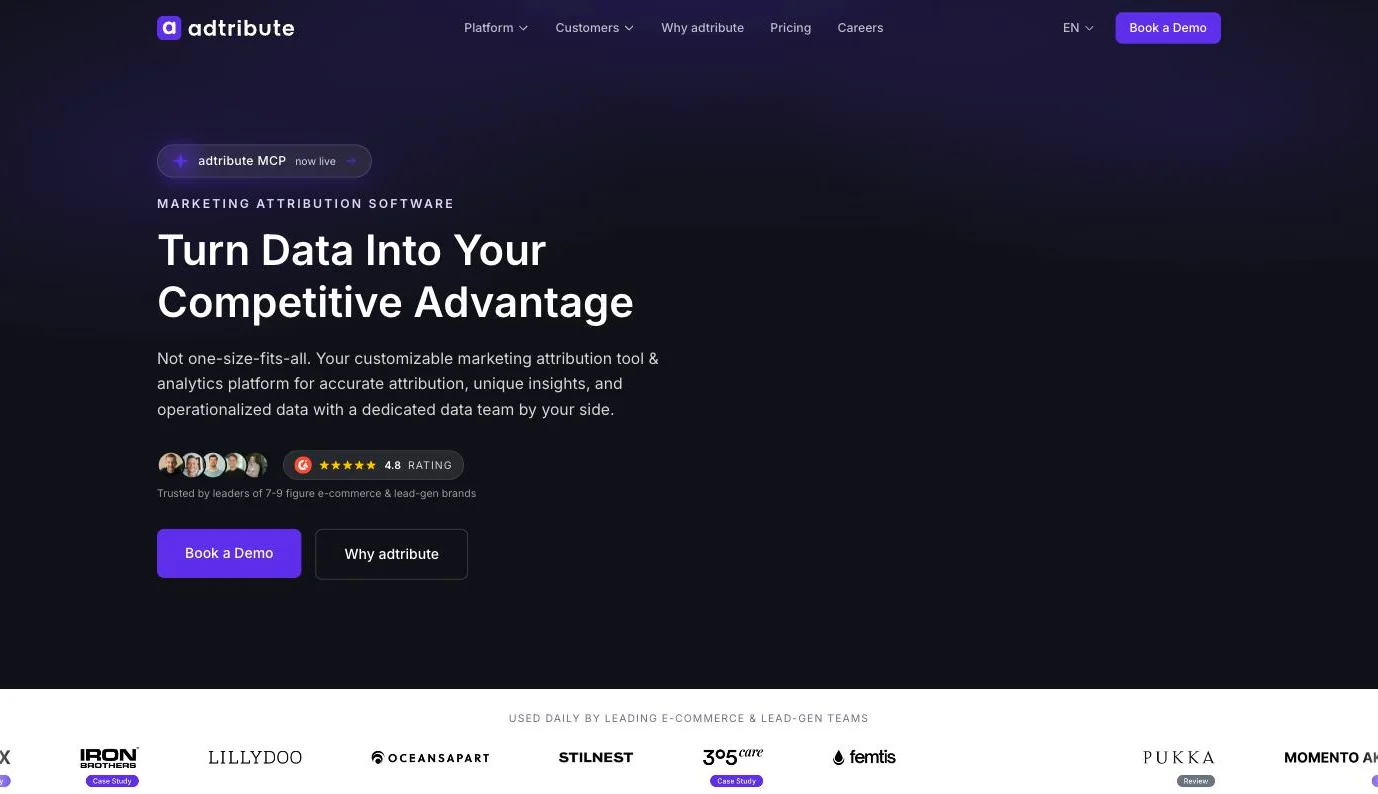
The list splits into three camps. Attribution suites and signal tools (Triple Whale, Adtribute, Reaktion, Northbeam, Tracify), a warehouse-native data stack (Polar Analytics) and profit and LTV apps (Lebesgue, Lifetimely).
Budget automation is rare. Admetrics' Ad Pilot moves Meta budgets inside your limits, and Triple Whale's Moby 2 and Polar's Operator change budgets after approval. Reaktion feeds POAS into Google and Meta bidding, and everything else leaves the budget move to the media buyer.
EU data residency narrows the field. Admetrics and Tracify host in Germany, Adtribute in the EU and Reaktion in Stockholm and Frankfurt.
Why ecommerce brands leave Klar
No server-side conversion feed to the ad platforms. Klar's first-party pixel and server-side endpoint recover conversions that browser pixels lose, but there's no CAPI enrichment or S2S feed to Meta, Google or TikTok. "Sending data back to platforms" sits on Klar's roadmap for Q1 2027. Until then, every ad algorithm keeps bidding on its own pixel's data, signal loss included, and a buyer the platform never sees is a buyer it won't look for again.
No budget automation. Klar shows CM3 per SKU and MMM saturation curves, but every budget change still happens by hand in the ad platforms, and its hosted MCP is read-only: "nothing in your Klar account can be changed through it." A Meta campaign spending €1,000 a day at a 3.6 ROAS can still lose €100 a day after COGS, returns and shipping. Klar will show that, and on a weekly review cycle the campaign burns another €700 before anyone cuts it (illustrative numbers).
The bill is re-rated on trailing net revenue every quarter. Both plans price on the last 12 months of net revenue, after returns and taxes, and monthly plans are re-rated every three months. A growing brand pays more each quarter even when its ad spend and the way it uses Klar stay the same.
How we ranked Klar alternatives
We scored every tool on four criteria, the same ones we use across our comparison pages. Prices and features are as of October 2026.
▪Attribution and tracking accuracy. Whether orders are captured first-party and server-side, which models you can compare, data-driven included, and whether MMM, incrementality or geo-lift sit on top.
▪Data foundation. Which store systems, ad channels and cost sources connect natively (Shopware, Magento and JTL matter for many Klar users), whether the data comes back out through an API, MCP or warehouse export, and where it's hosted.
▪Profit over revenue. Whether COGS, shipping, payment fees and returns land per order and roll up to CM2, CM3, POAS and EBITDA, or the tool stops at ROAS.
▪What happens after attribution. Whether enriched conversions go back to the ad platforms through CAPI or S2S, and whether anything moves budget inside limits you set, with every change logged.
Klar alternatives comparison 2026
#
PLATFORM
ATTRIBUTION
PROFIT CONTROL
S2S PUSHBACK
ACTION
1
Admetrics
Server-side, 9 models + custom, MMM
CM2, CM3, POAS to SKU, P&L to EBITDA
6 platforms (add-on)
Ad Pilot executes on Meta
2
Triple Whale
Triple Pixel, 8 models, MMM and GeoLift add-ons
Net profit, no CM2 or CM3
Sonar: Meta, Google, TikTok and more
Moby 2 on Meta, with approval
3
Polar Analytics
Server-side pixel, multi-touch, geo-lift (Custom)
Profit and CM by channel and product
Meta, Google
Operator in Slack, on approval
4
Adtribute
First-party pixel, 7 models + custom
CM1 to CM3
Meta, Google, Outbrain, Taboola
No
5
Reaktion
Server-side, UTM attribution
POAS after returns, returns per SKU
Google, Meta, TikTok
POAS fed into Google and Meta bidding
6
Northbeam
First-party MTA, MMM+, incrementality
No
Apex, Meta only
No
7
Tracify
Hybrid server-side, AI attribution
P&L with contribution margin
Meta only
No
8
Lebesgue
Le Pixel S2S, MMM (beta)
COGS and profit tracking
Meta (Le Pixel)
AI recommendations
9
Lifetimely
UTM first and last touch, survey
Daily P&L, CM, LTV cohorts
No
Profit Agent, on approval
Admetrics
★5.0
Best for: ecommerce brands spending across several ad platforms that want CM3 per campaign, CAPI enrichment and budget moves in one tool, without hiring a data team.
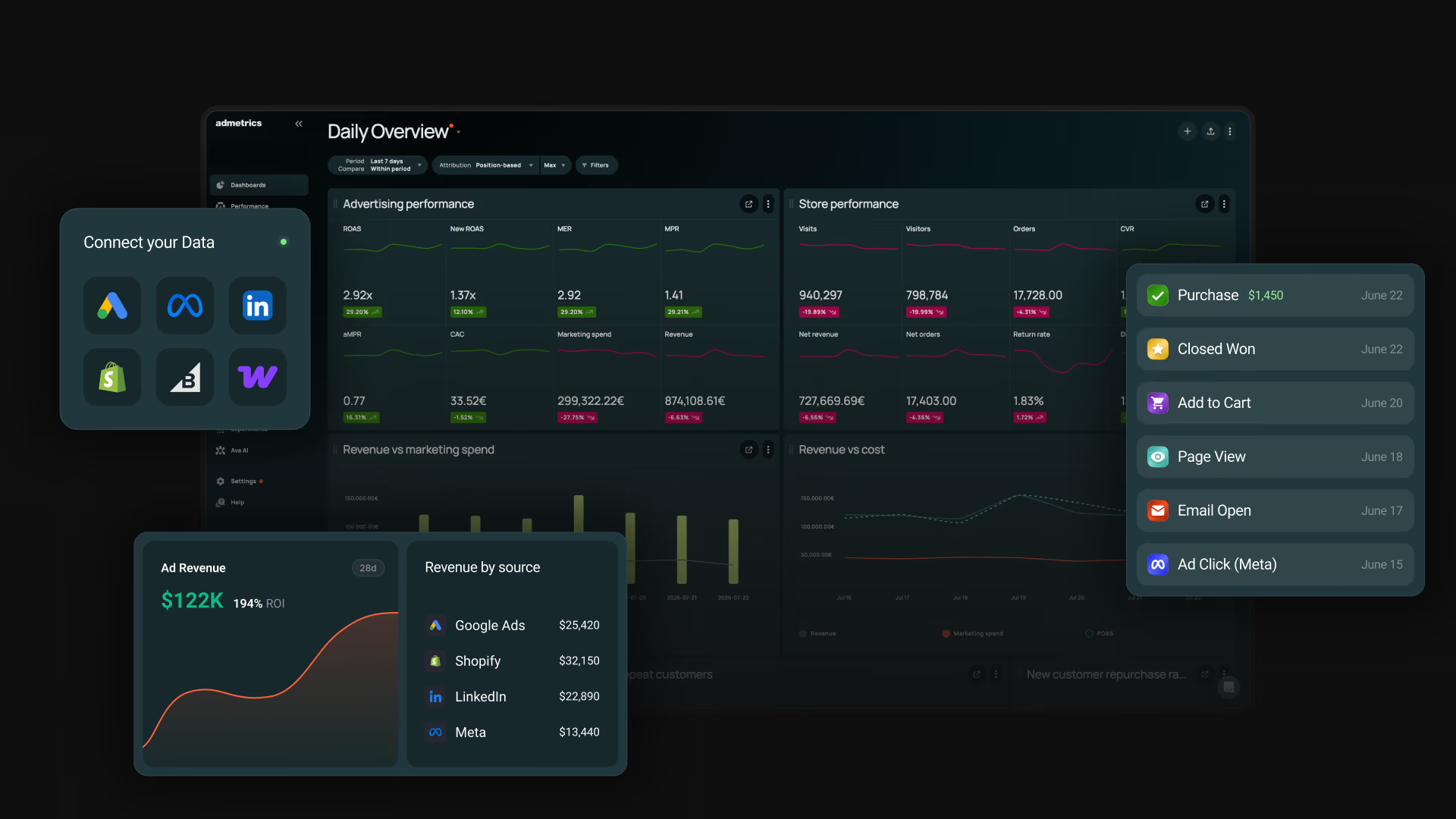
Admetrics matches Klar on profit depth and carries the number into the ad accounts. It tracks every order server-side, prices it down to the SKU, sends the enriched conversion back to six ad platforms and, with Ad Pilot, moves Meta budgets toward a profit target inside the limits you set. Setup takes about an hour.
Key features
▪First-party server-side tracking. Orders are captured server-side with cross-device journeys, unlimited lookback windows and every touchpoint behind a single order.
▪Nine attribution models plus custom rules. Multi-touch and data-driven models side by side, and a Chrome extension that puts Admetrics numbers inside the Meta, Google and TikTok ad managers.
▪CAPI enrichment to six platforms.S2S pushback of new-customer flags and margin-true conversion values to Meta, Google, TikTok, Snapchat, Outbrain and Taboola.
▪P&L to EBITDA, profit down to the ad. Gross revenue through discounts, returns, taxes, COGS, shipping, payment fees, logistics and marketing to EBITDA, with CM2, CM3, POAS and MER by SKU, campaign and single ad, and returns by campaign and product.
▪Ad Pilot and budget management.Ad Pilot changes budgets and on/off status every hour within user-set limits, with every change logged and reversible. Budget management for Meta, Google, TikTok and Microsoft is on every plan.
▪PRISMA MMM and Budget Optimizer. The marketing mix model retrains nightly and gives you response curves and budget scenarios.
▪Ava, MCP and Data API. Ava answers profit and performance questions from your own data, and the MCP and Data API on every plan let ChatGPT or Claude "query your attribution and budgets - and act on them."
▪Refresh and coverage. Data updates every 4 hours on Growth and Business (60- and 30-minute add-ons) and every 2 hours on Custom. Shopify, Shopware, WooCommerce, Magento, JTL, Amazon and custom stores connect, with 40+ integrations and customer matching across stores and Amazon on Custom.
▪Data residency in Germany. Servers in Germany, GDPR compliant.
Strengths
It acts on the profit number. Ad Pilot pulls budget from a losing Meta campaign within the hour, inside your limits, instead of at the next weekly review.
The ad platforms get enriched server-side conversions today, on six platforms, where Klar has pushback on its roadmap for Q1 2027.
Profit reaches ad level, with returns traced back to the campaign that sold them and new, returning and reactivated customers split out.
It's fast to try: setup in about an hour and a 21-day free trial with no credit card. Freiluftkind's Lukas Westensee reports "capturing 30% more data than our previous tool."
Limitations
No geo-lift or incrementality tests. Experiments are Bayesian A/B/n tests, while Klar, Triple Whale and Polar run geo-lift.
MMM and the Budget Optimizer are Custom-plan add-ons. Growth and Business get attribution, profit and budget management, but not PRISMA.
Ad Pilot runs on Meta only for now. Google is next, and Ad Pilot is an add-on from Business.
Pricing
Growth costs $399/month and includes the first $20,000 of monthly ad spend, with 1.5% above that. Business costs $899/month with $70,000 included and 1% above, and Custom is quoted for brands spending more than $100,000. Annual billing saves 15%, and the 21-day free trial needs no card. S2S conversion pushback is an add-on on every plan, Ad Pilot from Business, and PRISMA and the Budget Optimizer on Custom. Where Klar's bill follows trailing net revenue, this one follows ad spend.
Reviews
Admetrics holds 5.0 from 15 reviews on the Shopify App Store and 4.8 from 3 on G2 (checked October 2026).
Bottom line
If Klar gives you the right profit number and you still move budgets by hand on it, Admetrics keeps the P&L depth and closes the loop, with CAPI enrichment to six platforms and Ad Pilot acting inside your limits.
Best for: Shopify brands that want a free starting point, signal enrichment across many ad platforms and an AI agent that acts on Meta with approval.
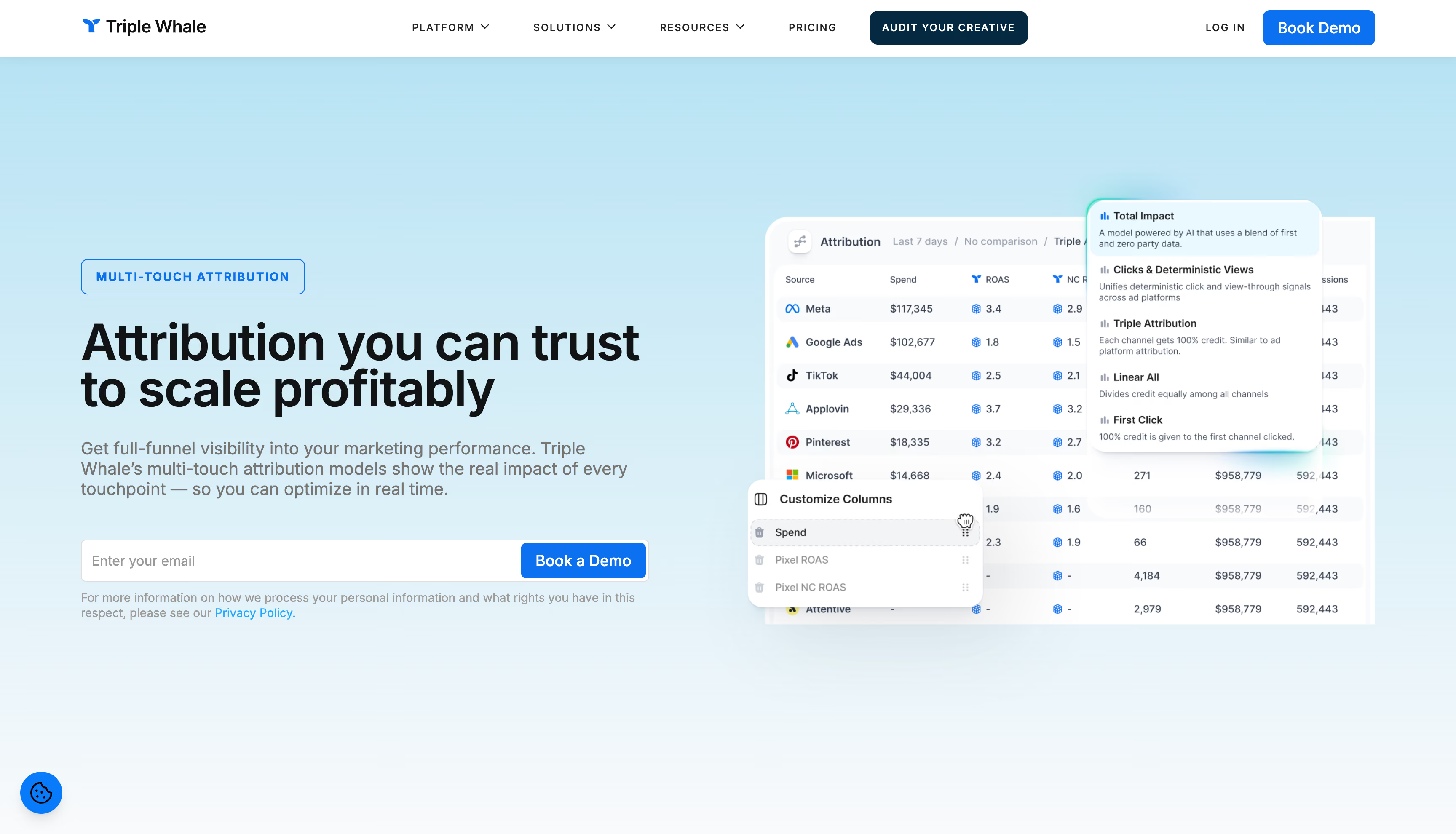
Triple Whale is a dashboard-first suite: pixel, attribution, MMM, signal enrichment and the Moby agent in one interface, with a free plan to start. For a Klar user, it trades profit depth for action.
Key features
▪Triple Pixel and eight models. Total Impact, Triple Attribution, Linear, First Click and Last Click among them, plus a post-purchase survey.
▪Compass MMM and GeoLift. Included on Enterprise and paid add-ons on eligible lower plans.
▪Sonar Optimize. First-party conversion data goes to Meta, Google Ads, TikTok and other platforms.
▪Net profit. COGS, shipping, payment gateway fees and custom expenses roll up to net profit.
▪Moby 2. Pauses, scales and launches variants on Meta; changes queue for approval unless your rules let it act alone.
▪60+ integrations. Shopify (including headless), WooCommerce, BigCommerce, custom builds such as Magento and Salesforce Commerce Cloud, Amazon, Walmart (beta) and TikTok Shop. SOC 2 Type 2, GDPR and CCPA.
Strengths
The free plan, with first and last click, 10 users and 12 months of data, lets you test the switch at no cost.
Sonar sends the signal back to Meta, Google and TikTok, where Klar sends nothing today.
Geo-lift is available through Compass.
Moby 2 proposes the budget move on Meta and a person presses the button.
Limitations
Profit stops at net profit. There's no CM2 or CM3 per campaign and no POAS; contribution margin is only a product-analytics KPI.
The MCP is read-only. An AI assistant can read the data but can't act on it.
There's no Shopware connector.
Paid plans run for 12 months, where Klar's monthly plans carry no long-term contract.
Triple Whale pricing
Triple Whale combines GMV-based pricing with the package you choose. The Shopify App Store lists Foundation at $219/month or $2,190/year and Automate at $749/month or $7,490/year, both as 12-month subscriptions. Enterprise is quoted, and the free plan costs nothing.
Triple Whale reviews
Triple Whale holds 4.1 from 93 reviews on the Shopify App Store and 4.5 from 482 on G2 (checked October 2026).
Bottom line
Triple Whale is a step back from Klar on profit and a step forward on action. It fits a Shopify brand that wants to start free and is happy to work out CM3 elsewhere.
Best for: Shopify brands with an analyst who want warehouse-native BI and SQL access.
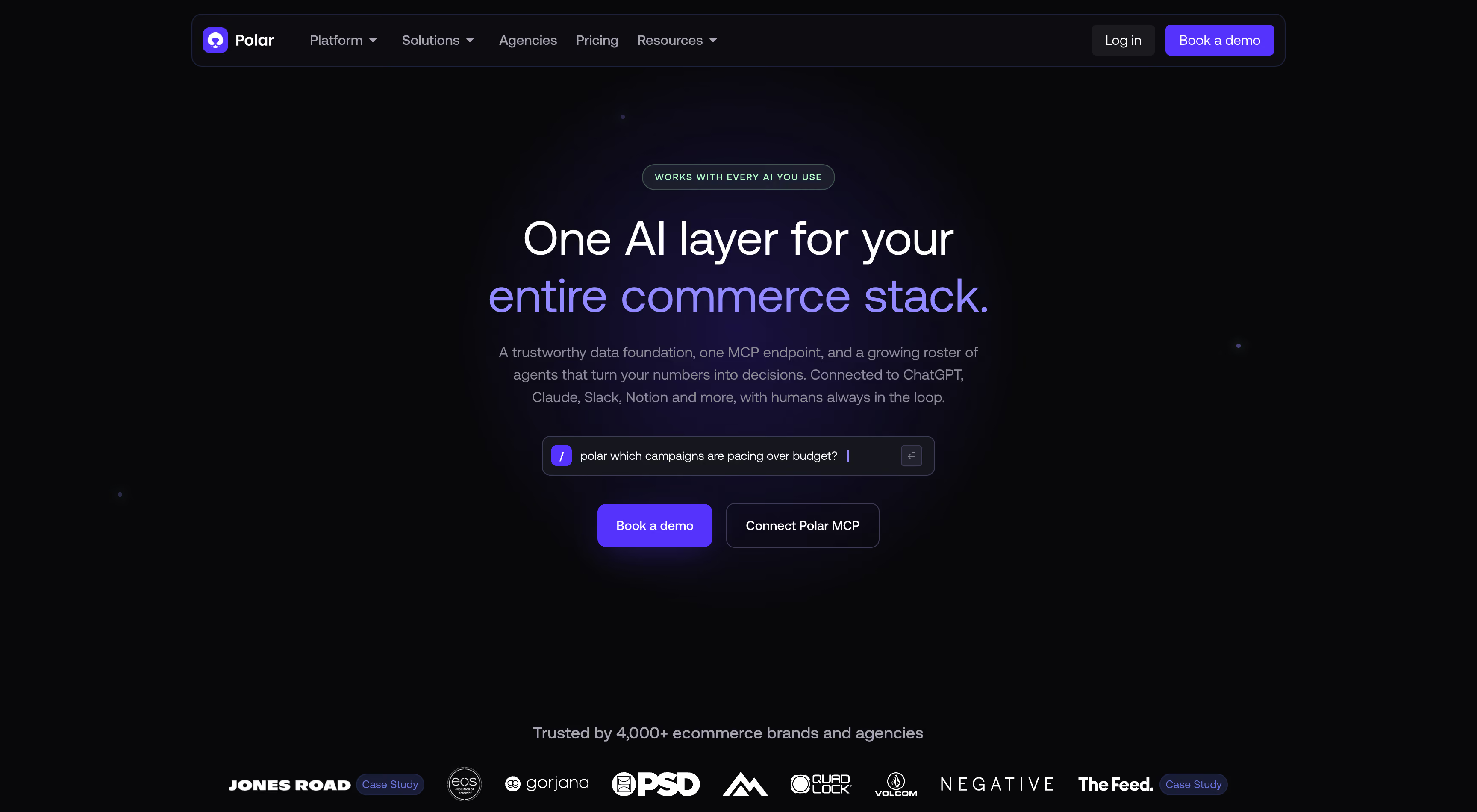
Polar is warehouse-native BI: a dedicated Snowflake instance per customer, with a semantic layer and attribution on top. Moving from Klar to Polar trades profit depth and shop-system coverage for raw data access.
Key features
▪Server-side first-party pixel. Served from your own domain, with multi-touch models and view-through attribution.
▪Lift tests. Geo-lift on Meta, Google, TikTok and TV, run with a dedicated Polar data scientist on the Custom plan.
▪Advertising Signals. CAPI enrichment to Meta and Google.
▪Profit and LTV. Profit, contribution margin, LTV and cohorts by channel and product, plus inventory planning.
▪AI agents and MCP. Ask Polar, AI agents, an MCP for Claude and ChatGPT, and Polar Operator in Slack for Meta, Google Ads, Amazon Ads and Klaviyo.
▪Shopify-first connectors. One-click Shopify, Amazon Seller and Vendor Central, and marketplaces such as Bol.com and Otto; custom connectors on request.
Strengths
The data is yours to query in a dedicated Snowflake warehouse.
CAPI enrichment to Meta and Google closes the signal gap Klar leaves open.
Operator shifts budgets and pauses ads, with every change outside Polar "held for human confirmation."
Limitations
A lighter profit layer. There's no P&L to EBITDA and no SKU-level CM3.
No Shopware, WooCommerce or Magento connector, which rules Polar out for Klar users on those systems.
No MMM. Polar's own comparison page says its "MMM is in development."
The warehouse needs an analyst. Without one, most of what Polar adds over Klar goes unused.
Polar Analytics pricing
Polar uses GMV-based pricing. The pricing page shows a Core and a Custom plan without figures, and the Shopify App Store lists Core from $750/month, with discounts for annual terms. There's no free plan.
Polar Analytics reviews
Polar holds 4.9 from 116 reviews on the Shopify App Store and 4.7 from 23 on G2 (checked October 2026).
Bottom line
With an analyst and a Shopify store, Polar swaps some of Klar's profit depth for open data, CAPI enrichment to Meta and Google and budget moves once someone approves them. On Shopware, or with nobody to work the warehouse, Adtribute fits better.
Best for: German brands on Shopware or Shopify that want CM1 to CM3 with first-party tracking and conversion postbacks, hosted in the EU.
Adtribute is the closest to Klar in setup: built in Germany, hosted in the EU, priced partly on net revenue, with Shopware 5 and 6 supported. Unlike Klar, it already sends attributed conversions back to the ad platforms.
Key features
▪First-party tracking. Adtribute calls it "ITP, ETP, and ad blocker proof," with cross-device stitching.
▪Seven models plus custom. First-touch, last-touch, last non-direct, linear, time-decay, position-based and data-driven.
▪Conversion postbacks. Attributed conversions go to Meta, Google, Outbrain and Taboola, as part of the Actions add-on.
▪CM1 to CM3. P&L dashboards with CM1, CM2 and CM3, plus cohort, LTV and retention dashboards.
▪MCP and BI. An MCP for Claude, ChatGPT and Gemini, BI dashboards and a semantic layer.
▪German shop systems. Shopify, Shopware 5 and 6, WooCommerce, Plentymarkets and others; Magento through custom integrations; Amazon via Sellerboard on Insights. Unlimited users.
Strengths
Conversions go back to four platforms today, where Klar's pushback is a Q1 2027 roadmap item.
Plentymarkets connects, alongside Shopware 5 and 6.
"Built in Germany. Hosted in the EU. GDPR compliant." keeps data residency where Klar users expect it.
Limitations
No MMM or incrementality tests. Klar's €400 plan has both.
The P&L stops at CM3, where Klar runs to EBITDA and shows CM3 per SKU.
Postbacks, no budget changes. Budgets still move by hand.
Built for bigger brands. Adtribute names €3M+ and €10M+ yearly net revenue as the best fit for its plans, while Klar says it makes sense from €1M.
Slower start. "Most brands are live within 1 to 2 weeks," against Klar's two-hour onboarding.
Adtribute pricing
Pricing depends on net revenue and features, billed monthly or yearly. The pricing page shows Attribution at €449/month (€499 struck through) and Insights at €549/month (€649 struck through), and Adtribute's directory page gives €449 as the annual rate for Attribution. Add-ons run from €89/month (Data Warehouse Exports) to €1,499/month (Data Team). Like Klar's, the bill moves with net revenue.
Adtribute reviews
Adtribute holds 4.8 from 24 reviews on G2 and 5.0 from 7 on OMR Reviews. It has no Shopify App Store listing (checked October 2026).
Bottom line
Adtribute is the closest like-for-like move for a Klar user on Shopware who wants conversions back in Meta and Google without giving up EU hosting. You give up MMM, geo-lift and the EBITDA end of the P&L, and budgets still move by hand.
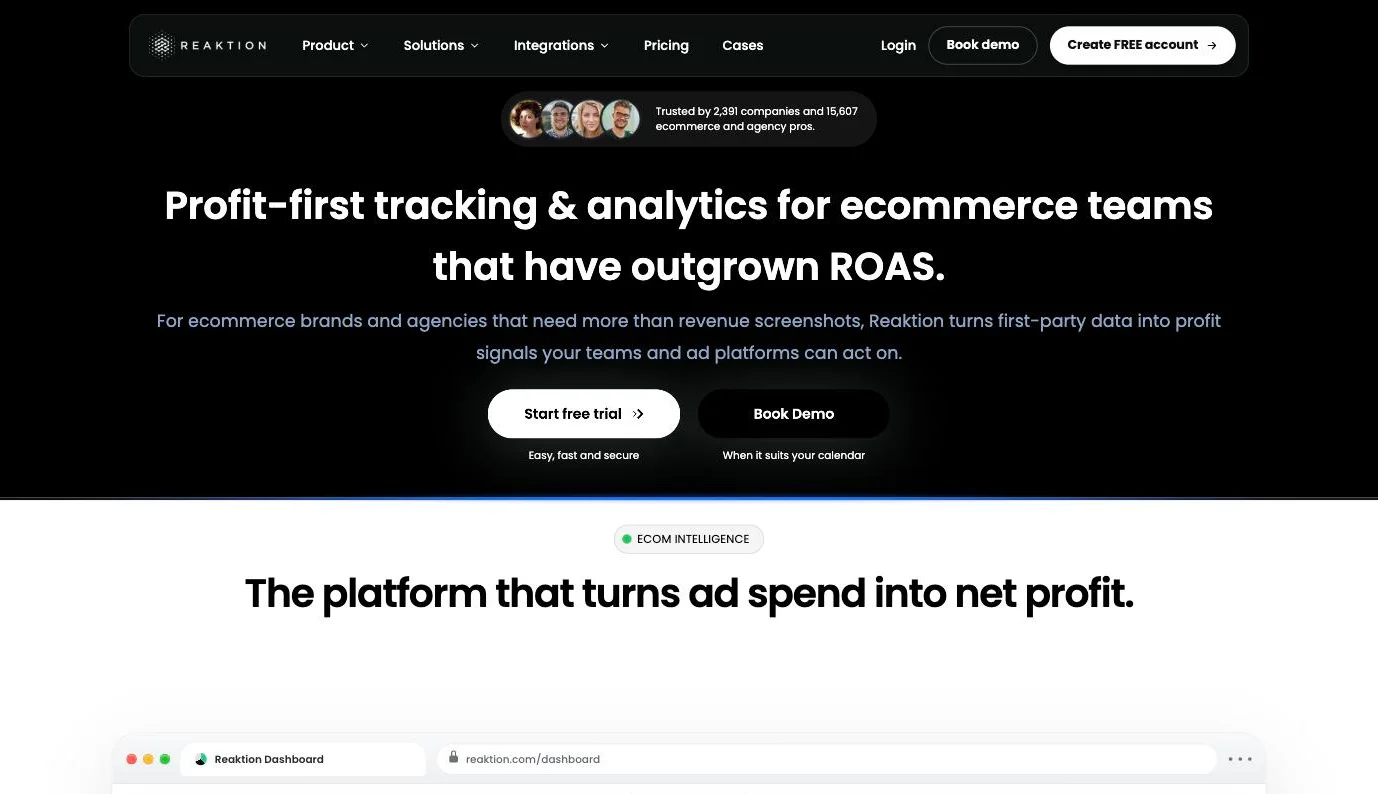
Reaktion
★4.7
Best for: small stores that want Google and Meta bidding on POAS after returns.
Reaktion is for teams that have moved past ROAS and want the ad platforms bidding on margin. Its server-side tracking feeds profit after returns and refunds back to Google and Meta, so the bid runs on POAS today. Klar measures profit in more depth but sends none of it to the platforms.
Key features
▪Server-side tracking. Events go to Google, Meta, TikTok, GA4 and Klaviyo, Consent Mode V2 compliant.
▪POAS bidding. Profit after returns and refunds is fed into Google and Meta bidding.
▪Returns and costs. Returns down to SKU and variant, product-level costs and a near real-time P&L.
▪Retention. CLV and LTV cohorts with RFM segmentation.
▪Wide shop list. Shopify (including Plus and headless), WooCommerce, Magento, BigCommerce, PrestaShop, Shopware, DanDomain and Norce; other sources, Bing among them, via Sheets.
▪EU data centers. Stockholm and Frankfurt. Reaktion says setup takes under 10 minutes.
Strengths
Profit reaches the bidding on Google and Meta now.
Shopware, Magento, BigCommerce and PrestaShop all connect.
EU data centers and a low entry: $85/month for 250 orders, well under Klar's €200 Core.
Limitations
Attribution is UTM-based. There are no multi-touch models, MMM or incrementality tests; a broader attribution tool is marked "Coming soon."
No CM2, CM3 or EBITDA. The near real-time P&L stops short of the GMV-to-EBITDA walk Klar shows.
Bidding signals, no budget changes. Campaign budgets still move by hand.
No MCP.
Bing only via Sheets, and there's no JTL or Centra connector.
Reaktion pricing
Reaktion prices on orders and number of stores, billed monthly. The Shopify App Store lists Starter at $85/month (250 orders), Rise at $169 (1,000), Evolve at $349 (2,500) and Pro at $549 (5,000), with extra orders at $0.12 to $0.20 each depending on the plan. There's no free plan, and the trial runs 10 days (30 for agencies).
Reaktion reviews
Reaktion holds 4.7 from 28 reviews on the Shopify App Store and 4.9 from 7 on G2 (checked October 2026).
Bottom line
If what you mainly want is Google and Meta bidding on POAS, Reaktion is a low-cost way to get there. It replaces little of Klar's attribution and none of its MMM or geo-lift, so some brands run it alongside Klar.
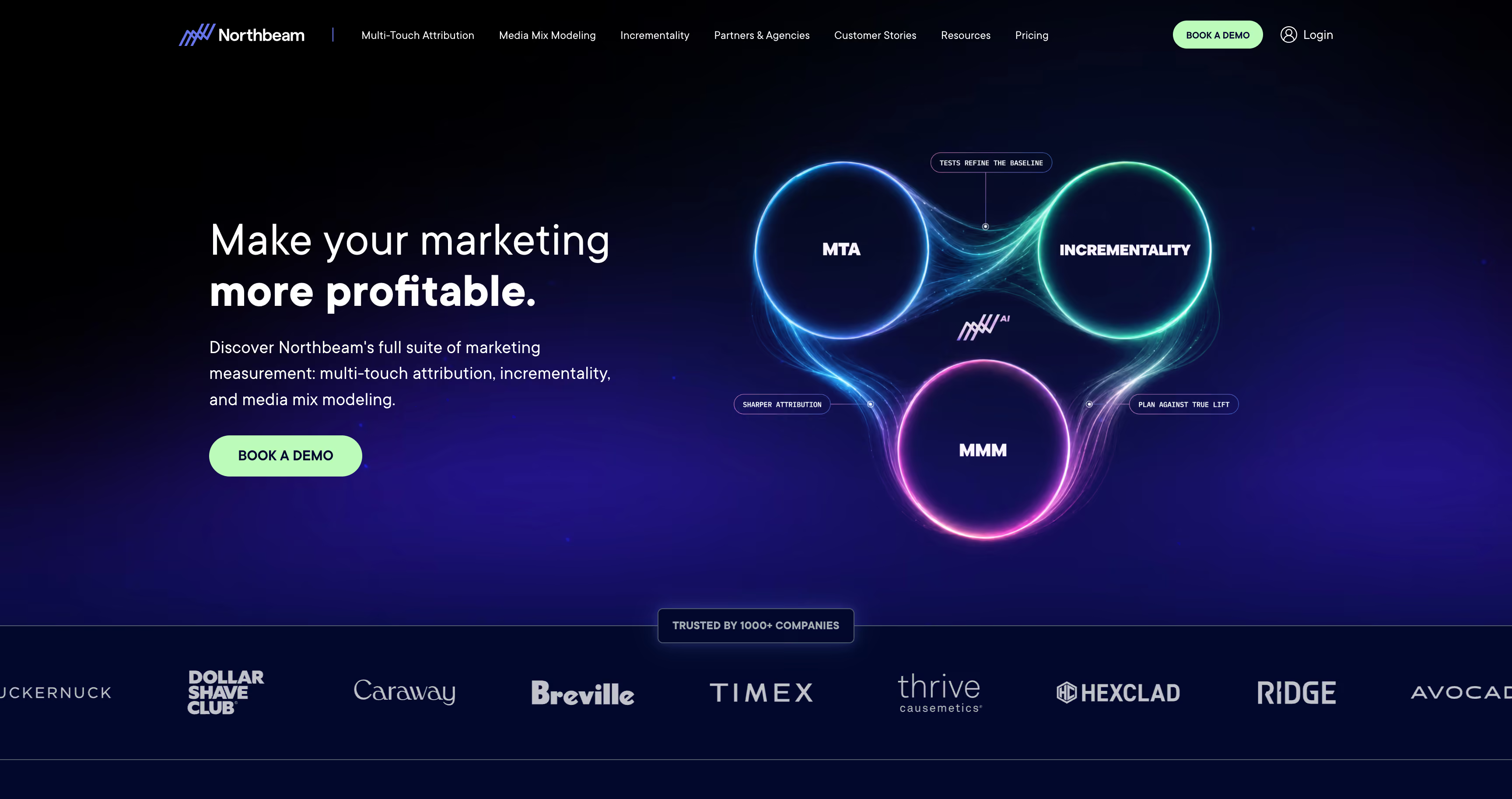
Northbeam
★5.0
Best for: brands spending seven figures a year on paid media that want first-party MTA with MMM+ and incrementality to grow into.
Northbeam is a paid-media measurement platform, with plans sized by ad spend. On measurement it's at least level with Klar, and on profit it's the furthest from Klar of any tool here.
Key features
▪First-party pixel. Runs on your own subdomain, with server-side order data as the source of truth.
▪MTA with deterministic views. First Touch, Last Touch, Linear and Clicks-Only, plus Clicks + Deterministic Views, with "infinite" lookback windows.
▪MMM+ and incrementality. MMM+ with daily forecasts and budget scenarios on Enterprise, and an incrementality product optional on Professional and Enterprise.
▪Northbeam Apex. Order-level data goes to Meta via CAPI; the docs also list AppLovin and Snap (closed beta).
▪Read-only MCP. On every plan, for ChatGPT and Claude.
▪Integrations. Native order sync for Shopify and Amazon, a Custom Orders API for the rest, and ad integrations from Meta and Google to The Trade Desk, Tatari and MNTN. Google Cloud, SOC 2 Type 2, and a DPA and SCCs on request.
Strengths
MTA, MMM+ and incrementality in one product put it level with the strongest tools here on measurement, ahead of Klar.
Apex sends the signal back to Meta.
Ad coverage reaches CTV and programmatic channels such as Tatari and MNTN.
Limitations
No profit layer. There's no COGS or contribution-margin input, so POAS and CM3 aren't native.
The highest entry on this list. Starter is $1,500.
Native order sync covers Shopify and Amazon only. Shopware, Magento and JTL go through the Custom Orders API, which starts on Professional at $3,500/month.
No budget automation. MMM+ recommends, and the media buyer makes the move.
Northbeam pricing
Northbeam prices on pageviews, with plans framed by ad spend. Starter shows $1,500 for brands spending under $1.5M a year on ads, Professional $3,500/month on an annual contract, and Growth and Enterprise are quoted. There's no free plan or trial.
Northbeam reviews
Northbeam holds 5.0 from 2 reviews on the Shopify App Store and 4.5 from 16 on G2 (checked October 2026).
Bottom line
Northbeam trades Klar's P&L for heavier measurement and a signal back to Meta. It fits a high-spend team that wants MTA and MMM+ in one place and keeps profit reporting somewhere else.
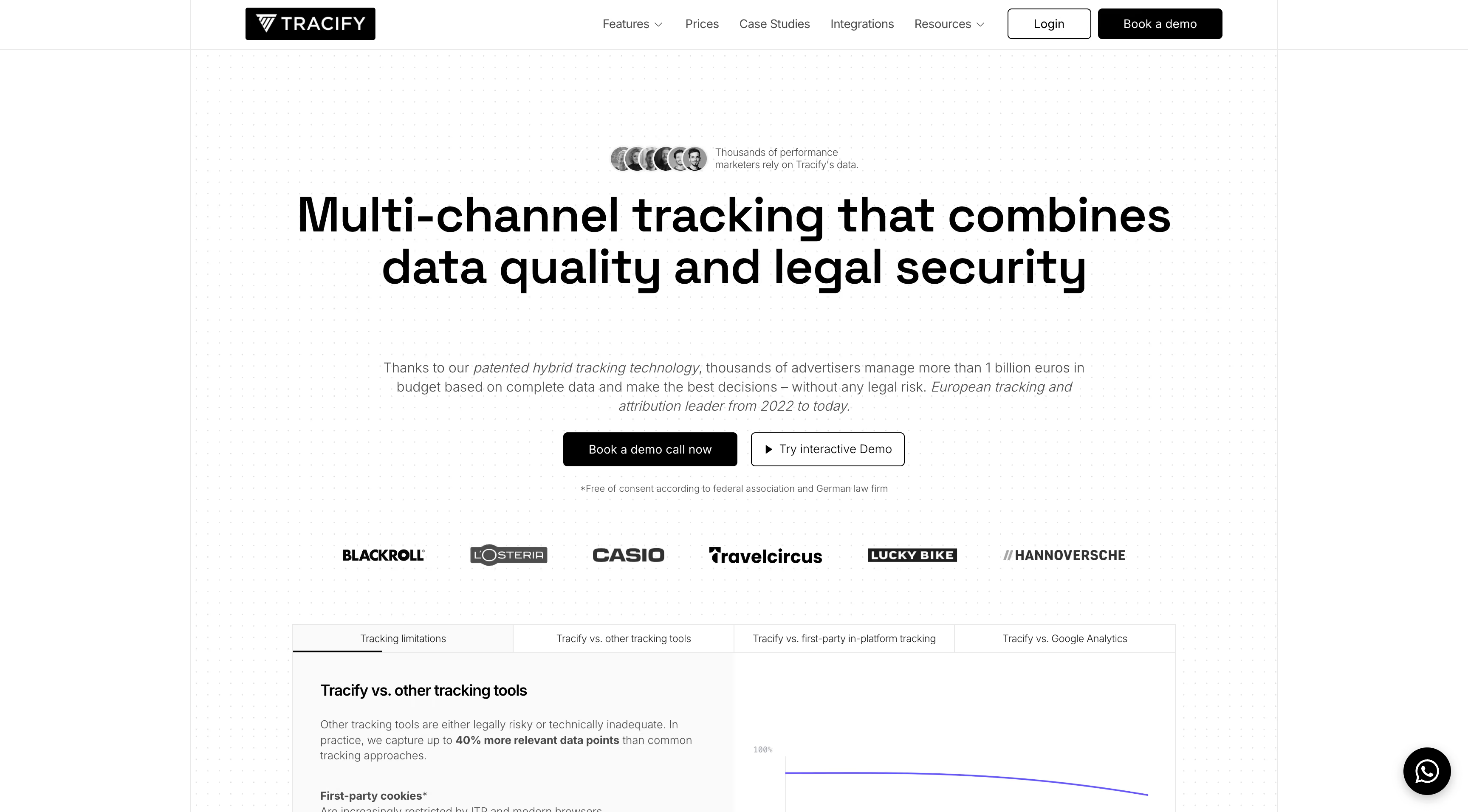
Best for: German brands whose main problem is signal loss on Meta and that want consent-independent tracking hosted in Germany.
Tracify replaces Klar's tracking half, not its reporting. It sells "patented hybrid tracking technology," described as "cookie-free and consent-independent," scores each touchpoint by its incremental value, and sends the conversions it detects back to Meta.
Key features
▪Hybrid server-side tracking. Consent-independent tracking, with first-party cookie tracking added where a visitor consents, plus AI Matching across devices and sessions.
▪AI Attribution. Each touchpoint is rated by its incremental value, with unlimited attribution windows.
▪Meta conversion pushback. Conversions Tracify detects go back to Meta Ads through a dedicated Meta dataset.
▪P&L dashboard. Net revenue, contribution margins, COGS, AOV and refunds, with configurable shipping, handling, transaction and general costs.
▪Chrome extension. Tracify data inside the Meta, Google and TikTok ad managers.
▪Integrations and hosting. Shopify and Shopify Plus, WooCommerce, Shopware 5 and 6, Magento, Ablefy and custom shop systems on request; webhooks, an API and an MCP server. Servers in Munich and Frankfurt, with no processing outside the EU.
Strengths
Data residency is settled: every system runs in Germany, a step more specific than Klar's "Europe."
Meta optimizes on conversions from consent-independent tracking, which cuts signal loss on the biggest channel.
Shopware 5 and 6 and Magento connect natively.
Limitations
No MMM or geo-lift.
A shorter P&L. Contribution margins are there, but there's no EBITDA, SKU-level CM3 or POAS.
No LTV or cohort reporting.
Pushback reaches Meta only, and there's no budget automation.
No app tracking, per the German pricing FAQ.
Tracify pricing
Tracify starts at €500/month ("ab 500 €/Monat" on the German page) and doesn't disclose plan names or a pricing basis. There's no free plan; testing runs in pilot phases agreed in a demo. That's above Klar's €400 attribution plan.
Tracify reviews
Tracify holds 4.9 from 13 reviews on G2 and 4.8 from 143 on OMR Reviews (checked October 2026).
Bottom line
Tracify fits a brand that needs cleaner Meta signal and data kept in Germany. Profit, retention and budget decisions still happen in another tool.
Lebesgue
★4.9
Best for: small Shopify and WooCommerce stores that want profit tracking and LTV on a budget.
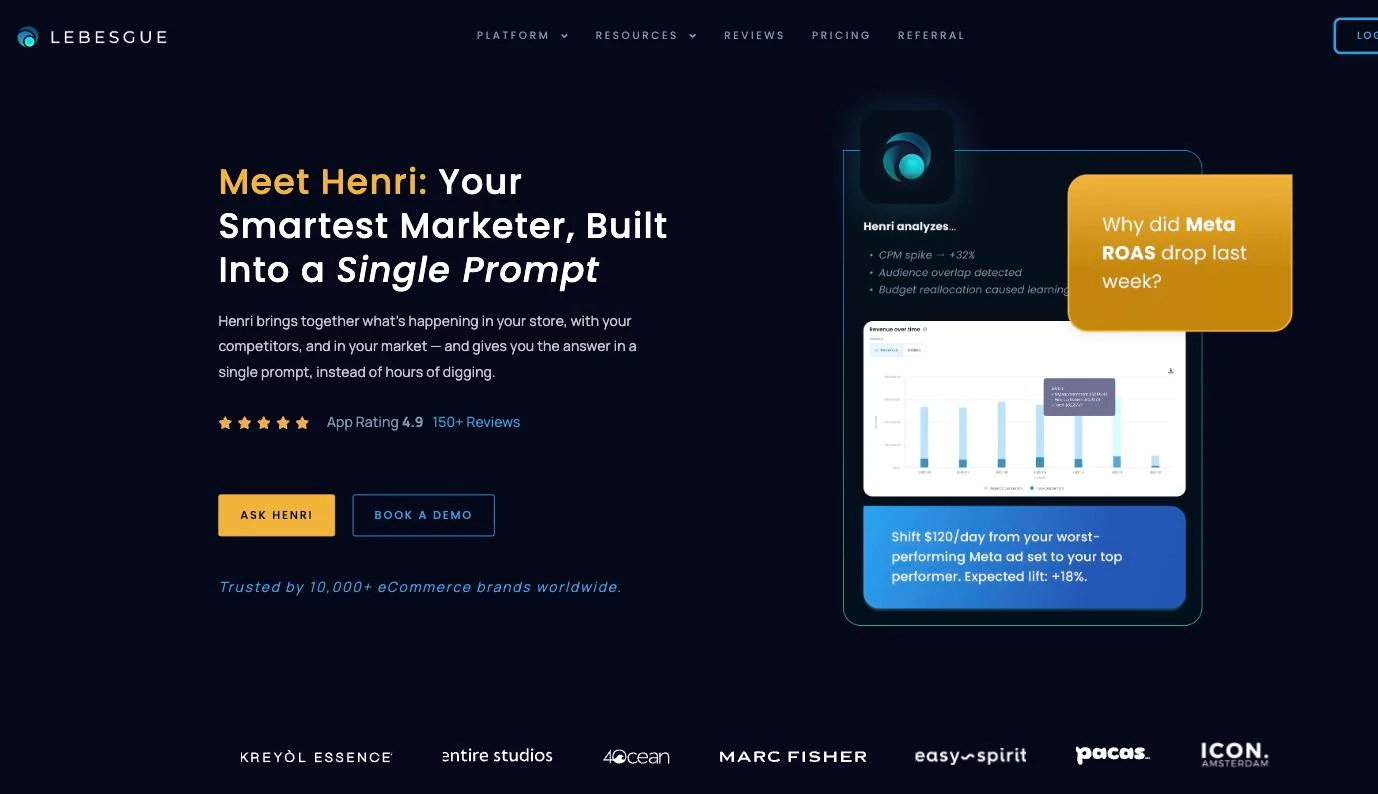
Lebesgue runs on Shopify and WooCommerce only, which is the first filter for a Klar user. It brands the product "AI CMO": analytics, profit tracking and AI agents in the main app, and attribution in Le Pixel, sold as the top plan and as a separate app.
Key features
▪Le Pixel. First-party pixels, server-to-server connections and multiple models, game-theory attribution included, with the Meta Conversions API.
▪MMM (beta). A weekly-updated PDF report, with at least three months of data and $5,000+ monthly ad spend suggested.
▪Profit and LTV. COGS and profit tracking, custom costs, and LTV and cohorts by product, state or count.
▪Henri AI. AI agents with data-backed recommendations; Ultimate AI lists "AI bid management via Henri AI" and "Ad budget allocation recommendations."
▪Integrations. Meta, Google, TikTok, Klaviyo, GA4 and Amazon.
Strengths
A free plan covers store performance and profit tracking.
Le Pixel sends conversions back to Meta through the Conversions API.
LTV and cohorts come close to what a Klar Core user reads today.
Limitations
Shopify and WooCommerce only. There's no Shopware, Magento, JTL or Centra connector.
Attribution is the expensive part. Le Pixel costs $749/month, more than Klar's €400 attribution plan.
MMM is in beta, with no incrementality tests.
Profit stops short of Klar's. There's no contribution margin or POAS.
Lebesgue pricing
The Shopify App Store lists Free, Ultimate at $79/month ($711/year), Ultimate AI at $149/month ($1,341/year) and Le Pixel at $749/month ($6,741/year). Paid plans include a 14-day free trial, and MMM is free for early-access users during the beta.
Lebesgue reviews
Lebesgue holds 4.9 from 133 reviews on the Shopify App Store for the main app and 4.7 from 13 on G2; the separate Le Pixel app has one review (checked October 2026).
Bottom line
For a small Shopify or WooCommerce store leaving Klar mainly over price, Lebesgue covers profit tracking and LTV for free or close to it. Add Le Pixel, though, and the saving is gone.
Lifetimely
★4.9
Best for: Shopify brands that mainly need a daily P&L and LTV cohorts.
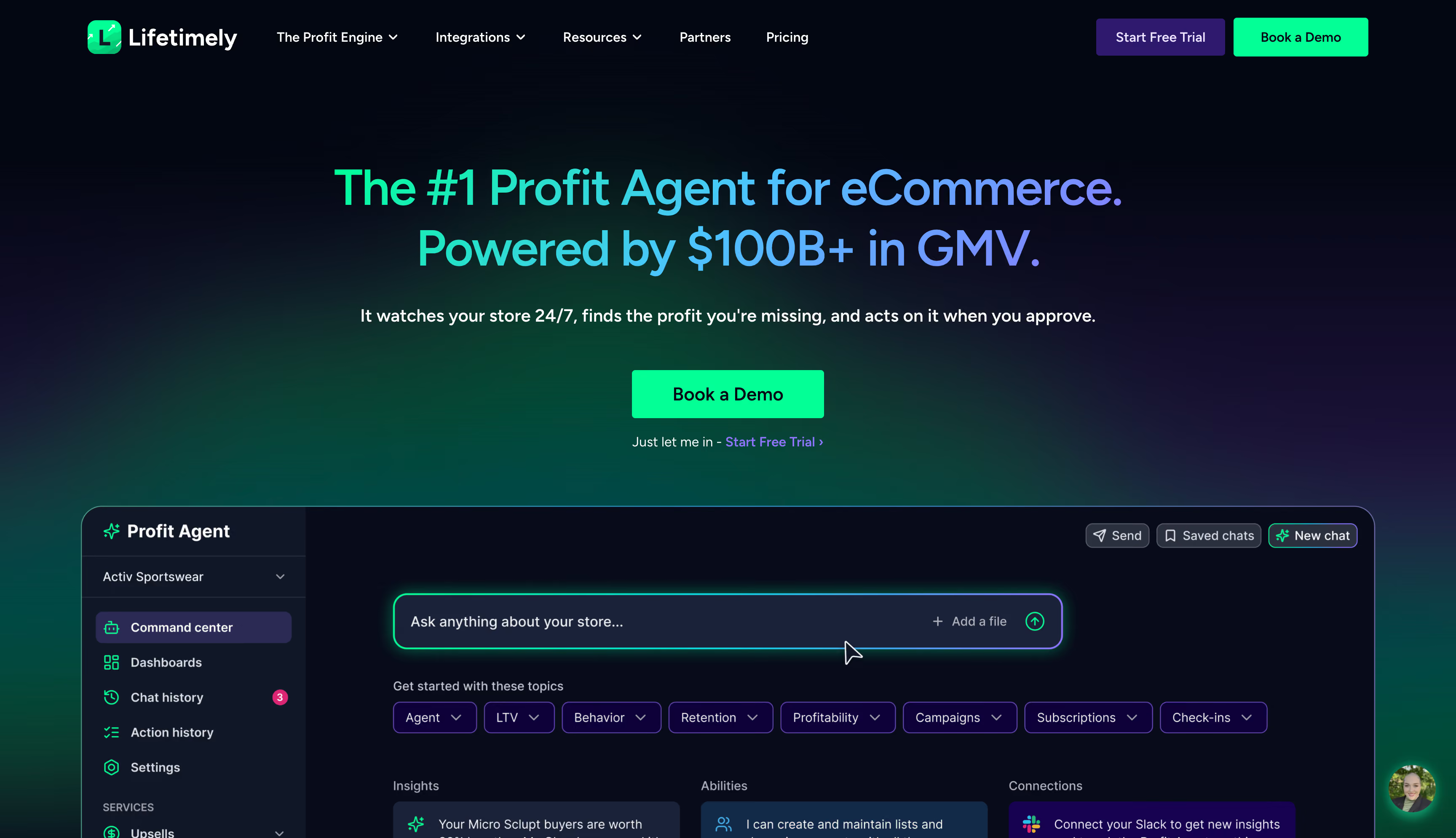
Lifetimely comes closest to Klar's Core plan, with a daily P&L, contribution margin and LTV cohorts, and falls furthest behind on attribution. It's part of AMP and operated by Lifetimely Singapore Pte Ltd.
Key features
▪Daily P&L. COGS, shipping, fees and opex, with contribution margin as net sales minus applicable variable costs.
▪Predictive LTV. LTV cohort reports with CAC, revenue and profit by segment and channel, CAC payback and a sales forecast.
▪UTM attribution. First touch and last touch for Facebook, Google and TikTok, plus a post-purchase survey.
▪Profit Agent and MCP. Profit Agent recommends a next move and waits for the merchant's approval; both it and the Lifetimely MCP are on paid plans.
▪Integrations. Shopify, with Amazon sales data as a $75/month add-on, and Meta, Google, TikTok, Pinterest, Snapchat, Bing, Klaviyo, ReCharge and QuickBooks Online. Historical import takes 30 minutes to 24 hours.
Strengths
Predictive LTV and a sales forecast sit next to the cohorts.
Profit reporting sits close to Klar's level.
The entry is low: free up to 50 orders a month, $49 up to 500.
Limitations
Attribution is UTM first and last touch on three ad platforms, with no server-side tracking, pushback, MMM or incrementality tests.
Shopify only. A Klar user on Shopware, Magento or JTL can't move.
AI inputs go to OpenAI. AMP names Amazon Web Services, WP Engine and Shopify as infrastructure and shares AI inputs with OpenAI.
No budget automation. Profit Agent recommends only.
Most costs are entered by hand.
Lifetimely pricing
Pricing follows monthly Shopify order volume: Free up to 50 orders, S at $49/month (500), M at $149 (3,000), L at $299 (7,000), XL at $499 (15,000), XXL at $749 (25,000) and Unlimited at $999 (25,000+). Plans S to XXL have a 14-day free trial.
Lifetimely reviews
Lifetimely holds 4.9 from 565 reviews on the Shopify App Store and has no G2 reviews (checked October 2026).
Bottom line
A Shopify brand on Klar Core that mostly reads the P&L and cohorts gets much of that from Lifetimely for less, plus predictive LTV. It doesn't replace Klar's attribution plan.
Best Klar alternative: final verdict
Admetrics is the best Klar alternative for most ecommerce brands. It keeps the P&L depth Klar users rely on, down to SKU-level CM3 and EBITDA on EU-hosted data, and adds what Klar leaves to your team: CAPI enrichment to six ad platforms and Ad Pilot moving Meta budgets hourly inside your limits. It runs on Shopify, Shopware, WooCommerce, Magento, JTL and custom stores, on German servers, from $399/month (Ad Pilot from the $899 Business plan).
The others fit narrower jobs. Triple Whale suits Shopify brands that want a free plan and an agent that acts with approval, from $219/month on Foundation, but stops at net profit. Polar Analytics fits teams with an analyst who want a Snowflake warehouse, from $750/month on Shopify. Adtribute is the EU-hosted Shopware option with conversion postbacks, from €449/month. Reaktion gets POAS into Google and Meta bidding from $85/month. Northbeam fits high-spend brands that want MTA with MMM+ and incrementality, from $1,500 on Starter. Tracify offers consent-independent tracking in Germany from €500/month, with pushback to Meta only. Lebesgue and Lifetimely cover profit and LTV on small budgets, with free tiers and attribution that stays thin.
Before you cancel Klar, check whether an annual plan locks your rate until its end date. Then run Admetrics next to Klar for the 21-day trial and compare the POAS and new-customer CAC each tool reports per campaign. A new pixel only sees visits from the day it's installed, so keep Klar live until the trial ends. For the two tools side by side, feature by feature, see Admetrics vs Klar.
++
Frequently Asked Questions
What are the best Klar alternatives?+
Admetrics is the most complete Klar alternative, with server-side tracking, CM2, CM3 and POAS down to the SKU, CAPI enrichment to six ad platforms and Ad Pilot moving Meta budgets inside your limits. Triple Whale suits a free start on Shopify, Polar Analytics a warehouse and SQL, Adtribute EU hosting with Shopware and postbacks, and Reaktion POAS bidding on a small budget. Northbeam and Tracify cover measurement and tracking, and Lebesgue and Lifetimely profit and LTV on a budget.
How much does Klar cost?+
Core starts at €200/month and Core + Attribution at €400/month, both priced on the last 12 months of net revenue after returns and taxes. Monthly plans are re-rated every three months, and annual plans lock the current rate. There are no setup costs, long-term contracts or free plan, and the 14-day trial starts once the account is set up. Klar says the product makes sense from €1M in annual net revenue.
What is Klar?+
Klar (getklar.com) is an ecommerce analytics platform from Klar Insights GmbH in Munich, unrelated to the payments company Klarna. It combines profit reporting from GMV down to SKU-level CM3 and EBITDA with CLV, cohort and retention reporting, and its Core + Attribution plan adds multi-touch attribution on a first-party pixel, MMM and geo-lift tests. The data is hosted in Europe.
Does Klar send conversions back to Meta and Google?+
No. Klar's roadmap lists sending data back to platforms for Q1 2027, and until then the conversions its pixel and server-side endpoint collect stay in Klar's reports. Admetrics sends enriched conversions to six platforms, and Triple Whale, Polar Analytics, Adtribute and Reaktion send them to Meta and Google, among others. Northbeam, Tracify and Lebesgue send them to Meta.
What's the best Klar alternative for Shopware brands?+
Admetrics connects Shopware next to Shopify, WooCommerce, Magento, JTL and custom stores, and adds CAPI enrichment and Ad Pilot on top of the profit view. Adtribute and Tracify support Shopware 5 and 6, and Reaktion connects Shopware too. Triple Whale, Polar Analytics, Lebesgue and Lifetimely have no Shopware connector, and Northbeam needs its Custom Orders API from the Professional plan.
Klar vs Polar Analytics: which fits an ecommerce brand?+
Klar is deeper on profit, with a P&L to EBITDA and SKU-level CM3, supports Shopware, Magento, Centra and JTL, includes MMM on its attribution plan and hosts data in Europe. Polar gives each customer a Snowflake warehouse, sends conversions to Meta and Google and shifts budgets after approval, but it's Shopify-first. Pick Klar if profit depth and EU hosting matter most, and Polar if you have an analyst who wants SQL. If you need CM3 and conversions sent to six ad platforms in one tool, Admetrics covers both.
Klar vs Triple Whale: which fits an ecommerce brand?+
Triple Whale has a free plan, sends first-party conversions back through Sonar Optimize and lets Moby 2 manage Meta ads with approval. Klar goes further on profit, hosts data in Europe, supports Shopware and offers monthly plans with no long-term contract, where Triple Whale's paid plans are 12-month subscriptions with GMV-based pricing. Pick Klar for profit depth and EU hosting, and Triple Whale for a free start and an agent on Meta. If you want both the profit view and the budget move, Admetrics covers both.
What do Klar reviews say?+
Klar holds 5.0 from 5 reviews on G2 and 4.8 from 129 on OMR Reviews. Its Shopify App Store listing, live since December 2023, has no reviews yet (checked October 2026).