Mission control
for e‑commerceFrom independent measurement to governed allocation. One closed loop, open to your entire stack.See how the system works →
9 best Hyros alternatives for ecommerce brands in 2026
Hyros ties the sale back to the click and stops before profit. We ranked 9 Hyros alternatives on tracking accuracy, data foundation, profit over revenue and what happens after attribution. Pricing, limitations and review patterns included.
Silvana Chirita·Updated October 22, 2026·30 min read
The best Hyros alternative for most ecommerce brands is Admetrics, which tracks conversions first-party and server-side on German servers, sends enriched conversions back to six ad platforms, and reports contribution margin and POAS down to the SKU with returns split by campaign, from $399 a month.
Hyros was built to tie a sale that closes on a call, a webinar or a funnel back to the first click. A store needs its attribution tool to show what each campaign earned after product cost, shipping, fees and the orders that came back.
Two of the nine alternatives take product costs into profit by campaign, and only one carries it all the way to contribution margin by campaign and a P&L. Three will change budgets or campaigns themselves, and the rest report or recommend.
Paid entry tiers run from $57 a month (SegMetrics) to $1,500 (Northbeam Starter), five of the nine let you start on a free plan or a free trial, and two publish no price at all. The cheapest tool that answers your actual question is worth more than the biggest one that answers somebody else's.
Hyros competitors split into four camps: profit-led ecommerce platforms, measurement suites with MMM, click and conversion trackers, and funnel and lead attribution tools.
Why ecommerce brands leave Hyros
For an ecommerce brand, Hyros falls short in four places.
Profit stops at revenue minus COGS, shipping and taxes. Hyros was built for funnels that close on a call, and its profit view shows it: COGS and profit per ad, but no CM2 or CM3, no POAS, no P&L and no SKU-level report. Refunds count per traffic source with no product breakdown and no link to margin, so a campaign that sells the product customers send back most looks as healthy as one whose orders stay sold.
Nothing acts on the number. Hyros has no MMM, no incrementality or geo-lift testing and no budget allocation. AIR, its newer AI product, is a remarketing agent billed per message. Hyros reports which ad drove the sale, and every budget move is still manual in each ad account.
The data sits in the US. Hyros's privacy policy says its servers and data centers are located in the United States. Transfers run under the EU-US Data Privacy Framework and standard contractual clauses, and Hyros claims a SOC 2 Type 2 attestation. With no EU data residency option, a European brand whose legal team wants customer data kept in the EU has a real blocker.
Hyros pricing is the other half of the story
Hyros prices its one plan on tracked monthly revenue, so the bill follows what Hyros attributes rather than what you spend. A strong quarter, a price increase or more email revenue can move you up a band while ad spend stays flat. Hyros's contracts renew for the same term unless you cancel at least 30 days before the end, and AIR is billed on top at $0.10 per message with a 500-message monthly minimum.
How we ranked Hyros alternatives
Four criteria, ordered by how much each one changes where next month's budget goes.
▪Attribution and tracking accuracy. How conversions get captured, how many models you get, and whether you can write your own credit rules. Server-side tracking and a first-party pixel are the baseline Hyros already set, and the recovered conversions should reach more than one ad platform.
▪Data foundation. Which store systems connect natively, where the data sits and whether there's EU data residency, and whether you can get it out through an API, a warehouse or an MCP.
▪Profit over revenue. Whether COGS, shipping, fees and returns reach the report. Revenue minus COGS is where Hyros stops. POAS and CM2/CM3 at SKU level, with returns charged to the campaign that sold the order, is the bar.
▪What happens after attribution. CAPI enrichment back to the ad platforms, a budget move you can execute, an AI layer that answers from your own data. Most tools report, a few recommend, and three change budgets or campaigns themselves.
Hyros competitors fall into four camps against those criteria: profit-led ecommerce platforms (Admetrics, Triple Whale), measurement suites with MMM (Northbeam, Rockerbox), click and conversion trackers (Wicked Reports, AnyTrack, RedTrack), and funnel and lead attribution (Cometly, SegMetrics).
Hyros alternatives comparison 2026
#
PLATFORM
ATTRIBUTION
PROFIT CONTROL
S2S PUSHBACK
ACTION
1
Admetrics
Server-side + MTA (9 models + custom) + MMM
POAS to SKU, CM to EBITDA
6 platforms (add-on)
Budget Optimizer + Ad Pilot (add-ons)
2
Triple Whale
First-party pixel, 8 models + MMM
Net profit by ad
10 destinations
Moby on Automate
3
Northbeam
First-party pixel, 7 models + MMM
No (COGS-based targets)
Meta only, aggregated
Targets only
4
Rockerbox
CNAME pixel, 4 types + MMM
No
Google only
Scenario planner
5
Wicked Reports
First-party script, 4 models
No (ROI, LTV)
Meta (add-on), Google offline
Recommends (add-on)
6
AnyTrack
Server-side, first or last click
No
7 platforms (paid plans)
No
7
Cometly
Server-side pixel, 8 models
No
7 platforms
Suggests, you act
8
RedTrack
Server-side tracker, 4 models
No
8 platforms
Rules pause ads; scaling add-on
9
SegMetrics
Pixel, 4 models (server-side on Scale)
No (LTV only)
Daily, 4+ platforms
No
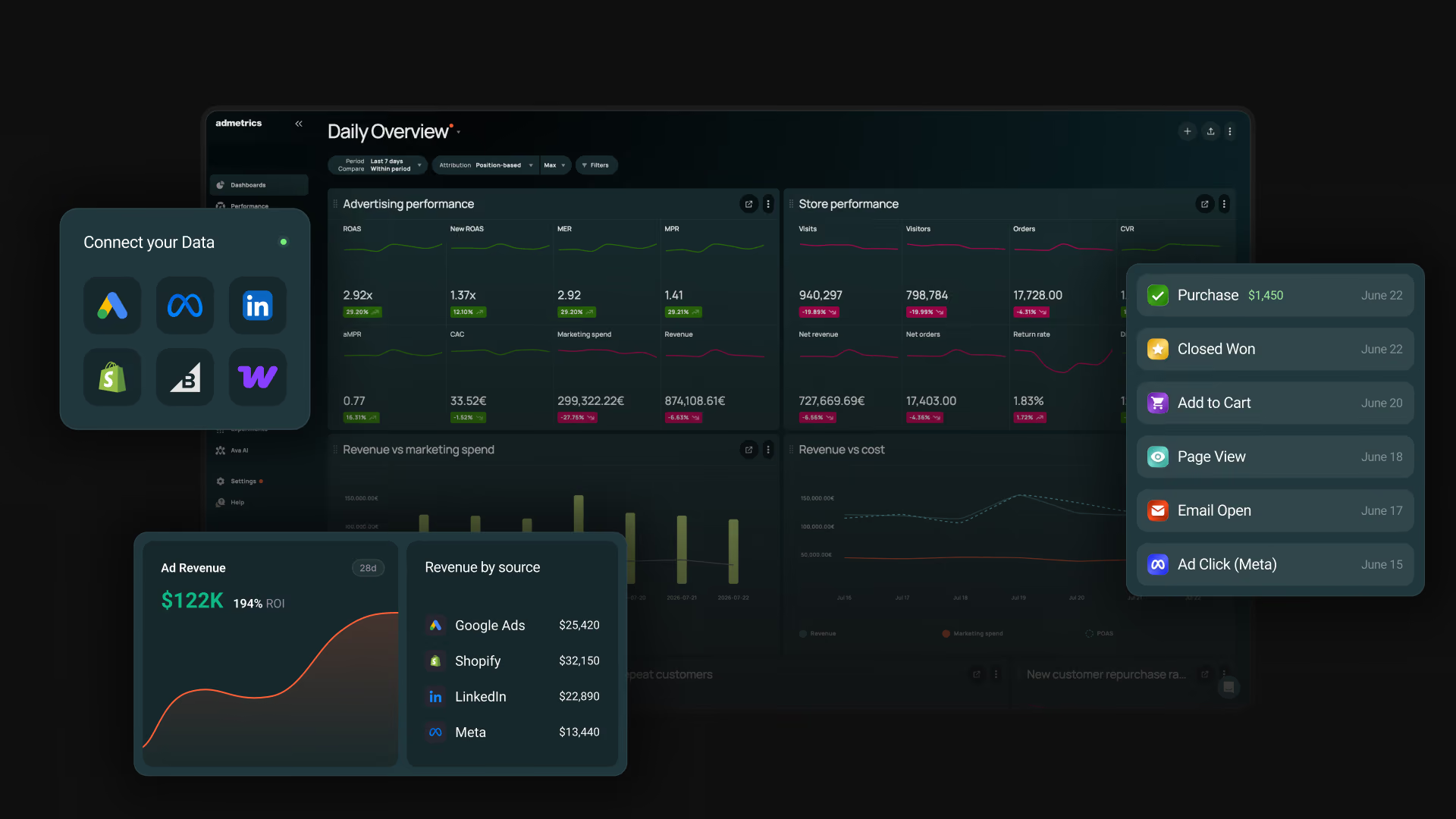
Admetrics
★5.0
Best for: ecommerce and DTC brands leaving Hyros because the report ends at revenue, who want every campaign judged on contribution margin and a tool that can move the budget as well.
Admetrics starts from the question Hyros leaves half-answered: after product cost, shipping, payment fees and returns, which campaign actually made money? Tracking runs first-party and server-side on servers in Germany, and the recovered conversions go back to six ad platforms as enriched signal. The profit layer sits on top, with contribution margin and POAS down to the SKU, returns split by campaign and product, and a P&L that runs through to EBITDA. On the plans that include them, the Budget Optimizer and Ad Pilot turn the result into budget moves.
Key features
▪First-party server-side tracking. Conversions are recorded on the server, without depending on a browser script that has to survive Safari, iOS and ad blockers, which recovers the signal loss a browser pixel can't.
▪Enriched conversions sent back to six platforms. Meta, Google, TikTok, Snapchat, Taboola and Outbrain receive the recovered purchases, and their bidding learns from buyers who actually converted.
▪Nine attribution models plus custom rules. Multi-touch and data-driven models come out of the box, and you can write your own credit rules.
▪Contribution margin and POAS to SKU. COGS, shipping, payment fees and returns net out at product level. Returns are attributed by campaign and product, and the P&L carries through to EBITDA.
▪MMM, Budget Optimizer and Ad Pilot. Mix modeling and the Budget Optimizer (add-ons on Custom) size each channel and propose the split. Ad Pilot (an add-on from Business) acts inside rules you set, with approvals and rollback.
▪Chrome plugin in the ad managers. Admetrics numbers appear inside Meta, Google and TikTok while you build and edit campaigns, which covers the habit the Hyros extension built.
▪Ava, MCP and Data API. Ava answers profit questions in plain language from your own data, and the MCP and Data API, included from Growth, connect your own AI tools and warehouse.
Strengths
Campaigns are judged on POAS and CM2/CM3, returns included.
Native connections for Shopify, Shopware, WooCommerce and Magento, plus custom stores, with unlimited shops, integrations and users.
Hosted on German servers for brands that need EU data residency.
Setup takes about an hour, and a parallel run against your current tool starts from the setup call.
Limitations
It starts at $399 a month. Triple Whale, AnyTrack, RedTrack and SegMetrics open lower.
Key pieces are add-ons. S2S pushback costs extra on every plan, Ad Pilot from Business, and MMM with the Budget Optimizer on Custom.
Not built for SaaS or call-based sales. There's no call tracking, so revenue that closes on a sales call belongs in Hyros or Cometly.
Admetrics pricing
Priced on ad spend. Growth is $399 a month with $20,000 of monthly ad spend included and 1.5% above that. Business is $899 with $70,000 included and 1% above, and it adds a dedicated customer success manager, Slack support and an e-com data audit. Custom is quoted, for $100,000 of ad spend and up. Growth and Business start with a 21-day free trial, and no credit card is needed.
Admetrics reviews
5.0 on the Shopify App Store and 4.8 on G2. Reviewers credit reliable tracking and multi-touch attribution, a flexible dashboard with detailed reporting, and onboarding support that extends to reading the data and allocating budget. No complaint recurs across them.
Bottom line
The pick for a store leaving Hyros because the report ends at revenue: the same style of tracking, the recovered signal on more platforms, and what each campaign earned after costs and returns. It costs more than a click tracker, and the action layer needs the higher plans.
Best for: Shopify brands that want published prices, a free plan to start on, and AI agents and MMM in the same platform.
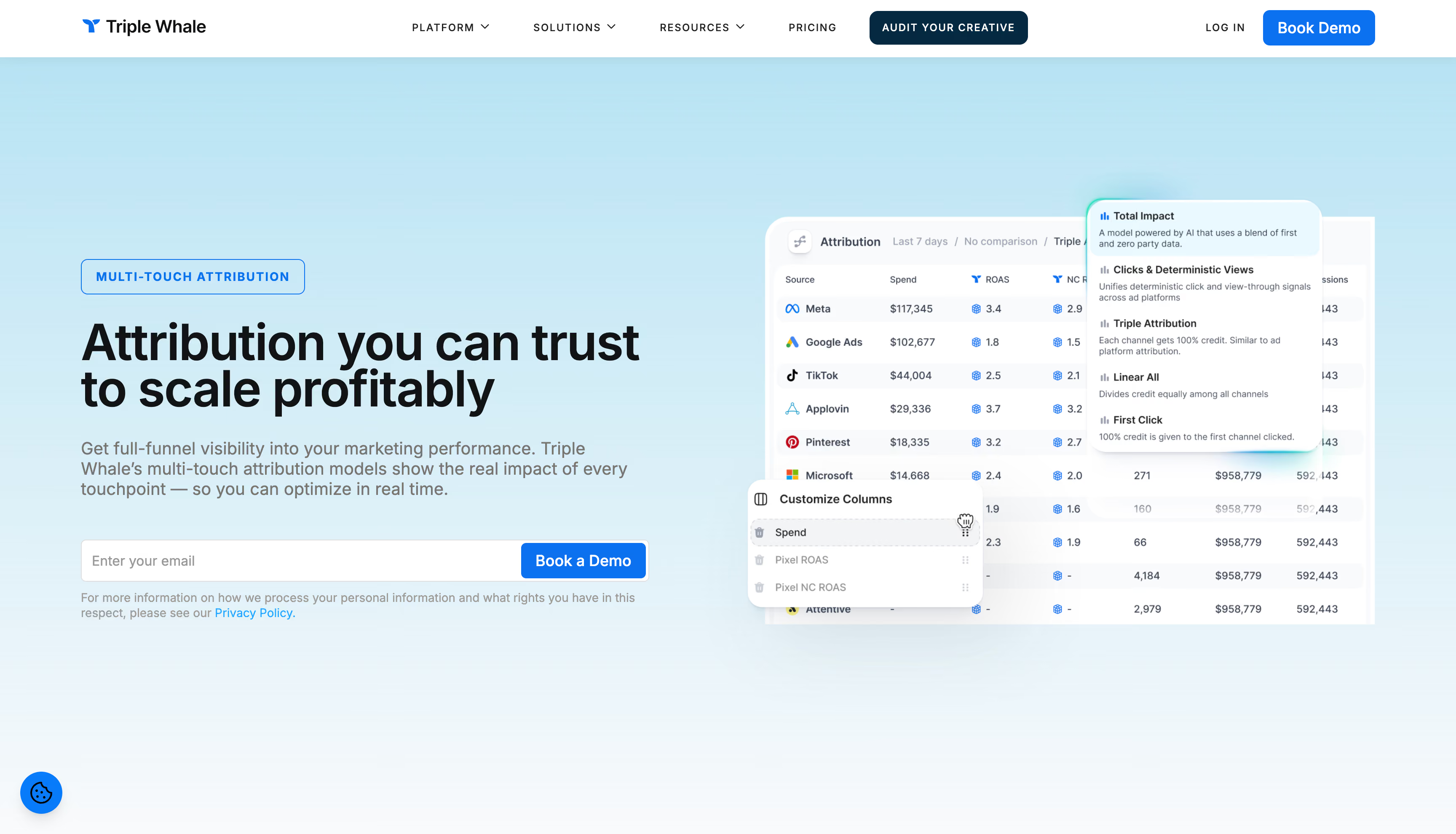
Triple Whale is a Shopify-first analytics suite. Sonar Optimize sends enriched conversions server-side to ten destinations from Meta and Google to ChatGPT Ads, and Moby, its AI agent layer, sits on top of more than 60 integrations. Two things change straight away for a Hyros user: the prices are published, and Compass adds the MMM and GeoLift testing Hyros doesn't offer. On profit it sits closer to Hyros than it first looks, taking in COGS, shipping, gateway fees and custom expenses and showing net profit by channel, campaign and ad.
Key features
▪Triple Pixel. A first-party pixel that builds an anonymous identity for each visitor, installed on Shopify as a theme app embed.
▪Sonar Optimize to ten destinations. Enriched conversions go server-side to Meta, Google Ads, TikTok, Reddit, X, AppLovin, Realize, ChatGPT Ads, Snapchat and Pinterest, and Sonar Send feeds abandonment events to Klaviyo.
▪Profit Optimization for Meta. A per-purchase profit value, net of COGS, shipping and fees, goes to Meta so its bidding can work toward margin.
▪Eight attribution models. First and last click, Clicks & Deterministic Views, two linear variants, Triple Attribution with and without platform views, and Total Impact, which blends in post-purchase survey answers, with windows from 1 day to lifetime.
▪Compass. MTA, a weekly MMM and GeoLift incrementality tests calibrated in one system.
▪Moby AI agents and MCP. Moby answers questions on your data and, on Automate, acts on campaigns inside limits you set. MCP access comes with Foundation.
▪60+ integrations. Among them are 21 ad platforms, marketplace sales from Amazon, Walmart and TikTok Shop, and warehouse sync to Snowflake and BigQuery.
Strengths
A free plan with the Triple Pixel, first- and last-click attribution and a 12-month lookback.
Server-side pushback to ten destinations.
Published Shopify App Store prices for Foundation and Automate.
Limitations
Profit stops short of margin by campaign. Net profit by campaign and ad is there, and Product Analytics shows contribution margin and return rate by product. There's no POAS, and returns aren't charged to the campaign that sold the order.
Off Shopify, you need a developer. WooCommerce, BigCommerce and headless stores need separate implementation, including for the Sonar passback to Meta, and Shopware isn't supported natively.
Paid plans are 12-month subscriptions. The tier moves up as your GMV grows, with advance notice.
Compass costs extra below Enterprise. Enterprise includes it, and on Foundation and Automate MMM and incrementality are a paid add-on.
No CRM integrations listed. A brand coming from Hyros with a lead or sales-call step loses that link.
US hosting. Data runs on Google Cloud in the US, and there's no EU data residency option.
Total Impact needs a survey. The model requires a post-purchase survey tool and at least seven days of survey data.
Triple Whale pricing
Free plan, Foundation at $219 a month ($2,190 a year) and Automate at $749 a month ($7,490 a year) on the Shopify App Store, with Enterprise quoted. The website prices on a combination of annual GMV and package, and the App Store figures don't say which GMV band they apply to. Billing is monthly or annual, and annual billing gives two months free. Retention, Conversion, Data Warehouse Sync and Moby Concierge are add-ons priced through sales, and Triple Whale recommends Enterprise for brands with at least $10 million in annual GMV.
Triple Whale reviews
4.5 on G2 and 4.1 on the Shopify App Store. G2's summary credits ease of use, data from every platform in one place, attribution tracking and customer support. The complaints it surfaces are price, especially for smaller businesses, slow loading, and attribution numbers that don't always hold up.
Bottom line
A Shopify suite with MMM on the higher plans. If profit after returns is why you're leaving Hyros, check how far its net-profit view goes before you sign a 12-month term.
Best for: larger DTC brands, Shopify first, that want multi-touch attribution with MMM and incrementality testing on the same contract.
Northbeam sells measurement, and a lot of it. Seven attribution models, including Clicks + Deterministic Views across Meta, TikTok, Snap and Pinterest, sit next to mixed media modeling and geo or holdout incrementality tests. Where it falls short for a store is profit and pushback, because COGS feeds Profit Benchmarks and stops there, and Apex shares aggregated, ad-level results with Meta and nothing else.
Key features
▪First-party pixel on your subdomain. Set up through a DNS record, with Shopify server-side tracking and a custom Orders API for other stores.
▪Seven attribution models. First touch, last touch, last non-direct touch, linear, clicks-only, Clicks + Modeled Views and Clicks + Deterministic Views, with an accrual accounting mode.
▪Mixed media modeling. A time-series MMM, with Media Mix Modeling+ sold as an Enterprise add-on.
▪Incrementality testing. Geo and holdout tests, announced in August 2026, as an optional add-on on Professional and Enterprise.
▪Profit Benchmarks. COGS goes in, and target ROAS, MER and CAC for each campaign come out.
▪Apex for Meta. Shares attributed, ad-level performance with Meta, off by default and switchable only by the account owner.
▪Northbeam MCP. Included from Starter.
Strengths
MMM and incrementality alongside MTA, which Hyros doesn't offer on any plan.
Two tiers with published prices, and Starter runs month to month.
Professional and Enterprise include a data review with a strategist and a CSM.
Limitations
No profit reporting layer. COGS sets targets. There's no contribution margin, POAS or net profit by campaign.
Pushback reaches Meta only, and only in aggregate. There's no CAPI feed to Google or TikTok.
Implementation takes 2–4 weeks on Shopify and 4–8 weeks elsewhere. Your team handles the DNS record, pixel, order sync, UTMs and ad connections.
Starter is Shopify-only, with no human onboarding. Other store platforms need Professional or a custom API setup.
Overage is billed on pageviews. $2 per thousand above the allotment with 6-hour refresh, or $6 with 1-hour refresh.
Annual, auto-renewing terms above Starter. Professional and Enterprise renew for the same term unless you give 30 days' notice, and fees are non-refundable.
US hosting. Servers are in the US, SCCs come on written request, and the Data Privacy Framework isn't mentioned.
Northbeam pricing
Starter is listed at $1,500 and positioned as month-to-month and usage-based for Shopify brands, though the page doesn't print a billing period next to the figure. Professional is $3,500 a month on an annual term, billed annually or semi-annually. Growth, delivered with an agency partner, and Enterprise are quoted. Pricing follows data volume measured in pageviews, ad spend places you in a tier, and each tier includes ad credits. There's no free plan or trial.
Northbeam reviews
4.5 on G2. G2's summary credits attribution accuracy, multi-touch tracking, clear reporting and customer support. The complaints are a steep learning curve, a product that's complex to use, and the cost.
Bottom line
A serious measurement suite for brands that want MMM and testing next to their attribution, and a clear step up from Hyros on modeling. On profit and pushback it does less than Hyros, and it costs more to start.
Best for: enterprise B2C brands with TV, CTV, direct mail or podcasts in the mix that want MTA, MMM and testing from one vendor.
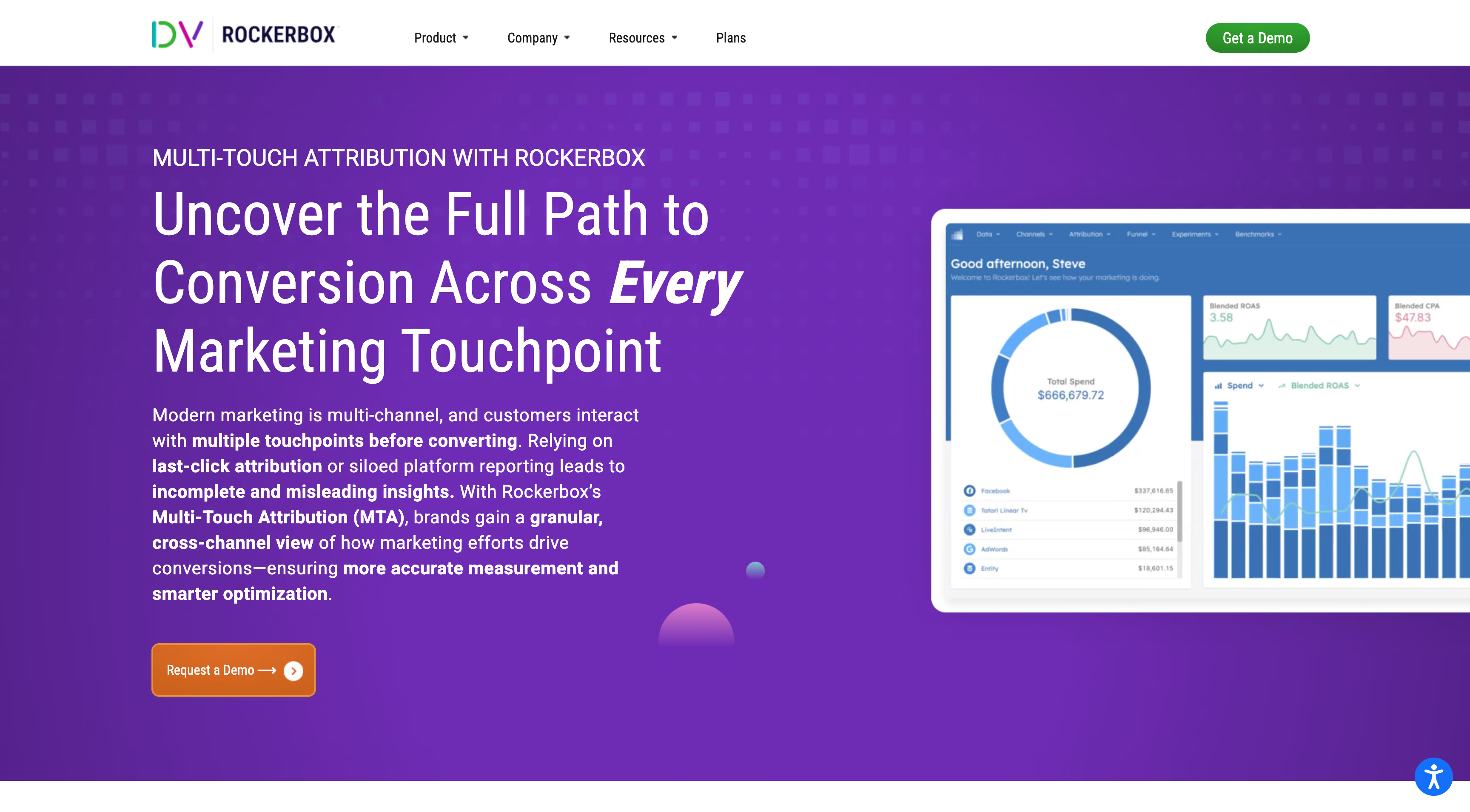
Rockerbox, now a DoubleVerify company, measures the channels most trackers never see. Beyond its first-party pixel, it reads promo codes, post-purchase surveys and view-through from TikTok and Pinterest, and it covers CTV, linear TV, direct mail and podcasts. Four attribution types, with a modeled multi-touch default, sit next to a Bayesian MMM with a scenario planner and incrementality testing. Moving from Hyros swaps one blind spot for another, since Hyros follows a lead through emails and phone calls while Rockerbox follows a household through the TV.
Key features
▪First-party pixel via CNAME. Trackers load from your own subdomain, and cookies are set in a first-party context.
▪Offline and upper-funnel coverage. CTV, linear TV, direct mail and podcasts, plus promo codes and post-purchase surveys.
▪Synthetic Events for Meta. Probabilistic modeled views, built partly from Meta CAPI events.
▪Four attribution types. First touch, last touch, even weight and a modeled multi-touch default.
▪Bayesian MMM with a scenario planner. Incrementality testing sits alongside it, and MMM for Shopify is a beta add-on.
▪Google Ads Conversions API. Uploads conversions daily from a Rockerbox segment to a new Google Ads conversion action.
▪Marketing Data Foundation. More than 100 integrations and delivery to BigQuery, Redshift and Snowflake, SOC 2 certified.
Strengths
Offline channels measured in the same system as paid social and search.
Standard Support includes a dedicated onboarding team and up to five hours of technical sessions.
Limitations
No profit layer. There's no COGS, contribution margin or POAS.
Pushback goes to Google Ads only. There's no CAPI feed to Meta. Google uploads run daily, fractional credit isn't sent, and PMax, Display, Discovery and YouTube get no view-through.
No server-side pixel. Collection relies on the CNAME pixel and modeled signals.
No published price. Plans are assembled per customer through a demo.
Slow to stand up. Its homepage puts MTA or MMM at 6–8 weeks and testing at 1–2 weeks.
US storage. Rockerbox stores all personal information in the US and uses SCCs for transfers.
Rockerbox pricing
Not published. The plans page asks you to select a mix of products and routes every plan through a demo, and Premium Support is priced separately. The free and starter plans Rockerbox announced in 2022 no longer appear on the site.
Rockerbox reviews
4.6 on G2. G2's summary credits ease of use, a complete view of channel performance that supports budget decisions, and straightforward integrations backed by responsive support. The main complaint is how long the initial setup takes.
Bottom line
The right call when TV and direct mail carry real budget and need measuring next to Meta and Google. For a store leaving Hyros over profit and pushback, it fixes neither.
Best for: ecommerce and subscription brands, roughly $5M to $50M in revenue by the vendor's own targeting, that want first-party click attribution with cohort and LTV reporting.
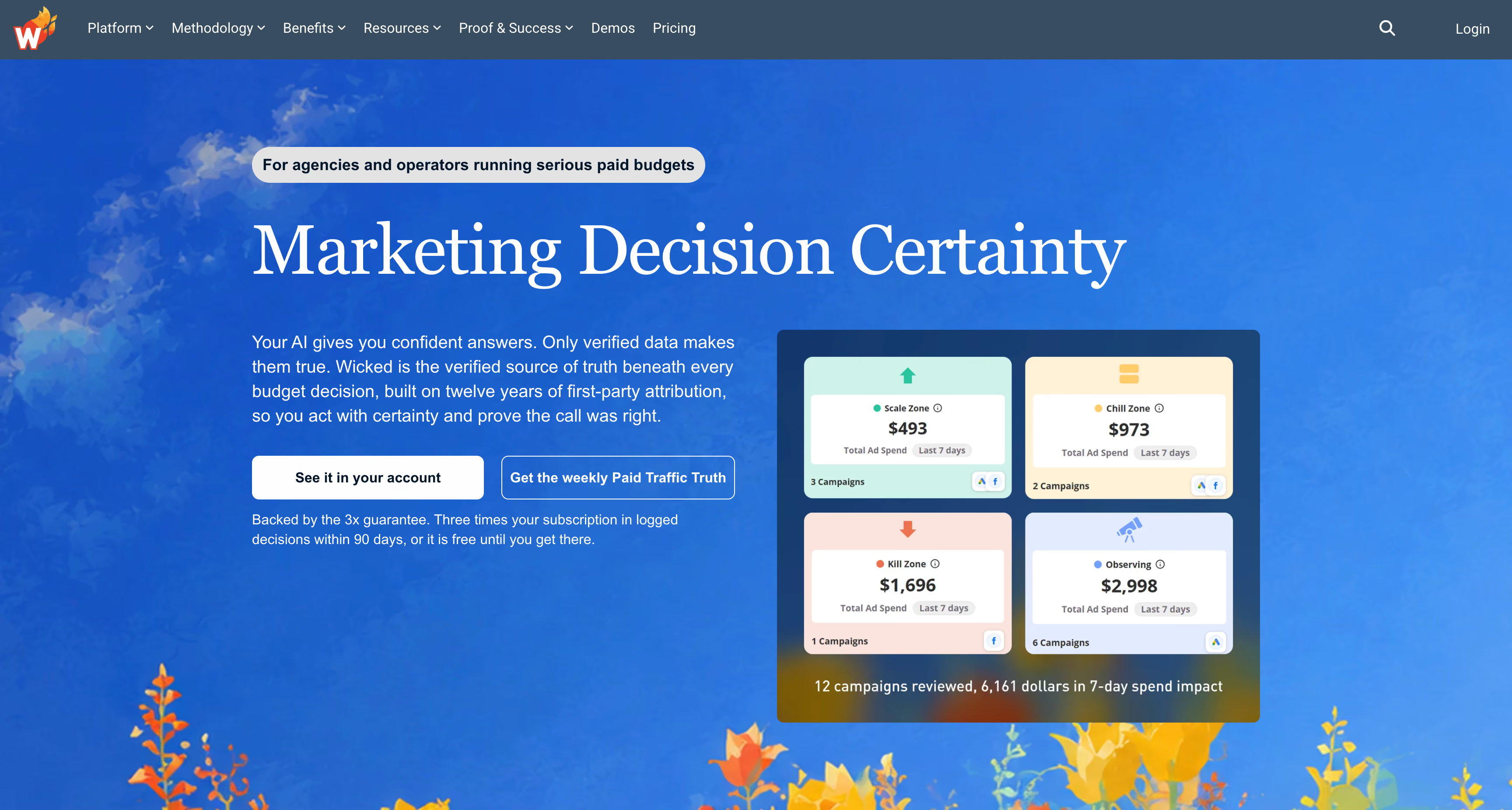
Wicked Reports pitches itself against Hyros directly, with its own Wicked-vs-Hyros page. It calls itself "The Attribution Operating System for eCommerce" and builds around that. The default model is U-shaped, cohort reports follow a customer's revenue for life, and 5 Forces AI sorts campaigns into Scale, Chill or Kill. For a store whose customers take weeks to come back, the cohort view is a sensible frame, though the money side of it ends at ROI.
Key features
▪Custom-domain tracking. Scripts load from your subdomain through CNAME records, in what Wicked calls a server-side hybrid, with a cookieless mode for strict consent setups.
▪Wicked 2.0 attribution models. First Click, Last Click, Linear and U-shaped (40/20/40, the recommended default), all crediting the sale to the date of the click.
▪Cohort and LTV reports. New-customer CAC and lifetime revenue grouped by the campaign that acquired the customer.
▪5 Forces AI. Scale, Chill or Kill recommendations per campaign. Like Advanced Signal, it's a $199 monthly add-on below Maximize.
▪Advanced Signal. New-customer purchases, segmented by product, go to Meta through the Conversions API. Google is marked as coming soon.
▪Shopify backfill. The free Shopify app pulls your full order history on connect, then syncs once a day, one store per account.
Strengths
Built for ecommerce first, with first-party tracking on your own domain.
Cohort and LTV reporting by acquiring campaign suits subscription and replenishment brands.
Prices are published, band by band.
Limitations
Profit stops at revenue. ROI, LTV and new-customer CAC are the financial metrics, and there's no COGS or contribution margin. Revenue includes shipping and tax, which Wicked says puts it about 3% off Shopify's number.
The lookback is shorter than the pitch. Help docs say Wicked evaluates clicks in the 90 days before a sale, while its Hyros comparison page claims infinite lookback.
Advanced Signal goes to Meta only, for now. Google gets daily offline conversions through a separate integration, and Google Advanced Signal is marked as coming soon.
It recommends, you act. 5 Forces labels the campaign; someone still makes the change in Ads Manager.
Hosting location isn't disclosed. The DPA says data leaves the EEA under SCCs.
Wicked Reports pricing
Prices are tiered by trailing 12-month gross revenue, with the first band running to $2.5M: Measure $499/month, Scale $699 and Maximize $999, and Enterprise "starts at $4,999" for brands above $50M, period not stated. When revenue moves into a new band, the price changes at renewal. No free plan or trial; a guarantee covers the first 90 days instead. Terms auto-renew unless you give written notice 30 days before the end.
Wicked Reports reviews
4.2 on G2. G2's summary credits useful analytics, tracking of marketing performance across several channels, detailed reporting and general ease of use. The complaint it surfaces is an interface that can feel clunky and hard to navigate.
Bottom line
An ecommerce-focused click tracker, and a fair landing spot if you liked Hyros's first-party attribution but never used its call tracking. At $499 a month it still stops at ROI, with no POAS, no CM2 and no budget action.
AnyTrack
★3.4
Best for: stores, affiliates and lead-gen teams that need server-side conversion tracking and Conversions API pushback without an enterprise contract.
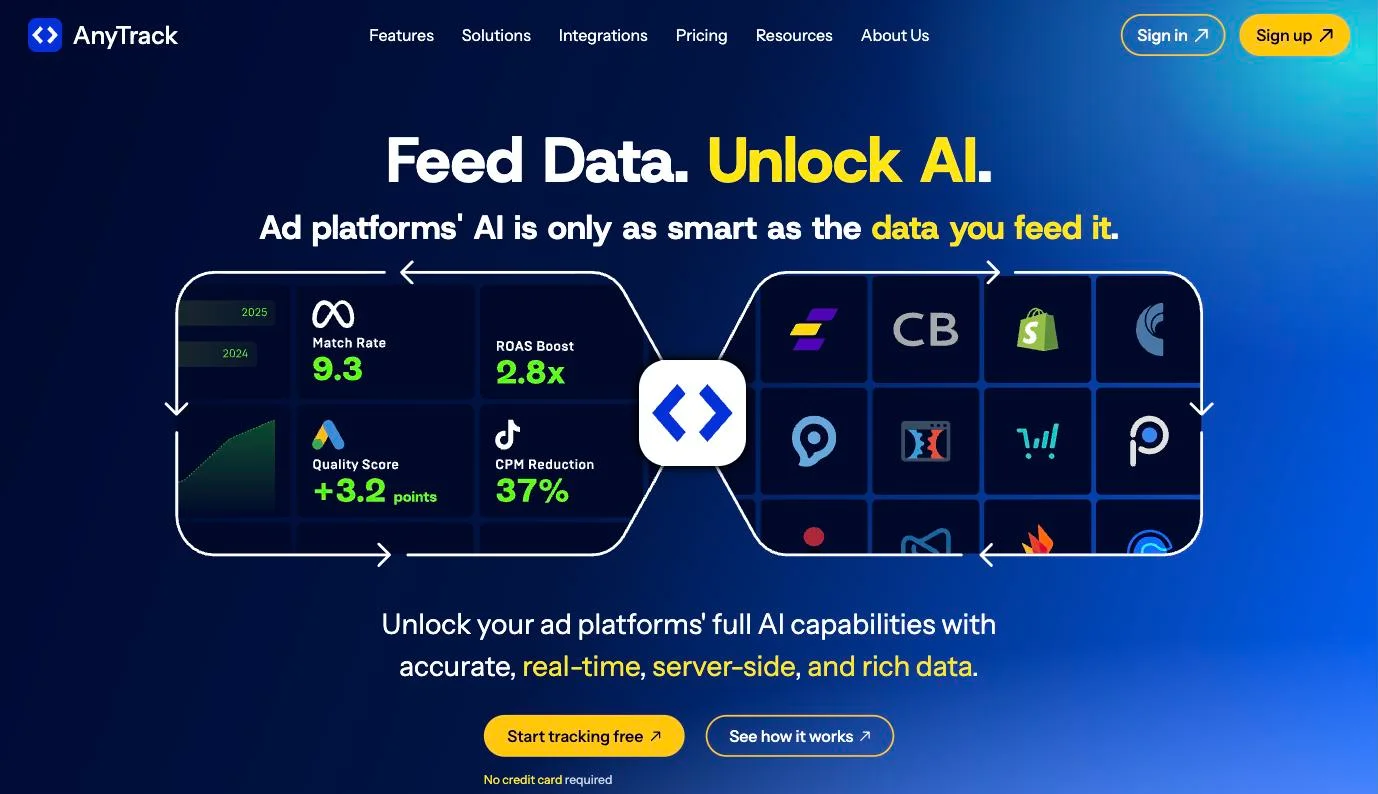
AnyTrack takes the part of Hyros that ad accounts feel most, conversions captured server-side and handed back to the platforms, and sells it at a published, session-based price with a free tier. A browser tag collects click IDs and form submissions, and sales arrive through postbacks, webhooks and APIs. The connector list leans toward affiliates, with about 91 affiliate networks next to nine ecommerce and checkout tools. What you give up from Hyros is memory: Hyros ties a buyer to one email or phone number across a long journey, and AnyTrack offers first or last ad click with windows of 1, 7 or 30 days.
Key features
▪Server-side and cookieless tracking on every plan. Free is included.
▪Conversion API to seven platforms. Facebook, Google, TikTok, Microsoft, Outbrain, Taboola and ChatGPT Ads, from Starter up.
▪Affiliate network coverage. Around 91 networks, including Awin, CJ, ClickBank and Impact, plus checkouts such as SamCart, ThriveCart and Funnelish.
▪First and last ad-click attribution. Switchable in the Campaign Report, defaulting to last click with the maximum window.
▪Overage without cutoffs. Tracking keeps running past your session limit, and the extra is billed per 1,000 sessions.
Strengths
Published prices from $100 a month for CAPI pushback, and a free tier to test the tracking first.
Native pushback to Outbrain and Taboola alongside the big platforms.
Billing on sessions, which doesn't climb with revenue the way Hyros's tracked-revenue price does.
Limitations
Two models and a 30-day ceiling. First or last ad click only, and Free and Starter can't change the window at all.
Profit never enters. Reporting is built on ROAS, and there's no COGS, margin or POAS.
The decisions stay with you. There are no budget recommendations or automation.
The free tier is a test drive. No CAPI, GA4, webhooks or cross-domain tracking, and you can't return to Free after a paid trial.
Store coverage is narrow. Shopify and WooCommerce are listed; Shopware, Magento and BigCommerce aren't.
Hosting region isn't disclosed. AnyTrack doesn't state a location or provider, the privacy policy and DPA name two different AnyTrack entities, and the referenced sub-processor list isn't on the page.
AnyTrack pricing
AnyTrack prices on monthly sessions. Free covers 5,000 sessions and one property. Starter is $100/month or $1,000/year for 100,000 sessions, Personal $150/month or $1,500/year for 500,000, and Advance $300/month or $3,000/year for 3 million, with Custom through sales. Overage runs $0.40 to $0.20 per 1,000 sessions depending on plan. Paid plans come with a 14-day trial that needs payment details.
AnyTrack reviews
3.4 on Trustpilot, which doesn't summarize its reviews. Reviews on G2 and Capterra, which show no summary either, credit easy setup, the range of ad and affiliate integrations and fair pricing. The complaints are pixel limits on the lower plans, some missing integrations and, from one reviewer, slow support on urgent tickets.
Bottom line
A sensible step down if Hyros was mostly your CAPI pipe and you sell through affiliates or funnels. For a store, it fixes signal loss and stops there, with no COGS and no POAS.
Cometly
★4.8
Best for: B2B SaaS teams attributing pipeline and Stripe revenue, and lead businesses that close through a CRM and booked meetings.
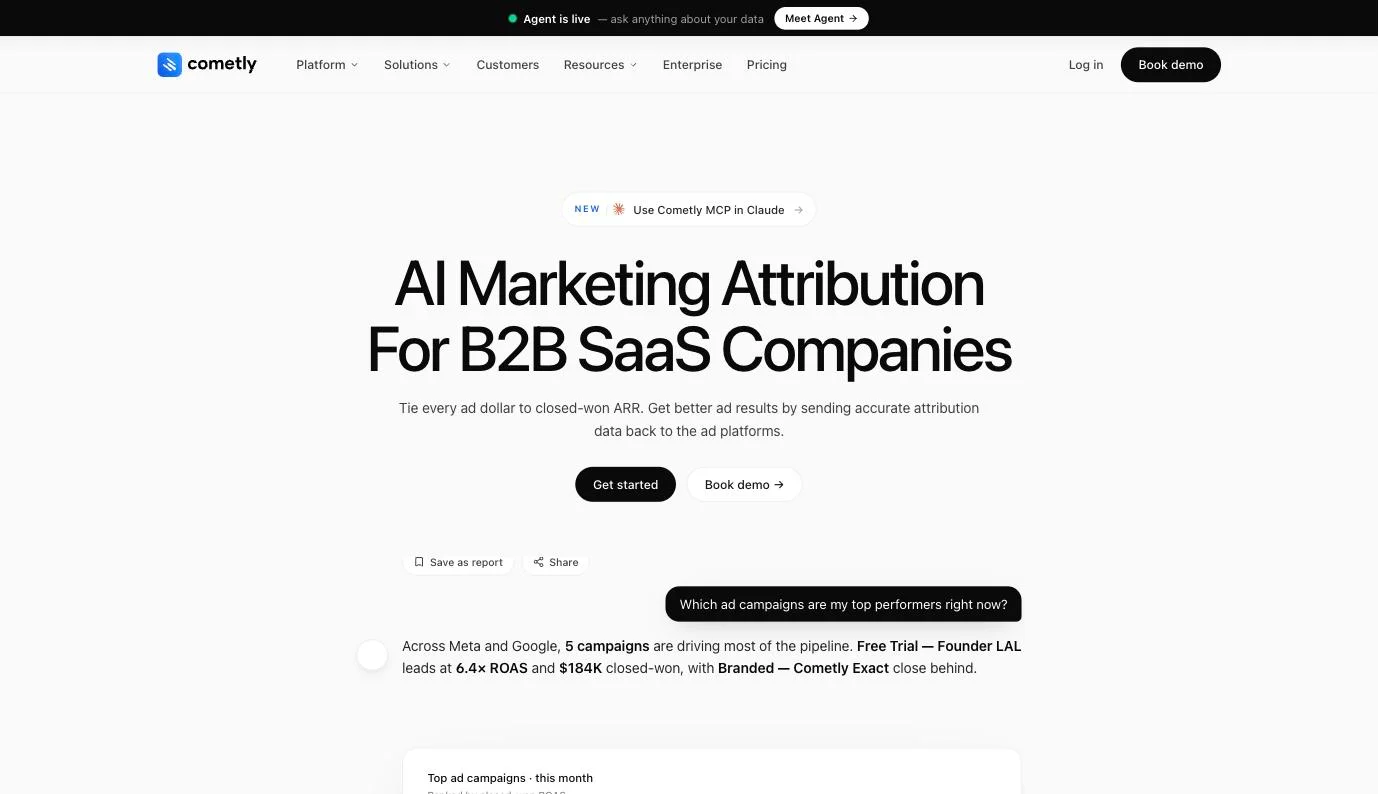
Cometly still runs a Hyros alternative page, but it now calls itself "the marketing attribution platform built for B2B SaaS", connecting ad spend, sessions, CRM pipeline and Stripe revenue. For the part of Hyros's market that sells through demos and booked calls, the fit is natural: five native CRMs, Calendly and Chili Piper for meetings, and eight attribution models including custom rules. Stores get an unusually candid answer, because Cometly's own Triple Whale comparison page says SKU and merchandising analytics aren't its priority and points Shopify D2C brands to Triple Whale.
Key features
▪First-party server-side pixel. A one-line install, described as resilient to ad blockers and Safari's tracking prevention.
▪Conversion API on both plans. Meta, Google, LinkedIn, TikTok, Microsoft, Reddit and Snapchat.
▪Eight attribution models. First-touch, last-touch, linear, U-shaped, time-decay, position-based, full-path and custom, with windows from 1 day to lifetime.
▪CRM and revenue attribution. HubSpot, Salesforce, Pipedrive, Close and Attio, plus Stripe and Chargebee, with reporting built around MRR, ARR, expansion and LTV.
▪Cometly Agent. Natural-language questions about your attribution data, running on models from Anthropic and xAI.
▪Shopify via webhook. A theme pixel plus a paid-order webhook mapped to a Purchase event, which feeds Meta and Google CAPI.
Strengths
Broad CAPI coverage, included on every plan.
Model choice with custom rules and lifetime windows, closer to Hyros's flexibility than the other trackers here.
No annual commitment, and you cancel from billing settings.
Limitations
No profit layer, by its own account. COGS and SKU analytics are areas Cometly says it doesn't try to compete on.
Shopify is a workaround. The App Store app is unavailable, orders without an email can't be tracked, and Cometly's Meta CAPI can't run alongside Shopify's native one.
No public price. The pricing page shows plans and no dollar figures.
US hosting, SOC 2 in progress. Data sits in US regions on Laravel Cloud, AWS and SingleStore. A DPA with SCCs is available.
No budget modeling. There's no MMM or incrementality testing. Its AI Ads Manager suggests what to pause or scale, and you make the change from Cometly.
Cometly pricing
Core and Enterprise are sized on monthly pageviews, though its ai-info page says sessions and ad spend, and a $150-per-seat figure in the page's metadata isn't shown on the page itself. Annual billing saves 20%. The pricing page says going over your allowance moves you up a tier next period, while the terms say extra pageviews are billed in arrears. No free plan and no trial. You can cancel any time and keep access to the end of the period, without refunds.
Cometly reviews
4.8 on G2. G2's summary credits easy setup and accurate tracking, a user-friendly interface, responsive support, and an affordable way to manage channels in one place. The complaints are lighter: setup takes longer on a complex tech stack, and the documentation could be better.
Bottom line
The right move for a SaaS or lead business leaving Hyros for CRM-grade attribution and wide CAPI coverage. Cometly itself sends stores elsewhere, and there's no profit number to work from.
RedTrack
★4.5
Best for: affiliate media buyers, and Shopify brands that want free or low-cost CAPI pushback with an ad tracker attached.
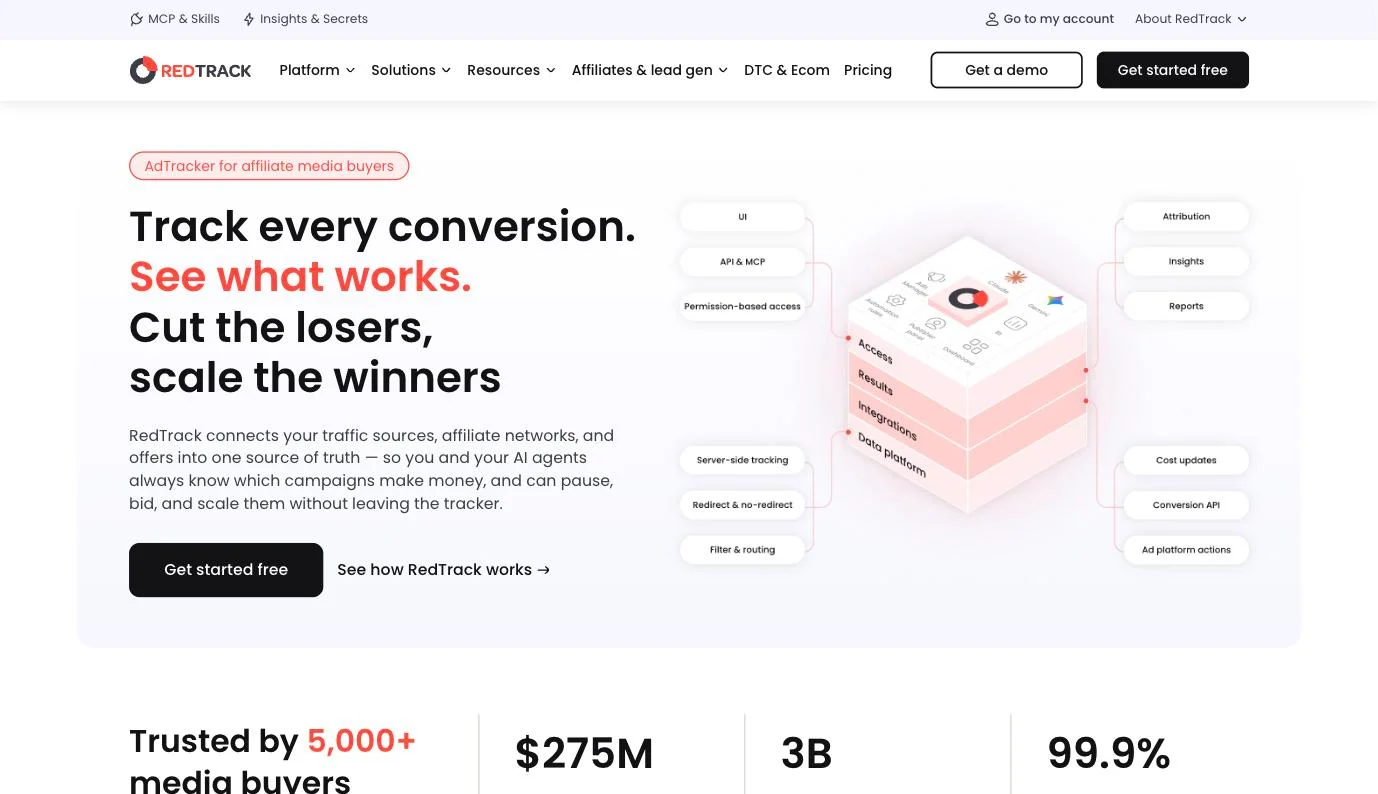
RedTrack comes from the affiliate side of performance marketing, and its homepage still calls it an "AdTracker for affiliate media buyers". It now runs a second track for Ecom and DTC, priced on annual tracked revenue, the same basis Hyros uses, with the numbers on the page. For a store, the free tier is the interesting part: Relay gives one store CAPI to seven platforms, with no card. The metrics are ROAS, CAC and LTV, and COGS never comes in.
Key features
▪Relay, a free CAPI plan. One store and one user, with CAPI to Meta, Google, TikTok, Snapchat, Pinterest, AppLovin and OpenAI ads and UTM-based last click.
▪Native CAPI on paid plans. Meta, Google, TikTok, Snapchat, Microsoft, X, Pinterest and OpenAI Ads, with other networks reached through server-to-server postbacks.
▪Multi-touch on Brand and Agency. First-touch, last-touch, linear and U-shaped, plus a report that compares models side by side.
▪Store connectors. A one-click Shopify app, and API order sync for WooCommerce, Magento, Adobe Commerce, BigCommerce, PrestaShop and CartPanda.
▪Spend sync and MCP access. Ad spend syncs every 30 minutes, or up to every five with an add-on, an AI Copilot answers questions, and premium API and MCP access is an add-on.
Strengths
Free CAPI for a single store, and multi-touch from $99 a month.
Order sync for Magento and Adobe Commerce.
A Cyprus company that says it stores personal data in the EEA.
Limitations
Profit isn't in the model. There's no COGS, margin or POAS.
Relay is last click only. No attribution modeling, cohorts, API ad spend sync or live chat on the free plan.
EEA, mostly. The GDPR page says servers are in the EEA, while the DPA lists LeaseWeb hosting in Singapore and Virginia among its sub-processors.
Shopify edge cases need care. RedTrack's docs warn that third-party checkouts can drop the click ID, cash-on-delivery apps may not fire the purchase webhook, and upsell apps may skew counts.
Higher ecom tiers aren't priced publicly. Prices are shown at the $250K tracked-revenue tier only.
No budget layer. There's no MMM or budget allocation, though rules can pause ads and a paid add-on scales them.
RedTrack pricing
RedTrack runs two price lists. Ecom & DTC is priced on annual tracked revenue: Relay is free, Brand $99/month ($83 billed annually) and Agency $599/month ($499 annually), all shown at the $250K tier. Affiliates & Lead Gen is priced on events and seats: Solo $169/month for 5 million events, Team $399 for 20 million, Enterprise $999 for 75 million, and Custom above that, with overage per 1,000 events. Premium API and MCP access costs $1,990 a year. Paid plans come with a 14-day trial.
RedTrack reviews
4.5 on G2. G2's summary credits a user-friendly interface, reliable customer support, performance tracking and integrations. The complaint it surfaces is an initial setup that's complex and comes with a learning curve, with reporting that can feel complicated too.
Bottom line
A low-cost option for a store leaving Hyros mainly for the pushback: free for one store, and $99 a month for multi-touch. POAS and budget allocation still need another tool.
SegMetrics
★4.8
Best for: coaches, course creators and info-product businesses that want revenue and lifetime value traced back to ads, email and funnels.
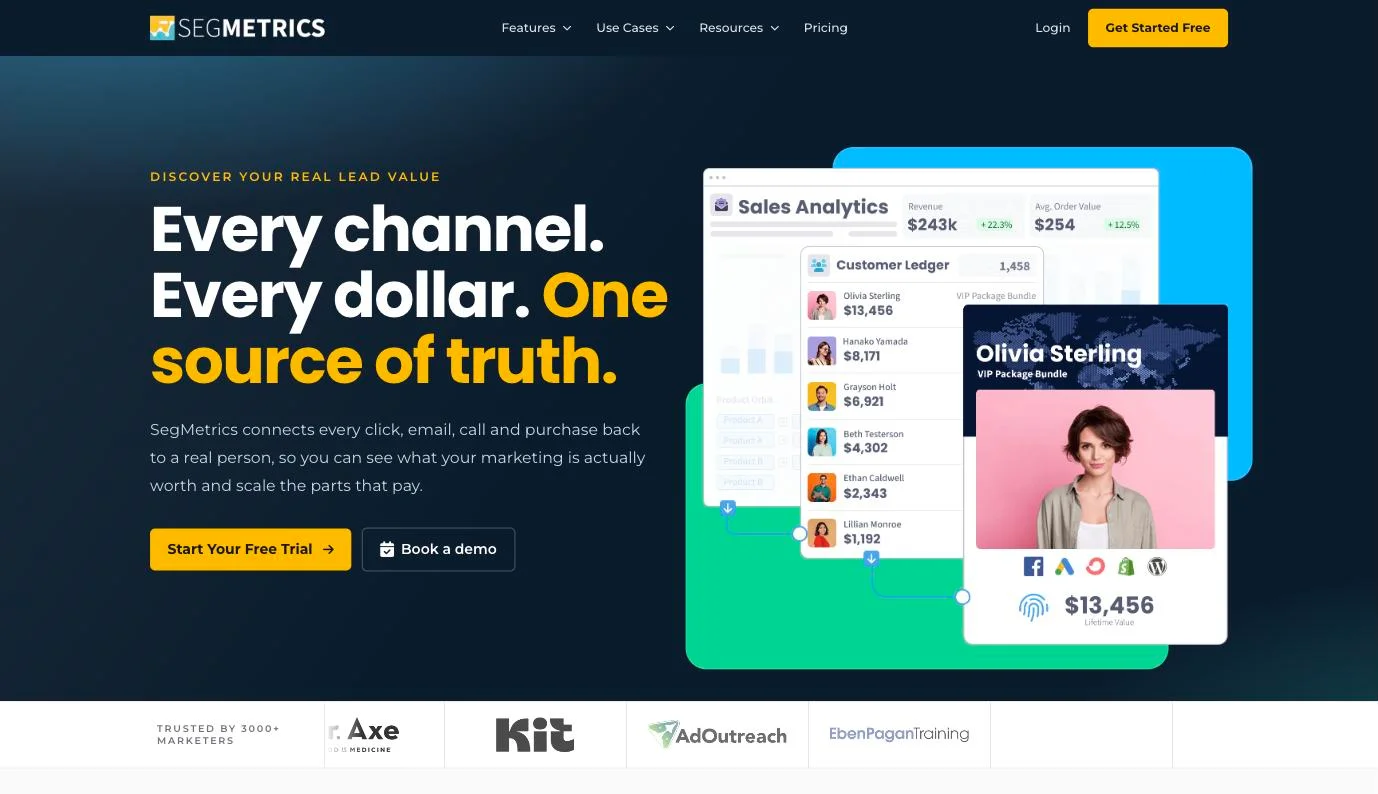
SegMetrics competes with Hyros on the ground where Hyros is strongest. Both grew up around funnels: an opt-in, an email sequence, a sale weeks later, and a lifetime value that builds from there. SegMetrics runs its own Hyros alternative page, and its attribution models give the audience away. Next to Linear Distributed and First Visit sits Optin, which credits the last click before someone joined your list, and Purchase, the last click before they bought. Where Hyros matches email and phone across long journeys, SegMetrics leans on the contacts in your email platform and CRM, and bills on them too.
Key features
▪Attribution models built around the list, with full LTV tracking. Linear Distributed (the default), First Visit, Optin (90-minute window) and Purchase (24-hour window).
▪Conversion Feeder. Sends conversions daily to Facebook, Google, TikTok and Bing, plus Facebook and Google offline conversions.
▪Around 140 integrations. CRMs such as HubSpot, Salesforce and Keap, payment processors from Stripe to GoCardless, and ten carts including Shopify, WooCommerce and BigCommerce.
▪Server-side tracking on Scale. First-party data sent from your server, set up to respect your consent banner.
▪AI Analyst through MCP. Read-only access to your SegMetrics data from Claude, ChatGPT, Gemini or any MCP client.
Strengths
Attribution models designed for opt-in-first funnels.
Paid plans from $57 a month.
A 14-day trial plus a refund of payments made in the last 30 days.
Limitations
Revenue and LTV, no margin. There's no profit, COGS or margin reporting, although the Shopify listing is tagged "profit insights".
Pushback is daily. Ad platform algorithms work from data a day behind.
Server-side tracking starts at $397 a month. Only the Scale plan includes it.
US-only storage. Data is processed and stored in the US, and SOC 2 isn't claimed.
Attribution starts with the pixel. Journeys only count from the day it went in, and Linear Distributed can count one contact under several ads.
Nothing acts. There are no budget recommendations, MMM or automation.
SegMetrics pricing
SegMetrics prices on active contacts: anyone active in your email platform, or who visited, purchased or held a subscription or deal in the last 30 days, with anonymous visitors excluded. At 10,000 active contacts, Launch is $57/month, Grow $197 and Scale $397, and Enterprise goes through a demo for companies above $10M a year in revenue. Annual billing gives two months free, and self-serve plans start with a 14-day trial. A store with a large, engaged email list should run its own count through the slider before assuming the contact-based bill lands under Hyros's revenue-based one.
SegMetrics reviews
4.8 on Capterra, which doesn't summarize its reviews. Individually, reviewers credit a clear view of which channels and campaigns drive revenue over long sales cycles, help spotting high-value leads, simplicity and attentive support. Against that sit a dated interface with a learning curve, fiddly form integrations and, in one review, billing that continued after cancellation.
Bottom line
A good fit for a coach, course or info-product business leaving Hyros, with funnel-shaped attribution and the prices on the page. For a store, it measures revenue and lifetime value well and stops there: no costs, daily pushback and US storage.
Best Hyros alternative: final verdict
For most ecommerce and DTC brands, Admetrics is the Hyros alternative that fixes the reason the search started. Tracking stays first-party and server-side, as it was on Hyros, and the recovered conversions go to six ad platforms. Profit carries past revenue minus COGS into contribution margin and POAS at SKU level, with returns charged to the campaigns that sold them and a P&L that runs to EBITDA, all on German servers. On the higher plans, Ad Pilot and the Budget Optimizer turn the result into a budget move. Prices are published, from $399 a month, and a 21-day trial needs no credit card. If your revenue closes on a sales call, Hyros is still the better fit, and if you're leaving anyway, Cometly suits B2B pipelines and SegMetrics suits info-product funnels.
++
Frequently Asked Questions
What is the best Hyros alternative?+
For most ecommerce brands, Admetrics. It keeps what Hyros does well, first-party server-side tracking and conversions sent back to the ad platforms, and adds what a store misses: contribution margin and POAS to SKU level, returns charged to the campaign that sold them, EU data residency and budget action on the higher plans. The other alternatives win narrower jobs: Triple Whale for Shopify brands that want a full suite with a free plan, Northbeam and Rockerbox for MMM (Rockerbox for TV and offline), Cometly for B2B SaaS, SegMetrics for info products and coaches, and RedTrack or AnyTrack for affiliates and stores that want CAPI on a small budget. For funnels that close on a call, Hyros itself is still a strong choice.
Who are Hyros's main competitors?+
Hyros competitors fall into four camps. Profit-led ecommerce platforms, Admetrics and Triple Whale, connect attribution to costs and can act on the result. Measurement suites with MMM, Northbeam and Rockerbox, add mix modeling and incrementality testing to multi-touch attribution. Click and conversion trackers, Wicked Reports, AnyTrack and RedTrack, capture the click and send conversions back through the platforms' conversion APIs. Funnel and lead attribution tools, Cometly and SegMetrics, follow a lead from the ad through a CRM, a call or an email sequence, which is closest to the job Hyros was built for. Which camp you need depends on where your sale closes and whether your problem is the count, the model or the margin.
How much does Hyros cost per month?+
Hyros doesn't publish a price list. It sells one plan priced on tracked monthly revenue, and the main pricing page quotes it on a call. The published add-on is AIR, the remarketing agent, at $0.10 per message with a 500-message monthly minimum. Contracts renew for the same term unless cancelled at least 30 days before the end. Because the bill moves with the revenue Hyros attributes, ask on the setup call how the price changes as tracked revenue grows.
Is Hyros free to use?+
No. Hyros has no free plan and no free trial for tracking. It offers a 90-day money-back guarantee instead, and its terms require refund requests in writing within 90 days of the first charge. The Shopify App Store lists the Hyros app at "Free", which covers installing the app, and tracking still runs on a paid plan. AIR, the separate remarketing agent, shows free-trial buttons on its pricing page without stating a trial length. Contracts renew automatically for the same term unless cancelled at least 30 days before the end. Among the alternatives, Triple Whale, AnyTrack and RedTrack have free plans, and Admetrics offers a 21-day trial with no credit card.
How does Hyros work?+
Hyros installs a tracking script on your site, through its Shopify app or by hand, and records visits with what it calls patent-pending "Print Tracking". Its own summary file describes the tracking as first-party and server-side, independent of browser cookies. Visits are matched to the same email address or phone number across devices, which lets Hyros follow a journey over months, with attribution windows of up to a year. Verified conversions go back to the ad platforms through Meta's Conversions API, Google offline conversions and TikTok's Events API. Results show in the Hyros dashboard, a mobile app and a Chrome extension inside the ad managers. Onboarding starts with a booked call, and Hyros promises same-day setup.
Does Hyros track profit, or only revenue?+
Both, up to a point. Hyros takes in cost of goods and reports profit per ad, and its Shopify page lists "true profit", LTV and subscription analytics. The profit figure stops at revenue minus COGS, shipping and taxes. Refunds show up per traffic source, without a product breakdown or any link to margin, and its site names neither contribution margin nor POAS as a metric. There's no P&L either. What a store misses is what a campaign earned after payment fees and the orders that came back. Triple Whale goes further on cost inputs, and Admetrics adds contribution margin, POAS to SKU and returns charged to the campaign and product that caused them.
What do Hyros reviews say?+
Hyros holds 4.9 on Trustpilot. Trustpilot's review summary credits knowledgeable support and onboarding staff, accurate tracking of ad spend and performance, and help scaling paid campaigns, and the main complaint is a dashboard that feels confusing at first because it shows so much detail. Read them with the business model in mind: Hyros serves info marketers, call-based sales teams, SaaS and agencies as well as stores, and praise for call attribution or long lead journeys may not carry over to a Shopify brand. Its Shopify App Store listing has no reviews. Weigh the comments from ecommerce users most heavily, especially on profit reporting, pricing on tracked revenue and renewals.