

Your pipeline ran clean. Your margin still doesn't add up.
Every sync finished overnight. Meta, Google and Shopify landed in the warehouse on schedule, row counts match, no errors in the log. The dashboard on top says paid social returned 4x. Finance says the quarter's margin fell. Both are right, because the pipeline moved revenue and nobody modeled what left again: returns, shipping, payment fees, the cost of the goods themselves.
That's the gap in most ETL tool comparisons. They rank connector counts and sync speed, which matter, then stop at the warehouse door. For an ecommerce team the harder problem starts after the load. A tool that delivers 700 sources of unreconciled data is a better pipeline and a weaker answer.
This guide compares the 10 best ETL tools for 2026 on what each one moves, how it transforms, and where it leaves you. Most are built for engineers who own a warehouse. One is built for the buyer who wants the finished margin table instead.
Key takeaways
What are ETL tools?
ETL tools extract data from source systems, transform it into a consistent structure, and load it into a destination, usually a data warehouse. That's the whole definition, and it hides most of the buying decision. The real differences sit around the edges: how many sources connect without custom code, whether the transformation happens before or after the load, how the tool copes with a schema change at 2 a.m., and what it costs once volume doubles.
A modern ETL platform also schedules jobs, retries failures and alerts someone when a sync breaks. Strip those away and you have a script. Keep them and you have the plumbing every dashboard, forecast and downstream ETL pipeline depends on.
For most teams the destination is a cloud warehouse such as Snowflake, BigQuery, Redshift or Databricks, and the best ETL tools for data warehousing keep that load reliable and cheap to run. What they don't do, by default, is decide what the data means. A revenue column arrives as revenue. Whether any of it was profit is a separate question, and one this guide keeps coming back to.
ETL vs ELT
ETL transforms data before it loads. ELT loads raw data first and transforms it inside the warehouse. The order decides where the compute bill lands and who writes the logic.
ELT won the last decade because warehouse compute got cheap and flexible. Load everything, model it later in SQL, and analysts can change their minds without re-running an extraction. That's the model behind ELT tools like Fivetran, Airbyte and Matillion. Classic ETL still earns its place when data must be cleaned or masked before it lands, as with regulated fields, or when heavy legacy transformations would be wasteful to repeat in a warehouse. Informatica, Talend and IBM DataStage grew up there.
The labels blur in practice. Hevo transforms in flight with Python and models afterward with dbt. Most ELT tools offer some pre-load option, and most ETL tools can push work down to the warehouse. Pick on the workflow, not the acronym.
A related question is ETL vs data integration. Data integration is the wider job of getting systems to share data, and ETL is one method inside it, alongside replication, API-based sync and master data management. Every tool here does data integration. Not every data integration product is built around the extract, transform, load sequence.
Types of ETL tools
Four splits do most of the sorting among ETL tools.
The categories overlap, and one tool can sit in three of them. The useful question is who will operate it on a bad day.
ETL for ecommerce marketing data
Ecommerce is where "the data loaded" and "the numbers are right" drift furthest apart. Ad platforms report their own conversions, often overcounting. Browser pixels miss sales when consent banners and tracking prevention block them. Returns arrive weeks after the order. Cost of goods lives in a different system from both. A pipeline that faithfully copies all of that into a warehouse has done its job, and still delivers a revenue figure that overstates what the business kept.
Closing the gap takes three things most ETL software leaves to you: capturing conversions server-side so the source data is complete, joining orders to ad spend, and subtracting COGS, shipping, fees and returns before calling a campaign a winner. On a general-purpose ETL tool, the second and third are SQL your team writes, tests and rewrites every time a cost changes.
That's why this guide scores profit readiness as its own criterion. A low-code data pipeline for ecommerce should hand a marketer a margin table, not a folder of raw rows. Only one tool below does that out of the box, and it's built around the ecommerce stack rather than hundreds of generic sources. Whether it fits depends on whether your sources are inside that stack.
How we scored these ETL tools
Admetrics publishes this guide and ranks its own product first, so every entry, ours included, is held to the same four criteria and carries real downsides.
The ranking is written for ecommerce and DTC buyers. A data engineering team choosing a loader should weight the first two criteria more heavily, and could reasonably put Fivetran or Airbyte first.
Scores draw on vendor documentation, published pricing pages and review sites including G2, Capterra and Gartner Peer Insights. Where a vendor's marketing and its documented behavior disagreed, we scored the documented behavior. Prices change often, so confirm current numbers with each vendor.
ETL tools comparison
1. Admetrics
★4.97Best for: ecommerce and DTC brands that want an ETL tool delivering store, ad and CRM data as one profit-ready model, without a data engineer or a separate warehouse project.
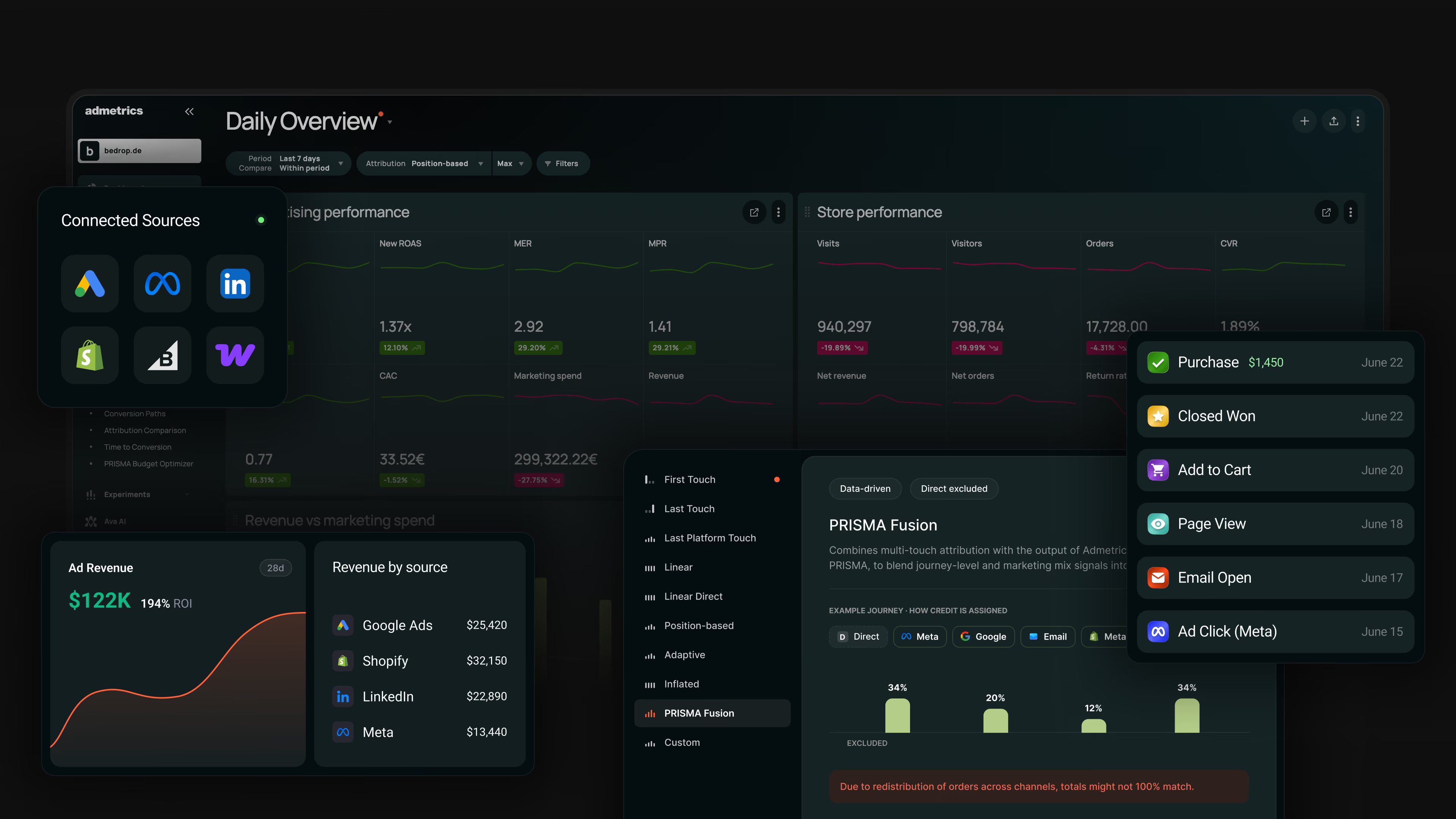
Most ETL tools finish when rows land in a warehouse. Joining orders to ad spend and subtracting returns is a second project, and it usually belongs to you. Admetrics folds it into the first. It connects your store, ad accounts, CRM and email tools into a no-code marketing warehouse, then carries the same data through attribution, contribution margin and budget decisions in one product. For a DTC team, that is the finished table a pipeline was supposed to produce.
Key features
Strengths
Limitations
Pricing
Admetrics prices against monthly ad spend, not seats. Growth starts at $339/month and covers the first $20,000 of spend, with 1.5% charged above. Business starts at $764/month, covers up to $70,000 and charges 1% on the excess. Above $100K a month, pricing goes custom. Every tier includes a 21-day trial, no card required.Reviews
The G2 profile averages 4.97 out of 5. Two themes repeat: tracking that holds up under scrutiny, and support that continues past implementation. One long-running customer called the tracking "absolutely reliable". Ehrenkind credits a 60% ROAS increase, and Nyfter reports tripling the volume of data it can track reliably.Bottom line
If the job is moving any source into any warehouse, a dedicated ETL tool does that. If the job is knowing whether paid media made money, Admetrics is the shortest path, with profit already in the answer.2. Fivetran
★4.3Best for: data teams that want connector upkeep outsourced and have an analyst or engineer to model the data once it lands in Snowflake, BigQuery or Databricks.
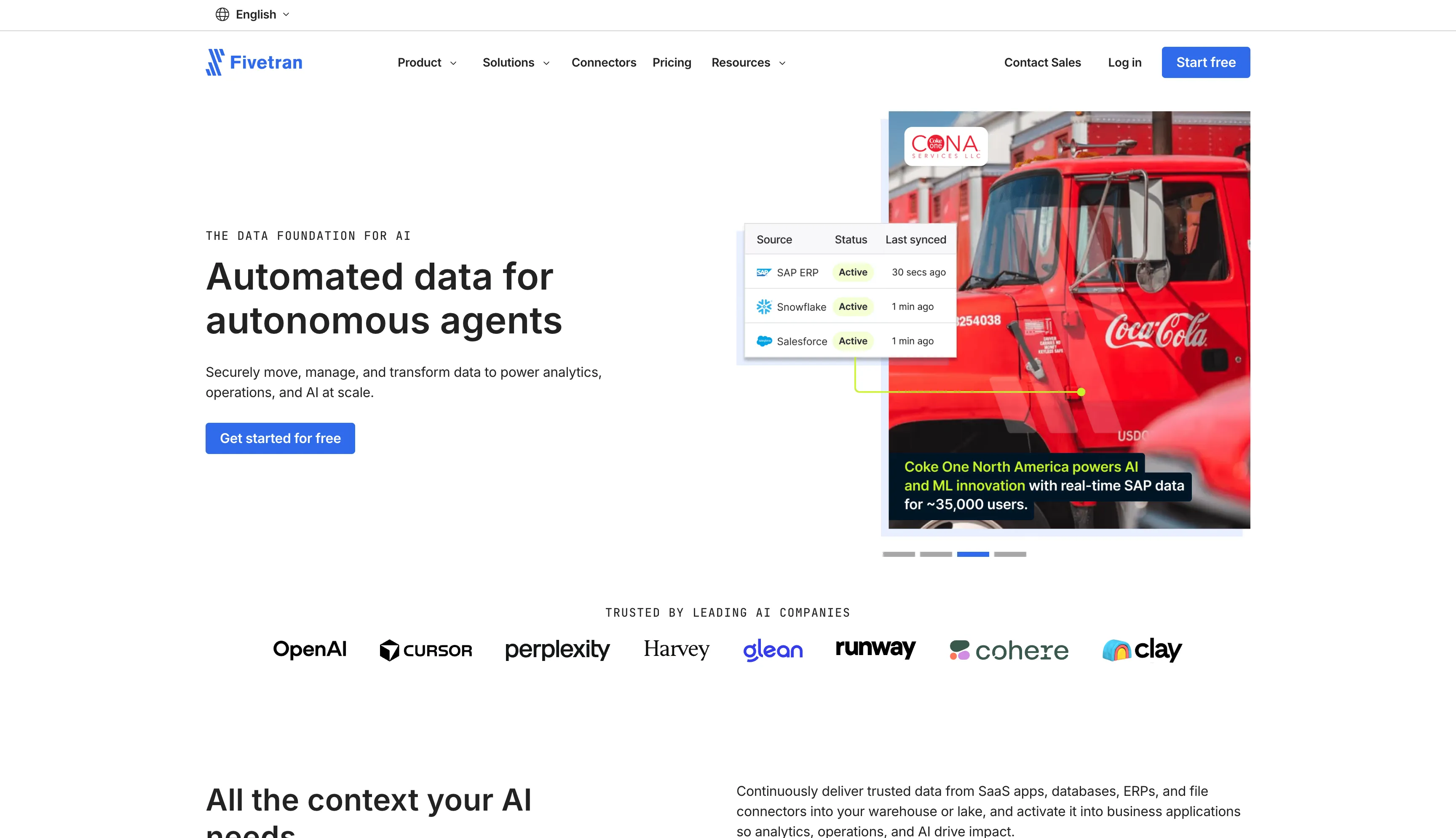
Among ETL tools, Fivetran sells one promise: name a source and a destination, and it keeps the pipe working. API changes and schema drift become the vendor's problem. Where it stops is the warehouse. What the rows mean for margin, attribution or next week's budget is a separate build, and most of it is yours.
Key features
Strengths
Limitations
Pricing
A Free plan covers 500,000 monthly active rows. Standard, Enterprise and Business Critical are usage-based, each connection on its own declining cost curve. Fivetran's own example for a 1 to 200 employee company, pulling Facebook Ads, Google Analytics 4, Google Ads and Marketo, lands near $511 a month at list price. Annual contracts discount up to 22%.Reviews
G2 averages 4.3 out of 5 across 800+ reviews. Praise is steady: fast setup and connectors that rarely break. Complaints cluster around price and its unpredictability, with support varying by plan tier.Bottom line
The strongest pure ELT tool here, and it ends where your marketing questions start. It lands ad and store data accurately. Whether that revenue was profit is left for you to build.3. Hevo Data
★4.4Best for: mid-market analytics teams without a data engineer that want no-code pipelines into a cloud warehouse, with Python available when a source needs reshaping.
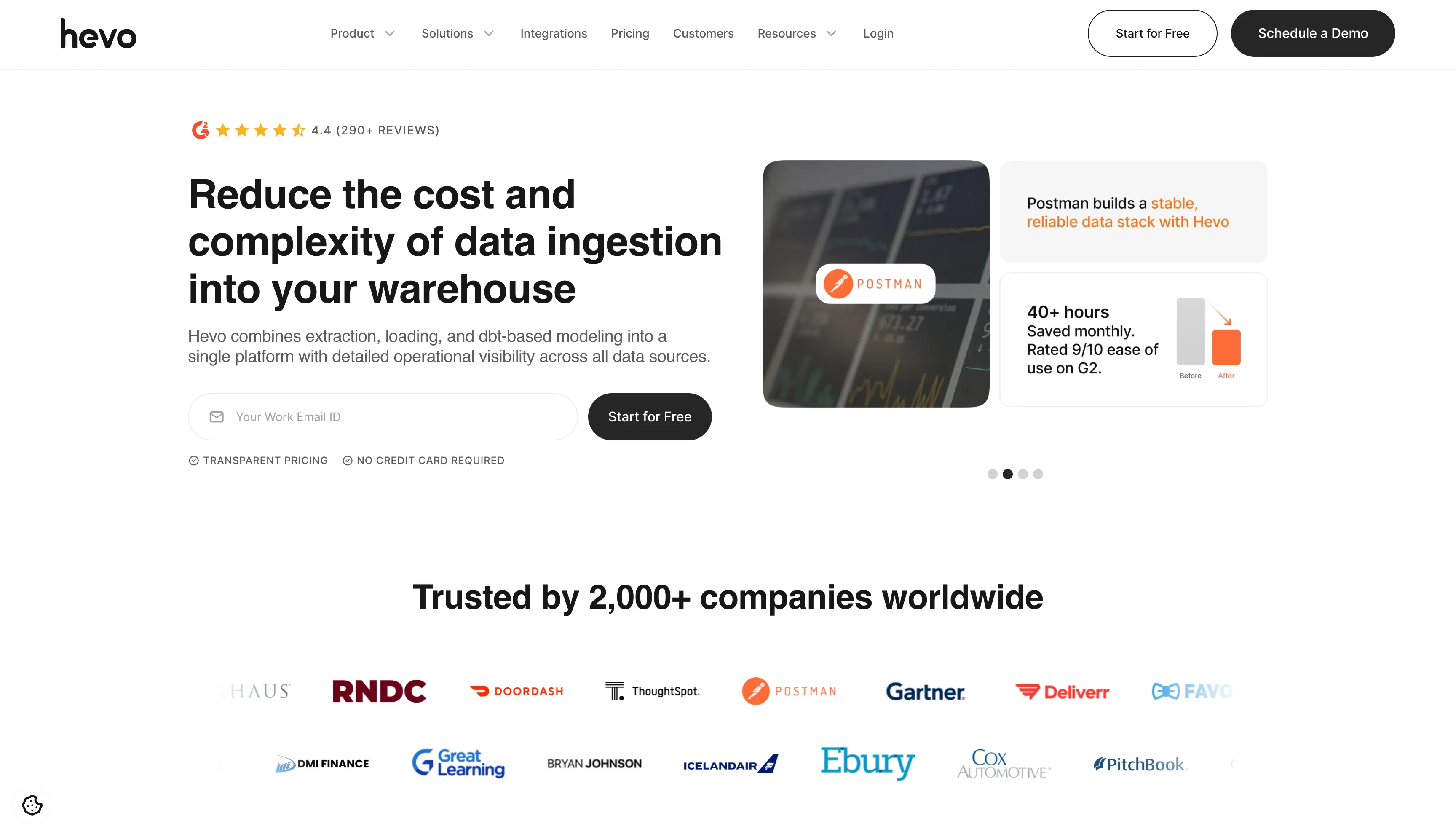
As ETL software goes, Hevo plays the same game as Fivetran with a smaller catalog and a lighter bill. You build a pipeline in the browser, the platform maps the source schema to your warehouse, and syncs run unsupervised. What it can't tell you is anything about the money behind the rows. The warehouse is still where the job ends.
Key features
Strengths
Limitations
Pricing
A Free plan covers 1 million events a month. Starter begins at about $299 a month ($265 billed annually) with 5 million events and scales on a slider to 50 million. Professional begins near $849 a month ($750 annually) from 20 million events up to 100 million. Business Critical is quoted. Overage bills on demand, and paid plans start with a 14-day trial.Reviews
G2 averages 4.4 out of 5 across roughly 290 reviews, and Capterra sits near 4.7. Reviewers praise support, simple setup and the connector list. Complaints: price at higher volumes, limited customization, the occasional missed notification.Bottom line
A friendlier, cheaper ETL tool for landing ad and store data in the warehouse. Margin, attribution and budget still wait for you after the load.4. Airbyte
★4.4Best for: engineering-led teams that want wide connector coverage without vendor lock-in, and can run pipelines themselves or pay for the managed cloud.
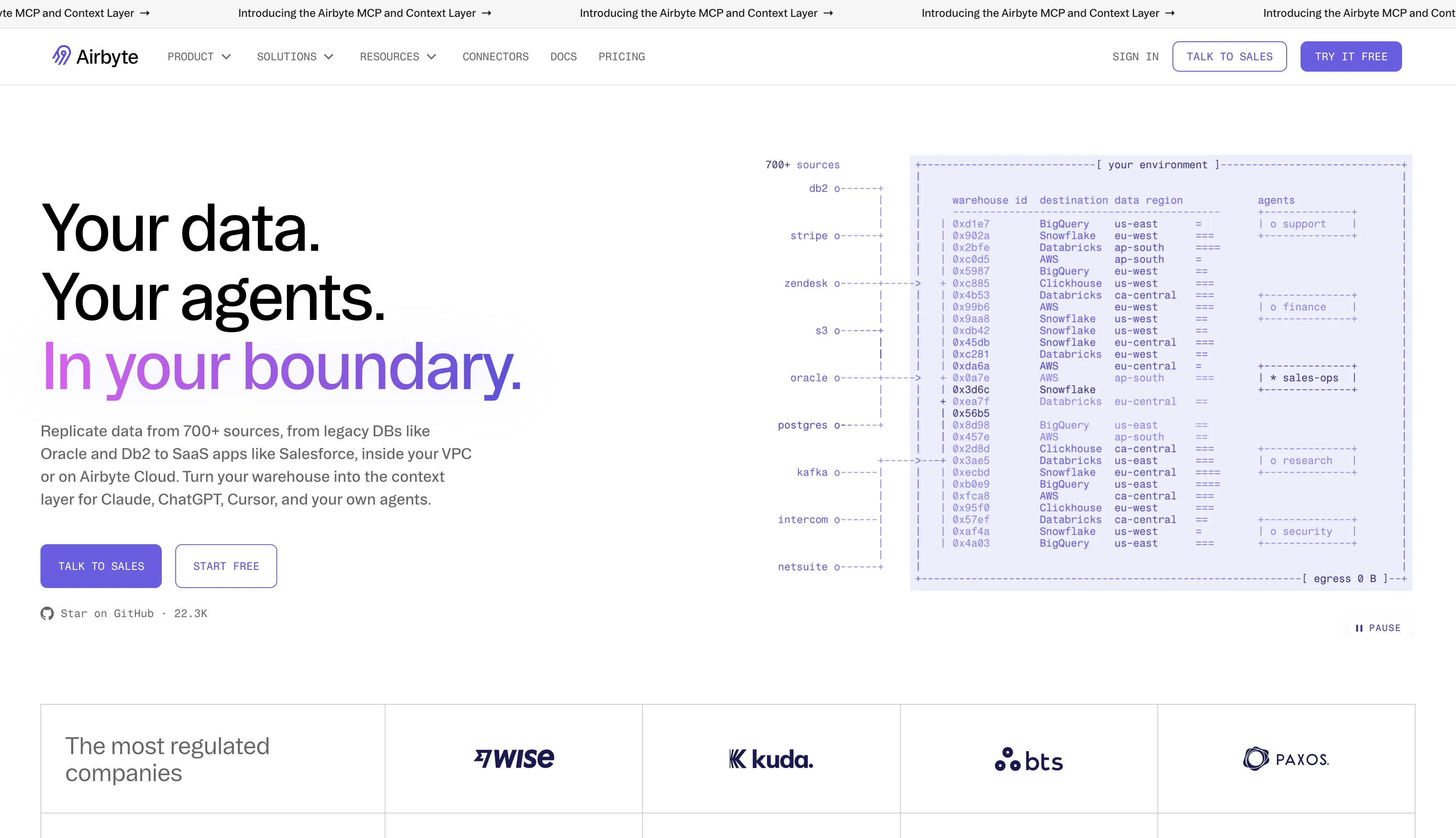
Airbyte began as the open alternative to managed ELT tools, and the pitch still works: a huge connector catalog, a builder for what the catalog misses, and the option to host it all yourself. That freedom is paid for in engineering hours instead of invoices. Like every pure ELT tool here, it ends at the warehouse door, with raw ad and store rows waiting for someone to make sense of them.
Key features
Strengths
Limitations
Pricing
Core is free to self-host. Standard cloud starts at $10 a month, billing credits by volume: 6 per million API rows, 4 per GB from databases. Plus adds SSO and 15-minute syncs. Pro and Enterprise Flex are sold on capacity pricing through sales.Reviews
G2 gives Airbyte 4.4 out of 5 from fewer than 80 reviews, a small sample. Reviewers like connector range, quick first setup and flexibility. They flag buggy lesser-used connectors and slow support on lower tiers.Bottom line
The right ETL tool for a team that treats pipelines as engineering work. For a marketer asking which campaign made money, it hands over raw material and nothing more.5. Matillion
★4.4Best for: data engineering teams on Snowflake, Databricks, BigQuery or Redshift that want visual pipeline design with the heavy transformation work running inside their own warehouse.
Matillion, now sold under the Maia name, is the ELT tool that takes the opposite bet from Fivetran. It cares less about collecting every source and more about what happens once data is in the warehouse, pushing transformation onto the warehouse's own compute. The newest layer is Maia Team, an agent that drafts pipelines from plain-language instructions. Strong for engineers. For a marketer, the output is still a well-built table with no opinion about profit.
Key features
Strengths
Limitations
Pricing
Matillion bills in credits: 1 per task hour for orchestration pipelines, 3 for transformation pipelines, plus 70 per developer user each month. Developer covers one user, Teams and Scale five. Scale adds SSO, lineage, hybrid deployment and streaming CDC. No price per credit is published, and warehouse compute is billed separately. A 14-day trial includes 500 credits.Reviews
G2 sits around 4.4 out of 5 across roughly 80 reviews, with Capterra near 4.3. Reviewers praise the interface, built-in connectors and responsive support. Complaints: cost at higher volumes, and a learning curve for teams short on SQL.Bottom line
A capable ETL tool for warehouse-first engineering teams, built around transformation. It builds the pipes well. What flows through them, and whether it was profit, remains your problem.6. Azure Data Factory
★4.5Best for: Microsoft-centric enterprises moving SQL Server and SSIS workloads into Azure, with engineers to build and maintain pipelines.
Azure Data Factory is the ETL tool for the Azure estate, and it behaves like plumbing. Microsoft calls it a serverless, code-free data integration service, and in practice it is a visual orchestrator that copies data, runs transformations and schedules both. It is built for companies whose data already lives in Azure SQL, Synapse and Data Lake, not for marketing data. Reaching profit from there is a project, not a feature.
Key features
Strengths
Limitations
Pricing
There are no plans, only meters. Orchestration runs about $1 per 1,000 activity runs, with the first 1,000 free each month. Data movement is roughly $0.25 per DIU-hour. Mapping Data Flows cost around $0.27 per vCore-hour on general purpose compute, on clusters of at least 8 vCores. Self-hosted runs cost more, and monitoring bills separately. These are US list prices, so confirm yours on Microsoft's pricing page.Reviews
G2 averages about 4.5 out of 5 across roughly 100 reviews, with Gartner Peer Insights at a similar level. Reviewers like the visual interface, automation and easy basic pipelines. They complain about debugging, sluggish large pipelines and pricing that's hard to forecast.Bottom line
The natural ETL tool if your estate already runs on Azure and SSIS. For a brand asking whether ad spend returned profit, it is infrastructure, and the profit part is yours to build.7. AWS Glue
★4.3Best for: AWS-native data teams with Spark skills that want serverless ETL and a shared catalog across Athena, Redshift and EMR.
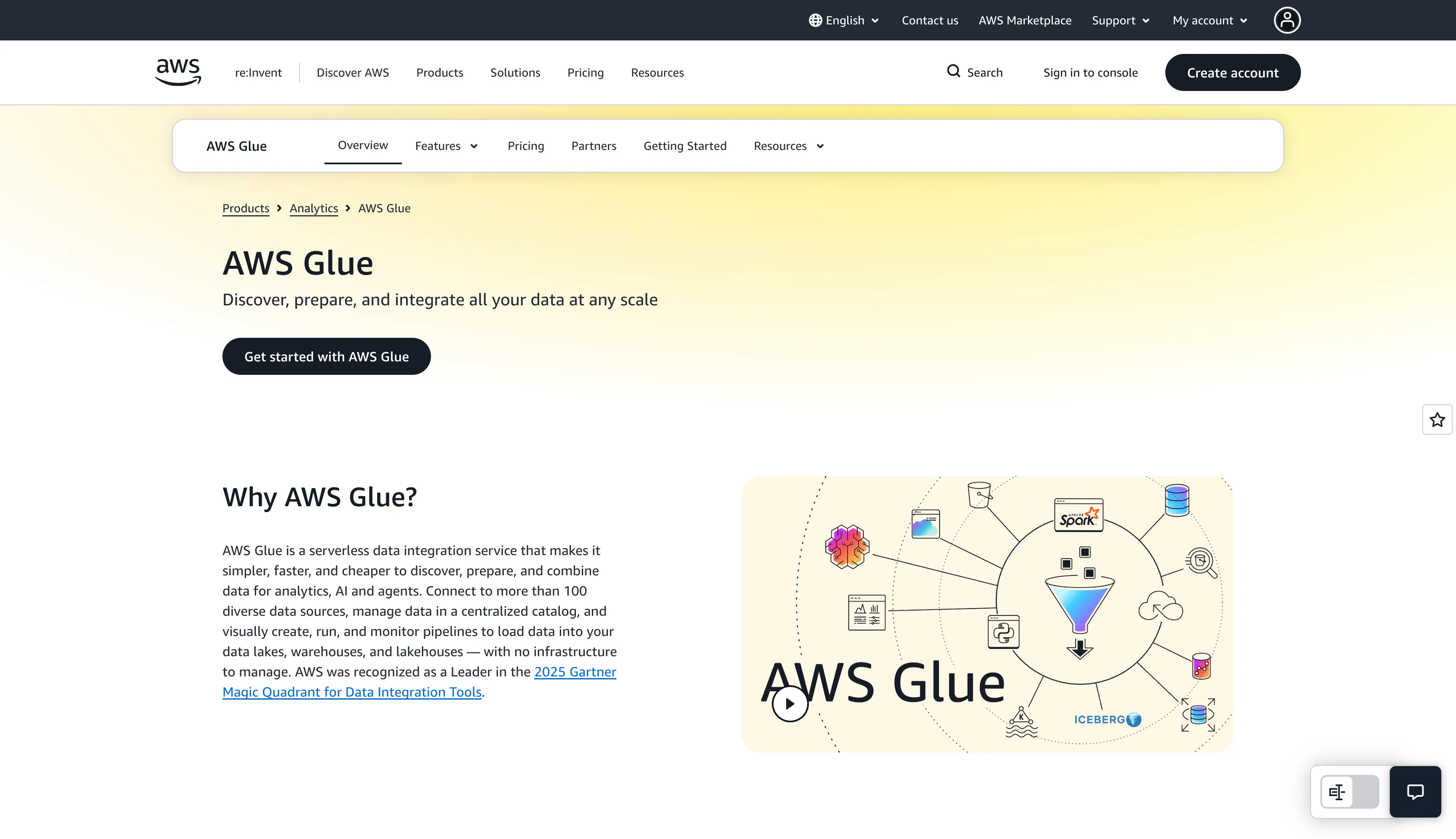
Glue is AWS's answer, among cloud ETL tools, to the question of who runs the Spark cluster. You write or generate a job, AWS provisions the compute, and a central catalog tracks what every dataset looks like. Newer zero-ETL integrations replicate sources like Facebook Ads and Instagram Ads straight into AWS storage. That reaches marketing data, but it stops at delivery. The rows land in Redshift or S3 as the platforms reported them, and everything after is a build.
Key features
Strengths
Limitations
Pricing
There are no plans, only usage. ETL jobs, interactive sessions, Data Quality runs and crawlers all bill at $0.44 per DPU-hour in the US list, metered per second with a one-minute minimum for jobs and ten minutes for crawlers. Flex execution drops non-urgent jobs to about $0.29, and the first million Data Catalog objects and requests are free. Rates vary by region.Reviews
G2 gives Glue 4.3 out of 5 across roughly 200 reviews. Reviewers like serverless scaling and tight AWS integration. They complain about complexity, debugging and a learning curve that punishes teams new to Spark.Bottom line
The sensible default ETL tool for a team living in AWS with engineers to spare. It moves the data, but never tells you whether the ad spend behind it paid back.8. Talend (Qlik Talend Cloud)
★8.9/10Best for: large enterprises that treat data quality and governance as seriously as data movement, with SAP, mainframe or hybrid estates alongside the cloud.
Talend is the veteran among ETL tools here. Since Qlik acquired it, the product is sold as Qlik Talend Cloud, an integration suite where quality checks, stewardship and a catalog sit next to the pipelines. That suits a compliance team and weighs heavily on a marketer. It can tell you a dataset is clean and trusted. Whether the revenue inside it survived returns and COGS is a question the Trust Score doesn't answer.
Key features
Strengths
Limitations
Pricing
Qlik publishes no list prices. Qlik Talend Cloud comes in Starter, Standard, Premium and Enterprise editions on capacity pricing: Starter and Standard meter data moved, and the upper tiers add job executions and hours. Starter omits some connectors, such as the native Oracle source. Third-party guides citing customer reports put entry deals in the low five figures a year, with enterprise far higher. A free trial is available.Reviews
TrustRadius scores Qlik Talend Cloud around 8.9 out of 10 across 74 reviews, and PeerSpot reviewers sit near 4 out of 5. Praise centers on connectors and data quality tooling. Criticism targets cost, stability on large datasets and maintenance overhead.Bottom line
A serious enterprise ETL tool for governed, large-scale integration. For a DTC team asking which channel made money, it's a lot of platform pointed at the wrong question.9. Informatica
★4.4Best for: global enterprises that want integration, data quality, master data and governance under one contract, and an IT team to run it.
Informatica is the heaviest ETL platform in this comparison, and it earns the weight. Its Intelligent Data Management Cloud bundles integration, quality, master data, cataloging and API management on one consumption meter, with an AI engine called CLAIRE threaded through it. Salesforce now owns the company, though IDMC is still sold on its own. The ambition is a single system of record for data operations. Whether a campaign paid back isn't part of it.
Key features
Strengths
Limitations
Pricing
Informatica publishes no price list. IDMC runs on Informatica Processing Units, a consumption meter shared across its services, with Flex IPU and volume-tier options that lower the unit cost as usage grows. A free entry-level Cloud Data Integration service has been reported, but beyond it everything is quoted. Third-party guides put enterprise deployments from roughly $50,000 a year.Reviews
Gartner Peer Insights rates IDMC 4.4 out of 5 across more than 1,300 ratings. Reviewers praise scalability, connectivity and integrated quality tooling, and criticize the learning curve, cost and administration effort.Bottom line
The most complete data management suite among these ETL tools, at enterprise price and weight. A DTC team asking whether ad spend returned profit would be buying a governance program to answer a margin question.10. IBM DataStage
★4.0Best for: large enterprises with heavy batch workloads and an existing IBM estate, where throughput and deployment control matter more than speed to first pipeline.
DataStage is one of the oldest ETL tools, and its reputation rests on raw processing power. The parallel engine splits big jobs across partitions and chews through volumes that would choke lighter tools. IBM is now folding it into watsonx.data integration alongside StreamSets, Databand and replication. It's built for warehouses, mainframes and regulated estates, not ad accounts.
Key features
Strengths
Limitations
Pricing
IBM's cloud plans run on capacity unit-hours, where one CUH equals one vCPU-hour of engine time. Lite is free but capped at 15 CUH a month and one job at a time. Standard is pay-per-CUH, and Enterprise bundles of 5,000, 10,000 or 25,000 CUH carry a discounted rate. Third-party listings quote roughly $1.75 to $2 per CUH. Self-managed software is licensed by core or VPC.Reviews
G2 averages 4.0 out of 5 across about 72 reviews, and Gartner Peer Insights sits at 4.4 across 120 ratings. Reviewers praise the engine's performance and reliability. They criticize cost, licensing, the learning curve and lock-in.Bottom line
A formidable enterprise ETL tool for batch work. For a brand asking whether ad spend made money, it's the biggest machine here pointed at the wrong question.The best ETL tools for 2026: final verdict
The best ETL tools in 2026 all do the same first job well. They move data from where it lives to where you can query it. What separates them is the job after that.
For a data team that wants connectors maintained by someone else, Fivetran is the safe default ETL tool and Hevo the friendlier, cheaper one. Airbyte suits engineers who want the code and the control. Matillion earns its place where transformation is the hard part, Azure Data Factory and AWS Glue where the estate already lives in Microsoft or AWS, and Informatica, Talend and IBM DataStage where governance and scale outrank speed.
If you run an ecommerce or DTC brand, the question changes from "how do I load this" to "did this spend make money." That's where Admetrics ranks first among these ETL tools: server-side tracking, store, ad and CRM data in a no-code warehouse, profit carried down to SKU, and budget moves on top. Its 40+ integrations are built around the ecommerce stack, so check your sources first. Book a demo, or run the 21-day trial against your live data and see whether the profit view changes which campaigns you'd scale.