
Your pipeline ran clean overnight. Meta spend, Shopify orders and Klaviyo revenue were all in the warehouse by 6 a.m. By Monday's budget meeting, nobody can say which campaign made money. Returns sit in another table, COGS lives in a spreadsheet, and the Meta numbers still don't match Shopify's.
That's the gap the best data integration platforms leave open. They're built to move data reliably, and most do it well. What they hand you is rows, not an answer, and the distance between the two is where ecommerce teams burn weeks of analyst time and a lot of ad budget.
This guide compares the 10 best data integration platforms and tools for 2026: what each connects to, how it transforms data, whether it carries the math through to profit, and who it actually suits. Think of it as a shortlist of the top data integration tools for ecommerce and DTC teams, with the trade-offs left in.
Key takeaways
What is a data integration platform?
A data integration platform is software that connects data sources, moves their data into one destination and prepares it so teams can use it without stitching exports together by hand. The destination is usually a cloud data warehouse, a data lake or an operational app.
Four jobs sit inside that definition. Connectors pull data from shops, ad platforms, databases and files. Pipelines move it on a schedule or continuously. Transformation cleans and reshapes it, so Meta's “spend” and Google's “cost” mean the same thing. Governance controls who can see what and tracks where each field came from.
You'll see the same category sold as data integration software, data integration tools or data integration products. The names overlap, and so does the scope: a lightweight connector service and a full enterprise suite both qualify. The split that matters is between platforms that only move data and platforms that also help you decide something with it. The top modern data integration platforms are starting to close that gap, and the ranking below shows who has.
Types of data integration tools: ETL, ELT and iPaaS
Data integration and ETL aren't synonyms. ETL, the oldest pattern, is one method inside the broader category. Teams searching for data integration ETL tools usually need one of the patterns below, and the platforms in this guide mix several.
ETL and ELT
ETL transforms data before loading it, which suits regulated environments that must mask or filter records first. ELT loads raw data into the warehouse and transforms it there, using the warehouse's own compute. Most new builds on Snowflake, BigQuery, Redshift or Databricks run ELT, which is why Matillion pushes its work down into the warehouse and Fivetran pairs with dbt for the T. The best data transformation tools for an ELT stack are the ones that run where the data already lives.
iPaaS and enterprise suites
iPaaS tools such as Boomi connect applications to each other through APIs and workflow logic. Enterprise suites such as Informatica and Talend add data quality, governance and master data on top. Both reach legacy systems that cloud-native pipelines can't, and both ask for a team to run them. For cloud data integration tools on an ecommerce stack, cloud ELT and marketing-specific hubs are usually the closer fit. For enterprise data integration software, the suites win on governance and hybrid reach.
Why most data integration platforms stop before the answer
A data integration tool can be flawless and still hand you the wrong number. Three gaps explain why, and none of them is about connectors.
The conversion was never captured. A platform can only load what a source recorded. Safari caps cookie lifespans, iOS users opt out of tracking, ad blockers drop scripts and consent banners withhold them. Every conversion lost in the browser is missing from the warehouse, however clean the pipeline. Server-side tracking sends the event from your own server instead. Admetrics does this, recovers 10 to 30% more conversions than a pixel, and streams them back to Meta and Google so the ad algorithms learn from real buyers.
Revenue arrives without cost. A 4x ROAS looks like a winner until you net out COGS, shipping, fees and returns. Spend and orders land as tables, the costs sit somewhere else, and someone has to join them in SQL. When that work gets skipped, budget follows revenue, and channels with heavy return rates look better than they are. It's also why customer data integration tools need to do more than sync a CRM: the customer, the order and the cost have to meet in one place.
Nothing acts on the data. Reverse ETL pushes tables into business apps, which is useful, but it isn't a budget decision. Between a reconciled dashboard and a changed bid there's still a person with a spreadsheet.
Those three gaps are why the ranking below weighs profit and action next to connectors. If you're comparing the best low-code data pipeline tools for an ecommerce brand, the question isn't how many sources they reach. It's how much work is left after the sync finishes.
How we ranked the best data integration platforms
We ranked each data integration tool on four criteria, weighted in this order:
Scores draw on official documentation, published pricing and verified reviews on G2 and Capterra. Where a vendor's marketing and its documented behavior disagreed, we scored the documentation. It's also why connector count alone earns little here: the largest catalog on the list, Boomi's, lands last.
On G2, the best rated data integration software in this group is Admetrics at 4.97. The rest sit between about 4.0 and 4.5. Ratings are one input, though: the top-rated data integration tools aren't always the ones that carry data through to profit.
Best data integration platforms 2026 comparison
Here's the full data integration tools list at a glance, with the details behind each score in the reviews that follow.
The 10 best data integration tools and platforms, reviewed
1. Admetrics
★4.97Best for: ecommerce and DTC brands that want a data integration platform whose output arrives already joined, costed and ready to act on, instead of building a pipeline, a warehouse and a modeling layer first.
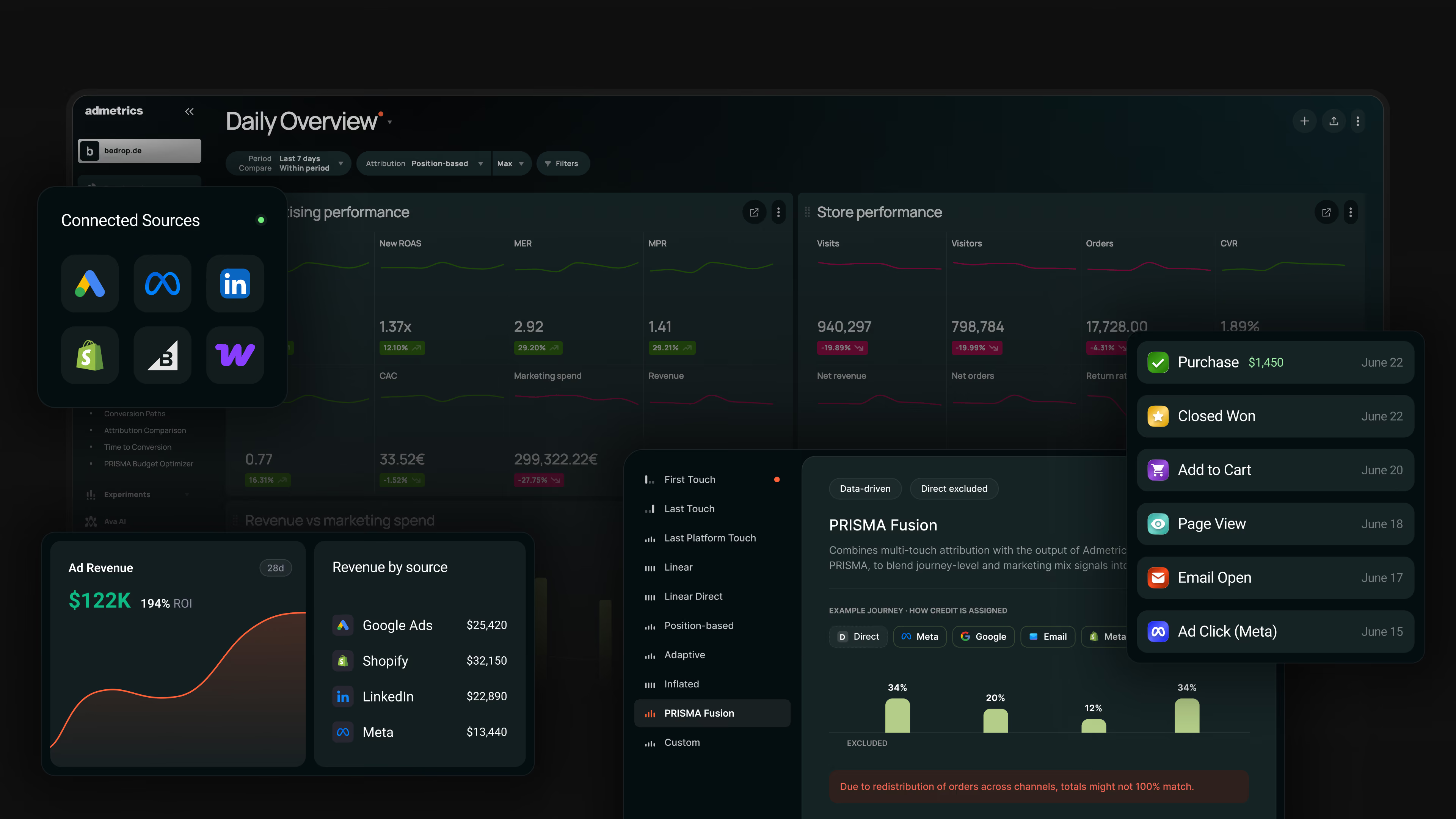
A standard integration stack ends at the warehouse. Connectors land Meta spend and Shopify orders in tidy tables, then an analyst spends the week joining them, bolting on COGS and debating which return rate to trust. The pipeline worked. The answer still isn't there.
Admetrics closes that gap. It's a no-code data integration platform built for ecommerce: shops, ad platforms, retention tools and payment providers connect natively and land in a layer that already understands orders, SKUs and returns. Tracking, attribution, profit and budget execution run on that same data, so nothing gets re-modeled downstream.
Key features
Strengths
Limitations
Pricing
Admetrics prices against monthly ad spend, not connector volume or seats. Growth starts at $399/month and covers the first $20,000 of monthly spend, with 1.5% charged above it. Business starts at $899/month, covers up to $70,000 and charges 1% on the excess. Above $100K per month, pricing is custom. Every tier includes a 14 to 21 day trial, no card required.Reviews
Admetrics holds a 4.97 average on G2, and reviewers keep returning to two things: tracking numbers that survive scrutiny, and a team that stays involved after implementation. One long-term customer called the tracking "absolutely reliable". Ehrenkind credits a 60% ROAS increase, and Nyfter tripled the data it could track reliably.Bottom line
If your problem is getting 400 sources into one warehouse, this isn't the data integration tool you want. If you sell physical products and the real problem is turning ad, shop and cost data into a budget decision, it replaces the connector, the warehouse and the modeling layer in one purchase.2. Fivetran
★4.3Best for: data teams that need a managed data integration tool landing hundreds of sources reliably in a warehouse and already own the modeling, BI and decision layer on top.
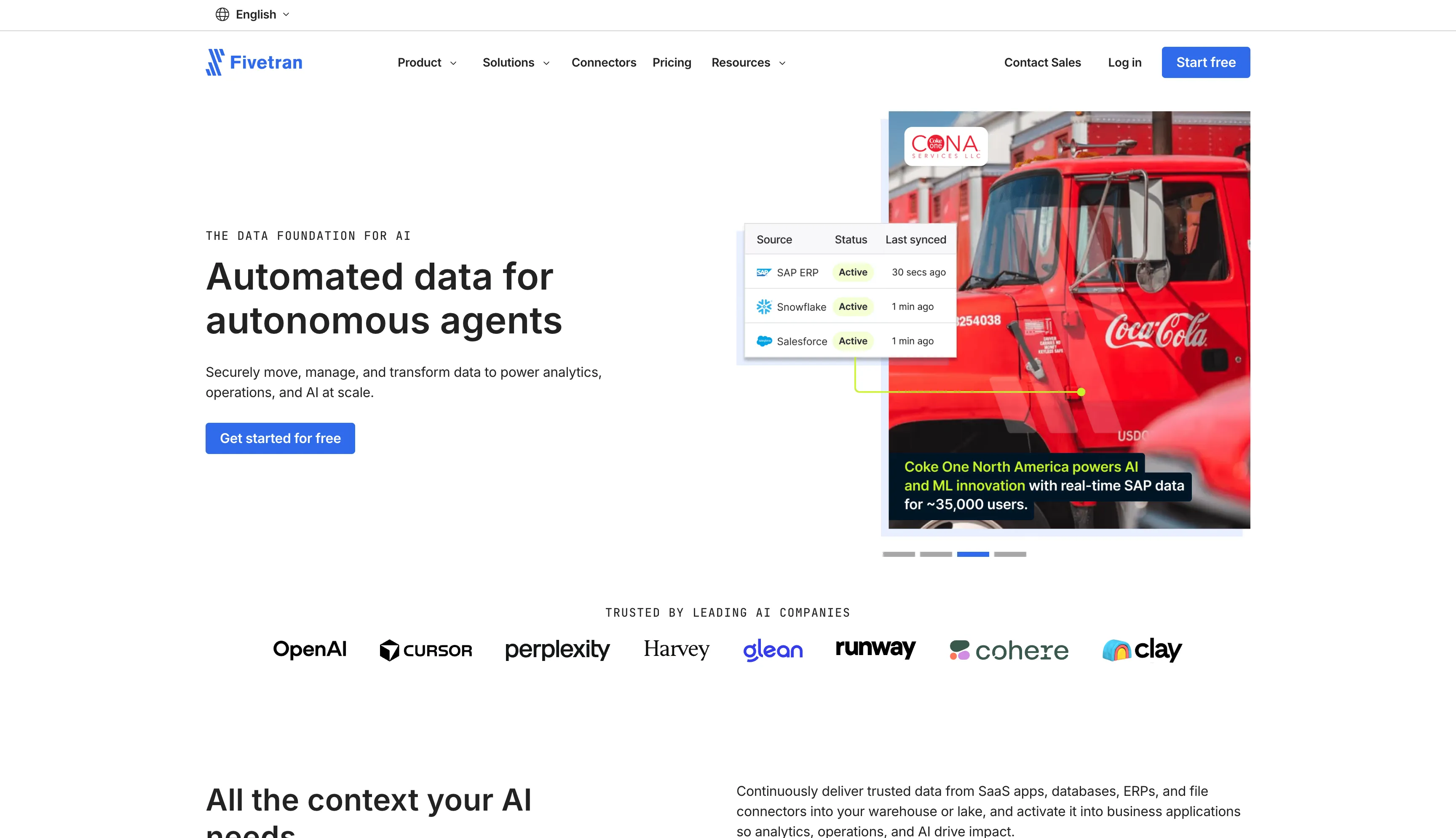
Fivetran is the data integration platform other pipelines get measured against. Point it at a source, pick a destination, and it replicates the data, absorbs schema changes and stays out of the way. What this data integration tool delivers is rows in a warehouse. Joining ad spend to orders, netting out costs and deciding what to scale all happen afterward, in tools you build or buy separately.
Key features
Strengths
Limitations
Pricing
Usage-based, billed on monthly active rows rather than seats. The Free plan covers 500,000 MAR for connections, 3,500 for activations and 5,000 monthly model runs. Beyond that comes Standard, Enterprise or Business Critical, with a $5 base charge per standard connection and enterprise database connectors reserved for upper tiers.Reviews
Fivetran sits near 4.3 on G2 across 800+ reviews and 4.5 on Capterra. Setup takes minutes and support answers quickly. The complaints are about the invoice: in one sample of recent G2 reviews, about a third named cost as the biggest drawback.Bottom line
The strongest pure data integration tool here, and it stops at the warehouse. With people to build everything after the sync, it's a safe buy. Without them, the missing layers show up as headcount.3. Adverity
★4.4Best for: enterprise marketing teams and agencies running dozens of markets on one data integration platform, with data specialists on hand to configure and govern the pipeline.

Every ad platform calls the same thing something different, and Adverity is built around that problem. It pulls from 600+ sources, then forces the fields into one agreed vocabulary before anything reaches your warehouse or BI tool. It's marketing ETL in the strict sense: powerful, configurable and demanding of whoever sets it up.
Key features
Strengths
Limitations
Pricing
No public price list. Adverity quotes each customer based on factors such as annual marketing spend and warehouse setup. G2 data reports an average implementation of about two months and a return on investment near 14 months.Reviews
Adverity holds 4.4 on G2 across 320+ reviews and 4.5 on Capterra. Reviewers praise the transformation options and the manual reporting work it removes.Bottom line
The right data integration tool for a large marketing team that needs clean, governed cross-platform data and has people to run it. It's overbuilt for a lean ecommerce brand, and it leaves profit and conversion capture for someone else.4. Funnel
★4.5Best for: marketing teams and agencies that want a governed data integration hub for ad, analytics and CRM data, feeding whichever BI tool or warehouse they already trust.
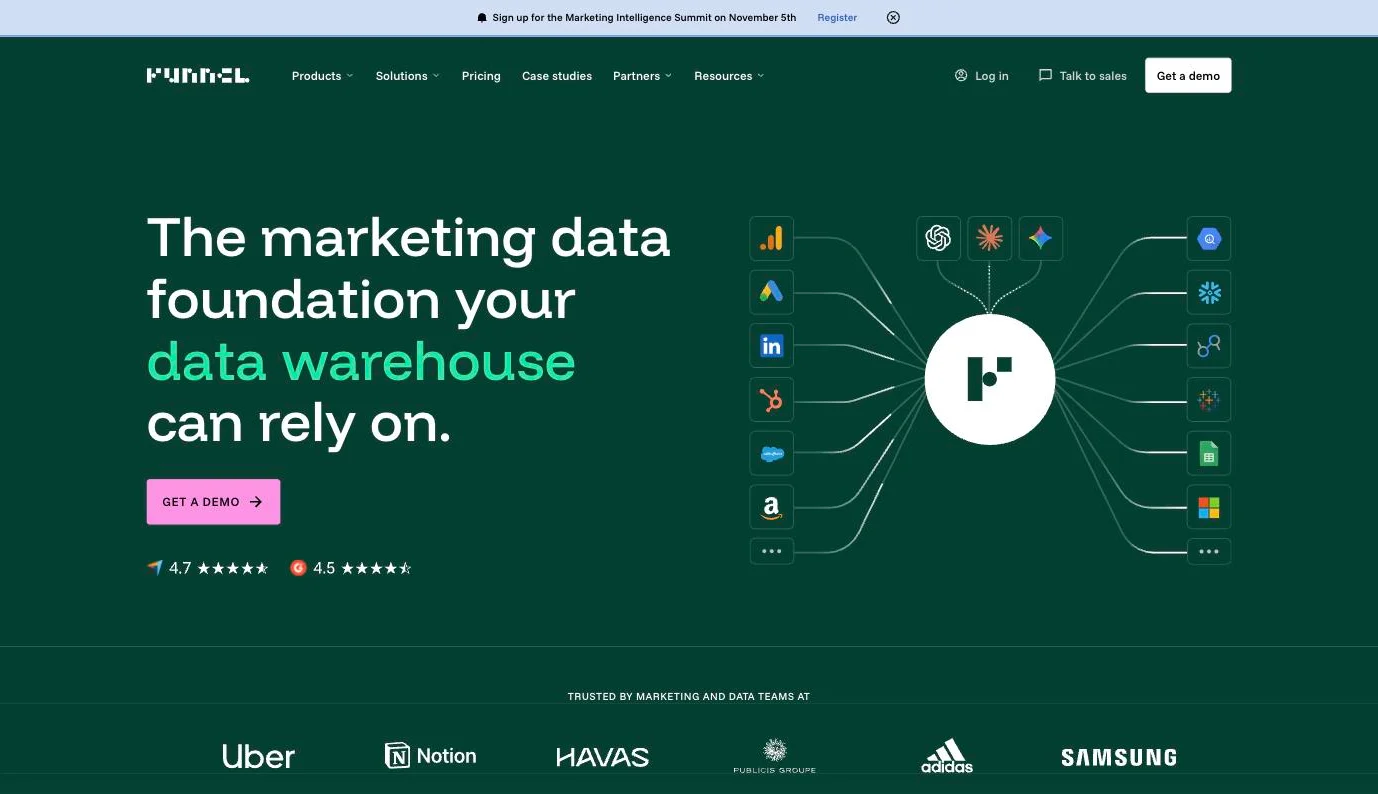
Funnel does one job with unusual discipline. It collects marketing data from 600+ sources, stores the full history, normalizes currencies and field names through a semantic layer, and sends the result to dashboards, BI tools or warehouses. Lately it has added AI access through MCP and a measurement product on the same hub.
Key features
Strengths
Limitations
Pricing
Flexpoint-based and usage-driven. Reports put the entry plan at about $400/month, with a Business tier near $800/month on third-party figures and Enterprise by quote.Reviews
Funnel scores 4.5 on G2 and 4.7 on Capterra. Reviewers praise how easily it pulls data from everywhere and the support. The complaints are consistent: the flexpoint model, cost at scale, and the occasional connector failure.Bottom line
One of the best marketing data integration platforms available, as long as the question is "where does my data live." It won't tell you what the data is worth, what it cost to earn, or where the budget should move.5. Airbyte
★4.4–4.5Best for: engineering-led teams that want an open-source data integration tool with full control over their pipelines, including the freedom to build or patch a connector when the catalog falls short.
Airbyte is what you pick when you'd rather own the pipeline than rent it. The core is open source, the catalog runs past 600 connectors, and when a source is missing you can build it yourself instead of filing a request and waiting. The price of that freedom is real engineering attention.
Key features
Strengths
Limitations
Pricing
The open-source edition is free to run on your own infrastructure, with engineering time as the real cost. Cloud Standard bills by data volume on a small monthly base, with API sources costing roughly $15 per million rows in credits according to Airbyte's published rates. Plus and Pro move to fixed credit packages or capacity-based pricing.Reviews
Airbyte holds about 4.4 to 4.5 on G2 across roughly 75 reviews. Reviewers like the connector builder, the catalog and the flexibility. The recurring complaints are connector reliability, resource use at scale and opaque error messages.Bottom line
The best-fitting data integration platform here for teams that want ownership and have the engineers to exercise it. If nobody on your side wants to maintain a pipeline, the savings turn into labor.6. Hevo Data
★4.4Best for: small and mid-size data teams that want a no-code data integration tool feeding a warehouse in an afternoon, with transformation and monitoring included.
Hevo targets the team that needs data in the warehouse this week and doesn't want to staff a platform to get it. Setup takes a few guided steps and the interface hides most of the plumbing. The trade-off shows up later, when pipelines get complicated.
Key features
Strengths
Limitations
Pricing
Event-based, counting each record inserted, updated or deleted in the destination. A free plan covers 1M events a month with a limited connector set. Paid plans start with Starter at roughly $239 a month on annual billing for 5M events, with Professional above it and a custom Business Critical tier for streaming and SSO. Third-party figures differ, so check the live page.Reviews
Hevo holds about 4.4 on G2 across 280+ reviews and 4.7 on Capterra. Reviewers praise ease of use, schema handling and support. Complaints: the transformation ceiling, thin logs, and event-based pricing that grows with volume.Bottom line
A friendly, affordable data integration platform for teams without a data platform group. Outgrow it, and you'll want more connectors, more control and a layer that tells you what the data earned.7. Matillion
★4.4Best for: data engineering teams standardized on Snowflake, Databricks or Redshift that want a data integration platform to transform data inside the warehouse and care less about connector count.
Most data integration tools on this list are built to move data. Matillion is built to work on it. Its pipelines push the heavy lifting down into your cloud data platform, so data never leaves the environment you already pay for, and a visual canvas sits on top of SQL and Python for the engineers who want both. Its newer layer, Maia, builds pipelines from plain-language prompts.
Key features
Strengths
Limitations
Pricing
Credit-based, metered by agent running time. A trial exists, but there's no permanent free tier. G2 lists credits from about $2 each, and third-party estimates put entry plans near $1,000 a month, with Teams and Scale tiers above that.Reviews
Matillion holds roughly 4.4 on G2 across 80+ reviews and 4.3 on Capterra. Reviewers praise the interface and transformation power. They flag cost at scale, a clunky Git experience and uneven support.Bottom line
A strong data integration tool for warehouse-centric engineering teams that want to shape data in depth. For an ecommerce brand that wants answers instead of pipelines, it's a toolkit with no instructions.8. Informatica
★4.3Best for: large enterprises that want one enterprise data integration platform for integration, data quality, governance and master data across hybrid and multi-cloud estates, with a dedicated team to run it.
Informatica approaches integration as one department of a much larger discipline. Its Intelligent Data Management Cloud handles ETL, ELT, replication and change data capture, then keeps going into quality rules, cataloging, governance and master data. For a bank or a manufacturer, that breadth is the point. For an ecommerce brand reading ad spend, it's a lot of platform in front of a simple question.
Key features
Strengths
Limitations
Pricing
Informatica publishes no rates. It sells capacity as Informatica Processing Units, consumed across integration, quality and governance services, on monthly or annual commitments with overage fees.Reviews
Cloud Data Integration holds about 4.3 on G2 across 105 reviews. Reviewers like the connectivity and built-in transformations. A BARC user survey flagged cost, missing functionality and business-user difficulty more often than for other vendors, and the learning curve comes up in most reviews.Bottom line
The right enterprise data integration software for a regulated company with a data office. For anyone else, it's more platform than the problem needs and arrives later than the budget decision does.9. Talend (Qlik Talend Cloud)
★4.0–4.2Best for: enterprise data teams that want a data integration platform with data quality built in, across hybrid estates that include ERP and legacy systems.
Talend started as an open-source ETL toolkit that developers liked to bend. Since Qlik acquired it in 2023, it has been folded into Qlik Talend Cloud, which pairs pipelines with profiling, cleansing, cataloging and a trust score for how ready a dataset is for analytics or AI. The pitch: quality shouldn't start after the data lands.
Key features
Strengths
Limitations
Pricing
Qlik doesn't publish list prices. Qlik Talend Cloud is tiered into Starter, Standard, Premium and Enterprise, with capacity-based pricing at the top and SAP and mainframe connectivity reserved for Enterprise.Reviews
Talend's G2 listings sit around 4.0 to 4.2, with about 200 reviews for Cloud Data Management and 65 for Data Integration. Reviewers credit the connector range and quality tooling, and flag the learning curve and rising costs.Bottom line
A serious data integration tool for enterprises where data trust is a requirement, not a nice-to-have. For a team that wants answers from ad and shop data this quarter, it's heavy machinery pointed at the wrong job.10. Boomi
★4.4Best for: enterprises that need applications, APIs, B2B exchanges and data pipelines connected across cloud and on-premises systems on a single low-code data integration platform.
Boomi began as an iPaaS, a tool for wiring one business application to another, and data integration came later as one more branch. The platform now spans application integration, APIs, EDI, master data and ELT pipelines, with AI agents on top. It's the broadest data integration platform on this list, and the one least shaped like a marketing data problem.
Key features
Strengths
Limitations
Pricing
Tiered by edition, from Base through Enterprise Plus, with per-connection licensing and most pricing quoted by sales. A Pay-As-You-Go option starts at $99 a month and meters usage per message, and a 30-day trial is available.Reviews
Boomi holds 4.4 on G2 across about 465 reviews. Reviewers praise ease of use, support and API management. Complaints: pricing opacity and the learning curve on complex builds.Bottom line
The right data integration platform for an enterprise connecting dozens of systems. For a brand that needs ad, shop and cost data turned into a budget decision, it's a lot of plumbing for a question it wasn't built to answer.How to choose a data integration platform
The best data integration pipeline tools differ less on features than on who has to run them. Choosing tools for data integration comes down to one habit: start with the decision the data has to support, then work backward.
The last question is where the best data integration tools for businesses separate. A pipeline answers where the data lives. The rest of the stack answers what to do with it.
The best data integration platforms for 2026: final verdict
Most of the best data integration platforms for 2026 do their core job: they connect sources, move data and keep schemas from breaking. For an ecommerce brand, the difference that matters is what happens after the sync.
Admetrics wins on that line, and it's the best data integration software on this list for an ecommerce brand. It runs the chain for a DTC brand end to end: first-party tracking that survives cookie loss, a data model that nets out COGS, returns and fees down to SKU, and budget execution on top. Its connector catalog is the smallest on this list at 30+, and for a brand that sells physical products that's a trade worth making. Everything else here moves data well and leaves the last mile to you.
The other data integration tools earn their place for narrower jobs. Fivetran and Airbyte lead for managed and open-source pipelines. Adverity and Funnel fit marketing teams running many markets. Hevo and Matillion suit lean and warehouse-centric teams. Informatica, Talend and Boomi serve enterprises with hybrid estates and a data office to run them. Pick by the job you actually have.
If you're an ecommerce or DTC brand deciding where next quarter's budget goes, start with Admetrics and use this list to challenge it against your stack. Book a demo, or run the 14 to 21 day trial against your live data and see whether the profit picture changes which campaigns you'd scale.