Tariffs Ecommerce: A Strategic Must-Know for DTC Success
Welcome to your deep dive into one of the most underappreciated aspects of online business strategy: tariffs ecommerce. Direct-to-Consumer (DTC) brands operate in a world of endless possibilities—and hidden costs. Among these, tariffs are silent profit killers that can make or break your global strategy. From unpredictable shipping costs to sneaky import taxes, tariffs silently shape your margins, logistics, and scalability.
In this ultimate guide, we’ll unpack the key tariff challenges DTC businesses face, benchmark global duty structures, and lay out actionable strategies to not just survive—but thrive—in a tariff-centric e-commerce world. Here is an in-depth article about navigating Trumps new tariffs impacts on eu e-commerce and how to respond.
Understanding Ecommerce Tariffs
Before you even think about scaling internationally, it’s crucial to understand what tariffs are. Simply put, a tariff is a tax imposed by a government on imported or exported goods. In ecommerce, this applies to your products moving across borders—whether raw materials entering your warehouse or finished goods shipping out to global customers.
There are two main types:
- Ad valorem tariffs: A percentage of the product's value.
- Specific tariffs: A fixed fee based on quantity (e.g., $3 per unit).
Tariffs are intended to protect domestic industries, but for DTC brands, they can unexpectedly raise product costs, disrupt delivery schedules, and complicate international growth.
Why Tariffs Matter to DTC Brands
Unlike traditional retail that often works with intermediaries, DTC brands have end-to-end responsibility for their supply chains. This means:
- You pay the duties—not a distributor.
- You’re responsible for accurate documentation.
- A customs delay can directly hit your customer experience.
In short, tariffs are not just a cost center—they are a strategic concern.
Benchmarking Tariffs Across Regions
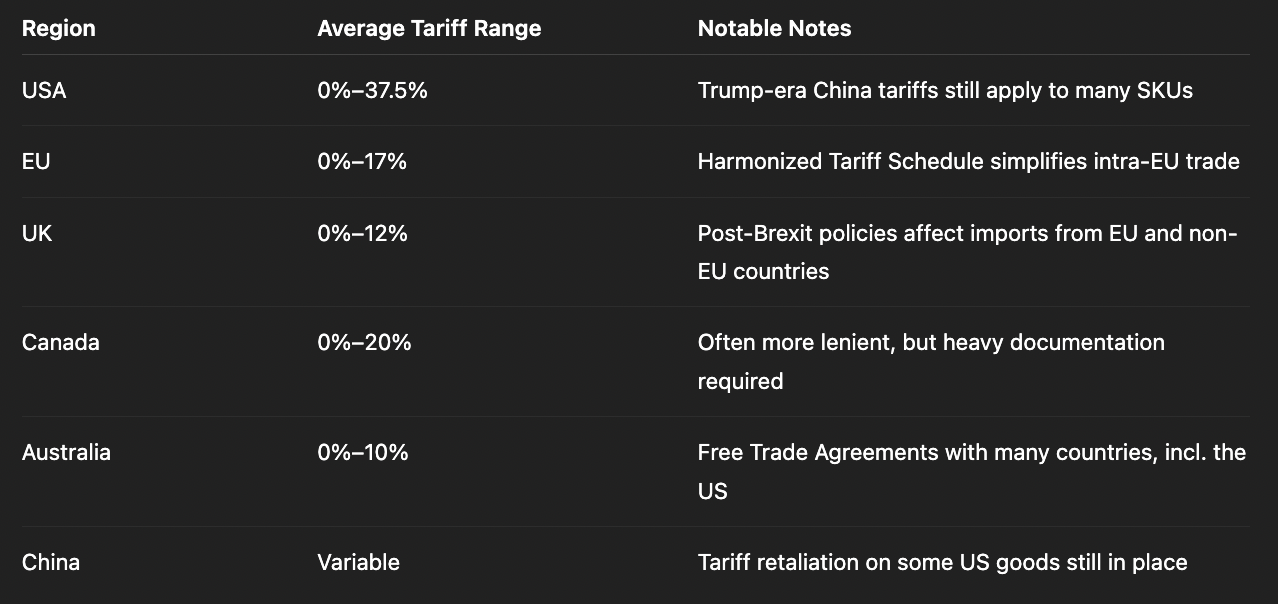
Navigating tariffs across countries can feel like deciphering ancient scrolls. Here’s a glimpse of tariff ranges across top markets:
Types of Tariffs Ecommerce Brands Face
Ecommerce brands face a wide variety of tariffs that go beyond simple import taxes. Understanding the different types is essential for crafting a well-informed international pricing and sourcing strategy.
Anti-Dumping Duties
These duties are applied when a foreign company exports a product at a price significantly lower than in its home market, often as part of an aggressive pricing strategy to capture market share. Governments impose anti-dumping duties to protect local manufacturers from this unfair competition.
For ecommerce brands, especially those in tech or apparel, anti-dumping measures can suddenly increase your costs without warning. Staying informed through trade updates is crucial to avoid being caught off guard.
Safeguard Measures
Safeguard tariffs are temporary duties imposed during sudden import surges that threaten domestic industries. Unlike anti-dumping duties, these are not aimed at penalizing unfair pricing but rather at providing breathing room to local producers.
If you're in a fast-growing category—like home fitness or electronics—where demand skyrocketed during a specific period, these measures might affect your imported stock unexpectedly.
Excise Duties
Excise duties are product-specific taxes, often applied to goods like alcohol, tobacco, e-liquids, sugary drinks, and even luxury items. While not technically "tariffs," they are collected at import in many countries, making them highly relevant for ecommerce businesses shipping these products.
Ensure you understand excise obligations per country—some regions require separate permits or additional health labeling compliance.
Tariffs and Customs Compliance
Customs compliance is a legal necessity, not just a paperwork burden. With more ecommerce shipments crossing borders daily, customs authorities are intensifying scrutiny.
Must-follow practices for compliance:
- Include proper documentation: Every shipment must be accompanied by a commercial invoice, the correct HTS code, and any certificates of origin if claiming preferential treatment under trade agreements.
- Monitor policy changes: Tariff rates and trade rules shift with political tides. Subscribe to updates from customs authorities or use compliance tools that auto-alert you.
- Hire customs brokers: If you're unsure, brokers can help avoid errors. They manage documentation, declarations, and inspections.
The risk of non-compliance is real—penalties can reach up to 500% of the misclassified tariff. Plus, repeated offenses can place your company on a customs watchlist.
Impact of Tariffs on Product Pricing
Tariffs aren’t just an accounting line item—they directly influence your pricing decisions and customer experience.
Three pricing models DTC brands use:
- Absorbing tariffs: You eat the cost to stay competitive. This protects conversion rates but squeezes profit margins, which can be unsustainable unless your gross margin is robust.
- Passing costs to customers: This model increases transparency but might trigger cart abandonment if duties show up unexpectedly at checkout.
- Hybrid strategy: Absorb tariffs on high-margin items, pass them on selectively for lower-margin or premium products. This approach allows for strategic flexibility.
Use tools like Shopify Scripts or Zonos to automate tariff-inclusive pricing logic.
Bottom line: Pricing isn’t just about cost—it's about how your brand communicates value while managing global complexity.
Managing Tariff Risk in Ecommerce
Tariffs can change overnight. Brands that survive turbulent trade climates are the ones that prepare in advance with proactive mitigation strategies.
Smart ways to hedge tariff risk:
- Supplier diversification: Avoid concentrating production in a single country. Source from multiple locations to maintain flexibility.
- Currency hedging: Use financial instruments or multi-currency accounts to protect against exchange rate swings, especially in volatile regions.
- FTA optimization: Take advantage of Free Trade Agreements like USMCA, EU-Japan EPA, or ASEAN FTAs. Proper documentation (like certificates of origin) is key to claiming these benefits.
If your business model relies heavily on imports, it’s wise to appoint a compliance manager or work with trade consultants who can spot risks early.
How Tariffs Influence Inventory Management
Tariffs can unexpectedly delay or inflate your inventory costs—especially for fast-scaling brands with tight cash cycles.
Consider these inventory tactics:
- Staggered shipping: Rather than importing large, tariff-heavy batches, break shipments into smaller loads to test tariff exposure and reduce customs risk.
- Regional fulfillment centers: Establish warehousing in or near target markets to take advantage of local exemptions or lower intra-region tariffs.
- Bonded warehouses: Store goods without paying duties until they’re sold or shipped, improving cash flow.
Tariff-aware inventory planning can give you the operational agility needed to adapt to trade volatility without compromising customer expectations.
Tariffs During Trade Wars and Political Shifts
Tariffs are often weaponized during geopolitical tensions. Here’s how they’ve shaken ecommerce brands in recent years:
US-China Trade War (2018–2020)
Duties on thousands of Chinese goods rose as high as 25%, causing ecommerce electronics and home brands to rapidly shift supply chains or raise prices.
Brexit
Post-Brexit rules shocked UK-based DTC brands. Suddenly, selling to the EU involved unexpected VAT charges, border delays, and new customs paperwork.
USMCA (formerly NAFTA)
While the USMCA retained tariff-free access across North America, it introduced stricter rules-of-origin documentation, impacting fashion, auto parts, and electronics ecommerce brands.
Takeaway: Political changes are business changes. Build flexibility into your systems to adapt fast. Read an in=depth article on marketing in a recession.
Tariff Engineering: Legal Product Modifications
One of the smartest—but least discussed—ways to minimize duties legally is through tariff engineering. This practice involves altering your product in a way that reduces its duty classification without changing the core functionality or violating any regulations.
Real-world examples of tariff engineering:
- Footwear: Brands have added ornamental features or changed materials to shift their product into a lower-tariff category.
- Kitchen appliances: Slight changes to plug types or voltage settings can reclassify a product from a high-tariff "consumer appliance" to a lower-duty "industrial component."
Key considerations:
- Consult with a customs attorney or trade specialist before making product modifications.
- Always document your intent and compliance trail—this can protect you during customs audits.
- Never cross into "fraudulent misclassification" territory. Ethics and legality must remain intact.
When done right, tariff engineering is a long-term cost-saving strategy that doesn't sacrifice product quality or consumer trust.
Sourcing Countries with Favorable Tariffs
One of the most effective tariff reduction strategies is sourcing your goods from countries with lower duty rates or existing Free Trade Agreements (FTAs).
Top countries ecommerce brands are turning to:
- Vietnam: Low labor costs and favorable trade relations with the US and EU.
- Mexico: Excellent for nearshoring North American production, with preferential access under USMCA.
- Bangladesh: Especially strong in apparel manufacturing, benefiting from GSP (Generalized System of Preferences) in many regions.
What to look for in a tariff-friendly sourcing partner:
- Experience with export documentation
- Knowledge of origin certificates for FTAs
- Willingness to adapt SKUs for classification advantages
Shifting your sourcing strategy can reduce landed costs by 15–30%—a huge win for any DTC brand scaling across borders.
Free Trade Agreements (FTAs) and Ecommerce
FTAs are your VIP passes through customs. These agreements between countries reduce or eliminate tariffs altogether—if you meet the criteria.
Popular FTAs for ecommerce brands:
- USMCA: Covers trade between the US, Mexico, and Canada.
- EU-Japan EPA: Removes duties on over 90% of goods traded between the EU and Japan.
- ASEAN Free Trade Area: Ideal for brands sourcing from Southeast Asia.
How to leverage FTAs:
- Ensure products meet the Rules of Origin (ROO)—proof that goods were manufactured or significantly transformed in a partner country.
- Acquire a Certificate of Origin to claim preferential treatment.
- Train your shipping and logistics team on FTA documentation protocols.
FTAs can unlock major cost savings and smoother logistics, making international expansion far more viable.
Working With 3PLs and Tariffs
Your Third-Party Logistics (3PL) partner is your frontline defense—and offense—when it comes to navigating tariffs.
What top 3PLs should offer:
- DDP (Delivered Duty Paid) options so your customers avoid surprise fees
- Experience with HTS code management
- Integration with FTA rules and customs pre-clearance systems
Questions to ask your 3PL provider:
- Do you use automated tariff classification tools?
- How do you handle multi-country shipping and tax calculations?
- Can you support bonded warehousing?
With the right 3PL partner, your tariff burden can be reduced through logistical efficiency, better compliance, and international strategy support.
Marketing and Transparency on Tariff-Impacted Pricing
Consumers today value transparency more than ever. If tariffs are forcing you to raise prices, it’s better to communicate clearly than to spring it as a surprise during checkout.
Best practices for tariff-related messaging:
- Include a note on product pages explaining tariff-related increases.
- Use FAQs or help center articles to explain duties for international customers.
- Offer temporary "tariff offset" discounts or bundled deals to ease the impact.
Real example:
Allbirds successfully communicated their 2019 price increases due to US-China tariffs by publicly posting a letter from the founders explaining the situation. The result? A surge in customer loyalty and social media support.
When done with clarity and integrity, tariff transparency can actually enhance your brand’s credibility.
Legal Insights for Tariff Management
Ignoring the legal side of tariffs can be dangerously costly. Beyond fines, non-compliance may lead to goods being seized, shipping bans, or losing access to certain markets.
Your legal checklist for tariff protection:
- Understand incoterms: Know who’s responsible for duties (e.g., DDP vs DDU).
- Hire a trade compliance lawyer for regular audits.
- Document everything: HTS codes, FTA claims, ROO validations.
Helpful resources:
- WCO (World Customs Organization) for global compliance trends.
- CBP (Customs and Border Protection) for U.S.-specific laws.
- Local trade offices or consulates for market-specific rules.
Even if you're a small DTC brand, investing in legal clarity now avoids massive pain later.
Scaling International Sales Amid Tariffs
If you’re aiming to sell internationally, tariffs shouldn’t stop you—but they should guide your approach.
Scaling strategies that work:
- Start with tariff-friendly countries first. Expand to high-duty zones once margins grow.
- Use a modular product catalog—offering SKUs tailored for duty optimization.
- Run limited-time pilots in high-tariff markets to test feasibility.
Smart move: Use regional marketplaces (e.g., Rakuten in Japan, Zalando in the EU) to test local demand before committing to major import volumes.
Scaling globally is possible—with a tariff-aware mindset, it’s also profitable.
Tariff Trends and 2025 Forecasts
Understanding the past helps predict the future. Tariff landscapes are shaped by politics, economics, and digital transformation.
Predictions for 2025 and beyond:
- Tech products and green energy components may face higher tariffs due to strategic national interests.
- Digital goods and SaaS could face "tariff-equivalents" like service taxes.
- ASEAN, Africa, and LATAM markets may offer the next big break for DTC brands due to favorable trade policies and growing demand.
Stay ahead by:
- Subscribing to trade intelligence tools like Trademo Intel or GlobalTrade.net
- Joining trade-focused Slack groups or forums
- Partnering with customs and logistics experts to monitor policy updates
The e-commerce brands that understand tariffs today are the global category leaders of tomorrow.
Conclusion: Turning Tariffs into Strategic Leverage for Ecommerce Growth
Tariffs may seem like bureaucratic speed bumps on the road to ecommerce expansion, but they’re actually much more than that. For Direct-to-Consumer (DTC) brands, tariffs represent both a challenge and an opportunity—a test of your agility, foresight, and operational excellence.
We’ve explored how tariffs ecommerce directly impacts product pricing, inventory planning, logistics, and even customer experience. While global trade policies can be volatile and opaque, those brands that take the time to understand and optimize around tariffs gain a serious competitive edge.
Whether it’s:
- Leveraging FTAs and duty drawbacks
- Optimizing your sourcing and fulfillment strategies
- Or communicating transparently with your customers
…the brands that treat tariff strategy as a pillar—not an afterthought—will find themselves better protected, more profitable, and globally scalable.
In a digital-first, border-blurring marketplace, trade regulations are no longer the sole concern of legal departments or logistics managers—they’re a core part of brand growth. The more informed your team is about the role tariffs play, the more resilient and adaptive your ecommerce operation becomes.
So as we look toward a future shaped by geopolitics, environmental regulation, and digital evolution, the question isn’t if you’ll deal with tariffs—but how well.
For deeper insights on how to grow smarter and market better in changing global conditions, explore Admetrics—your source for actionable analytics, e-commerce trends, and performance marketing strategies.
FAQs about Tariffs Ecommerce for DTC Brands
What is a tariff in ecommerce?
A tariff is a government-imposed tax on imported or exported goods. In ecommerce, tariffs are typically applied when products cross international borders, impacting the cost of goods sold and overall pricing strategy for DTC brands.
How do tariffs affect Direct-to-Consumer (DTC) brands?
Tariffs directly influence product pricing, shipping costs, profit margins, and logistics strategies. Since DTC brands manage their own supply chains, they are responsible for customs compliance, tariff classification, and related documentation.
Can I legally avoid paying high tariffs?
Yes, through strategies like tariff engineering, leveraging Free Trade Agreements (FTAs), or using duty drawback programs. However, these must be executed correctly with proper documentation to remain compliant with international trade laws.
What is DDP shipping, and how does it relate to tariffs?
DDP (Delivered Duty Paid) means the seller covers all duties and taxes upfront. It provides a seamless customer experience by eliminating surprise fees at delivery but requires the seller to handle all customs clearance responsibilities.
Should I pass tariff costs to my customers or absorb them?
It depends on your brand positioning and margins. Some brands absorb tariffs to maintain competitive pricing, while others pass them on transparently. A hybrid approach—absorbing for high-margin items and passing for others—is often the most effective.