Sending cold Google Ads traffic directly to your product page is one of the most expensive mistakes in ecommerce — and almost every brand is doing it.
Here's the problem: a cold visitor who clicks your search ad doesn't know you yet. They're comparing options, researching solutions, and nowhere near ready to hand over their card on a page they've never seen before. So they bounce. Your conversion rate hovers at 1.2%, your ROAS stays mediocre, and you conclude that Google Ads "doesn't work" for your brand.
It does work. You just have the wrong destination. The funnel stack — advertorials, quizzes and comparison pages — solves exactly this problem. Each format pre-sells the visitor before they reach your product page, and the conversion rate differences are not incremental. They are transformational. In this post, we'll break down how each funnel type works, when to use it, and how to build it.

Why Sending Cold Traffic to Product Pages Is Killing Your ROAS
Cold traffic is not warm traffic. When someone searches "best magnesium supplement", they haven't decided on a brand — they're still in research mode. A product page assumes they've already decided. That disconnect kills conversions before they have a chance to happen.
Think about what a cold visitor actually needs before they convert. They need to understand the problem clearly. They need to trust that you understand it too. They need social proof that others like them have succeeded with your product. And they need a logical reason to choose you over every competitor they're also comparing.
A product page gives them none of that. It gives them a price, some bullet points, and a "buy now" button. That's why the industry-standard direct-to-product-page conversion rate sits at 1.2–2%. Meanwhile, brands using the funnel stack regularly see conversion rates of 8–14%. Same traffic. Same product. Completely different destination.
The Funnel Stack: Conversion Rate Comparisons at a Glance
Before we go deep on each format, here's what the data looks like across the three funnel types:
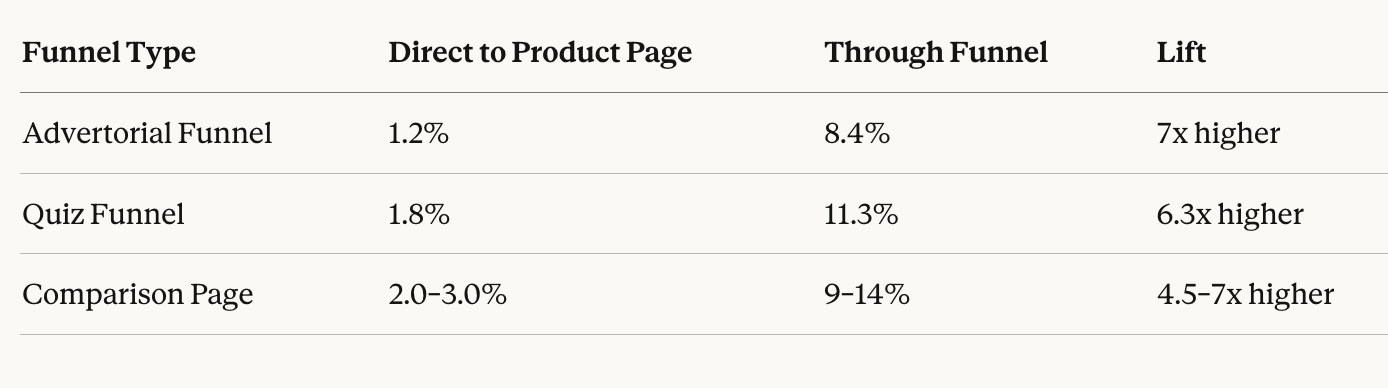
These aren't theoretical numbers. They represent the consistent difference between brands that route traffic intelligently and those that don't. Now let's break down how to build each one.
Funnel Type 1: The Advertorial — Your Pre-Sell Engine
An advertorial is a page that looks like editorial content — a news article, blog post, or first-person story — but exists to pre-sell your product. It educates, agitates, and introduces your solution in a way that feels earned rather than sold.
The key word is "feels". A well-written advertorial never reads like a sales page. By the time the reader reaches your product page, they're already convinced. You're not asking them to make a buying decision on the advertorial. You're simply handing them a reason.
The Advertorial Structure That Converts at 8.4%
Every high-converting advertorial follows a proven three-part framework:
- First 200 words — Educate on the problem. Build credibility by demonstrating deep knowledge of the reader's situation. Use specific language, clinical terms if relevant, and real data. This section establishes trust before any product is mentioned.
- Middle 300 words — Agitate the problem. Show the reader why common solutions fail. This is where you create urgency without using fake countdown timers. The problem is real. The solutions they've tried haven't worked. There's a reason for that.
- Final 200 words — Introduce your solution. Only now do you mention the product, positioned as the logical answer to everything the reader just read. The CTA is clear and frictionless: "find out more" rather than "buy now".
The result is a page that never looks like a sales pitch and always looks like journalism. When readers click through to your product page, they arrive pre-sold. Your product page simply closes what the advertorial opened.
What Makes an Advertorial Work
- Headline that speaks to a specific pain point — not the product
- First-person or third-person editorial voice — never brand voice
- No product images or pricing in the first 400 words
- Social proof woven into the narrative, not bolted on at the end
- A single CTA at the end — ideally "learn more" or "see how it works"
Here's all you need to know about Google ads insights.
Funnel Type 2: The Quiz Funnel — Personalisation at Scale
Quiz funnels are the highest-converting format in the funnel stack for one simple reason: they make the visitor feel like the recommendation was made specifically for them. That personalisation triggers a level of trust that no static page can replicate.
The mechanics are straightforward. Instead of a landing page, the visitor lands on a short quiz — typically 4–6 questions — that ends with a personalised product recommendation. By the time they see the product, they've already told you exactly what they need, and you've reflected it back to them. The conversion rate on quiz funnels averages 11.3% against a direct-to-product baseline of 1.8%.
How a High-Converting Quiz Funnel Works
The best quiz funnels for ecommerce follow this pattern:
- Entry headline: "Find your perfect [product] in 60 seconds" — sets up the value exchange immediately.
- Question 1: Primary goal (e.g., sleep / anxiety / muscle recovery). This segments the audience and makes every subsequent question feel relevant.
- Questions 2–4: Supporting qualifiers (age range, current routine, lifestyle preferences). Each answer increases micro-commitment.
- Question 5: Optional contact capture ("Where should we send your results?"). Placed before the result for email capture even from non-buyers.
- Result page: Personalised recommendation with copy that directly references their answers — "Based on your goal of better sleep and your current magnesium use, here's what we recommend..."
The psychology behind quiz funnels is commitment escalation. Once someone answers question one, their brain registers that they've started. Each subsequent answer deepens that commitment. By the time they reach the product recommendation, they're psychologically invested in a way a static page can never achieve.
Best Categories for Quiz Funnels
- Supplements and nutrition (multiple products, varied goals)
- Skincare (different skin types, concerns, routines)
- Pet products (breed, age, health concern)
- Fitness equipment (fitness level, space, goals)
- Any product with 3+ variants where the "right choice" depends on individual circumstances
Funnel Type 3: The Comparison Page — Steal Competitor Traffic
Comparison pages are the most underused format in the funnel stack — and for brands in competitive markets, they may be the highest-leverage play available. The logic is simple: someone searching "[competitor] alternative" or "[competitor] vs [your brand]" is already shopping. They just need a logical reason to choose you.
Most brands either ignore these searches entirely or send the traffic to their homepage. Both approaches waste an extraordinarily warm audience. A dedicated comparison page converts at 9–14% because it meets the visitor exactly where they are in the decision process.
How to Structure a Comparison Page That Converts
A high-converting comparison page has five components:
- Headline: "[Your Brand] vs [Competitor]: An Honest Comparison" — the word "honest" is critical. It signals objectivity and immediately differentiates you from a brand that's just running a hit piece.
- Comparison table: Side-by-side on ingredients, price per serving, certifications, shipping, and guarantee. Be accurate. If the competitor wins on certain attributes, acknowledge it — the honesty makes everything else more credible.
- Your strengths section: Go deep on the 2–3 areas where you genuinely outperform. This is where you tell the story, not just list the facts.
- Social proof specifically from switchers: Testimonials that mention the competitor by name ("I tried [competitor] for 3 months, then switched to [your brand] and...") are conversion gold.
- Clear CTA: "Try [your brand] instead" — direct, confident, no pressure language.
The Traffic Strategy Behind Comparison Pages
You build the page. Then you bid on the terms. Target: "[competitor] alternative", "[competitor] vs", "[competitor] review", and "[competitor] promo code". These searches cost 85% less per click than cold category keywords because your competitors have already paid to create the demand.
You're not creating intent. You're capturing intent someone else paid to generate. That's why comparison page economics are so compelling — lower CPC, warmer audience, higher conversion rate. Read more about e-commerce conversion rate optimization.
The Bottom Line
Most brands are drowning in data but starving for clarity. Tracking ROAS in Google Ads while your true contribution margin, repeat purchase rate, and customer lifetime value sit invisible across disconnected tools is not an analytics problem. It's an Admetrics problem. The moment you consolidate everything into a single source of truth, your growth decisions become obvious rather than guesswork.
To recap what Admetrics unlocks for scaling brands:
- True profitability tracking replaces surface-level ROAS — Admetrics pulls in COGS, fulfilment costs, and ad spend together so you see actual margin, not just revenue multiples.
- Cross-channel attribution replaces last-click blind spots — because the YouTube ad that warmed up the customer and the search ad that closed them both deserve credit, and Admetrics shows you exactly how the journey played out.
- Cohort-based LTV analysis replaces 30-day snapshots — so you stop killing campaigns that look unprofitable at day 30 but are printing money by month six.
The traffic is the same. The campaigns are the same. The only thing that changes is what you can see — and Admetrics gives you the visibility that turns good campaigns into great ones and great ones into untouchable growth engines.
Ready to see your real numbers? Start your Admetrics trial and find out what your Google Ads are actually making you.
Frequently Asked Questions
What is the funnel stack in Google Ads?
The funnel stack refers to the three pre-sell page formats — advertorials, quiz funnels, and comparison pages — that DTC brands use between a Google Ad click and the product page. Instead of sending cold traffic directly to a product page (which converts at 1.2–2%), the funnel stack pre-sells the visitor, warming them up before they hit the buy button. Each format serves a different stage and audience type.
When should I use an advertorial vs a quiz funnel?
Use an advertorial when your product solves a specific, emotionally resonant problem and your audience needs education before they trust the solution — common in supplements, health products, and financial tools. Use a quiz funnel when your product has multiple variants and the "right" choice depends on individual circumstances. If you sell one product in one format, an advertorial will outperform a quiz. If you sell six product variants to different buyer types, a quiz funnel will outperform an advertorial.
How do I build a comparison page without sounding aggressive toward competitors?
The key is to frame the page as genuinely useful to someone who is actively deciding, not as an attack piece. Use the word "honest" in the headline, acknowledge where the competitor is strong, and focus your argument on the 2–3 areas where you have a clear and demonstrable advantage. Testimonials from customers who switched are far more persuasive than brand claims. The tone should be confident, not combative.
How much traffic do I need before testing a funnel stack page?
You need enough traffic to reach statistical significance — typically 500–1,000 clicks per variant before drawing conclusions. For advertorials, run a 50/50 split between direct-to-product and advertorial-to-product for 2–3 weeks. Most brands see a clear winner within 10 days. Start with the advertorial funnel first: it requires no technical setup, works for almost any product category, and consistently delivers the highest initial lift for brands new to the funnel stack approach.
Can I use all three funnel types at the same time?
Yes — and the best-performing accounts do exactly this. Cold search traffic typically routes to the advertorial. Branded or category search traffic routes to the quiz funnel for personalisation. Competitor-term traffic routes to the comparison page. Each funnel type handles a different audience intent level, so running all three means you're giving every visitor the most relevant pre-sell experience for where they are in their buying journey.