Your auctions reprice every hour. Most teams optimize three times a day at best. Ad Pilot closes that gap: you set the targets, and it makes the decisions. Here is how it actually works, what it acts on, and why it knows when to brake.
The cadence gap
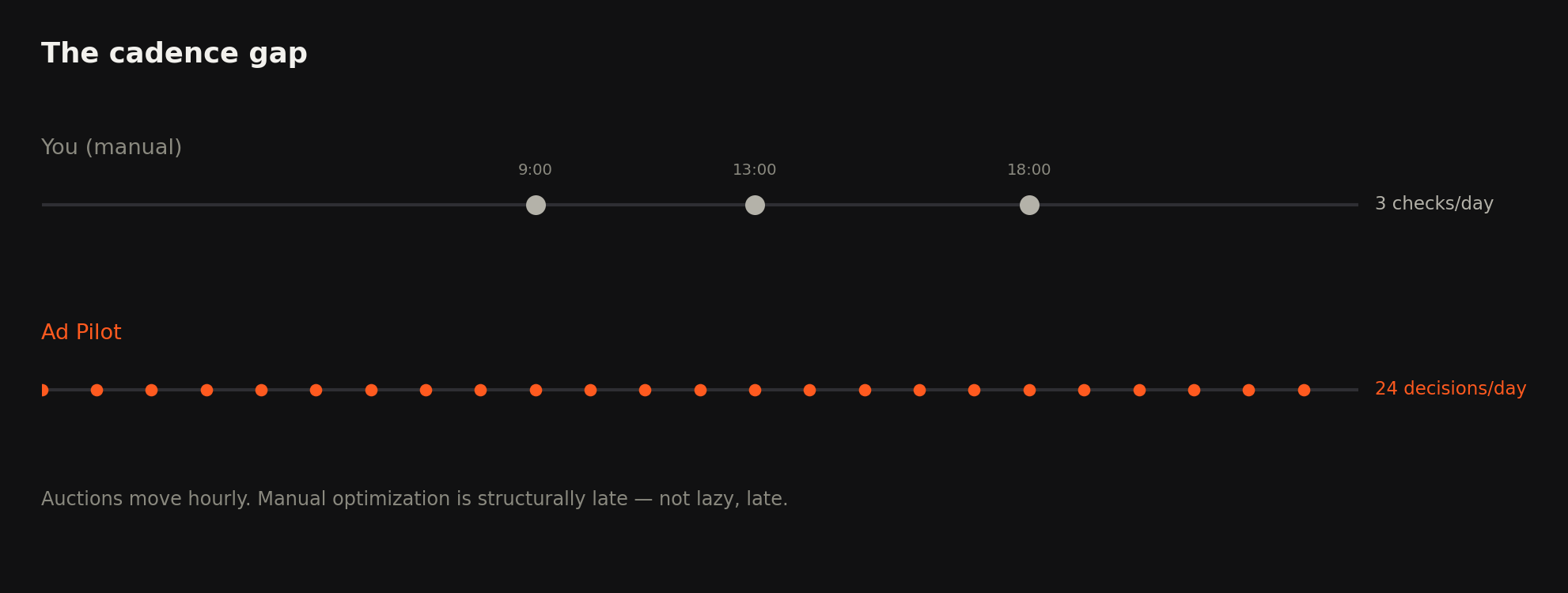
Manual campaign optimization has a structural problem, and it is not a lack of skill. It is clock speed.
Auction dynamics like CPMs, competition, and creative performance shift by the hour. A human team checks in the morning, maybe at lunch, and maybe before leaving. Everything that happens between those check-ins is money spent on yesterday's decision. Every optimization you make is, by definition, a reaction to something that already happened.
The platforms answer this with their own automation. However, platform automation optimizes based on platform-reported numbers. These are the same self-graded claims that inflate every dashboard. The platform will happily scale an ad set that looks brilliant on its own ROAS but loses money on your actual margin. They optimize for their goals, not yours.
That is the exact gap Ad Pilot was built to close: pairing machine cadence with your actual source of truth.
Targets in, decisions out
The configuration is deliberately minimal because you define what success means. Target CAC, POAS floors, and new-customer ROAS are the goals your business actually runs on. You set them once per account or per segment.
From there, Pilot evaluates every ad set every hour. It then takes one of three actions: scale (budget up within guardrails), cut (budget down), or kill (paused). When killed, nothing is deleted, and everything is completely reversible. On the ad level, where platforms only allow pausing, Pilot pauses. It is live today across Meta and Google, with more channels on the roadmap.
Every action is logged with its reasoning, including the current value, target, and the change made. You can watch every decision in the log, override any of them, and see what happened next. It is automation without the black box.

Three signal layers, one decision
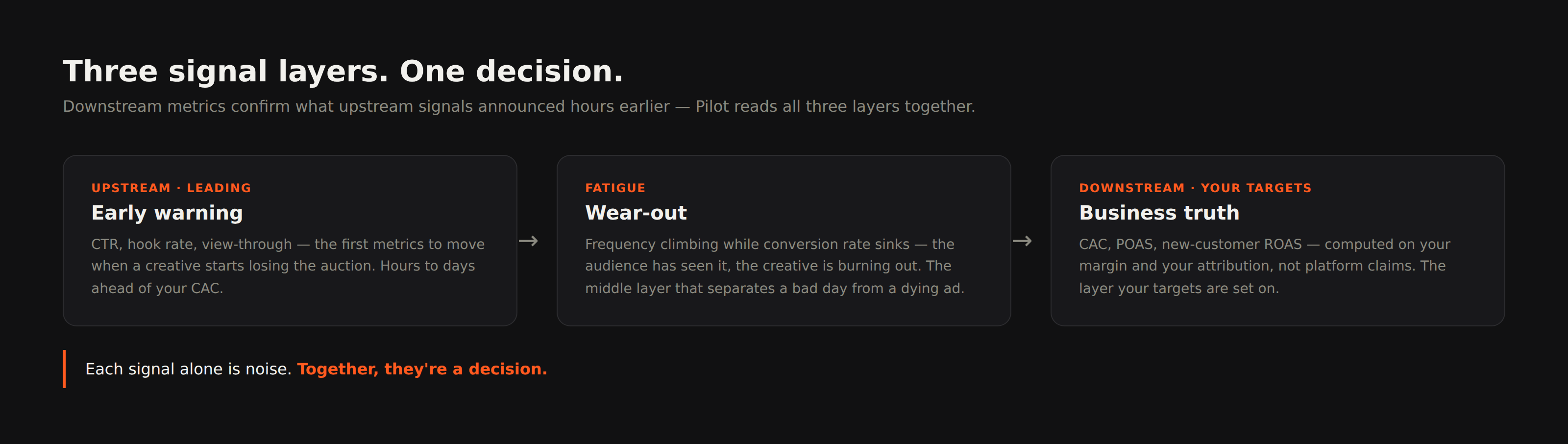
Reacting to CAC alone means reacting late. CAC is a lagging metric, so by the time it drifts, the money is already spent. Pilot reads three layers together:
- Upstream (the early warning): Click-through rate, hook rate, and view-through are the first numbers to move when a creative starts losing the auction. They shift hours to days before your business metrics feel the impact.
- Fatigue (the wear-out check): Frequency climbing while the conversion rate sinks is the signature of an audience that has seen enough. This middle layer separates a noisy day from a dying ad, which is the difference between holding steady and cutting spend.
- Downstream (your targets): CAC, POAS, and new-customer ROAS are computed on Admetrics data. This represents your real margin and attribution, fully deduplicated and fresh, instead of the platform's claims about itself.
Any one of these signals alone is just noise. A CTR dip can be a weekend effect, and a frequency spike can result from a small audience. Together, they form a clear pattern, and that pattern is exactly what Pilot acts on.
Knowing when to brake
Speed is only an advantage when the system knows when to slow down. Aggressive automation that chases every hourly fluctuation destroys accounts by restarting learning phases, whipsawing budgets, and mistaking noise for signal.
Pilot's guardrails are just as important as its speed. Every move is capped, so budgets shift in controlled steps instead of wild swings. Statistical caution is built in, meaning no decision fires on thin evidence. Learning phases are respected rather than reset. The brakes also work in both directions: Pilot will decline to scale a winner when the evidence shows the auction, rather than the ad, produced the spike.
The result is a system that acts hourly but thinks in trends. It pairs fast hands with a calm head.
Eight weeks in production
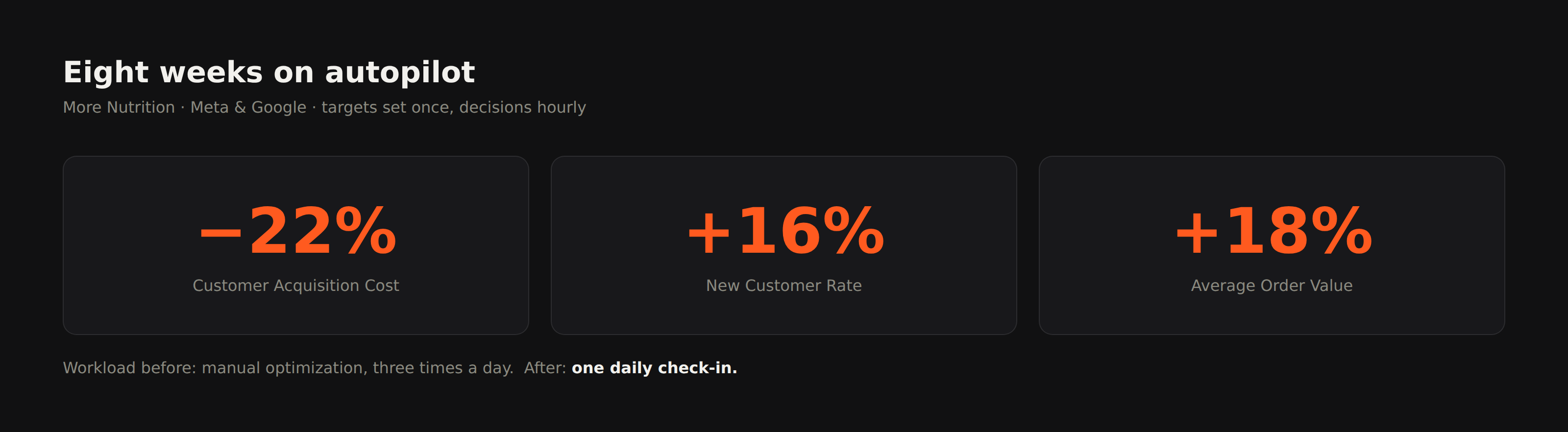
We ran Ad Pilot with More Nutrition across Meta and Google for eight weeks. Targets were set once at the start. From then on, Pilot made the hourly calls while the team checked in once a day.
- CAC down 22%
- New-customer rate up 16%
- Average order value up 18%
The operational shift is the part teams feel first. Moving from optimizing three times a day to reading a decision log once means the actual work shifts from making the calls to auditing them.
Getting started
Ad Pilot runs on your existing Admetrics setup. The exact same validated data that powers your reporting now powers your decisions. Define your targets, choose the ad sets it manages, set the guardrail ranges you are comfortable with, and hand over the hourly work.
Ad Pilot is live now in Admetrics. Your targets. Its hands on the controls.