Turning Ecommerce Data into Action with LLMs
Every click and every scroll adds to your business’s data story—but having data isn’t the same as using it. More ecommerce brands are turning to generative AI, especially LLMs like ChatGPT or Claude, to quickly transform information into insight. While these tools are powerful, getting the most from them means following a few best practices—especially when your goal is better, faster business decisions.
This guide covers:
- What LLMs can do for your store
- How to prepare your ecommerce data
- How to write LLM prompts that actually generate useful analysis
- Using AI to solve common ecommerce challenges
- How agentic AI (like Ava) is changing ecommerce analytics
What LLMs Bring to Ecommerce
If you’ve ever felt buried under an avalanche of spreadsheets, scattered dashboards, and endless CSV exports, you’re not alone. Modern ecommerce businesses generate more data than ever before—but raw data isn’t valuable until it becomes insight. This is where large language models (LLMs) truly shine. Think of them as your business’s lifeboat, surfacing patterns and opportunities that aren’t immediately obvious, and helping you see your business from angles you may never have considered.
Here’s how LLMs are redefining what’s possible in ecommerce:
Smarter Product Search
Traditional ecommerce search tools rely on basic keyword matches, so if a shopper’s query doesn’t perfectly match your product catalog, they’re out of luck. LLMs, on the other hand, understand natural language and intent. That means they can interpret what a customer meant to type—even if the wording is off, misspelled, or phrased differently. The result: search results that actually make sense, reduce friction, and lead to more sales.
Example:
A customer types “running shoes for flat feet.” Instead of just showing anything with “shoes” in the name, an LLM-powered search interprets the context, finding products specifically designed for support and comfort.
Better Chatbots & Customer Service
Forget the frustrating, one-size-fits-all chatbots of the past. LLMs power a new generation of conversational AI that can:
- Remember previous conversations and customer details
- Adapt responses based on the current context
- Resolve complex issues without sounding robotic
This means customers get faster, more relevant help—and your support team gets to focus on higher-value work.
Example:
An LLM-powered chatbot can handle nuanced questions (“Can I return an item I bought on sale last month if the tag is still on?”) and provide a helpful, accurate answer right away.
Personalized Product Recommendations
LLMs take recommendations to the next level. Instead of just suggesting “people also bought,” they analyze:
- Purchase history
- Browsing patterns
- Cart abandonment signals
- Customer segments
The result is suggestions that feel tailored to the individual, increasing cross-sell and upsell opportunities, and boosting average order value.
Example:
Someone who recently purchased a camera might get recommendations for compatible lenses, tripods, and editing software—right when they’re most likely to buy.
Fraud Detection & Prevention
Ecommerce fraud is constantly evolving, but so are LLMs. By analyzing vast amounts of transaction data, these models can recognize subtle fraud patterns:
- Odd purchase timing
- Suspicious combinations of items
- Unusual payment behaviors
They spot potential scams faster than traditional rules-based systems, helping keep your business and customers safer.
Customer Feedback Analysis
LLMs can ingest and summarize huge volumes of customer feedback in seconds—reviews, support tickets, social posts, and more. They do more than just count positive vs. negative comments; they can pick up on sentiment, common complaints, and even emerging product trends.
Example:
If dozens of reviews mention that a shoe runs small, the LLM can surface this as a trend, so you can adjust product descriptions, sizing recommendations, or even future orders.
Automated Insights from Your Data
The real superpower of LLMs is turning all that raw marketing, sales, and operational data into actionable findings. Instead of spending hours building pivot tables, you can ask an LLM questions like:
- “What was our most profitable customer segment last quarter?”
- “Which products are driving the highest repeat purchase rates?”
- “Are there patterns in cart abandonment by device or channel?”
LLMs synthesize the answer, highlight what matters most, and even suggest your next steps.
In short:
LLMs help you transform overwhelming data into clear, business-growing actions—whether you’re a solo founder or an enterprise brand with millions of customers.
What LLMs Can’t Do (Yet)
- LLMs can’t plug directly into your ecommerce data—they need you to upload or paste info.
- The quality of their analysis depends on what you provide.
- LLMs offer guidance and pattern-finding, not business decisions or guaranteed predictions.
What LLMs Bring to Ecommerce
If you’ve ever felt buried under an avalanche of spreadsheets, scattered dashboards, and endless CSV exports, you’re not alone. Modern ecommerce businesses generate more data than ever before—but raw data isn’t valuable until it becomes insight. This is where large language models (LLMs) truly shine. Think of them as your business’s lifeboat, surfacing patterns and opportunities that aren’t immediately obvious, and helping you see your business from angles you may never have considered.
Here’s how LLMs are redefining what’s possible in ecommerce:
Smarter Product Search
Traditional ecommerce search tools rely on basic keyword matches, so if a shopper’s query doesn’t perfectly match your product catalog, they’re out of luck. LLMs, on the other hand, understand natural language and intent. That means they can interpret what a customer meant to type—even if the wording is off, misspelled, or phrased differently. The result: search results that actually make sense, reduce friction, and lead to more sales.
Example:
A customer types “running shoes for flat feet.” Instead of just showing anything with “shoes” in the name, an LLM-powered search interprets the context, finding products specifically designed for support and comfort.
Better Chatbots & Customer Service
Forget the frustrating, one-size-fits-all chatbots of the past. LLMs power a new generation of conversational AI that can:
- Remember previous conversations and customer details
- Adapt responses based on the current context
- Resolve complex issues without sounding robotic
This means customers get faster, more relevant help—and your support team gets to focus on higher-value work.
Example:
An LLM-powered chatbot can handle nuanced questions (“Can I return an item I bought on sale last month if the tag is still on?”) and provide a helpful, accurate answer right away.
Personalized Product Recommendations
LLMs take recommendations to the next level. Instead of just suggesting “people also bought,” they analyze:
- Purchase history
- Browsing patterns
- Cart abandonment signals
- Customer segments
The result is suggestions that feel tailored to the individual, increasing cross-sell and upsell opportunities, and boosting average order value.
Example:
Someone who recently purchased a camera might get recommendations for compatible lenses, tripods, and editing software—right when they’re most likely to buy.
Fraud Detection & Prevention
Ecommerce fraud is constantly evolving, but so are LLMs. By analyzing vast amounts of transaction data, these models can recognize subtle fraud patterns:
- Odd purchase timing
- Suspicious combinations of items
- Unusual payment behaviors
They spot potential scams faster than traditional rules-based systems, helping keep your business and customers safer.
Customer Feedback Analysis
LLMs can ingest and summarize huge volumes of customer feedback in seconds—reviews, support tickets, social posts, and more. They do more than just count positive vs. negative comments; they can pick up on sentiment, common complaints, and even emerging product trends.
Example:
If dozens of reviews mention that a shoe runs small, the LLM can surface this as a trend, so you can adjust product descriptions, sizing recommendations, or even future orders.
Automated Insights from Your Data
The real superpower of LLMs is turning all that raw marketing, sales, and operational data into actionable findings. Instead of spending hours building pivot tables, you can ask an LLM questions like:
- “What was our most profitable customer segment last quarter?”
- “Which products are driving the highest repeat purchase rates?”
- “Are there patterns in cart abandonment by device or channel?”
LLMs synthesize the answer, highlight what matters most, and even suggest your next steps.
Getting the Most from LLMs: Prompting 101
LLMs need context. To deliver business value, give them:
- Background: What’s your business, your challenge, your goal?
- Details: The more specific, the better.
- Structure: Step-by-step instructions get clearer outputs.
- Follow-ups: Iterating and refining questions leads to deeper insights.
A useful acronym is MOBY: prompts should be Measurable, Obtainable, Bounded, and Yielding.
Preparing Your Data
Quality input = quality output. Before analysis, organize your data:
- Identify all sources (ecomm, ads, analytics, email, support, inventory, payments)
- Export in a standard format (CSV, API pulls)
- Confirm tracking and naming conventions are consistent
- Clean, deduplicate, and validate everything
For recurring analysis, build templates: dashboards, product reports, customer segmentation, ROI, and inventory summaries.
When using LLMs like ChatGPT, always give business context: goals, seasonal trends, recent changes, and, if available, industry benchmarks.
Crafting Effective LLM Prompts
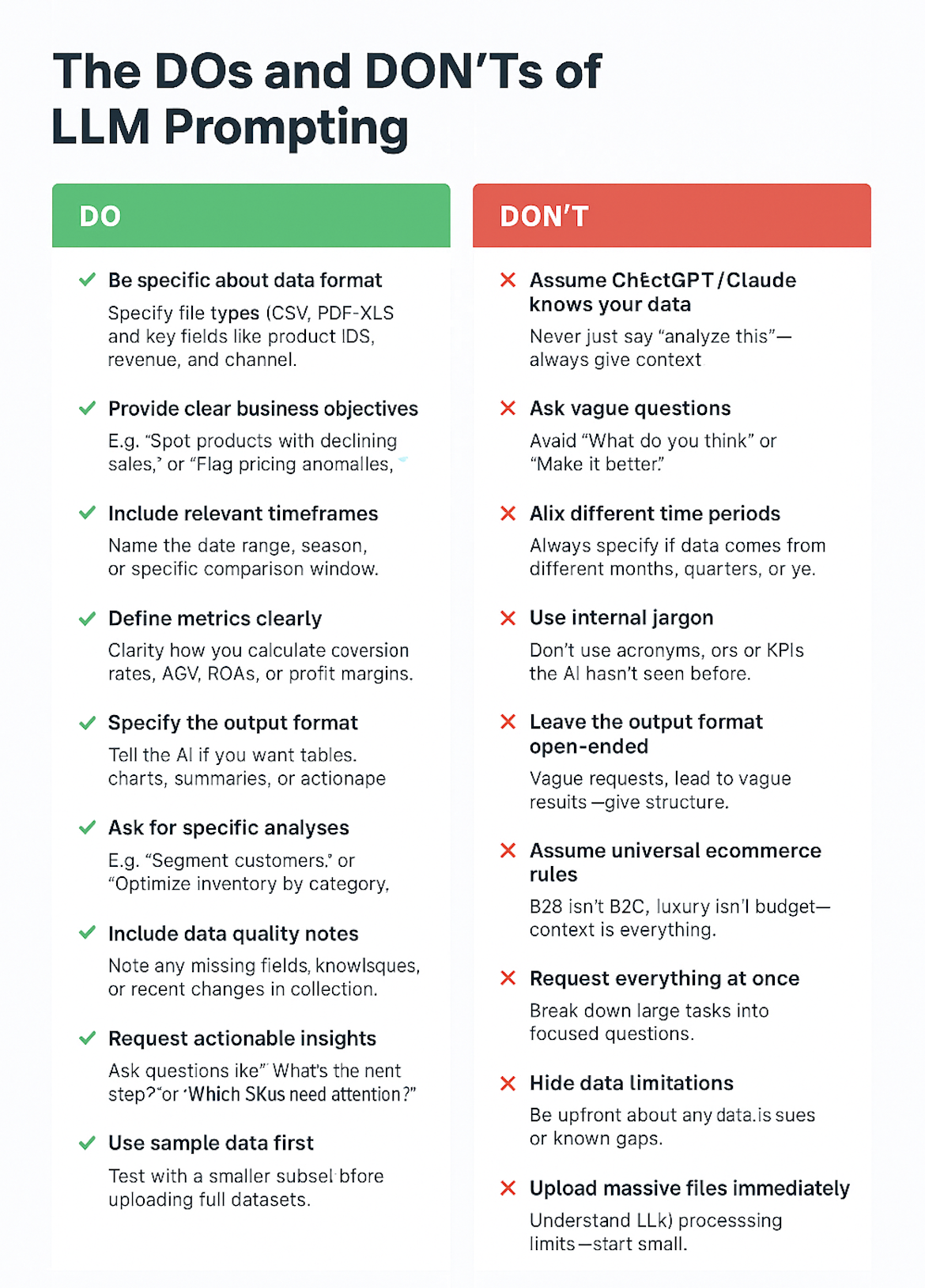
The difference between a vague, generic analysis and truly actionable insights often comes down to the quality of your prompt. A well-structured prompt guides the language model to focus on what matters most for your business, making it easier to get useful and relevant answers.
Why Prompt Quality Matters
When you ask an LLM for help, it doesn’t know your business goals, your data quirks, or your expectations—unless you tell it. The more clearly you explain what you want and why, the better the model can deliver.
Bad Prompt vs. Good Prompt
- Bad prompt:
“Analyze my data.” - This is too broad. The model won’t know what outcomes you care about, what kind of analysis you want, or how to format the results.
- Good prompt:
“Analyze Q4 sales and identify which product categories grew fastest, which customer segments drove the most revenue, and where I should focus inventory investments for Q1.” - This is specific, goal-oriented, and sets the model up to deliver real value.
Ask Actionable Questions
Effective prompts focus on what you need to know to make business decisions. Consider questions like:
- “Which customer segments have the highest lifetime value (LTV), and how can we attract more customers like them?”
- “What product bundles perform best together, and what are the common purchase paths?”
- “Which marketing channels are generating the highest average order value, and how should we adjust our spend accordingly?”
- “Are there patterns in cart abandonment by device or channel?”
These questions direct the model to analyze, compare, and suggest—not just summarize.
Request Concrete, Practical Output
Go beyond “give me insights.” Tell the LLM exactly what kind of output you want:
- Specific, prioritized recommendations:
Ask for ranked action items with clear business impact (e.g., “List top three actions to boost Q1 revenue, in priority order”). - Key metrics to track:
Request the model to identify or suggest the most important KPIs for your objective. - Timeline for implementation:
Ask for recommended next steps or a timeline (e.g., “Suggest a 30-day plan for rolling out your recommendations”).
Example Prompts for Ecommerce Analysis
Cross-Channel Ad Performance Analysis
With AVA, there’s no need to manually compile data from each ad platform or juggle spreadsheets. AVA automatically unifies your spend, ROAS, CPA, and other key metrics from Meta, Google, TikTok, and beyond—giving you a single source of truth in real time.
Prompt:
“Act as a performance marketing strategist. Using my latest 30-day and 365-day cross-channel ad data, evaluate each platform’s efficiency, customer acquisition costs, and overall impact on revenue. Recommend how to rebalance our ad budget for maximum ROI, highlight top and underperforming channels, and surface any emerging trends or anomalies. Please provide:
- An executive summary of findings
- A platform performance scorecard
- Suggested budget allocation table
- A ranked action plan for next steps”
With Admetrics AVA:
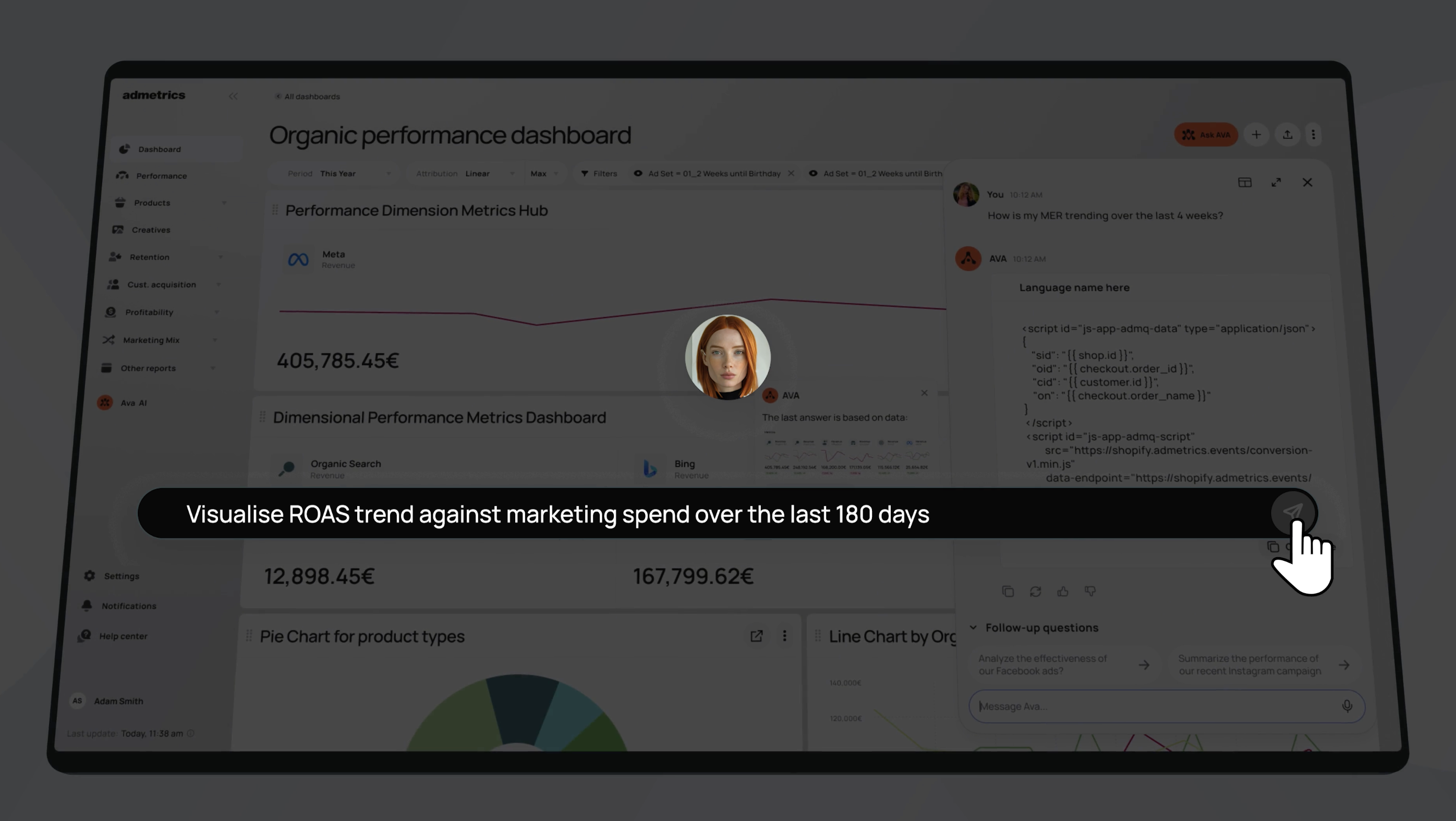
AVA handles this process automatically—delivering daily, real-time insights into all your ad accounts without the need to download or upload any files. The AVA “Budget Recommendation” and “Channel Insights” modules continually monitor your performance, flag inefficiencies, and provide instant, data-backed budget optimizations. You get a clear executive summary, platform comparison, and prioritized action plan, all tailored to your goals, right out of the box.
Inventory Trends & Demand Forecasting (AVA Use Case)
Managing inventory is much easier when you have all your sales and stock data automatically synchronized and analyzed. With AVA, your inventory and sales metrics are unified across channels, providing a real-time overview that factors in margins, lead times, and even seasonality.
Prompt:
“As a retail performance analyst, review my 12+ months of product-level sales and inventory data. Identify the top and bottom performers by profitability, forecast demand for the next period, flag any potential stockout risks, and recommend optimal reorder strategies. Highlight seasonal trends and prioritize your recommendations based on potential financial impact.”
With Admetrics AVA:
AVA does all the heavy lifting behind the scenes—constantly integrating your inventory, sales, and performance data from every channel. AVA’s automated analysis surfaces which products are underperforming, forecasts demand shifts, alerts you to low-stock risks, and recommends when and how much to reorder—all with clear, daily action items prioritized for revenue impact. This saves your team hours of manual work and ensures you never miss a critical inventory signal.
Customer Lifetime Value (LTV) Analysis
Unlocking true customer value starts with a complete, unified view of your buyers—their order history, engagement, and acquisition sources. With Admetrics AVA, your customer data from every touchpoint is brought together for instant analysis.
Prompt:
“As a customer analytics specialist, review my unified customer dataset, including purchase history, engagement, and acquisition channels. Identify high-value segments, forecast which new customers are most likely to become high-LTV, and rank acquisition sources by customer quality. Recommend retention and growth strategies prioritized by revenue impact, and segment your suggestions by ease of implementation.”
With Admetrics AVA:
AVA automates the heavy lifting—continuously consolidating customer data and surfacing actionable insights in real time. AVA instantly identifies your most valuable segments, predicts future high-LTV customers, and pinpoints which channels deliver long-term value. The platform delivers clear retention and growth recommendations, ranked by impact and difficulty, so you can quickly act on what matters most for customer lifetime value—without the manual data crunching.
Ad Creative Performance
To maximize your ad results, you need to connect creative details—like images, copy, and formats—to hard performance data. With Admetrics AVA, all your creative assets and ad performance metrics are automatically linked and analyzed side-by-side across platforms.
Prompt:
“Act as a creative analytics strategist. Analyze my last 60 days of ad campaign data—including visual assets, copy, and placements. Identify which creative elements (visual themes, messaging, formats) drive the best results, highlight patterns among top and bottom performers, and recommend specific changes to boost future performance. Please provide a summary of findings, a comparison table, creative best practices, and a ready-to-use template for new ad concepts.”
With Admetrics AVA:
AVA automatically ingests your creative and performance data, then runs real-time analysis to reveal which ad elements truly convert. You’ll instantly see which visuals, headlines, calls-to-action, and formats work best for each audience and channel. AVA delivers an actionable summary, detailed comparisons, data-driven creative guidelines, and even a template for your next round of ad creatives—saving hours on manual analysis and guesswork.
Goal Pacing Analysis
Staying on target in a fast-paced ecommerce environment requires live tracking of sales, marketing, and customer acquisition goals. Admetrics AVA, all your current, historical, and target data is connected, allowing for instant progress checks and proactive decision-making.
Prompt:
“Act as a growth performance analyst. Review my month-to-date sales, customer, and marketing performance against established targets. Highlight where we’re ahead or behind pace, forecast expected results for the end of the month, and recommend urgent actions to close any gaps. Please provide a live dashboard, forecast summary, prioritized action plan, updated budget recommendations, and a risk assessment for missing targets.”
With Admetrics AVA:
AVA continuously aggregates and monitors your performance data in real time. The platform automatically benchmarks your current numbers against goals, visualizes pacing with intuitive dashboards, and generates daily updated forecasts. AVA also recommends where to adjust spend, shift focus, or implement tactical changes—delivering a clear, prioritized plan to keep your team on track and ensure nothing slips through the cracks.
Why Admetrics AVA Beats Any LLM Analysis
Always Up-to-Date:
AVA automatically ingests, normalizes, and updates your ad, sales, and customer data across every channel—no manual data pulls, uploads, or spreadsheet merges needed.
Seamless Integration:
Connect all your marketing, analytics, and ecommerce platforms with just a few clicks. AVA brings your data together in one place for a unified, real-time view.
Built for Ecommerce & DTC:
AVA is purpose-built for ecommerce, with deep understanding of the KPIs, attribution models, and data quirks that matter most to online brands and agencies.
Instant, AI-Powered Insights:
Skip the endless pivot tables and manual reporting. AVA delivers automated recommendations, forecasts, and optimization tips as soon as your data is available.
Automated Anomaly Detection:
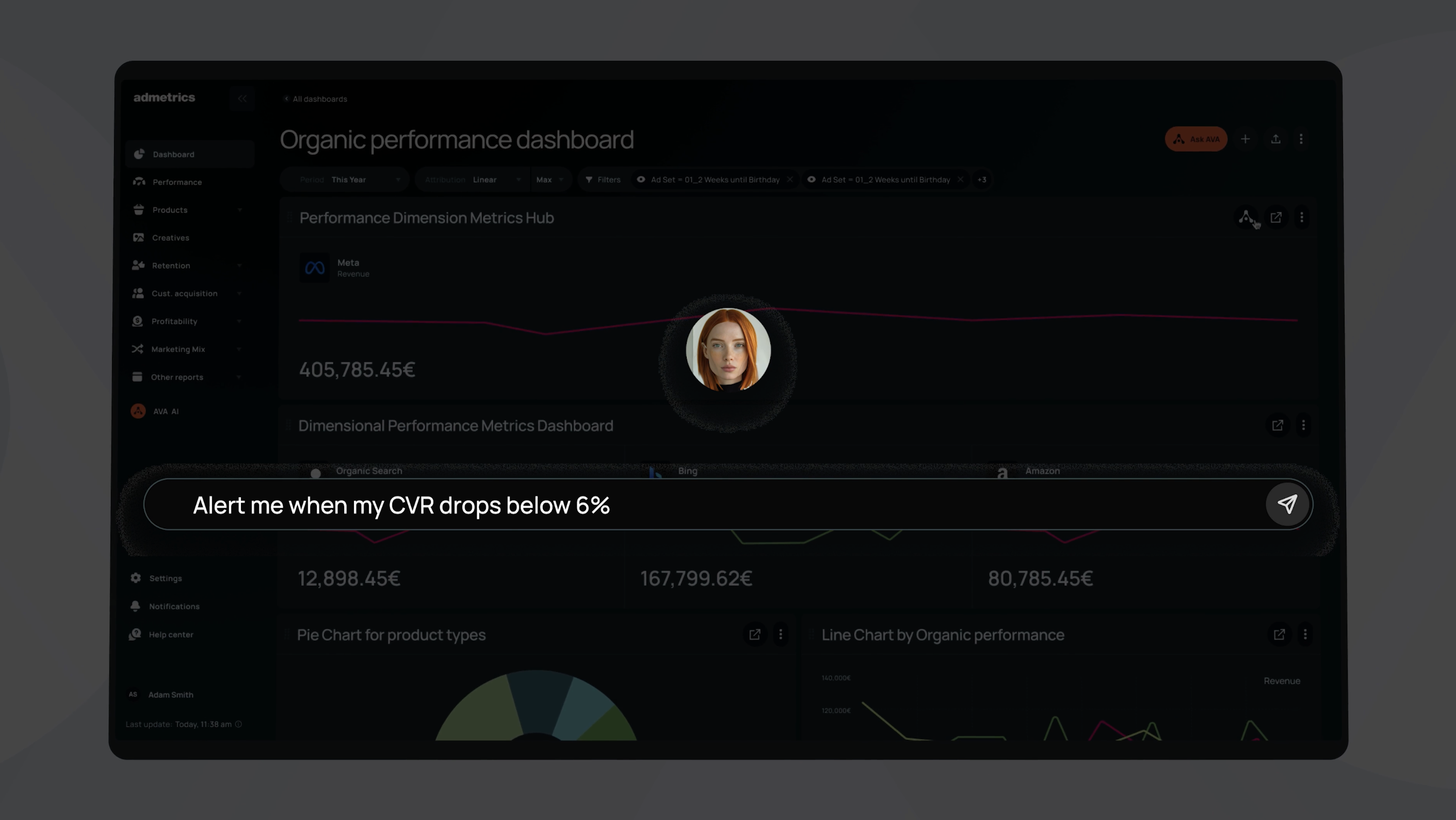
AVA continuously monitors your metrics and instantly flags unusual trends, outliers, and performance issues—helping you catch problems before they impact your bottom line.
Customizable for Your Workflow:
Need a new report or analysis? AVA’s AI can be tailored to your business logic and reporting needs—no technical skills required.
Massive Time Savings:
What used to take your team hours or days, AVA handles in minutes. Focus on decision-making and growth, not data wrangling.
In short: Admetrics AVA takes the heavy lifting out of data analysis, freeing you up to act faster, optimize smarter, and grow your business with confidence.
Conclusion
The world of ecommerce is moving faster than ever—and so is the data that drives your business decisions. While manual analysis and traditional spreadsheet workflows may have worked in the past, today’s brands need real-time insights, proactive recommendations, and seamless automation to stay competitive.
Admetrics AVA was designed to meet these modern demands. By continuously integrating and analyzing your data from every platform, AVA eliminates the tedious tasks of data collection and manual reporting. Its AI-powered capabilities empower you to identify opportunities, avoid costly mistakes, and make smarter decisions—without the guesswork or delays.
Whether you’re looking to optimize ad spend, forecast demand, understand customer value, or simply keep pace with your goals, AVA delivers actionable insights at the speed of ecommerce. The result? More time for strategy, greater confidence in your decisions, and the ability to scale your brand with clarity.
Ready to leave manual analysis behind? Discover how Admetrics AVA can transform your data into real business growth—starting today.
FAQs Best AI Prompts for Ecommerce: Guide to Effective LLM Prompting
1. How do Large Language Models (LLMs) improve traditional e-commerce product search?
Traditional search engines rely on exact keyword matches. If a customer searches for "running shoes for flat feet" but your product is tagged "arch support sneakers," traditional search will likely return zero results. LLMs understand natural language, context, and user intent. They interpret what the shopper actually means, surfacing highly relevant products even if the exact phrasing or spelling is off, which drastically reduces friction and increases conversions.
2. What are the main limitations of using a standard LLM for my e-commerce data?
While powerful, general-purpose LLMs (like standard ChatGPT or Claude interfaces) have three distinct limitations for e-commerce operators:
- Manual Data Entry: They do not plug directly into your live store data. You have to manually export, clean, and upload CSV files or paste data.
- Prompt Dependency: The quality of the analysis is entirely dependent on how well you write the prompt.
- No Native Execution: They provide guidance and pattern recognition, but they cannot make live business decisions or execute changes automatically.
3. How should I prepare my e-commerce data before feeding it into an LLM?
Because AI models require clean inputs to produce accurate outputs, data hygiene is non-negotiable. Before prompting an LLM, you must:
- Identify and consolidate all data sources (ads, Shopify, support, inventory).
- Export the data into a standard, readable format like a CSV.
- Clean and deduplicate the entries, ensuring consistent tracking and naming conventions.
- Provide the LLM with clear business context, such as your seasonal trends, goals, and industry benchmarks.
4. What is the "MOBY" framework for writing effective AI prompts?
To get the best possible analysis from an LLM, your prompts should follow the MOBY acronym:
- Measurable: Ask for specific metrics or KPIs.
- Obtainable: Ensure the request is something the AI can actually calculate based on the data provided.
- Bounded: Give the AI a clear scope, such as a specific timeframe (e.g., "Q4 2025") or channel.
- Yielding: Request a concrete, actionable output, like a prioritized list or a 30-day implementation plan.
5. How does a generic prompt differ from an effective, actionable prompt?
A bad prompt is vague, like asking, "Analyze my data." The AI doesn't know your goals, so it will return generic summaries. A highly effective prompt assigns a role, sets a goal, and dictates the output format.
Example of a Good Prompt: "Act as a performance marketing strategist. Analyze Q4 sales data to identify which customer segments drove the most revenue. Provide a ranked list of the top three actions to boost Q1 revenue based on these segments."
6. Can AI tools actively help prevent e-commerce fraud?
Yes. Because fraud tactics evolve rapidly, traditional rules-based security systems often lag behind. LLMs and machine learning algorithms analyze massive datasets of transaction history in real time to spot subtle anomalies. They can flag odd purchase timing, suspicious item combinations, and unusual payment behaviors much faster than manual reviews, protecting both the merchant and the consumer.
7. How does AI assist with inventory and demand forecasting?
Stockouts and overstocking both kill e-commerce margins. AI tools unify historical sales metrics, ad performance, and lead times to forecast future demand accurately. An agentic AI platform will proactively flag products that are at risk of selling out, identify underperforming stock tying up capital, and recommend exact reorder quantities based on seasonal trends and financial impact. Discover the best AI tools for DTC.
8. How can AI improve Customer Lifetime Value (LTV) analysis?
Understanding LTV requires connecting the dots between a customer's acquisition source, purchase history, and ongoing engagement. AI aggregates this fragmented data to identify your most profitable customer segments. It can predict which newly acquired customers are likely to become high-LTV buyers, rank your marketing channels by the quality of customers they bring in, and suggest targeted retention strategies to keep them engaged.
9. How does AI analyze ad creative performance across multiple platforms?
Instead of manually comparing Facebook visuals to Google copy in a spreadsheet, AI tools link creative elements directly to performance metrics (ROAS, CPA). The AI analyzes themes, messaging, formats, and placements across all channels simultaneously. It then highlights exactly which visual or copy combinations drive the highest conversions, providing marketers with data-backed guidelines and templates for their next ad campaigns.