Precise data tracking, automated decision-making, and rapid creative iteration are the cornerstones of modern e-commerce success. The case of The Quality Group (TQG), the powerhouse behind leading nutrition brands ESN and More Nutrition, demonstrates a compelling success story of how to overcome severe scaling bottlenecks. By moving away from gut feelings and manual optimizations, TQG learned how to successfully optimize mediabuying with AI and robust data infrastructures.
Background
The Quality Group operates in a highly competitive, fast-moving market. Historically, their strategy mirrored many successful D2C brands: relying on weekly promotions, utilizing a few core channels (like Meta and Google), and heavily leveraging influencer marketing. However, as the digital landscape evolved, the game changed. What worked in 2020, managing a few channels with broad targeting and manual budget adjustments—became unmanageable. By 2024, managing over 13 channels, hundreds of campaigns, and thousands of creatives became an impossible task for human media buyers alone, especially during peak events like Black Friday, where they could see up to 95,000 orders in a single hour.
The Challenge
The nutrition brands ESN and More Nutrition faced a critical realization: 90% of e-commerce brands fail to scale because they optimize for the wrong signals. Their previous setup was holding them back in four major ways:
- Surface Level KPIs: Focusing on surface-level metrics like platform-reported ROAS that didn't reflect true business profitability or net margin.
- Platform KPIs: Trusting platform algorithms (like Meta or TikTok) that inherently optimize for their own success rather than the brand's actual incremental revenue.
- Lack of a Creative Engine: Struggling to continuously produce, test, and iterate winning creatives at the volume required for modern scaling.
- Slow Decision-Making: Relying on human media buyers to manually log in multiple times a day to adjust budgets meant taking too long to cut losing ads or scale winning ones, leaving massive revenue on the table.
These issues severely hampered their ability to acquire true new customers profitably, as algorithms naturally gravitated toward retargeting existing brand loyalists.
Strategic Approach: How to Optimize Mediabuying with AI
To rectify these challenges and break through their growth plateau, TQG, the team behind the nutrition brands ESN and More Nutrition, partnered with Admetrics to implement a structured, data-first approach. They shifted from "gut-feeling" decisions to a fully automated, AI-enhanced media buying ecosystem.
1. The Mechanics of Replacing "Last-Click" with Multi-Touch Attribution
Moving away from last-click isn't just about changing a setting in a dashboard but requires a fundamental overhaul of how data is collected and processed. Here is how Admetrics powered this shift:
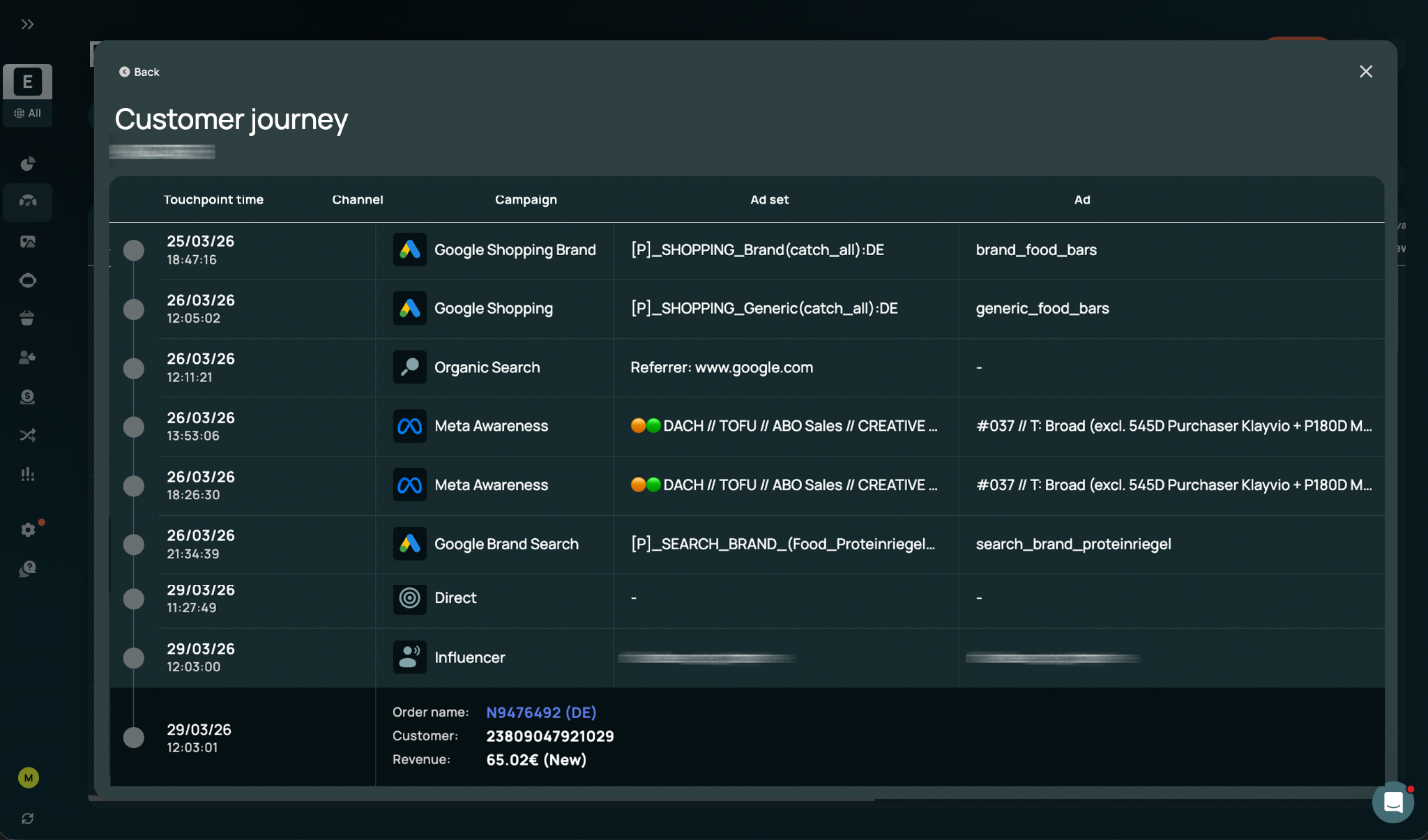
- Massive Data Aggregation: Admetrics acts as a centralized data warehouse. It continuously pulls API data from over 13 ad platforms (Meta, Google, TikTok, Snapchat, Pinterest), CRM/Shopify data, and even offline retail data.
- Near Real-Time Customer Journey Mapping: During peak events like Black Friday, TQG experiences up to 95,000 orders in a single hour. Admetrics’ infrastructure is built to crunch these massive server-to-server (S2S) data loads in minutes, reconstructing the exact touchpoints of a customer's journey before they hit "buy."
- The U-Shape Model Logic: TQG specifically implemented a U-Shape multi-touch model within Admetrics. This rule-based model heavily weights the first touch (e.g., an influencer introducing the brand on TikTok) and the last touch (e.g., a Google Search ad right before purchase), while evenly distributing the remaining credit to the "middle" touchpoints (e.g., a Meta retargeting ad).
- New vs. Existing Customer Split: Admetrics was configured to cleanly separate new customer acquisition data from returning customer data, ensuring TQG never accidentally scaled budgets on campaigns that were just farming existing loyalists.
2. How Admetrics Feeds the AI-Powered Creative Engine
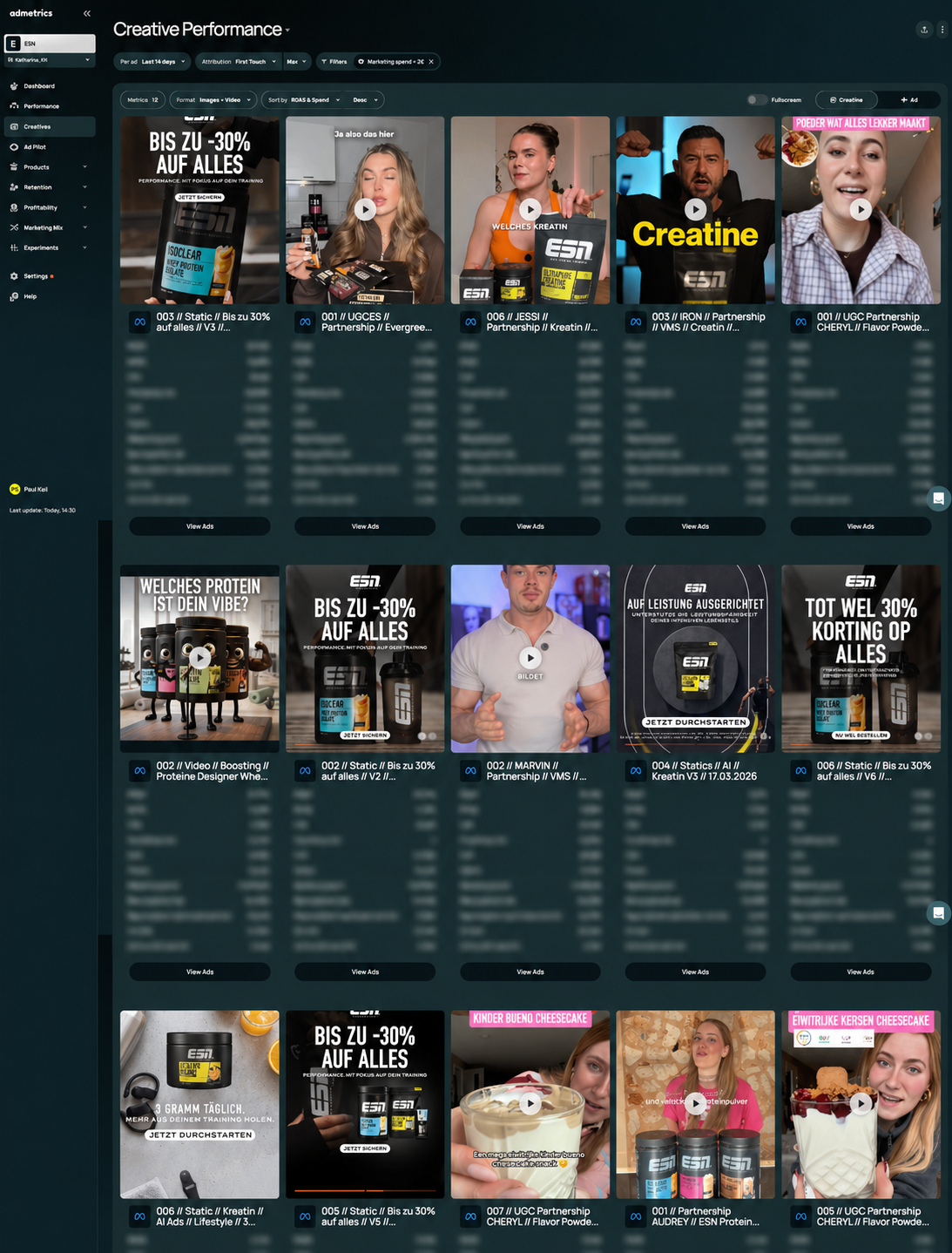
While TQG uses external AI tools (like Claude, Midjourney, and Apify) to generate the creatives, Admetrics acts as the crucial feedback loop that tells the AI what to generate.
- Granular Signal Tracking: To kill 85% of ads and find the winning 15%, you need exact data on why an ad failed. Admetrics tracks granular, top-of-funnel metrics like "Hook Rates" (who stopped scrolling) and "Video View-Through Rates" alongside bottom-funnel metrics like Customer Acquisition Cost (CAC).
- Angle Iteration over Ad Iteration: Instead of just looking at which video performed best, Admetrics allows TQG to tag and track specific marketing angles (e.g., "Taste vs. Competitors" or "Benefits for Marathon Runners"). When the Admetrics dashboard shows that the "Marathon Runner" angle has a high hook rate but low conversion, TQG feeds that specific data back into their Custom GPTs to generate a better script for the next iteration.
- Rapid Asset Deployment: Generating 100 ads a week is useless if you can't traffic them. TQG uses integrations alongside Admetrics (like Rapid Ads) to push these AI-generated assets directly from Google Drive into the ad platforms automatically, bypassing the manual upload bottleneck.
3. The Execution of "AdPilot" for Automating Micro-Decisions
Intraday budget management is where human media buyers lose the most time. AdPilot is Admetrics' automated media-buying feature that effectively replaces manual spreadsheet calculations. Here is how it operates:
- Tripartite Signal Evaluation: AdPilot doesn't just look at ROAS. It is programmed to evaluate three distinct layers of data every single hour:
- Early Warning Signals: Are CTRs and Hook Rates dropping today compared to a 7-day trend?
- Fatigue Signals: Is ad frequency spiking while reach stagnates? (This tells the AI the audience is exhausted).
- Downstream KPIs: Is the New Customer CAC remaining below the profitable threshold?
- Strict Pre-defined Guardrails: The AI is not left to guess. TQG sets strict boundaries. For example: "If New Customer CAC exceeds €20, and Frequency is over 3, execute KILL command."
- The Four Core Commands: Based on the data, AdPilot autonomously pushes commands directly to Meta, Google, or TikTok via API:
- Scale: Aggressively increases budget on ad sets where early warning signals are green and CAC is highly profitable.
- Increase: Bumps budgets marginally for stable performers.
- Cut: Reduces spend on ads that are nearing the unprofitable threshold to save margin.
- Kill: Instantly pauses creatives or ad sets that have hit fatigue or failed to convert, stopping wasted spend immediately.
By having AdPilot handle these micro-decisions 24/7, TQG’s team transitioned from manual "button pushers" to high-level strategic directors managing the overall AI guardrails.

Implementation and Results
The rollout of this AI-driven creative engine and the Admetrics-powered automated decision framework produced transformative outcomes within a 12-month span:
- > 70% Reduction in CAC: By focusing on new customer acquisition rather than platform vanity metrics, they slashed their Customer Acquisition Costs.
- > 65% Increase in New Customer Rate: Moving away from broad retargeting and utilizing exclusion audiences brought in entirely new market segments.
- > 19% Increase in AOV: Smarter product bundling (like the Starter Kit funnel) naturally lifted the Average Order Value.
- > 20% Increase in Repurchase Rate: Acquiring the right customers through targeted creative angles led to higher brand loyalty and LTV.
- > 81% Increase in Total Revenue from Paid Social: Efficient scaling allowed them to push budgets further than ever before.
- 10x Creative Output: By implementing an AI-assisted pipeline rather than manual editing, they massively scaled their weekly ad production.
- Operational Clarity: Media buyers transformed into "Media Controllers", acting as strategic overseers of the AI engine rather than manual button-pushers.
- 25x Revenue Growth in Affiliate Marketing: By shifting to clean measurement logic and data-driven capital allocation, they could suddenly measure incremental value, compare it against other channels, and steer performance directly at the partner level.

Key Takeaways
This case highlights the underestimated potential of blending robust data attribution with artificial intelligence:
- Data Quality Dictates Automation Success: You cannot optimize mediabuying with AI if your baseline data is flawed. Clean, multi-touch attribution is the prerequisite for automated scaling.
- A Creative System Beats Creative Luck: Relying on one "winner" ad is a recipe for fatigue. You need an AI-assisted pipeline to continuously generate, test, and kill creative variations.
- Stop Optimizing for Platform ROAS: Shift your focus to actual business impact—specifically New Customer CAC and long-term profitability margins.
- Automation Needs Guardrails: AI tools like AdPilot thrive when given strict business rules. Define your precise limits for scaling and cutting, and let the machine execute them flawlessly at scale.
Conclusion
The Quality Group’s collaboration with Admetrics not only overcame severe tracking and scaling bottlenecks but set a new industry benchmark for performance marketing. By abandoning legacy tactics and embracing a system to optimize mediabuying with AI, they turned data ambiguity into confident, massive scaling, without sacrificing their profit margins.
Are you struggling with fragmented tracking, creative fatigue, and unprofitable scaling? Start your Admetrics trial today to explore how our advanced attribution, AI-driven automation, and S2S integration solutions can revolutionize your advertising strategies and significantly boost your true ROAS, just as we did for ESN and More nutrition.
FAQs on the case study and strategies used by ESN and More Nutrition
Here are 10 Frequently Asked Questions based on the case study and strategies used by The Quality Group to optimize media buying with AI:
1. What does it mean to "optimize media buying with AI"?
Optimizing media buying with AI involves using artificial intelligence and machine learning tools to automate the creation, testing, and budget allocation of ad campaigns. Instead of humans manually adjusting bids or guessing which creatives will work, AI analyzes real-time data to automatically scale winning ads, pause losing ones, and generate highly targeted ad variations.
2. Why is platform-reported ROAS (Return on Ad Spend) considered a "vanity metric"?
Platform-reported ROAS (like the numbers you see inside Meta or Google Ads dashboards) often overreports success because platforms optimize for their own credit. They might claim a high ROAS by taking credit for customers who were already going to buy (retargeting brand loyalists) rather than measuring true, incremental new customer acquisition and net profit margins.
3. What is the difference between last-click attribution and multi-touch attribution?
- Last-Click Attribution: Gives 100% of the credit for a sale to the final ad a customer clicked before buying (usually Google Search or a bottom-funnel Meta ad), ignoring all prior touchpoints.
- Multi-Touch Attribution: Distributes credit across the entire customer journey. It recognizes top-of-funnel channels (like influencers, TikTok, or Pinterest) that introduced the brand to the customer long before they made the final search and purchase.
4. How can AI be used in a creative strategy?
AI can completely overhaul the creative process by handling heavy lifting at scale. Brands can use AI scraping tools (like Apify) to find customer pain points in competitor reviews, use Large Language Models (like Gemini or Claude) to write specific creator briefs, and use AI design tools (like Firefly or Higgsfield) to generate and iterate on ad assets rapidly.
5. What is AdPilot and how does it help with scaling?
AdPilot is an automated feature within Admetrics that acts as an AI media buyer. It continuously monitors campaign performance against strict, pre-set profitability guardrails. It autonomously scales budgets for high-performing ads, increases bids incrementally, cuts budgets on underperforming ads, and pauses (kills) ads that fall below profitability thresholds, all without human intervention.
6. Why did TQG stop promoting their premium best-sellers to cold audiences?
Data revealed that premium flagship products (like a €55 tub of protein) had too high of a price barrier to effectively acquire new customers. Instead, they engineered a low-cost, high-value "Protein Starter Kit" (around €18). This lowered the Customer Acquisition Cost (CAC) significantly, getting people to try the product, which naturally led to a high repurchase rate later.
7. Why is the "creative" considered the new targeting?
With privacy changes and smarter algorithms, manual interest-based targeting (e.g., selecting "people who like fitness" in Meta) is becoming less effective. Today, feeding the algorithm highly specific, angle-driven creatives allows the AI to find the right audience on its own. If the creative speaks to a specific pain point, the right people will engage with it, effectively doing the targeting for you.
8. What does it mean to turn media buyers into "Media Controllers"?
When AI takes over the repetitive, manual tasks of media buying (like adjusting daily budgets, pausing bad ads, and calculating bids), human employees evolve into "Media Controllers." Their role shifts from pushing buttons to overseeing the AI, setting the strategic guardrails, interpreting complex data models, and feeding the system better creative inputs.
9. How does data scraping improve ad performance?
Data scraping involves pulling reviews and comments from competitor products on platforms like Amazon or Trustpilot. By analyzing what customers hate about a competitor's product (e.g., bad taste, poor mixability), you can create ads that directly address those exact pain points, positioning your product as the perfect solution.
10. How can small e-commerce brands apply these strategies without massive budgets?
Small brands don't need to generate 100 ads a week to see success. They can apply these principles by:
- Using affordable AI tools (like Apify or ChatGPT) to discover unique customer angles.
- Focusing on 2-3 high-quality, pain-point-driven creatives rather than spamming generic ads.
- Moving away from platform vanity metrics and strictly tracking their New Customer CAC and 30-day LTV (Life-Time Value).