Your best-performing ad just hit 10x ROAS. You triple the budget. Three weeks later, your CPA explodes by 200%. Sound familiar? This isn't bad luck—it's the predictable result of ignoring creative scaling, and it's costing DTC brands millions in wasted ad spend every single day.
Most brands scale blindly. They find one creative that works, pump money into it, and watch helplessly as performance craters within weeks. The diagnosis is simple: the algorithm gets bored, and so do your audiences. But the solution requires understanding a fundamental shift in how Meta's advertising system actually works in 2026—and creative scaling sits at the center of that shift.
The Death of Traditional Targeting and the Rise of Creative Scaling
Meta advertising used to be mechanical. We selected interests, built lookalike audiences, and micromanaged ad sets with surgical precision. Those days are over. The platform's machine learning has evolved beyond demographic targeting into something far more sophisticated—and creative scaling has become the primary lever for performance.
Here's the uncomfortable truth: your creative is now your targeting. The algorithm doesn't just use your ads to show products; it uses them to identify who should see those products in the first place. Your creative signals determine which auctions you can enter, which users you can reach, and what you'll pay to reach them.
You used to win by configuring better hacks in Ads Manager. Today, you win through constant production of new, diverse, and better creatives. This isn't about making your ads prettier—it's about feeding the algorithmic machine that controls your profitability.
The Asset Diet: Why Limited Creatives Cost You Money
The fundamental problem facing most advertisers is what we call the "asset diet"—running campaigns with insufficient creative variety to satisfy the algorithm's appetite for diversity. This manifests in multiple costly ways that compound over time.
Meta's algorithms make placement decisions in milliseconds, evaluating thousands of signals to determine who sees what ad, when, and in what context. When your creative library is shallow, the system's options narrow dramatically. You become less competitive in auctions because the algorithm can't find optimal fit between your limited assets and the massive variety of user contexts.
Here's the mechanism: Meta wants to show the right ad to the right person in the right moment. If you only provide morning video content, the system can't effectively monetize evening scrollers who prefer static content. Your average CPM increases because you're forcing the algorithm to compete in suboptimal contexts rather than giving it tools to win in diverse situations.
The reality is stark. Advertisers who fail to provide format variety pay a "monotony tax" in the form of higher CPMs and lower reach. The system literally penalizes lack of creative diversity by making your existing ads more expensive to deliver. Meanwhile, competitors with robust creative scaling systems capture inventory you never even see. Do your creative research and discover what's trending right now in Meta's official Ad Library.
Understanding the Holy Trinity of Creative Scaling
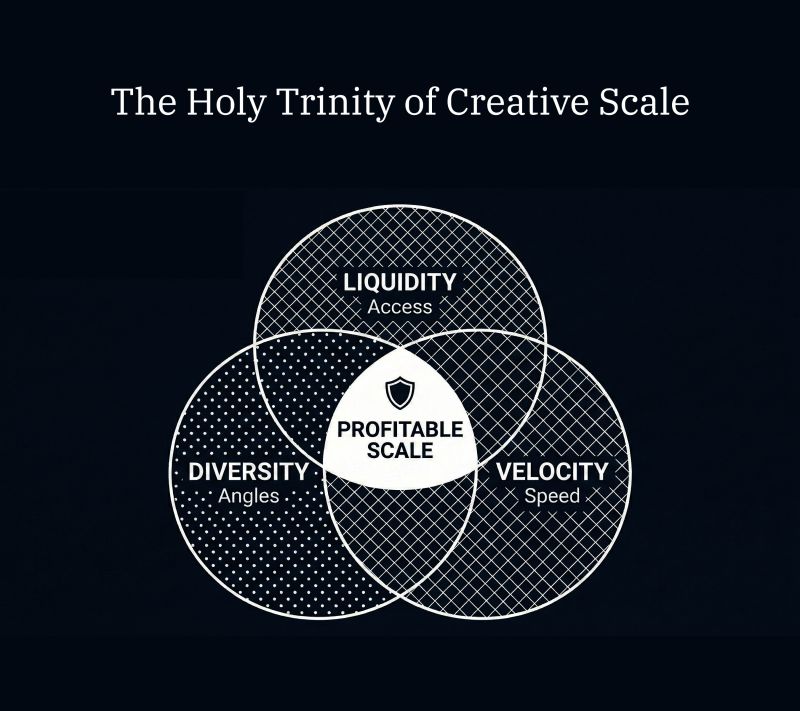
Successful creative scaling rests on three interconnected pillars that work together to maximize your auction participation and minimize your costs:
Creative Velocity: The Speed of Ad Production
Creative velocity measures how quickly you can produce and deploy new ad variations. In practical terms, this means the number of distinct creative assets you launch per week or month. High creative velocity keeps your campaigns fresh, prevents audience fatigue, and gives the algorithm continuous signals to optimize against.
Brands stuck at low creative velocity—launching one or two ads per month—face an inevitable performance cliff. As frequency climbs and click-through rates decline, they have no fresh ammunition to deploy. By the time they produce new creatives, they've already burned money on fatigued audiences.
Creative Diversity: The Range of Angles and Approaches
Creative diversity captures how many different messaging angles, value propositions, and emotional hooks you're testing simultaneously. This isn't about creating three versions of the same image with slightly different colors. True creative scaling demands fundamentally different approaches to communicating your product's value.
One creative might emphasize social proof through customer testimonials. Another might lead with problem-agitation-solution messaging. A third could use comparison angles against competitors. Each angle resonates with different audience segments and different stages of awareness, expanding the total addressable market your campaigns can profitably reach.
Creative Liquidity: The Coverage Across Formats and Placements
Creative liquidity refers to your ability to compete in every available placement with native, optimized formats. The user who watches Instagram Reels at 7 AM, scrolls Facebook Feed at lunch, and browses Marketplace at night represents three different auction opportunities—and three different format requirements.
If you only have static images, you're automatically excluded from roughly half of Meta's available inventory. You miss the morning video viewer entirely. You can't compete in Stories placements. You're paying a penalty in every auction you do enter because your format mismatch signals lower engagement probability to the algorithm.
Why Your Winning Creative Becomes Your Biggest Liability
Let's talk about the lifecycle of what most advertisers call a "winning creative." Day one, it launches. Performance is incredible. You found the angle, the hook works, engagement is high. You increase budget aggressively because the numbers justify it. This is where creative scaling discipline typically breaks down.
Week two, you notice frequency creeping up. Click-through rate edges slightly downward. But ROAS is still strong, so you hold steady. Week three, frequency hits 4-5. CTR has dropped by 30%. CPA is rising but you're still profitable. You tell yourself it's variance. Week four, the wheels come off. CPA has doubled. You're losing money on every conversion. You panic and slash budgets.
This pattern repeats across thousands of ad accounts every single day. The problem isn't that the creative was bad—it's that you treated one good creative as a permanent solution instead of a temporary advantage requiring constant replacement through creative scaling.
The algorithm optimizes for engagement signals. When a creative is new and resonating, those signals are strong. The system rewards you with efficient delivery and low costs. But as the same users see the same ad repeatedly, engagement drops. The algorithm interprets this as declining quality, adjusts your auction competitiveness downward, and you pay more for worse results.
The Creative Scaling Protocol for Sustainable Profitability
Moving from reactive panic to proactive creative scaling requires implementing systems rather than relying on lucky punches. Here's the operational framework that separates consistently profitable accounts from those trapped in boom-bust cycles.
Stop Playing Best Practice Roulette
Copying what worked for other brands or chasing the latest "viral" format is gambling disguised as strategy. What works for a competitor might fail for you because their audience, product positioning, and brand equity differ from yours. Creative scaling means building a testing infrastructure that generates proprietary insights about what resonates with your specific customers.
Implement a structured testing calendar. Allocate 20-30% of creative production specifically to experimental formats and angles that fall outside your current winning formula. Document what you learn. Over time, this builds institutional knowledge about which creative scaling approaches generate sustainable performance for your brand specifically.
Treat Diversification as Requirement, Not Option
The minimum viable creative library for serious creative scaling includes static images, videos, carousels, and user-generated content variations. Each format should exist with and without audio. Each should test multiple hooks designed for different usage contexts and awareness stages.
This isn't busy work—it's auction access. Each format type opens distinct inventory pools and user segments. A user who habitually skips videos but engages with carousels represents revenue you capture through format diversity or lose through format poverty. Creative scaling means ensuring you can compete profitably wherever your potential customers spend attention.
Test different narrative structures across formats. Your static ads might lead with social proof. Your videos could emphasize product demonstrations. Your carousels might showcase use cases or feature comparisons. This format-specific messaging optimization compounds the benefits of simple format diversity.
Monitor Your Opportunity Score Religiously
Meta provides an Opportunity Score that explicitly tells you where you're leaving money on the table through insufficient creative scaling. This metric evaluates whether your campaigns can effectively compete across available placements and audience segments given your current creative assets.
A low Opportunity Score typically signals that you're constraining the algorithm too severely—often through inadequate creative diversity. The system is saying "I could deliver better results and spend more of your budget profitably, but you haven't given me the tools to do so." This is a direct creative scaling deficiency.
Check Opportunity Scores weekly. When they decline, audit your creative library against the specific recommendations Meta provides. Are you missing key formats? Do you lack diversity in messaging angles? Is your creative refresh cadence too slow? Treat low scores as leading indicators of coming performance problems.
Implement Creative Velocity Thresholds
Creative scaling velocity must match your frequency and engagement metrics. Establish clear replacement triggers that force creative refresh before performance degrades too far. A practical rule: replace or supplement any creative when frequency exceeds 4.0 or when click-through rate declines by more than 20% over two weeks.
This requires maintaining a production pipeline with ready-to-deploy assets. You can't afford to notice creative fatigue on Monday and wait two weeks for new assets to arrive. High-performing creative scaling operations maintain a creative buffer—several tested assets in reserve, ready to launch when replacement triggers fire.
Consider implementing systematic creative rotation even for strong performers. Instead of running one creative until it dies, rotate multiple strong performers on a fixed schedule. This prevents over-exposure to any single message while maintaining consistent performance through constant freshness.
The Technical Reality of Creative Scaling in 2026
Understanding why creative scaling matters requires grasping how Meta's auction system actually functions behind the scenes. The platform evaluates billions of potential ad impressions daily, making split-second decisions about which advertiser wins each opportunity and at what price.
Your creative assets are the primary signal the algorithm uses to estimate engagement probability for each potential impression. When deciding whether to show your ad to a specific user in a specific moment, the system predicts how likely that person is to engage based on your creative's historical performance with similar users in similar contexts.
Limited creative diversity means the algorithm has fewer high-confidence predictions. It can't say "this user profile in this context responds well to this type of creative" because you haven't provided sufficient variety for pattern recognition. Your auction competitiveness suffers because the system has less confidence in positive outcomes.
Robust creative scaling operations give the algorithm maximum flexibility. With diverse formats, multiple messaging angles, and constant creative refresh, you enable the system to find optimal matches between user contexts and ad variations. This confidence translates directly into lower costs and higher reach.
Building Your Creative Scaling Production System
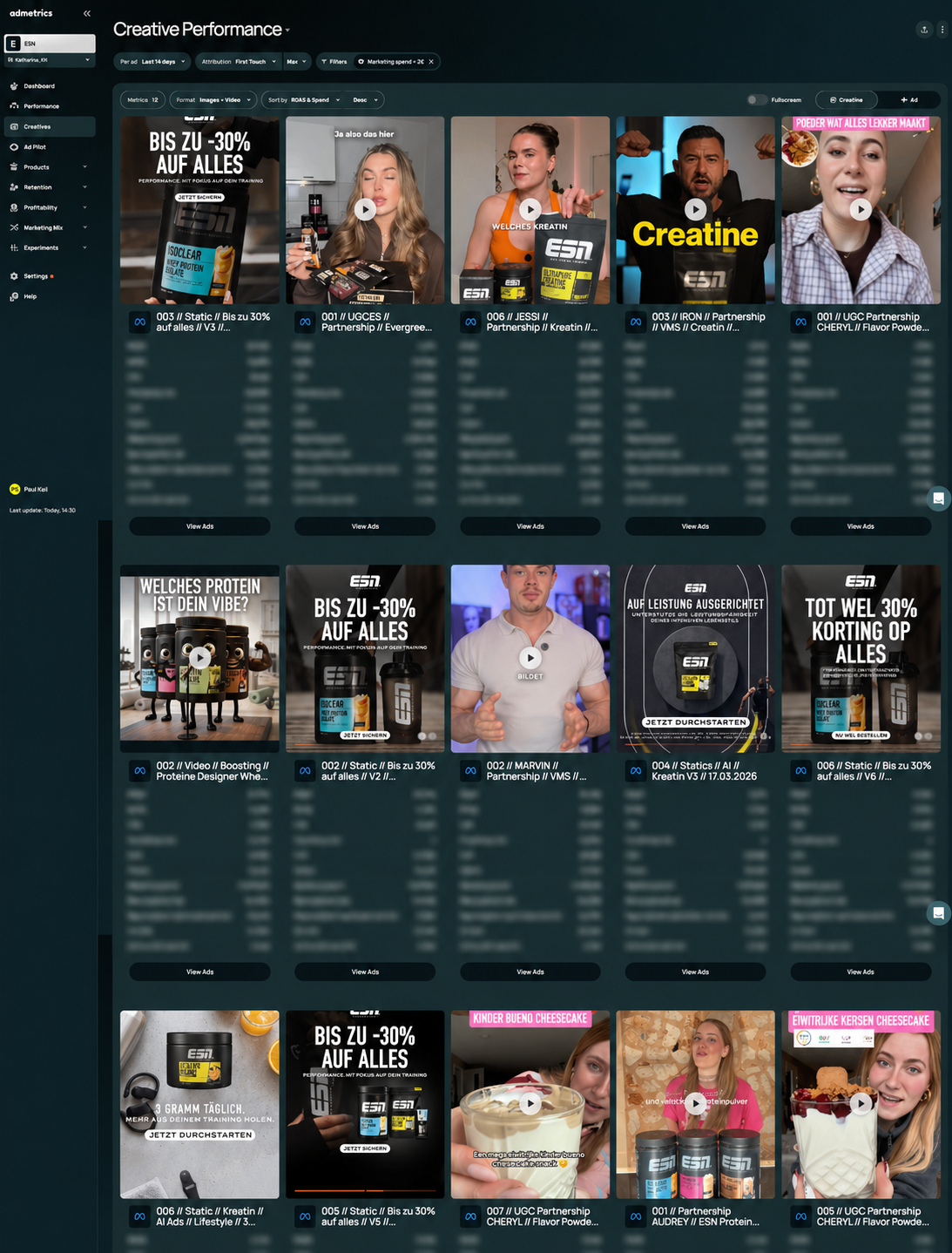
Sustainable creative scaling requires operational infrastructure, not just good intentions. Most brands fail at creative scaling because they lack systematic production processes that can generate diverse assets at velocity without breaking the bank.
Start by conducting a creative audit. Catalog your current asset library. How many distinct creative concepts do you have? How many formats does each concept exist in? How frequently are you launching new creative variations? For most brands, this audit reveals the gap between current capabilities and creative scaling requirements.
Next, establish production partnerships that can deliver velocity. This might mean working with multiple creative agencies, building an internal content team, or leveraging creator networks for user-generated content at scale. The specific structure matters less than achieving consistent output of diverse, quality assets weekly.
Implement creative briefs that explicitly call out format requirements and messaging diversity. Don't brief "create an ad"—brief "create this concept in static, video, and carousel formats, with distinct hooks optimized for cold traffic, retargeting, and existing customers." Build creative scaling requirements into the production process from the start.
Consider developing creative templates and frameworks that allow rapid variation production. A single product shoot can generate dozens of creative permutations if you plan for it—different background styles, text overlays, call-to-action variations, and editing styles. Creative scaling efficiency comes from systematic reuse and recombination of creative elements.

Measuring Creative Scaling Success
You can't improve what you don't measure. Effective creative scaling requires implementing metrics that track both production velocity and marketplace performance across your creative portfolio.
Track creative production metrics weekly. How many new distinct creative concepts launched? How many total format variations deployed? What's your ratio of active creatives to total ad spend? High-performing accounts typically maintain at least 8-12 active creative variations per campaign, refreshing 25-30% of their library monthly.
Monitor creative performance metrics at the asset level. Which formats drive lowest CPM? Which messaging angles achieve highest CTR? Which creative types generate best ROAS? This granular analysis reveals where your creative scaling investments generate maximum return. Here is more info on how to calculate ROAS for ecommerce.
Pay special attention to creative fatigue indicators. Track frequency by creative, CTR trends over time, and CPA deterioration curves. Understanding how quickly your creatives fatigue helps you calibrate creative scaling velocity to match your specific account dynamics. Some niches and audiences burn through creatives faster than others.
Implement portfolio-level creative metrics. What percentage of spend runs on creatives less than 30 days old? How diverse is your messaging angle distribution? Are you achieving format parity across major placements? These meta-metrics indicate whether your creative scaling operation is actually functioning or just producing volume without strategic diversity. Here's more on Creative Best Practices by Meta Business.
Common Creative Scaling Mistakes That Kill Performance
Even brands that understand creative scaling principles often sabotage their efforts through predictable execution errors. Recognizing these anti-patterns helps you avoid expensive mistakes.
The first major error is creating shallow diversity—producing multiple creatives that are cosmetically different but strategically identical. Three ads with the same hook, same messaging angle, and same visual style in slightly different colors don't constitute creative scaling. They're one creative pretending to be three. The algorithm treats them as near-duplicates, and you get minimal diversity benefit.
Another critical mistake is inconsistent creative scaling velocity. Brands launch eight new creatives one month, then nothing for six weeks, then four new assets, then another drought. This boom-bust approach prevents the algorithm from building stable performance patterns and forces constant relearning. Consistency in creative scaling cadence beats sporadic volume.
Many advertisers also neglect creative scaling for retargeting audiences. They invest heavily in diverse prospecting creatives but show the same retargeting ad for months. This misses enormous opportunity—engaged users deserve equally sophisticated creative scaling to move them through the conversion journey efficiently.
Finally, the worst creative scaling mistake is production without testing structure. Launching ten new creatives simultaneously without clear hypothesis or measurement framework wastes opportunity to learn. Structured creative scaling staggers launches, isolates variables, and builds systematic understanding of what works rather than hoping something sticks.
The Competitive Advantage of Creative Scaling Excellence
Brands that master creative scaling compound advantages over time that become nearly impossible for competitors to overcome. This isn't just about month-to-month performance—it's about building durable competitive moats.
First, effective creative scaling generates proprietary data about what resonates with your specific audience. Every creative test reveals insights about messaging, format preferences, and emotional triggers that work for your customers. Over months and years, this accumulates into deep customer understanding that competitors can't easily replicate.
Second, established creative scaling operations create muscle memory and systems that improve efficiency over time. Your production partners understand your brand. Your internal teams know what works. Your templates and frameworks evolve. The cost and speed of generating diverse, quality creatives improves continuously.
Third, consistent creative scaling investment builds brand recognition and trust that amplifies advertising effectiveness. Users who see diverse, quality content from your brand repeatedly—even if they don't immediately convert—build familiarity that makes future messages more likely to resonate. You're not just buying conversions; you're building brand equity that makes creative scaling increasingly profitable.
Conclusion: Feed the Algorithm or Accept Declining Margins
The harsh reality of Meta advertising in 2026 is simple: brands that treat creative scaling as optional will be systematically outcompeted by those who treat it as operational requirement. You can no longer win with the same three ads you used in 2024. The algorithm demands constant feeding, and creative scaling is how you satisfy that demand while maintaining profitability.
Your job isn't buying traffic anymore. Your job is producing the systematic creative diversity that allows the algorithm to buy traffic efficiently on your behalf. This requires operational transformation—moving from campaign optimization to content production as your primary growth lever.
The brands winning today implement creative scaling as core competency. They maintain production pipelines that generate diverse assets weekly. They monitor frequency and engagement metrics religiously. They refresh creatives proactively before performance craters. They treat creative scaling not as marketing expense but as algorithmic infrastructure investment.
Ready to transform your Meta advertising with systematic creative scaling? Explore how Admetrics' advanced analytics platform helps you measure creative performance at scale, identify fatigue signals early, and optimize your creative scaling operations for maximum profitability across every campaign.
Frequently Asked Questions
What is creative scaling and why does it matter for Meta Ads?
Creative scaling is the systematic production and deployment of diverse ad creatives at velocity to prevent audience fatigue and maximize auction participation across Meta's platforms. It matters because Meta's algorithm uses your creative assets to determine which auctions you can enter and what you pay—limited creative diversity directly increases your CPMs and reduces your reach, making creative scaling essential for profitable advertising.
How many creatives do I need for effective creative scaling?
Effective creative scaling typically requires maintaining 8-12 active creative variations per campaign, with 25-30% of your creative library refreshing monthly. Each major product or campaign should exist in multiple formats (static, video, carousel) with diverse messaging angles, giving the algorithm sufficient variety to optimize delivery across different user contexts and placements.
What's the difference between creative scaling and just making more ads?
Creative scaling is strategic diversification, while "making more ads" is often shallow volume. Creative scaling requires format diversity (static, video, carousel), messaging angle diversity (different value propositions and hooks), and systematic refresh cadence. Three versions of the same ad in different colors isn't creative scaling—it's cosmetic variation that provides minimal algorithmic benefit. Discover the ultimate guide to server side tracking and unlocking 3x more accurate ad data.
How do I know when to replace a creative in my creative scaling rotation?
Replace or supplement creatives when frequency exceeds 4.0 or when click-through rate declines by more than 20% over two weeks. These metrics indicate audience fatigue that will degrade performance. Proactive creative scaling means monitoring these indicators constantly and maintaining a creative buffer of tested assets ready to deploy when replacement triggers fire.
Can small brands with limited budgets still implement creative scaling?
Yes, effective creative scaling is possible at any budget through smart prioritization and efficient production. Start with one concept produced across three formats (static, video, carousel). Use user-generated content and creator partnerships to generate volume affordably. Focus creative scaling investment on your highest-spending campaigns first, then expand as you prove ROI and build production efficiency.
How does creative scaling impact Meta's Opportunity Score?
Creative scaling directly influences your Opportunity Score by expanding your campaign's ability to compete across placements and audience segments. Limited creative diversity constrains the algorithm's delivery options, lowering your Opportunity Score. Robust creative scaling with diverse formats and messaging increases the score by giving Meta's system flexibility to find optimal user-creative matches across inventory.
Here are 10 in-depth FAQs based on the provided guide to mastering Meta Ad creative scaling.
What happens if I rely on just one or two "winning" ads?
If you rely on a limited number of ads, you suffer from the "asset diet." Meta’s algorithm wants to show the right ad format to the right person at the right time. If you only provide static images, the algorithm cannot compete for users who only watch Reels. This lack of format variety forces the algorithm to bid in suboptimal auctions, resulting in a "monotony tax"—you will pay higher CPMs (Cost Per Mille/Thousand Impressions), reach fewer people, and experience rapid audience fatigue.
What are the three pillars of the "Holy Trinity" of creative scaling?
To scale successfully, your operation must rely on three interconnected pillars:
- Creative Velocity: The speed at which you produce and deploy fresh assets (e.g., refreshing 25-30% of your library monthly).
- Creative Diversity: Testing fundamentally different messaging angles, emotional hooks, and value propositions (not just changing the background color of the same image).
- Creative Liquidity: Having assets optimized for every available placement (Stories, Reels, Feed, Marketplace) so you can compete across the entire Meta inventory.
Why does a winning ad suddenly become unprofitable after a few weeks?
This is the classic boom-bust cycle of creative fatigue. When an ad is new, it generates strong engagement, and the algorithm rewards you with cheap delivery. However, as the algorithm shows that same ad to the same audience repeatedly, their engagement naturally drops. The algorithm interprets this drop in engagement as declining ad quality, adjusting your auction competitiveness downward, which causes your Cost Per Acquisition (CPA) to skyrocket.
What are the specific metrics that trigger a need for a creative refresh?
Do not wait for your campaign to become unprofitable to replace an ad. Implement proactive "Creative Velocity Thresholds." A highly practical rule of thumb is to replace or supplement an ad when:
- Frequency exceeds 4.0 (meaning the average user has seen the ad four times).
- Click-Through Rate (CTR) declines by more than 20% over a two-week period.
What is the Meta "Opportunity Score," and how does it relate to creative scaling?
The Opportunity Score is a metric provided by Meta that explicitly tells you if you are leaving money on the table due to algorithmic constraints. A low score usually means you are starving the algorithm of creative diversity. It is the system's way of saying it could spend your budget more efficiently, but you haven't provided the necessary variety of formats or messaging to do so.
How should I structure my creative testing calendar to avoid "Best Practice Roulette"?
Blindly copying competitors is dangerous because their audience and brand equity differ from yours. Instead, allocate 20% to 30% of your creative production specifically for experimental formats and angles that fall outside your current winning formula. By testing these variables systematically and documenting the results, you build proprietary, institutional knowledge about what actually works for your specific brand.
What is the most dangerous mistake brands make when attempting to scale creatives?
The most critical mistake is "shallow diversity." This happens when a brand produces ten creatives that look slightly different cosmetically (e.g., the same video hook and message but with different actors or font colors). The algorithm treats these as near-duplicates, meaning you get zero algorithmic benefit for your production efforts. True scaling requires fundamentally different strategic approaches in your creatives.
Why is creative scaling just as important for Retargeting campaigns as it is for Prospecting?
Many advertisers spend thousands developing diverse creatives for cold traffic (prospecting) but show their "warm" retargeting audiences the exact same ad for months on end. This is a massive missed opportunity. Users who have already engaged with your brand are further down the funnel; they require sophisticated, diverse creative scaling (like testimonials, specific feature highlights, or comparison angles) to efficiently push them to conversion.
I have a small budget; how can I realistically implement creative scaling without breaking the bank?
You don't need a massive agency to scale creatively. You can achieve this through smart prioritization:
- Start small but diverse: Take one strong concept and format it three ways (a static image, a video, and a carousel).
- Leverage UGC: User-Generated Content and micro-creator partnerships are highly affordable ways to generate diverse volume rapidly.
- Template creation: Build design frameworks where one product shoot can yield dozens of permutations simply by changing text overlays, backgrounds, and CTAs.