Imagine your customers discovering, purchasing, and receiving support for your products through AI agents that seamlessly communicate across platforms—all while you maintain complete control over your brand experience and customer data. This isn't a distant future; it's happening now with Google's Universal Commerce Protocol (UCP), and as performance marketers, we need to understand how it will reshape attribution, customer journeys, and marketing measurement.
Understanding What Google UCP is and Why It Matters
What is Google UCP exactly? The Universal Commerce Protocol is Google's open standard designed to enable AI agents to interact seamlessly across the entire shopping journey—from product discovery to checkout to post-purchase support. Think of it as a universal language that allows different AI systems, payment providers, and retail platforms to communicate without requiring custom integrations for each connection.
Unlike previous commerce protocols that focused on specific touchpoints, UCP was co-developed with major retailers including Shopify, Etsy, Wayfair, Target, and Walmart. The protocol has garnered endorsements from over 20 industry leaders including payment giants like Visa, Mastercard, American Express, Stripe, and Adyen, as well as major retailers like Best Buy, Macy's, The Home Depot, and international players like Flipkart and Zalando.

How Google UCP Transforms the Shopping Experience
The Universal Commerce Protocol introduces several breakthrough capabilities that fundamentally change how customers interact with brands:
AI-Powered Checkout in Google Search
UCP powers a new checkout feature in AI Mode within Google Search and the Gemini app. Shoppers can now complete purchases from eligible U.S. retailers directly within their research experience, using Google Pay or PayPal with saved payment methods and shipping information from Google Wallet.
For DTC brands, this means capturing sales at the exact moment of intent—eliminating friction that typically leads to cart abandonment. Retailers maintain seller-of-record status and can customize integrations to their specific needs, ensuring brand consistency while leveraging Google's massive search traffic.
Business Agent: Your Virtual Sales Associate
Google's Business Agent feature allows customers to chat directly with branded AI agents right on Search. These virtual sales associates answer product questions in your brand's voice, connecting with consumers during critical shopping moments.
Currently live with retailers like Lowe's, Michael's, Poshmark, and Reebok, Business Agent can be activated and customized through Merchant Center. In coming months, brands will be able to train these agents using their own data, access customer insights, provide related product offers, and enable direct agentic checkout within the conversation.
Optimizing for Conversational Commerce Discovery
Google recognizes that search behavior is evolving beyond keywords. That's why they're introducing dozens of new data attributes in Merchant Center designed specifically for conversational commerce discovery.
These attributes go beyond traditional product data to include:
- Answers to common product questions
- Compatible accessories and substitutes
- Detailed usage scenarios and benefits
- Product comparisons and alternatives
For DTC brands, optimizing product feeds with these conversational attributes is crucial for visibility in AI Mode, Gemini, and Business Agent interactions. This represents a shift from keyword optimization to intent-based product information architecture.
Direct Offers: AI-Powered Promotional Advertising
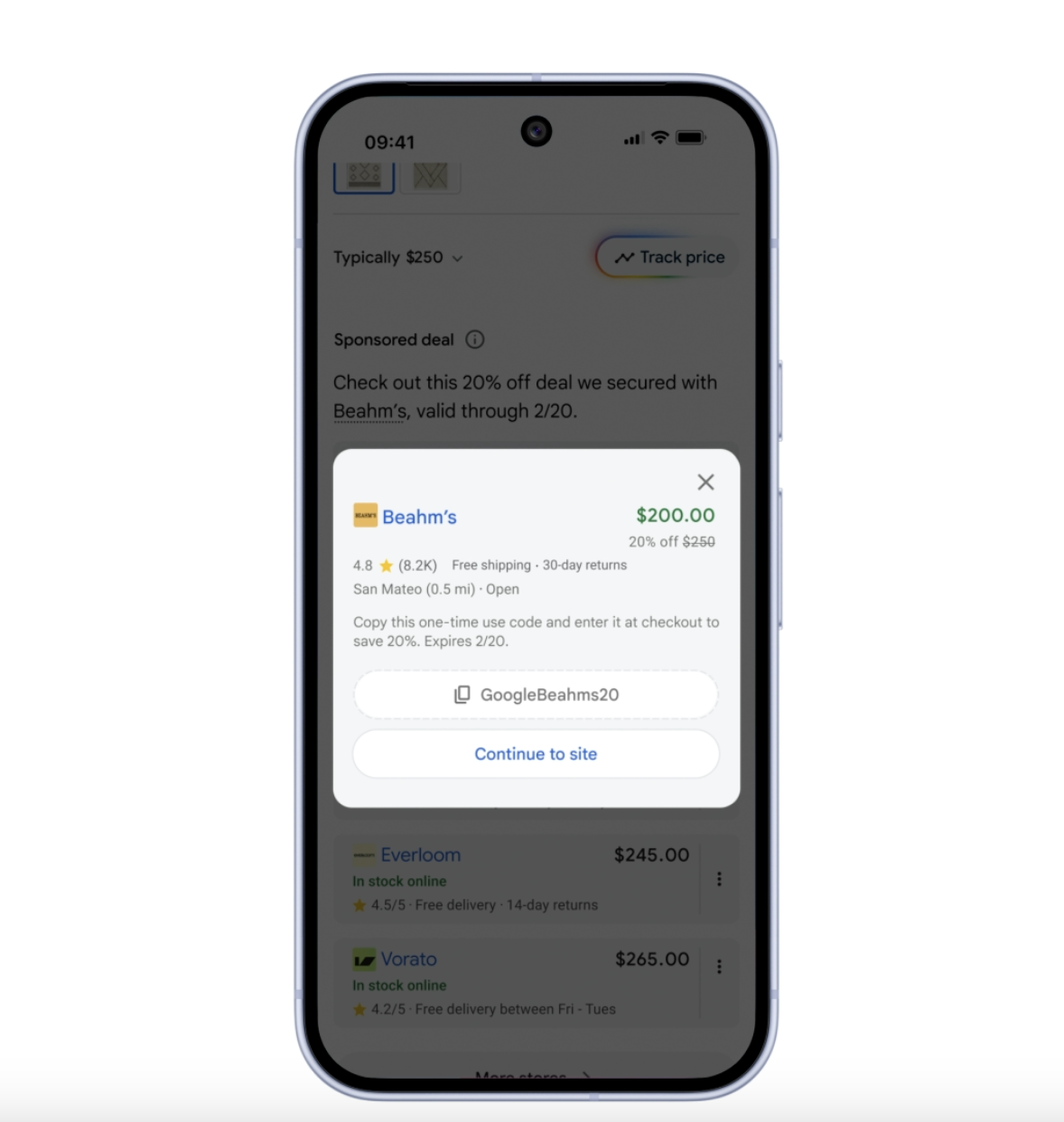
Google is testing a new ad format called Direct Offers within AI Mode, allowing advertisers to present exclusive deals to high-intent shoppers.
Here's how it works:
When a customer searches with specific product criteria (like "modern, stylish rug for high-traffic dining room, easy to clean"), Google elevates relevant products. With Direct Offers, qualifying retailers can feature special discounts—like 20% off—directly in the AI-generated results, labeled as "Sponsored deal."
Retailers set up relevant offers in campaign settings, and Google's AI determines when each offer is contextually relevant to display. The pilot initially focuses on discounts but will expand to include bundles, free shipping, and other value-driven attributes.
Brands like Petco, e.l.f. Cosmetics, Samsonite, Rugs USA, and Shopify merchants are already participating in shaping this new advertising format.
Measuring ROI in the UCP Era
As agentic commerce expands, marketing measurement must evolve. Here's what DTC brands should prioritize:
Implement comprehensive tracking: Ensure your analytics stack captures conversions from UCP-powered touchpoints, including AI Mode checkouts and Business Agent interactions. Integration between your commerce platform and attribution solution is critical.
Leverage server-side attribution: Client-side tracking alone won't capture the full customer journey when AI agents are involved. Server-side measurement provides the data fidelity needed for accurate attribution in this new landscape.
Monitor incrementality: As new channels like Direct Offers emerge, measuring true incrementality becomes essential. Are these AI-powered touchpoints generating new demand or simply capturing existing demand through different channels?
Optimize for lifetime value: UCP's seamless experience may accelerate initial conversions, but DTC success depends on repeat purchases. Track customer cohorts acquired through AI-powered channels to understand long-term value and retention patterns.
Platforms like Admetrics that offer multi-touch attribution, incrementality testing, and customer journey analytics become increasingly valuable as commerce fragments across AI surfaces. Learn more about server side tracking in this guide to unlocking 3x more accurate ad data.
Technical Integration and Compatibility
What is Google UCP's relationship to other commerce protocols? UCP was designed for interoperability, working alongside existing standards including:
- Agent2Agent (A2A): For agent-to-agent communication
- Agent Payments Protocol (AP2): For secure, agent-led payments that Google introduced previously
- Model Context Protocol (MCP): For AI model interactions
This compatibility means retailers don't need to choose between protocols. Instead, UCP provides an umbrella framework that works across verticals and integrates with your existing commerce infrastructure.
For Shopify, WooCommerce, BigCommerce, and other platform users, UCP integration will likely roll out through official partnerships and plugins, making adoption relatively straightforward once broadly available.
Privacy, Security, and Brand Control
Despite the convenience of AI-powered commerce, brands maintain critical controls under UCP:
Seller of record status: Retailers remain the legal seller, maintaining customer relationships and data ownership rights.
Customizable integration: Brands can configure UCP implementations to align with their specific requirements, policies, and customer experience standards.
Secure transactions: Built on Google's Agent Payments Protocol, UCP transactions leverage secure payment methods already saved in Google Wallet, with PayPal integration expanding availability.
Brand voice control: Through Business Agent customization and training on brand-specific data, companies maintain consistent messaging and positioning.
For marketers concerned about losing customer touchpoints to AI intermediaries, these controls provide important safeguards—but only if properly configured and monitored.
Global Expansion and Future Capabilities
While UCP features are launching first with eligible U.S. retailers, Google plans global expansion in coming months. Additional capabilities in development include:
- Discovering related products through AI recommendations
- Applying loyalty rewards within agentic checkout flows
- Powering custom shopping experiences tailored to brand identities
- Enhanced customer insights from Business Agent interactions
- Expanded Direct Offers formats beyond discounts
For international DTC brands and those planning global expansion, monitoring UCP's rollout across markets will be essential for maintaining competitive parity.
UCP Roadmap Overview
The Universal Commerce Protocol (UCP) roadmap outlines strategic priorities to build a fully agentic, global commerce standard that extends beyond isolated transactions. Key upcoming initiatives focus on deepening the consumer journey through features like loyalty programs, member benefits, and personalized cross-selling or upselling. Additionally, UCP aims to support global markets with a phased rollout and localized payment interoperability in regions like India, Indonesia, and Latin America.
The protocol is also expanding its reach across specific industries, actively developing new schema capabilities tailored to the unique discovery, booking, and checkout processes of the food and lodging sectors. To achieve these ambitious goals, UCP encourages open collaboration, inviting businesses, developers, and payment providers to help shape the next generation of global commerce.
Preparing Your DTC Brand for the UCP Revolution
Smart preparation today positions your brand for success tomorrow. Here's your action plan:
Audit your product data: Review your current product feeds and identify gaps in conversational attributes. What questions do customers commonly ask? What usage scenarios should you document? What compatible products and alternatives should you highlight?
Evaluate your tech stack: Ensure your analytics platform can track and attribute conversions from new AI-powered channels.
Optimize for AI discovery: Beyond traditional SEO, think about how AI agents will evaluate and recommend your products. Detailed product information, clear value propositions, and comprehensive Q&A content become crucial.
Test Business Agent opportunities: If eligible, activate and customize Business Agent through Merchant Center. Experiment with brand voice, train on your data, and monitor customer interactions for insights.
Plan Direct Offers strategy: Consider how promotional advertising in AI Mode fits your acquisition strategy. What offers drive conversion without eroding margins? How do AI-discovered customers compare to traditional channel acquisitions?
Conclusion: Embracing Agentic Commerce Without Losing Attribution Clarity
Understanding what is Google UCP is just the beginning—the real challenge for DTC brands and ecommerce leaders lies in adapting marketing strategies, measurement frameworks, and customer experiences for this new paradigm of AI-powered shopping. As customers increasingly rely on AI agents to discover, evaluate, and purchase products, brands that optimize for conversational commerce while maintaining rigorous attribution and analytics will gain significant competitive advantages.
The Universal Commerce Protocol represents Google's vision for open, collaborative agentic commerce, but success requires more than just technical integration. It demands strategic thinking about customer journeys, data architecture, and performance measurement in an increasingly AI-mediated marketplace.
Ready to future-proof your DTC analytics for the agentic commerce era? Explore how Admetrics' advanced attribution and analytics platform helps ecommerce brands maintain measurement clarity across fragmenting customer touchpoints, ensuring you never lose sight of what's actually driving revenue—even as AI agents reshape the shopping experience.
Frequently Asked Questions
What is Google UCP and how does it work?
Google UCP (Universal Commerce Protocol) is an open standard that enables AI agents to seamlessly interact across the entire shopping journey—from discovery to purchase to support. It creates a common language for agents, retailers, and payment systems to communicate without requiring custom integrations for each connection, powering features like AI-powered checkout in Google Search and branded Business Agents.
Who developed Google UCP and which companies support it?
Google UCP was co-developed with major retailers including Shopify, Etsy, Wayfair, Target, and Walmart. It has endorsements from over 20 industry leaders including Adyen, American Express, Best Buy, Flipkart, Macy's Inc., Mastercard, Stripe, The Home Depot, Visa, and Zalando, representing broad ecosystem support across retail and payments.
How does Google UCP affect marketing attribution for DTC brands?
Google UCP introduces new AI-powered touchpoints like AI Mode checkout and Business Agent interactions that complicate traditional attribution models. DTC brands need robust analytics solutions that can track customer journeys across these fragmented touchpoints, implement server-side tracking to capture agent-initiated transactions, and measure incrementality of new AI-powered channels accurately.
What is the difference between UCP and other commerce protocols?
Google UCP is designed to work alongside and integrate with existing protocols like Agent2Agent (A2A), Agent Payments Protocol (AP2), and Model Context Protocol (MCP). Rather than replacing these standards, UCP provides an umbrella framework that spans the entire commerce journey across discovery, purchasing, and post-purchase support, working across multiple verticals.
When will Google UCP be available for my ecommerce store?
Google UCP features are launching initially with eligible U.S. retailers, with global expansion planned for coming months. Features like AI-powered checkout in Google Search and Business Agent are rolling out in phases. Eligible retailers can activate Business Agent through Merchant Center starting now, while Direct Offers is currently in pilot testing with select brands.
How can I prepare my product catalog for Google UCP?
Optimize your product data with new conversational attributes in Merchant Center, including answers to common questions, compatible accessories, substitutes, and detailed usage scenarios. Focus on comprehensive product information that helps AI agents understand not just what your products are, but how they solve customer problems and compare to alternatives. Here is all you need to know about multi touch attribution for ecommerce.