In today’s fast-moving ecommerce world, understanding what is digital media marketing is essential for sustainable growth. It’s more than a trend—it's a performance framework that aligns marketing investments with business outcomes. For CMOs, VPs of Growth, and performance leads, this approach ties every media dollar to measurable impact, from revenue acceleration to brand equity growth.
Operational marketers also rely on digital media as their testing ground. It’s where campaigns pivot in real-time, adapting creatives and budgets to performance signals. With consumer attention scattered across platforms like TikTok, Meta, and Google, the pressure to engage audiences dynamically has never been higher. Teams that master these systems unlock scalable efficiency, higher ROAS, and cross-channel clarity. Digital media marketing isn’t just about reaching more people—it's about reaching the right ones, at the right moment, with performance to match.
Understanding What Is Digital Marketing
So, what is digital media marketing? At its core, it’s the use of digital platforms—social media, search engines, email, websites—to engage and convert audiences. But for data-driven DTC marketers, it’s anything but basic.
Digital media marketing integrates content, technology, and analytics into a full-funnel system. The goal: maximize KPIs like ROAS, customer lifetime value (LTV), and conversion rate.
Top-performing campaigns:
- Combine Meta and TikTok for both discovery and acquisition
- Use first-party data strategies to improve targeting
- Leverage attribution tools to measure incrementality
With customers interacting across multiple channels, digital media marketing ensures coherence in messaging and measurement. Executed well, it transforms paid media from a cost center into a primary growth engine.
Why Every DTC Leader Should Prioritize Digital Marketing
Every revenue-focused leader should grasp what is digital media marketing. It's how marketers connect campaign input to business output.
For strategic leads, this means:
- Justifying spend based on CAC and LTV
- Understanding attribution paths, not just final clicks
- Aligning investments with operational priorities
For execution teams, digital media marketing is the campaign operating system.
They:
- Iterate creatives weekly or even daily
- Monitor channel-by-channel ROAS
- Navigate algorithm changes to stay performant
The most competitive ecommerce brands don’t treat digital media as tactical. It’s a strategic pillar—powering retention, acquisition, and brand growth in a single, measurable loop.
Getting Started With Digital Marketing the Right Way
To build an effective digital media marketing motion, start with clarity. Define your customer journey, KPIs, and data infrastructure.
Here’s how to begin:
- Map Your Funnel: Identify platforms that align with each stage—from awareness (TikTok) to conversion (Search).
- Set Smart KPIs: Target ROAS, LTV:CAC ratios, or blended performance metrics for each channel.
- Optimize Attribution: Build your stack with MMM, clean rooms, or platform-native tools.
- Create Test-and-Learn Loops: Run creative sprints, monitor incrementality, and iterate fast.
Collaborate across teams. Integrate creative, media buying, and analytics into one feedback cycle. Momentum comes from repeatable tests, not guesswork.

When to Activate Your Digital Marketing Strategy
Timing shapes outcomes in digital campaigns. Understanding when to activate digital media drives higher ROI.
Time-sensitive triggers include:
- Seasonal demand peaks (Q4 holidays, January fitness wave)
- Product launches and channel expansions
- Platform algorithm adjustments (Meta’s Learning Phase, TikTok trending audio)
For example, high-intent search campaigns often convert best early in the week. Social ads might peak Friday through Sunday. Use historical data layered with platform insights to fine-tune launch windows.
Strategic alignment between media timing and business operations creates measurable lift. The best campaigns don’t just run on budget—they run on cadence.
Building Scalable Advantage Through Media Marketing
Digital media marketing isn’t just a tactic. It’s a lever for exponential brand growth.
Winning brands:
- Align digital spend with LTV goals and margin performance
- Systematize creative testing to unlock channel efficiency
- Use performance signals to evolve messaging dynamically
Adopting a continuous optimization model drives both scale and sustainability. When creative teams produce assets based on engagement data, and media managers use real-time reporting, they build compounding advantages.
A growth mindset backed by testing velocity, attribution clarity, and cross-team alignment becomes an unbeatable moat. That’s the power behind consistently answering—and actioning—the question: what is digital media marketing?
How Admetrics Enhances Your Digital Marketing Strategy
Admetrics empowers ecommerce marketers to win in a fragmented, high-speed environment. Our platform fuses AI with advanced experimentation tools to help you:
- Optimize spend based on predictive models, not gut feeling
- Gain privacy-first insights across customer journeys
- Scale winning creatives faster using automated A/B testing
By surfacing actionable data, Admetrics lets teams act with confidence, cut wasted spend, and maximize campaign profitability. It’s a system built for performance marketers driving ambitious growth.
Start your journey with smarter, faster decision-making. Book a demo or kick off a free trial.
Frequently Asked Questions About What Is Digital Marketing
1. What exactly is digital media marketing in the context of DTC e-commerce?
At its core, digital media marketing is the use of online platforms (social media, search engines, email) to engage audiences. However, for a data-driven DTC brand, it is a comprehensive, full-funnel performance framework. It integrates content, technology, and analytics to tie every single media dollar to measurable business outcomes, maximizing key metrics like Return on Ad Spend (ROAS) and Customer Lifetime Value (LTV).
2. Why do competitive e-commerce brands treat digital media as a strategic pillar rather than a simple tactic?
Tactics are short-term, but strategy builds a moat. Top-tier brands treat digital media as a strategic pillar because it connects campaign inputs directly to business outputs. For CMOs and VPs of Growth, it is the mechanism used to justify spend based on Customer Acquisition Cost (CAC) and LTV. It powers retention, acquisition, and brand growth in a single, measurable, and highly scalable loop.
3. What are the foundational steps to launching a scalable digital marketing strategy?
Building an effective motion requires clarity and strong data infrastructure. The foundational steps include:
- Map Your Funnel: Align specific platforms with specific customer journey stages (e.g., TikTok for awareness, Google for conversion).
- Set Smart KPIs: Establish clear targets for ROAS, LTV:CAC ratios, and blended performance metrics.
- Optimize Attribution: Move beyond basic tracking by implementing Media Mix Modeling (MMM), data clean rooms, or advanced platform-native tools.
- Create Test-and-Learn Loops: Run rapid creative sprints, monitor incrementality, and iterate based on real-time feedback.
4. How does cross-channel digital marketing work in practice?
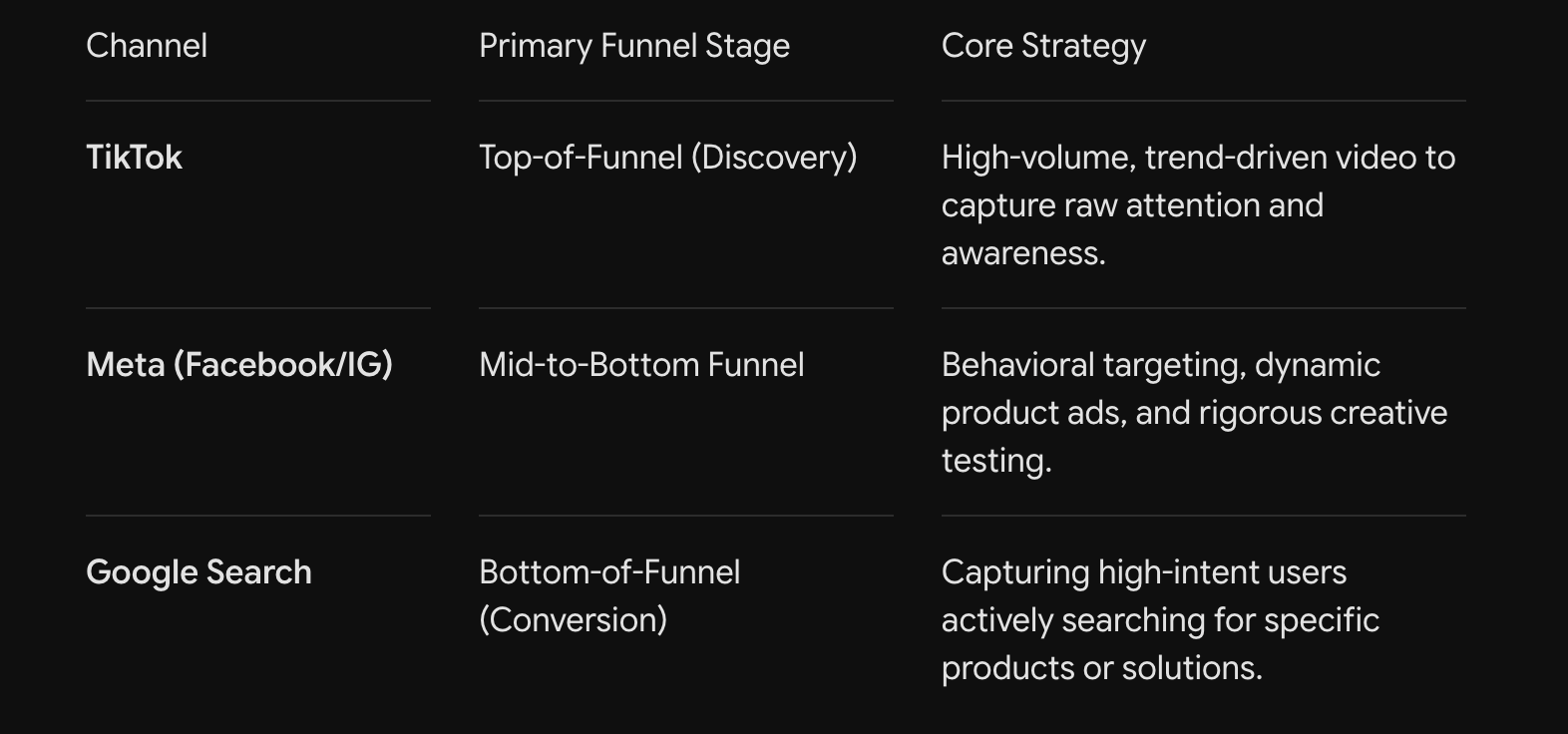
Customers do not shop in a silo; they interact with your brand across multiple touchpoints. A successful digital marketing strategy ensures cohesive messaging and accurate measurement across the entire ecosystem. Here is how top campaigns typically align channels:
5. Why is "timing" considered a critical lever in digital media campaigns?
A campaign isn't just about the budget; it's about the cadence. Activating campaigns at the right time drastically improves ROI. Strategic marketers time their launches around:
- Seasonal Demand Peaks: Capitalizing on Q4 holiday shopping or the January fitness wave.
- Algorithm Adjustments: Navigating Meta’s Learning Phase efficiently or jumping on trending TikTok audio early.
- Micro-Trends: Understanding that high-intent search campaigns often convert best early in the week, while social media ads might peak from Friday through Sunday.
6. What is multi-touch attribution, and why is it necessary?
Historically, platforms gave 100% of the conversion credit to the "last click" before a purchase. Multi-touch attribution is a modernized method that distributes conversion credit across all the touchpoints a customer interacted with (e.g., watching a TikTok ad, clicking an email, and finally converting via a Google Search). This provides a true picture of which channels are actually driving incrementality.
7. How does first-party data improve digital marketing targeting?
With increasing privacy regulations and the deprecation of third-party cookies, relying solely on platform algorithms is risky. First-party data refers to the information your customers give you directly (emails, purchase history, website behavior). Integrating this data into platforms like Meta or Google allows you to build highly accurate "lookalike" audiences and retarget high-LTV users, vastly improving targeting precision.
8. How does continuous creative testing build an "unbeatable moat" for brands?
Digital media marketing is the ultimate testing ground. When brands systemize creative testing, they stop relying on gut feelings and start evolving their messaging dynamically based on hard engagement data. This continuous optimization model—where creative teams iterate assets weekly or daily based on media managers' real-time reports—creates compounding advantages and massive channel efficiency over time.
9. How does digital media marketing differ fundamentally from traditional marketing?
Traditional marketing (like billboards or print) is static, delayed in its reporting, and difficult to tie directly to a specific sale. Digital media marketing is data-rich, highly measurable, and adaptable in real time. If a digital ad isn't hitting its target CPA or CTR on a Tuesday morning, a performance marketer can pivot the creative or budget by Tuesday afternoon.
10. How do platforms like Admetrics enhance a DTC brand's digital strategy?
In a fragmented, high-speed environment, manual data crunching leads to missed opportunities. Platforms like Admetrics fuse AI with advanced experimentation tools to streamline growth. They allow brands to:
- Optimize spend based on predictive models rather than guesswork.
- Gain privacy-first insights across complex customer journeys.
- Scale winning ad creatives much faster through automated A/B testing and incrementality measurement.
11. How does digital media marketing differ from traditional marketing?
Digital strategies are data-rich, faster to adjust, and more measurable across metrics like CTR, CPC, and ROAS. Here is all you need to know about Amazon ads.