Are you measuring the numbers that actually drive profit, or are you getting lost in platform-specific vanity metrics? For direct-to-consumer (DTC) brands navigating rising ad costs and privacy changes, having a clear set of Performance Reporting Benchmarks is no longer optional. It is the absolute key to survival and sustainable growth.
In 2026, the digital advertising landscape has fundamentally shifted. Relying on outdated data points or fragmented platform reporting will lead you to make expensive mistakes. In this guide, we will explore the most critical Performance Reporting Benchmarks, provide up-to-date 2026 industry data, and offer a data-driven playbook to ensure your brand scales profitably.
Why Performance Reporting Benchmarks Matter for DTC Brands in 2026
The era of easy paid social arbitrage is officially over. With customer acquisition costs (CAC) surging and holding steady at higher baselines over the last two years, DTC marketers cannot afford to optimize purely for cheap clicks.
Today, utilizing accurate Performance Reporting Benchmarks allows you to diagnose the true health of your business. These benchmarks help you determine if a drop in revenue is due to a failing ad creative, a broken post-click landing page experience, or a macro shift in platform media costs. By measuring your metrics against accurate 2026 data, you can quickly identify whether you are leading the pack or bleeding cash, allowing you to adjust your strategy before it impacts your bottom line.
The Core Performance Reporting Benchmarks for 2026
To understand where your brand stands, you need to look at both channel-specific media costs and holistic business health indicators. Based on recent 2026 data, here are the benchmarks you must track:
1. Platform Costs: Meta CPM and Google CPC
In 2026, media costs remain high, but they are predictable if you know the ranges.
- Meta CPMs: Across DTC ad accounts, Meta CPMs currently sit in an $18 to $45 band for most advertisers, with highly competitive niches like apparel swinging into the $50–$70 range during peak Q4 seasons.
- Google Ads CPC: The average cost per click (CPC) in Google Ads hovers around $5.42 across industries, while the average search click-through rate (CTR) sits at a healthy 6.64%.
2. Marketing Efficiency Ratio (MER)
Because platform attribution is increasingly fractured by privacy updates, successful DTC brands now look at Blended MER (Total Store Revenue divided by Total Ad Spend) to gauge overall efficiency.
- Apparel & Accessories: 2.1 to 3.4
- Beauty & Skincare: 2.5 to 4.0
- Supplements & Wellness: 3.0 to 5.5
- Furniture & Home Goods: 1.5 to 2.5 (lower MER is acceptable here due to high AOV and longer consideration windows)
3. CAC Payback Window and LTV:CAC Ratio
How fast do you make your money back? In 2026, cash flow is critical.
- CAC Payback Window: Recovering your CAC within 45 to 90 days is considered healthy for most DTC categories. Anything under 30 days is exceptional, while a payback window over 120 days is dangerous without significant cash reserves.
- LTV to CAC Ratio: The new standard benchmark remains 3:1. For every $1 you spend to acquire a customer, you should generate $3 in lifetime gross margin.
4. Sitewide Conversion Rates
Driving traffic means nothing if your storefront does not convert. In 2026, the global average e-commerce conversion rate ranges roughly between 1.70% and 2.96%. However, top-tier Shopify stores (the top 10%) consistently push past 4.5% by ruthlessly optimizing site speed, digital wallet integration (like Apple Pay), and mobile checkout friction.
How to Improve Your Performance Metrics
Knowing the Performance Reporting Benchmarks is just the baseline. To beat the averages and drive profitable growth, execute these three strategies:
- Fix Your Tracking Infrastructure: If you are running ads on Meta, you must deploy the Conversions API (CAPI). Brands utilizing CAPI correctly see match rates jump from roughly 60% to the 75–88% range, directly improving the algorithm's ability to find buyers.
- Shift Focus to Retention: With acquisition costs remaining high, retaining a customer is exponentially more profitable. Increasing your 60-day repeat purchase rate reduces the pressure on your front-end ROAS and dramatically shortens your CAC payback window.
- Test Creative Radically: Stop swapping minor copy details on the exact same ad concept. Ad platform algorithms reward structurally different storytelling. Test completely new visual angles and formats to break out of expensive CPM pockets.
How Admetrics can help
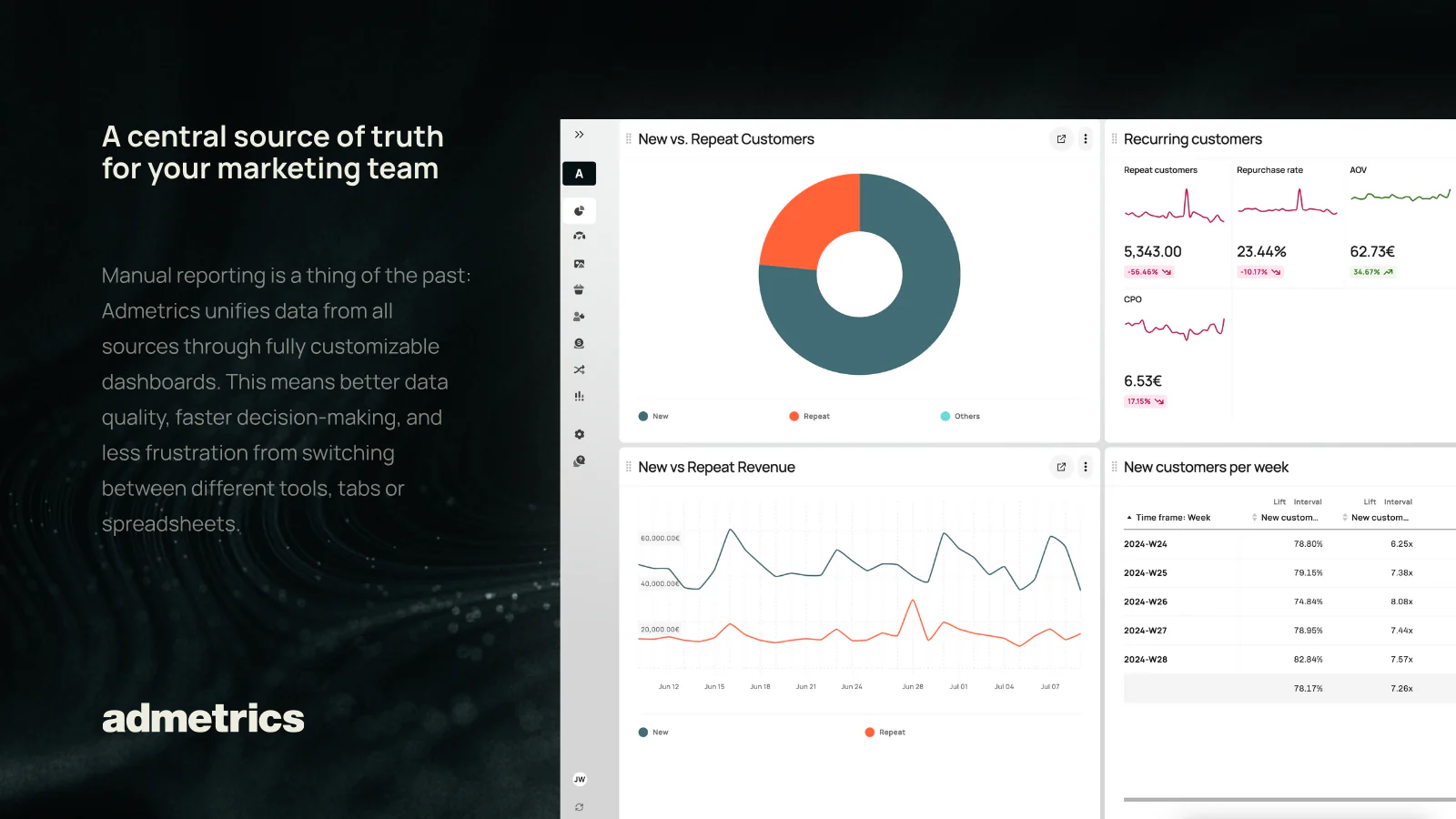
Admetrics helps teams build and operationalize Performance Reporting Benchmarks that hold up in both the ad account and the boardroom.
You can standardize reporting across Meta, Google, and TikTok, then connect it to incrementality signals so you stop optimizing for distorted attribution. As a result, your benchmarks reflect true revenue lift and marginal returns, not just platform reported ROAS.
If you want to see it in action, book a demo and start your free trial here.
FAQ
What are Performance Reporting Benchmarks?
Performance Reporting Benchmarks are reference ranges for KPIs like ROAS, CAC, LTV, payback window, conversion rate, and contribution margin. They help you interpret results consistently and make faster decisions.
How often should Performance Reporting Benchmarks be updated?
Use them weekly for pacing, monthly for channel and budget allocation, and quarterly for a strategy reset. Also update them after major promo changes, pricing shifts, or tracking changes.
Which KPIs should Performance Reporting Benchmarks include for DTC?
Most teams track blended ROAS, MER, CAC, new customer CAC, contribution margin, payback window, conversion rate, and LTV by cohort. Then they add leading indicators like CPM, CTR, CPC, and CVR to explain movements.
What is a good ROAS benchmark?
A good ROAS is the one that hits your contribution profit and payback targets. It depends on gross margin, shipping costs, discounting, and how quickly customers reorder.
How do I benchmark Meta versus Google fairly?
Compare channels on incremental lift and blended business outcomes, not last click ROAS. Then normalize with contribution margin and cohort payback so intent differences do not distort the comparison.
Do Performance Reporting Benchmarks still work with imperfect attribution?
Yes. In fact, they matter more. Use one internal attribution lens for decision making, then validate with incrementality tests or structured experiments to keep targets grounded in reality.
What breaks Performance Reporting Benchmarks suddenly?
Tracking changes, creative fatigue, promo intensity shifts, inventory constraints, audience saturation, and competitor bidding pressure can all break benchmarks. Leading indicators help you diagnose which driver is responsible.
How can AI improve Performance Reporting Benchmarks?
AI can forecast CAC and ROAS ranges, detect anomalies earlier, and predict creative fatigue using signals like CTR decay and frequency. However, you still need clean inputs and a validation loop using incrementality or marginal returns.