For years, digital advertising has been dominated by two quiet steps that happen long before a single impression is served: retrieval and ranking. Retrieval builds a shortlist of potentially relevant ads from a universe of tens of millions; ranking then arranges that shortlist to decide what actually shows up in the feed. Most marketers focus on the glamorous end—creative hooks, bids, budgets—while the heavy lifting happens in the background.
That background just changed. Meta Andromeda is a new retrieval engine that upgrades the shortlist step with far more model capacity, faster throughput, and finer-grained personalization. Why should you care? Because the industry has flooded platforms with orders of magnitude more creative (thanks to Advantage+ automation and generative AI), and the old retrieval pipelines couldn’t evaluate enough options fast enough. In short: retrieval became the bottleneck, and Andromeda is Meta’s answer.
The practical takeaway is simple: when retrieval gets dramatically better, the best lever for performance shifts. Instead of winning by micromanaging audiences and knobs, advertisers increasingly win by supplying a diverse, strategically structured creative library that the system can match to people and contexts—automatically and at scale.
What Exactly Is Meta Andromeda?
Andromeda is a new, hardware–software co-designed ads retrieval system. It runs on Meta’s in-house MTIA silicon and NVIDIA’s Grace Hopper Superchip, enabling much larger and more complex models to sift through the ad universe and assemble a high-quality shortlist for ranking. In Meta's words, retrieval selects “from tens of millions of ad candidates into a few thousand relevant candidates,” before ranking decides the winners.
What’s new under the hood. Andromeda introduces a deep neural architecture tailored to modern AI hardware, a hierarchical ad index, and an inference pipeline built for low latency and high throughput. The upshot is a 10,000× increase in model capacity, a 3×+ jump in model inference QPS, and measurable improvements in early outcomes: +6% recall at retrieval and +8% ad-quality improvement on selected segments during deployment. These are retrieval-stage gains; they raise the ceiling for what the subsequent ranking and auction can accomplish.
Scope check. Andromeda does not decide the final ad you see—that’s the ranking system’s job. But by upgrading the shortlist, Andromeda changes which options ranking even gets to consider. That change alone can cascade into better personalization, stronger engagement, and more efficient spend allocation system-wide.
Why Retrieval Became the Bottleneck
Two forces collided to stress the old pipelines:
- Creative proliferation. Advantage+ automation broadened the pool of eligible ads (via automated audiences, placements, and formats), while gen-AI tools made it much cheaper and faster to produce more variations. The volume of viable creative exploded, and retrieval had to scan far more candidates per request. Facebook explicitly cites this surge—and the high compute cost of predictive targeting—as a scaling pain.
- Tighter latency + richer signals. As people and sessions change rapidly, retrieval must react in near real time with more complex models—without delaying delivery. That means more features, more parallelism, and smarter indexing so the system stays personal at the speed of scroll.
In parallel, community chatter around old heuristics (like keeping ≤6 ads per ad set) has faded; in practice, many buyers now run far more ads—if they’re meaningfully different—precisely because the system can evaluate more options per request. That shift maps to Andromeda’s remit: process more candidates quickly, then find the right matches.
How Andromeda Works at a High Level
Think in vectors and candidates. Retrieval maps users, contexts, and creatives into dense embeddings. Those embeddings let the system quickly surface ads that are semantically “nearby”—not just “you like shoes,” but “you tend to click red flip-flops for beach trips.” This is why retrieval is distinct from ranking: retrieval’s job is to surface eligible candidates that look promising for this moment and this person. Meta’s recommendation stack (across products) typically includes multi-stage candidate generation, filtering, and then ranking—Andromeda is the ads-specific evolution of that first stage.
Hierarchical indexing. Rather than scanning every ad equally, Andromeda organizes creatives into a hierarchical index that prunes the search space fast. The retrieval model and index are jointly trained so the index aligns with the neural network’s understanding of relevance. This yields sub-linear inference cost and makes it practical to consider far more candidates per request—crucial when creative libraries balloon.
Sequence learning and context. Beyond static traits, Meta has also invested in sequence learning—models that learn from the order and timing of interactions, helping the system infer nuanced intent and shift recommendations as behavior changes. While sequence learning spans more than ads, the architectural pattern reinforces why retrieval demanded a rethink: more signals, more temporal nuance, bigger models.
Bottom line: Andromeda turns retrieval into a modern, hardware-accelerated, learned system that can handle the creative deluge and still match people to the right ideas swiftly.
The Strategic Shift for Advertisers on Meta
Creative becomes the “new audience.” When retrieval scales and personalizes, the message inside the ad—the angle, proof, offer, and context—does more targeting than micromanaged levers. Put differently: your creative portfolio is what Andromeda learns from. The system can’t match what you don’t provide.
Here’s a practical playbook to align with a retrieval-first world:
1) Simplify structure; go broad. Use broad audiences with Advantage+ defaults (placements, delivery). Keep the number of ad sets low; allocate budget where learning can pool across more creative. You can still layer must-have exclusions or geo bounds, but resist the itch to fragment. Meta’s guidance around Advantage+ emphasizes simplified, automation-first setups—and Andromeda is built to benefit when you do.
2) Diversify meaningfully, not cosmetically. Build a Creative Grid that spans:
- Angles: Problem/solution, social proof, founder POV, demo, objection-buster, offer/urgency, lifestyle/context.
- Formats: 6–15s vertical, 20–30s square, static, carousel.
- Personas/contexts: First-time buyer vs. switcher; budget-sensitive vs. premium; weekday vs. weekend use case.
Aim to launch 12–20 distinct ads (scale up/down with budget). Think different ideas for different people, not 15 near-identical edits.
3) Iterate in learning-friendly batches. Add 3–5 fresh concepts weekly, not just micro-edits. Promote clear winners, prune true laggards, and avoid resetting everything at once.
4) Measure contribution, not just CTR. Early signals (thumb-stop, 3-sec views, CTR, CPC) are useful, but graduate quickly to CPA/CAC on qualified outcomes (and, where possible, AOV/LTV). Keep attribution windows consistent when comparing creatives; triangulate platform vs. backend reads.
5) Embrace Advantage+ creative where it helps. Meta reports ~22% ROAS increases for advertisers who switched on Advantage+ creative features, and ~7% more conversions from image generation. Your mileage will vary, but these tools feed the very creative breath Andromeda thrives on.
Implications for the Broader Ads Ecosystem
The shift isn’t just a Meta story. Retrieval has been the backbone of large-scale recommendations across the industry; Andromeda simply makes it explicit—and advertiser-relevant—in paid distribution.
- Search & video platforms. Multi-stage retrieval and ranking are standard in large recsys stacks. As creative inventories and formats expand (short-form video, shopping-first surfaces), expect more emphasis on creative signals and session context to compose shortlists dynamically—much like Andromeda’s role for ads.
- Retail media & marketplaces. Product-rich environments have long relied on candidate generation from feeds and intent. With richer creative (video, lifestyle imagery) and first-party purchase signals, retrieval will increasingly weigh creative descriptors and context of use (bundle, season, store proximity) to qualify candidates faster.
- Social discovery platforms. Creator-led ecosystems already treat content as dynamic targeting. The more platforms can read creative semantics (objects, settings, sentiments), the more retrieval can connect the right story to the right scroller in real time.
- CTV & streaming. As ad loads diversify and contextual moments multiply (genre, mood, co-viewing), retrieval matters more. The winning play is creative systems that adapt to moments, not just audiences.
Strategically, this nudges the market toward compute and model capacity as competitive moats, and toward creative taxonomies as shared currency. Agencies and in-house teams that build creative ops—pipeline, metadata, experimentation—will outpace those still treating production as a once-a-quarter sprint.
Org & Workflow Changes You’ll Need
Upgrading retrieval shifts the performance constraint from “can the system find my audience?” to “am I feeding the system enough distinct, high-quality ideas often enough?” That requires new muscle:
1) Creative Ops as a product discipline.
- Build a modular asset pipeline (hooks, proofs, demos, CTAs) you can recombine quickly.
- Systematize UGC partnerships and brand guardrails so quantity doesn’t degrade quality.
- Tag everything with a creative taxonomy:
Angle_Format_Persona_Context_Offer. Names are data.
2) Lightweight, continuous experimentation.
- Treat creative like a multi-armed bandit: always exploring a few new angles while exploiting what’s winning.
- Commit to a weekly micro-add (2–3 new ideas) and a monthly bigger drop (new personas or formats).
- Promotion and pruning rules: define thresholds for early kill (e.g., p95 CPC, low hook rate) and scale-up triggers (e.g., CPA 20% below baseline with stable delivery).
3) Budgeting for portfolios, not ad sets.
- Instead of splitting budgets by audiences, fund creative portfolios aligned to customer jobs (e.g., “first purchase,” “category switch,” “seasonal use”).
- Give the system room to reallocate within the portfolio as retrieval finds new matches.
4) Measurement hygiene.
- Keep windows consistent when judging creatives.
- Pair platform attribution with backend sanity checks and periodic incrementality/MMM reads so you don’t over-credit flashier hooks that don’t convert downstream.
Risks, Limitations, and Ethics
No system upgrade eliminates trade-offs. A clear-eyed view will make your results more durable.
1) Automation dependence.
When retrieval improves, it’s tempting to blame “the machine” for poor outcomes. Resist that. Andromeda can’t fix weak propositions, muddy offers, or slow landing pages. It will more efficiently deliver the wrong message if you give it the wrong message. The remedy is disciplined creative hypothesis, message-match on landing pages, and regular qualitative reviews.
2) Representation and fairness.
More personalization raises the stakes for who gets represented in your creative. If your portfolio underrepresents certain demographics or contexts, retrieval has fewer chances to match them well. Bake diversity into casting, scenarios, and voiceovers; monitor who’s responding and who’s being missed; correct course with intentional angles.
3) Transparency and policy.
As generative tools permeate ad production, platforms are tightening disclosure. Meta has expanded gen-AI transparency and labeling for creatives made or significantly edited with its tools. If you lean on Advantage+ creative or similar, align with labeling norms and internal brand policies to prevent consumer confusion.
4) Privacy and regulation.
A richer retrieval stack still operates inside privacy guardrails (consent, data minimization, policy enforcement). Expect continued evolution under regional regimes (e.g., DMA/DSA/CPRA). Practically, this means you should keep server-side events healthy, ensure consent flows are robust, and design tests that don’t depend on fragile micro-targeting.
5) Measurement fog.
A more capable retrieval system can change who sees which creative, making apples-to-apples comparisons harder if you constantly reset campaigns or windows. Counter with stable frameworks: coherent naming, consistent look-back windows, and periodic holdouts where feasible.
Bottom line. Andromeda upgrades how ads are shortlisted. It won’t conjure demand—but it can finally give your best ideas a fairer shot at being seen by the right person at the right moment. Your job is to supply those ideas, continuously and with intent.
KPIs & Measurement: Reading the Tea Leaves
Goal: Define what “good” looks like.
Start with a KPI ladder so teams read signals in the right order and avoid overreacting to noisy early metrics.
Early indicators (attention & fit):
- 3-sec view rate / thumb-stop rate: Are we earning a pause? Use these to compare hooks and openers across formats.
- CTR & CPC: Useful for screening ideas; not reliable as end goals. Normalize by placement/format when comparing.
Mid-funnel (message match & friction):
- LP view rate (click→LP load): Diagnoses tracking/speed/message mismatch.
- Add-to-Cart / View-Content rates & Cost per ATC: Signal whether the idea makes commercial sense. If attention is high but ATC/VC stalls, fix offer/objections before adding budget.
North stars (business outcomes):
- CAC/CPA to qualified conversions (not just form fills).
- AOV, LTV, refund/return rate: Creative that “wins” but attracts low-quality or high-return buyers isn’t winning.
Attribution hygiene:
- Keep windows consistent when comparing creatives (e.g., 7-day click for all).
- Triangulate: Meta’s reporting for speed; backend for truth; MMM/geo-tests for incrementality.
- Decision rules: Set min spend/impressions before judging (e.g., each ad needs N conversions or ≥X% of median CPA) and promote/prune on relative lift vs. your rolling baseline, not absolute “benchmarks.”
Diagnostic loop:
- Hook weak → rework first 1–3 seconds.
- Hook strong, CTR good, LPV low → fix load speed/message match.
- LPV good, ATC/VC low → adjust offer/social proof/objections.
- ATC decent, CPA high → streamline checkout/retargeting/creative match post-click.
What to Watch Next
Goal: Forward-looking close.
- Multimodal retrieval becomes standard. Expect retrieval to weigh text + image + video + audio jointly—reading what you show (objects, scenes, tone) and how people respond (watch patterns, rewinds, mutes) to shortlist better candidates in real time.
- Auto-generated variants tied to persona clusters. Platform tools will increasingly propose angle/format swaps (“turn this demo into an objection-buster for switchers”) and pre-tag assets with semantic metadata that travels through reporting.
- Richer experimentation surfaces. Look for platform-level creative experiments (per-angle lift studies, hook testing modes) and explainability snippets (“this ad was matched to X context because…”). Diagnostics won’t be fully transparent, but the clues will get better.
- Measurement resilience. Privacy pressure keeps rising; expect more on-platform lift tests, media mix modeling helpers, and server-side integrations to be table stakes.
- Creative ops tooling. Taxonomy, asset management, and lightweight bandit optimizers will move from nice-to-have to core stack components.
How Admetrics makes Andromeda work for you
Server-side truth > platform guesses.
You need to stream deduplicated, consent-aware server-side conversions to Meta so retrieval learns from actual outcomes, not flaky client events. Admetrics’ S2S integrations (Meta CAPI, TikTok Events API, Snap CAPI) enforce event hygiene: event IDs for deduping, reliable value, currency, content metadata, and Event Match Quality guardrails. Pricing for Admetrics’ S2S Pixel is 0.2% of tracked ad spend [Inference]. Any claimed efficiency lift figures beyond Meta’s public numbers are [Unverified] unless backed by a public case study.
Evidence-based promotion and pruning.
The solution is contribution, not vibes. Admetrics Quantify (Bayesian attribution) estimates lift at the creative-cluster level (e.g., “Objection-buster × UGC vertical × First-time buyer”), so you promote winners and kill true laggards without resetting everything.
Budget to portfolios, validated by MMM.
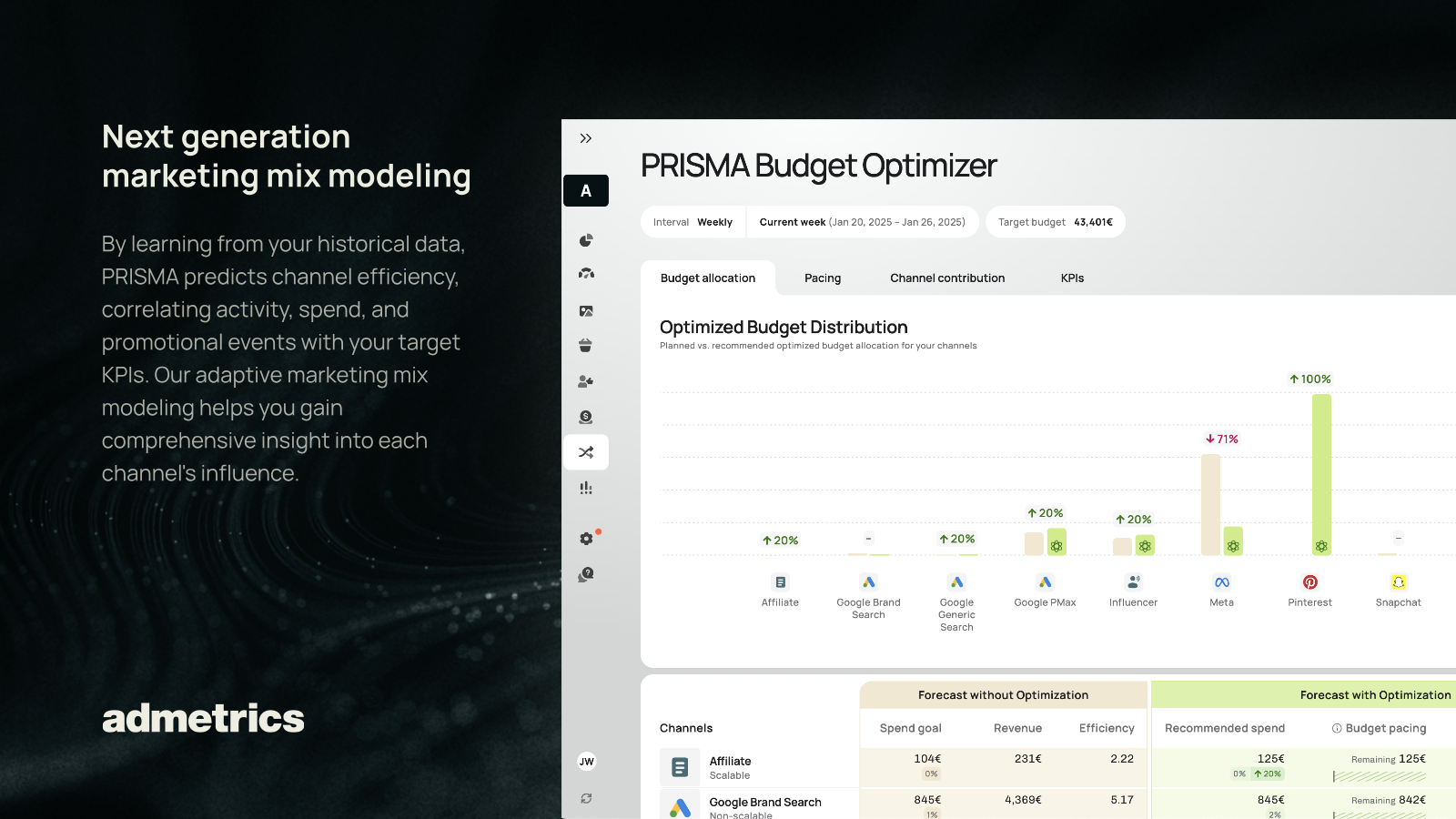
Stop funding audiences; fund jobs-to-be-done portfolios (“first purchase,” “switcher,” “seasonal”). PRISM4 MMM pressure-tests platform data for incrementality and rebalances toward creative clusters that actually move CAC and revenue, not just CTR.
Guardrails and drift detection.
Ava (Admetrics' AI assistant) enforces thresholds: hook-rate floors, CPC p95 caps, CPA deltas vs. baseline, EMQ minimums. It flags drift (e.g., hook rate slides, EMQ drops after a theme change) before spend compounds.
KPI ladder
- Attention fit: thumb-stop / 3-sec view rate → compare hooks and openers by format.
- Click economics: CTR, CPC (normalized by placement).
- Message match: LP view rate (click→load), ATC / VC rates.
- Business outcomes: CPA/CAC to qualified conversions, AOV/LTV, refund/return rate.
Attribution hygiene: keep windows consistent; triangulate Meta for speed, backend for truth, MMM/geo-tests for incrementality.
Failure modes to eliminate
– Browser-only tracking: retrieval learns from missing/duplicated events. Fix with S2S and dedupe.
– Cosmetic “diversity”: 15 cuts of the same idea = one idea. Distinct angles or don’t ship.
– Over-fragmentation: too many ad sets strangle learning. Consolidate.
– KPI whiplash: changing windows or campaigns weekly makes apples-to-apples impossible. Lock the framework.
Bottom line
Feed Meta high-integrity server-side outcomes and a genuinely diverse, well-tagged creative portfolio, and Andromeda will find profitable matches at scale; feed it noise and sameness, and it will just waste budget faster. Meta’s own data shows retrieval is stronger and Advantage+ creative can lift results; your job is to give the system clean signals and real variety—and to keep only what pays back.
Make Andromeda work for you — with Admetrics
Feed Meta server-side truth, ship a well-tagged creative portfolio, and scale only what’s proven. Admetrics turns Andromeda’s retrieval power into revenue with a clean signal backbone, creative intelligence, and always-on guardrails.
Plug in S2S Pixel (deduped, consent-aware conversions via CAPI), read impact in Data Studio (Angle × Format × Persona × Context), promote with evidence via Quantify (creative-cluster lift), validate and rebalance with PRISM4 MMM, and keep spend honest with Ava (hook-rate floors, CPC p95 caps, CPA deltas, EMQ thresholds).
Conclusion
When the shortlist gets smarter, your advantage shifts from micromanaging audiences to supplying more—and more distinct—ideas the system can match to people and moments.
Your playbook, in one breath:
- Simplify structure. Broad setups, Advantage+ defaults, fewer ad sets.
- Diversify creative. Angles × formats × personas; ideas over tiny edits.
- Iterate relentlessly. Weekly micro-adds, monthly bigger drops; promote/prune by contribution.
- Measure what matters. Read the KPI ladder from attention → action → value; keep windows consistent; triangulate platform, backend, and incrementality.
Do this well and Andromeda stops being a black box and starts being a force multiplier—finding the right message × moment combos at scale while you focus on the only sustainable edge left in performance marketing: better ideas, faster.
FAQ section
Is Andromeda just “more automation”?
It’s a retrieval upgrade—bigger, faster shortlists before ranking. Automation is the outcome (smarter matching). You still control the inputs: signals, creative variety, and guardrails.
Retrieval vs. ranking—what’s the difference in practice?
Retrieval decides which ads get considered; ranking decides which of those actually serve. Better retrieval feeds ranking better options and raises the performance ceiling.
Do interests and detailed targeting still matter?
Sometimes, but far less. Default to broad and let creative do the “targeting.” Keep only hard exclusions or compliance constraints; use narrow targeting for proven edge cases.
How many ads should I run now?
“As many as are truly different.” A good starting range is 12–20 distinct concepts. Near-duplicates don’t count—ideas over tiny edits.
What counts as “meaningfully different” creative?
New angles (problem/solution, social proof, demo, objection-buster, offer, lifestyle/context), formats (short vertical, square video, static, carousel), or personas/contexts (first-time vs. switcher, weekday vs. weekend).
Does Advantage+ creative help or hurt?
Often helpful when seeded with diverse base concepts. Use it to expand useful variants, then monitor quality with clear promotion/prune rules.
What KPI ladder should we use?
Read signals in order: attention fit (3-sec view / thumb-stop) → click economics (CTR, CPC) → message match (LP view rate, ATC/VC, cost/ATC) → business outcomes (CAC/CPA to qualified conversions, AOV/LTV, refunds/returns).
Which attribution window is right?
Pick one (e.g., 7-day click) and keep it consistent for creative comparisons. Triangulate platform for speed, backend for truth, and MMM/geo tests for incrementality.
How long before judging a new batch?
Set minimum evidence (e.g., N conversions or spend near target CPA) before promote/prune decisions. Iterate in small batches (3–5 new concepts) to avoid constant resets.
CPC looks fine but purchases are weak—what now?
Follow the diagnostic ladder: strong hook + CTR but low LP views → fix speed/tracking/match; LP views good but ATC/VC low → strengthen offer/objections/social proof; ATC decent but CPA high → streamline checkout/remarketing and ensure post-click message match.