Your Meta ads are humming along nicely. You're seeing solid returns and feeling confident about growth. Then you double your ad spend, expecting double the results. Instead, your world crumbles. Cost per acquisition skyrockets. ROAS plummets. You're left wondering what went wrong.
Welcome to the dreaded Meta ads scaling plateau. It's the point where throwing more money at campaigns actually hurts performance. Moreover, it's one of the most common challenges in paid advertising.
This comprehensive guide reveals a proven framework for Meta ads scaling. You'll learn to identify bottlenecks systematically. Furthermore, you'll develop breakthrough strategies that transform plateaus into profit machines.
Why Meta Ads Scaling Hits a Wall
Most advertisers make a critical mistake when scaling. They assume more budget equals more growth. Unfortunately, this misconception keeps them trapped in plateau purgatory.
The Science Behind Scaling Plateaus
Meta ads scaling faces negative economies of scale. As you increase spend, several things happen:
- You exhaust your most responsive audiences
- Competition increases for premium ad placements
- Creative fatigue sets in faster
- Audience overlap becomes problematic
Additionally, your initial success often comes from low-hanging fruit. These high-intent, easy-to-convert prospects get saturated quickly. Consequently, scaling requires reaching less qualified audiences at higher costs.
The Micro-Optimization Trap
Many advertisers obsess over tiny improvements. They'll spend weeks testing button colors or headline variations. However, these "one-trick pony" optimizations won't break fundamental scaling barriers.
Micro-optimizations have their place. But when you're hitting plateaus, small tweaks are like rearranging deck chairs on the Titanic.
The Meta Ads Scaling Framework: From Reactive to Strategic
Successful Meta ads scaling requires systematic thinking. Instead of random testing, you need a repeatable framework for diagnosing and solving problems.
Think like a doctor. First, diagnose the root cause. Then, prescribe the appropriate remedy. This approach beats randomly trying different solutions.
The Core Principle: Profitable Volume Over Perfect ROAS
Here's the paradigm shift that separates winners from plateau prisoners. Your goal isn't maintaining perfect ROAS at all costs. Instead, focus on profitable ways to increase total spend and revenue.
For example, consider these scenarios:
- Current: €10,000/month at 4x ROAS = €30,000 profit (75% margin)
- Scaled: €50,000/month at 2.5x ROAS = €93,750 profit
The scaled version has lower efficiency but significantly higher absolute profit. That's the difference between a €30k/month business and a €90k/month business.
Diagnosing Your Meta Ads Scaling Bottleneck: 6 Key Metrics
Poor performance isn't the disease – it's just the symptom. To prescribe the right cure, you need to diagnose the underlying bottleneck using the six fundamental metrics that determine Meta ads profitability.
The Funnel Formula
Every Meta ad campaign performance comes down to this equation:
Revenue = Traffic × Conversion Rate × Average Order Value
And profitability depends on:
Profit = (Revenue × Margin) - (Traffic × Cost Per Click)
Let's break down each component:
CPM (Cost Per Mille)
Your CPM indicates market competition and audience saturation. If your CPM is consistently rising without performance improvements, you're likely facing increased competition or audience fatigue.
Benchmark: CPMs vary significantly by industry and location, but sudden 50%+ increases often signal audience exhaustion.
CTR (Click-Through Rate)
This measures creative engagement and audience relevance. Low CTR typically indicates creative fatigue or poor audience-message fit.
Benchmark: For accounts under €100k/month spend, link click CTRs below 1% generally indicate creative problems. Above 2% is strong performance.
AOV (Average Order Value)
Higher AOV provides more budget flexibility for customer acquisition. This is often the most overlooked scaling lever.
Benchmark: AOVs of €60-€100 provide good scaling runway. Below €40 makes profitable scaling extremely challenging at volume.
Conversion Rate
This reflects your landing page and offer effectiveness, but shouldn't be viewed in isolation.
Benchmark: 2-5% is generally solid, but a 1% conversion rate with high AOV often outperforms 8% conversion with low AOV.
Margin
Your gross margin determines how much you can afford to spend on acquisition while remaining profitable.
LTV (Lifetime Value)
Understanding customer lifetime value allows you to acquire customers at higher initial costs for long-term profitability.
The Bottleneck Principle: Identification Process
Here's the crucial insight: you can't improve everything simultaneously. Your first step is identifying the single biggest constraint limiting your growth. Is it creative fatigue (low CTR)? Poor conversion (low CR)? Insufficient margin (low AOV)?
Focus your efforts on the biggest bottleneck first. This approach delivers the most dramatic improvements fastest.
Formulating Your Hypothesis—The Power of New Angles as Breakthrough Strategies for Meta Ads Scaling
Once you've identified your primary bottleneck, develop your breakthrough hypothesis. This isn't about creating more of the same content. Instead, find fundamentally new approaches to reach untapped audiences.
Vertical vs. Horizontal Meta Ads Scaling
Understanding these two scaling approaches is crucial for breakthrough growth.
Vertical Scaling (Iteration)
This involves improving what already works. If you have successful ad creative, vertical scaling might include:
- Testing different hooks on the same concept
- Using different talent while keeping the same message
- Adapting successful creatives for different placements
Horizontal Scaling (New Angles)
This is the key to breaking major plateaus. Horizontal scaling opens entirely new audience segments through fresh angles.
Real-World Meta Ads Scaling Success Stories
Let's examine how German brands achieved breakthrough growth through strategic angle shifts.
Product Angle Innovation: Junglück's Strategy
Junglück initially built success around single-ingredient skincare products. They targeted conscious consumers with straightforward messaging. When they hit a growth plateau, they didn't just create more squalane oil ads. Instead, they developed new product bundles like "Anti-Redness Sets" and "Moisture Boost Kits."
This strategy was brilliant. They used essentially the same ingredients but packaged and marketed them to address specific skin concerns. Consequently, they opened entirely new audience segments who weren't interested in single-ingredient products.
Target Audience Expansion: MyMuesli's Approach
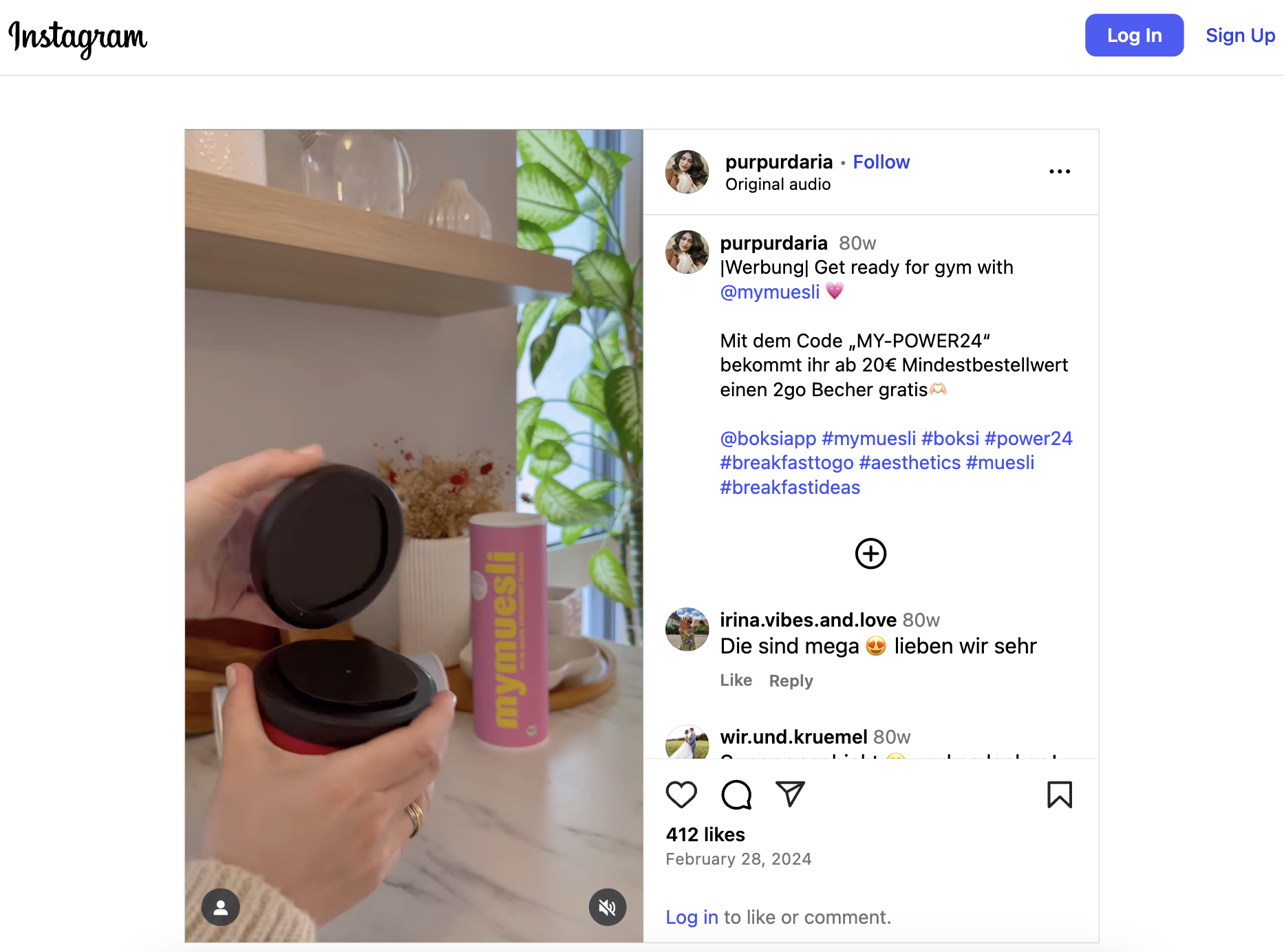
MyMuesli started with custom muesli mixes targeting health-conscious consumers who valued personalization. Their core message was "Your personalized muesli." To break through their plateau, they expanded beyond customization. They launched convenience-focused product lines like "MyMuesli2Go" and "MyPorridge." This approach allowed them to target busy professionals and commuters. These represented a completely different audience segment that prioritized convenience over customization.
Creative Examples That Defy Meta Ads Scaling Conventions
Counter-Cyclical Creative: GESKE's Premium Approach
While most brands follow UGC trends, GESKE German Beauty Tech took the opposite approach. When the market was saturated with low-quality user-generated content, they launched premium campaigns.
Their professionally produced campaigns featured A-list celebrities like Courtney Cox, Megan Fox and Nina Dobrev. This high-quality approach helped them break through noise and establish authority in a crowded beauty market.

Authority-Based Marketing: Holy Energy's Authentic Integration
Holy Energy mastered unconventional marketing by integrating authentically with gaming streamers and YouTubers. Instead of traditional ads, their product placements feel natural.
Their product placements feel like genuine parts of streams and videos. The creators they work with are authorities in their niche. Their enthusiastic, authentic endorsements create powerful social proof that traditional ads can't match.
Emotional Storytelling: Schwarzkopf's Breakthrough Campaign
Henkel Schwarzkopf LIVE moved beyond rational product features to emotional storytelling. Their campaign featuring 87-year-old Sheila dyeing her hair pink "to be seen" was brilliant.
This approach tapped into deeper desires for self-expression and visibility. Consequently, it resonated with a much broader audience than traditional "long-lasting color" messaging.
The "Slipstream Strategy"
About You has grown by leveraging diverse influencer authority, creating a "everyone is wearing this" perception. Their strategy of using multiple well-known figures across different niches – models, musicians, TV personalities – builds widespread, aspirational brand recognition while targeting competitors' mid-funnel audiences.
The Meta Ads Scaling Optimization Loop: Test, Analyze, and Iterate
Successful Meta ads scaling isn't a one-time breakthrough. It's a systematic, ongoing process that transforms sporadic wins into predictable growth.
The 4-Step Growth Flywheel
1. Hypothesize
Based on your bottleneck analysis, develop a specific hypothesis. Be clear about what you're testing and why.
2. Test
Launch focused campaigns to test your hypothesis. Don't muddy the waters by testing multiple variables simultaneously.
3. Analyze
Use Meta's reporting tools and your six key metrics to measure results. Look beyond surface-level ROAS. Dig into underlying metrics to understand what's working and why.
4. Define
Re-evaluate your bottlenecks based on new data. Often, solving one constraint reveals the next limiting factor. This becomes your focus for the next iteration.
The "Big Bets" Principle in Meta Ads Scaling
While systematic testing is crucial, breakthrough growth often requires bigger bets on promising opportunities. Mercedes-Benz's historical campaign about Bertha Benz exemplifies this approach. Instead of playing it safe with rational luxury messaging, they invested heavily in emotional storytelling.
Their campaign focused on female empowerment and inspiration. This big bet allowed them to break free from rational plateaus and connect with audiences on deeper levels. The key is balancing systematic smaller tests with strategic larger investments in your most promising hypotheses.
Maintaining Long-Term Meta Ads Scaling Momentum
The most successful scaling operations maintain this loop continuously. They're always testing new angles and analyzing performance. Additionally, they identify the next bottleneck to solve. This creates compound growth over time. Each iteration builds on previous wins while opening new opportunities. Learn more about how to scale Facebook ads effectively.
Transform Your Meta Ads Scaling Results Today
Breaking through Meta ads scaling plateaus requires systematic thinking over random optimization. The framework outlined here transforms campaigns from stagnant to scalable.
Remember the key principles: diagnose before you prescribe, focus on profitable volume over perfect ROAS, and maintain continuous testing loops. However, implementing this framework manually can be overwhelming. You need to constantly monitor six key metrics across multiple campaigns. Moreover, identifying subtle patterns and bottlenecks requires deep analytical expertise.
This is where Admetrics becomes your Meta ads scaling secret weapon. Instead of drowning in spreadsheets and guessing at bottlenecks, Admetrics delivers unique actionable insights that pinpoint exactly where your scaling efforts should focus. With AI-powered attribution and deep funnel insights, Admetrics automatically surfaces what’s holding you back — whether it’s creative fatigue tanking CTR, audience saturation inflating CPMs, or landing pages dragging down conversion rates.
Ready to break through your Meta ads scaling plateau with data-driven precision? Stop guessing at solutions and start scaling with confidence. Start your free Admetrics trial today.
Frequently Asked Questions on Scaling Meta Ads to 7 Figures
What is Meta ads scaling and why does it plateau?
Meta ads scaling is the process of systematically increasing ad spend while maintaining profitability. Plateaus occur due to audience saturation, increased competition, and creative fatigue. As you exhaust high-intent prospects, costs increase while conversion rates decrease.
How do I identify my biggest Meta ads scaling bottleneck?
Focus on six key metrics: CPM, CTR, AOV, conversion rate, margin, and LTV. Compare your performance against benchmarks. For instance, CTRs below 1% indicate creative problems, while AOVs below €40 make scaling challenging. Identify the metric performing worst relative to benchmarks.
What's the difference between vertical and horizontal Meta ads scaling?
Vertical scaling improves existing successful campaigns through iterations like new hooks or talent. Horizontal scaling opens new audience segments through fresh angles, product variations, or target markets. Horizontal scaling is typically more effective for breaking major plateaus.
How much should I expect ROAS to decrease when scaling Meta ads?
ROAS typically decreases 20-40% when scaling effectively. The goal is increasing absolute profit, not maintaining efficiency. For example, scaling from €10k spend at 4x ROAS to €50k at 2.5x ROAS increases monthly profit from €30k to €93k despite lower efficiency.
What budget should I allocate for testing new Meta ads scaling angles?
Allocate 20-30% of your total ad budget for testing new angles and audiences. This provides sufficient data for meaningful results while maintaining proven campaigns. Successful tests can then receive increased budget allocation.