Marketing ROI for Beauty Brands is the decision language that separates teams who simply spend from teams who build durable, margin backed growth. In beauty, you rarely win by trusting a single platform dashboard. Instead, the customer journey moves across creators, paid social, search, email, and repeat replenishment.
Because of that, marketers face a real tension between reported ROAS and what the P and L shows after returns, discounts, shipping, and product mix changes. Marketing ROI for Beauty Brands creates a shared truth. It helps marketing, finance, and merchandising agree on what growth is actually worth.
Marketing ROI for Beauty Brands: What It Means in Real Terms
Marketing ROI for Beauty Brands measures how much incremental profit your marketing creates compared to what you spend. In other words, if you add one more euro to Meta, TikTok, Google, influencers, or retail media, how much incremental contribution margin do you gain.
However, ROI gets tricky in beauty because purchases often happen after multiple touches. A customer might discover you on TikTok, compare on Google, click a creator link, then buy after an email. Platform attribution tends to over credit the last touch, so you can scale the wrong thing.
ROI vs ROAS vs MER: Use the Right Tool
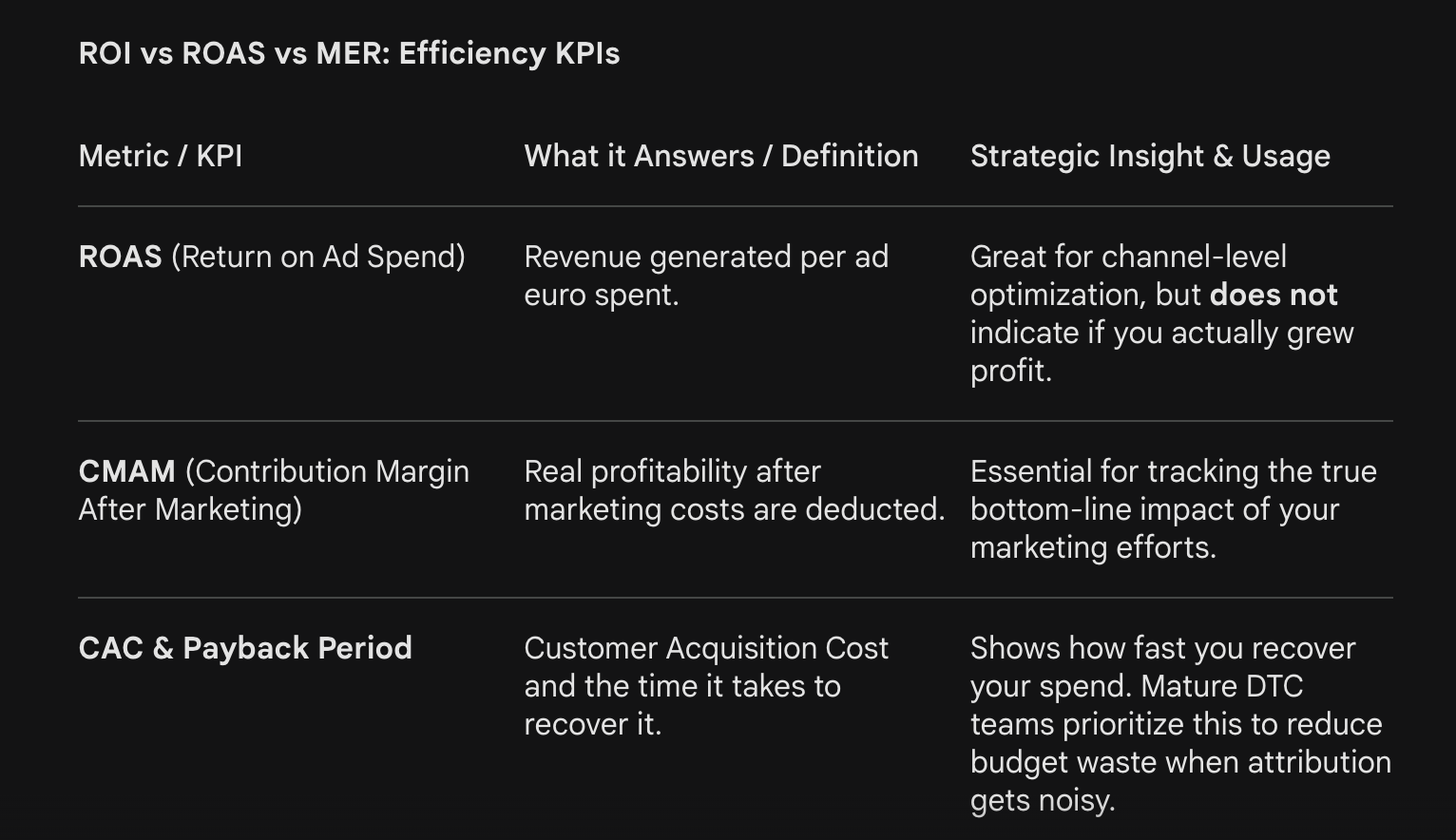
ROAS answers revenue per ad euro. It helps with channel level optimization, but it does not tell you if you grew profit.
Marketing ROI for Beauty Brands works best when you also track these efficiency KPIs:
* Contribution margin after marketing (CMAM) to see real profitability
* CAC and CAC payback period to understand how fast you recover spend
* LTV by cohort to separate new customer quality from short term revenue
* MER to capture blended efficiency across channels
As a rule, mature DTC teams review ROI and payback, not just ROAS. That shift reduces budget waste when attribution gets noisy.
Why Marketing ROI for Beauty Brands Is Harder Than It Sounds
Beauty teams deal with several ROI killers at once. First, margins swing with promotions, bundles, and sampling. Second, returns and refunds distort net revenue. Third, customer journeys fragment across devices and channels.
Even worse, privacy changes reduce deterministic tracking. So, platforms fill gaps with modeled conversions, and those models can disagree.
Common causes of “good ROAS, bad profit”
These issues show up repeatedly in €1M plus DTC brands:
* Heavy discounting that inflates conversion rate but compresses margin
* Increasing CPMs that raise CAC even when creative looks strong
* Retargeting that captures demand without adding incrementality
* Product mix shifts toward low margin SKUs
* Shipping and fulfillment costs rising faster than AOV
If you feel this gap right now, you are not alone. Most growth teams do not have an ROI problem, they have a measurement and decision loop problem.
Who Owns Marketing ROI for Beauty Brands Inside a DTC Team
Marketing ROI for Beauty Brands works only when ownership is clear. The CMO or Head of Growth should own the ROI definition and targets, because they control budget and forecasts.
At the same time, performance and creative teams must operate the system daily. Therefore, you need shared rules that connect creative tests and channel changes to business outcomes.
A simple ownership model that works
Use this split to avoid endless dashboard debates:
- Finance owns the cost and margin inputs, including returns and shipping
- Growth owns spend allocation, marginal ROAS targets, and testing cadence
- Ecommerce owns conversion rate, AOV, and onsite experience improvements
- Brand and creative own message market fit and creative volume
When these groups align, Marketing ROI for Beauty Brands becomes a planning tool, not a post mortem.
Getting Started: A Step by Step ROI Setup
You can build a strong Marketing ROI for Beauty Brands framework without waiting for a perfect data warehouse. Start with a few non negotiables.
Step 1: Pick one primary goal per quarter
Choose a single outcome, then set targets that connect to profit.
Examples:
* Profitable new customer growth with a fixed CAC payback target
* Margin protected revenue growth with a minimum CMAM threshold
This focus prevents teams from chasing conflicting goals across channels.
Step 2: Fix your tracking hygiene
Instrumentation does not need to be fancy, but it must be consistent.
Prioritize:
* Clean UTMs across every paid and creator link
* Consistent naming for campaigns, creatives, and offers
* Server side tracking where feasible to reduce signal loss
Then, reconcile spend and revenue daily. One source of truth reduces internal friction fast.
Step 3: Build an ROI view that includes margin reality
Marketing ROI for Beauty Brands needs net revenue and contribution, not just gross sales.
Include:
* Returns rate by product and channel
* Discount depth and promo codes
* Shipping, pick and pack, and payment fees
* COGS and packaging
Even a simple model will beat platform ROAS when you need board level confidence.
Step 4: Add incrementality to separate lift from noise
Attribution shows correlation. Incrementality testing shows causation.
Start with one high spend lever, often Meta prospecting or Google non brand. Keep the test design boring and defensible. For example, use geo holdouts or budget based lift tests with clear pre and post periods.
Then, compare:
* Incremental revenue and incremental contribution
* Incremental CAC and payback
* New customer share and LTV by cohort
This is where Marketing ROI for Beauty Brands becomes a decision engine.
When to Push Spend and Prove Marketing ROI for Beauty Brands
Marketing ROI for Beauty Brands tends to improve when demand signals and measurement quality line up. So, the best time to scale is not always the biggest calendar moment.
Scale when the business conditions stay stable
Push spend when these inputs remain consistent for at least one to two weeks:
* Inventory availability stays healthy
* Pricing and promo story remain steady
* Landing pages do not change daily
* Support and fulfillment can handle volume
Stability reduces noise, so your read on CAC and marginal returns becomes more reliable.
Scale after CVR stabilizes, not on launch day
Launches create volatility. However, scaling after you see consistent conversion rate and AOV often delivers better contribution margin. You also give algorithms time to learn, which helps performance.
Use marginal ROAS to avoid scaling into saturation
Blended ROAS can look fine while marginal returns collapse. Therefore, set a marginal ROAS or marginal CAC threshold.
If the next euro buys weaker audiences and higher CPMs, reduce spend or refresh creative. This simple guardrail protects profit.
Turning Marketing ROI for Beauty Brands Into a Repeatable Growth System
Marketing ROI for Beauty Brands becomes powerful when it runs weekly, not quarterly. The goal is a tight feedback loop between measurement and action.
A weekly operating rhythm for performance obsessed teams
This cadence works well for scaling brands:
- Review blended metrics: MER, CAC, contribution margin, and payback
- Diagnose channel shifts: spend mix, CPM, CTR, CVR, and AOV changes
- Decide reallocations based on marginal returns, not last click swings
- Ship creative and offer tests tied to a forecasted ROI impact
- Document learnings so you build a compounding playbook
Because beauty relies heavily on creative, you should treat creative throughput as a growth constraint. More high quality angles and formats often raise ROI faster than micro bidding changes.
Where AI and predictive analytics fit today
AI already helps DTC teams move faster, especially in:
* Creative concept generation and variant production
* Predictive LTV and cohort quality scoring
* Anomaly detection for CAC spikes and tracking breaks
However, AI only helps when your inputs are clean. So, invest in data quality and incrementality first, then layer predictive models on top.
Conclusion
Marketing ROI for Beauty Brands is not a vanity metric. It is how you translate creative, media, and merchandising decisions into profit, payback, and LTV growth. When you define it clearly and measure it consistently, you stop scaling based on platform bias.
If you want more defensible growth, focus on margin aware measurement, incrementality, and marginal returns. Then, run a weekly system that forces decisions, not just reporting. That is how Marketing ROI for Beauty Brands becomes scalable and resilient.
How Admetrics Can Help
Admetrics helps DTC teams improve Marketing ROI for Beauty Brands by unifying Meta, Google, TikTok, and ecommerce outcomes into a single decision ready view. You can reduce platform bias, reconcile performance with profit, and see what actually drives incremental growth.
Because Admetrics combines multi touch attribution with incrementality testing, you can:
* Track blended ROAS, MER, CAC, and payback in one place
* Separate new customer growth from returning customer capture
* Spot diminishing returns early with marginal performance views
* Make budget shifts with more confidence and less debate
Book a demo here: https://www.admetrics.io/en/book-demo
FAQ
What does Marketing ROI for Beauty Brands actually measure?
Marketing ROI for Beauty Brands measures incremental profit impact from marketing, not just attributed revenue. It accounts for costs and margin drivers like discounts, returns, shipping, and product mix.
How is Marketing ROI for Beauty Brands different from ROAS?
ROAS measures revenue per ad euro inside a channel. Marketing ROI for Beauty Brands goes further by factoring in contribution margin, CAC payback, and incrementality across channels.
What is the fastest way to improve Marketing ROI for Beauty Brands?
Fix measurement first, then optimize spend based on incrementality and marginal returns. After that, improve conversion rate and AOV through stronger offers, better landing pages, and higher performing creative.
Which attribution approach best supports Marketing ROI for Beauty Brands?
Use multi touch attribution for directional decisions, then validate with incrementality tests. Relying only on last click usually under values upper funnel and over credits retargeting.
How often should we report Marketing ROI for Beauty Brands?
Review weekly for pacing and reallocations. Decide monthly on budgets and channel strategy. Reassess quarterly for cohort LTV, payback, and the true impact of retention.
What metrics should leaders track alongside Marketing ROI for Beauty Brands?
Track contribution margin after marketing, CAC, CAC payback period, MER, new customer share, and LTV by cohort. These KPIs connect marketing actions to board level outcomes.
How do incrementality tests improve Marketing ROI for Beauty Brands?
They isolate true lift versus baseline demand. As a result, you avoid over investing in channels that capture existing demand without creating incremental contribution.
Why does Marketing ROI for Beauty Brands drop when we scale spend?
Scaling often increases CPMs, expands into weaker audiences, and accelerates creative fatigue. Marginal returns fall, so you need creative refreshes, better offers, and tighter guardrails.
How do returns affect Marketing ROI for Beauty Brands?
Returns reduce net revenue and contribution margin. Model returns by product and channel so you do not overestimate ROI in categories or campaigns with higher refund rates.
What is MER and why does it matter for beauty brands?
MER is total revenue divided by total ad spend. It helps you understand blended efficiency across channels, especially when attribution is noisy or when upper funnel spend supports lower funnel conversions.
How should we allocate budget across Meta, TikTok, and Google?
Start with marginal returns and incrementality, not platform reported ROAS. Then, diversify by funnel stage and validate with tests so you scale what actually drives incremental profit.