Are you tired of watching your Instagram ad budget disappear faster than your morning coffee? You're not alone. Many businesses struggle with rising advertising costs on Instagram, but the good news is that learning how to minimize Instagram ad costs doesn't require a marketing degree or massive budget cuts.
Instagram advertising costs have increased by 35% over the past two years, making cost optimization crucial for business success. However, smart advertisers are finding ways to reduce their spending while actually improving their results. This comprehensive guide will show you exactly how to slash your Instagram ad costs without sacrificing performance. Read more about Instagram SEO for e-commerce and ho to leverage the social media platform.
Understanding Instagram Ad Pricing
Before diving into cost-cutting strategies, you need to understand how Instagram prices its ads. The platform uses an auction system where advertisers compete for ad placements based on three main factors: bid amount, ad quality, and estimated action rates.
Instagram's algorithm favors ads that generate genuine engagement over those that simply throw money at the platform. This means you can actually spend less while achieving better results by focusing on quality over quantity.
The average cost per click (CPC) on Instagram ranges from $0.20 to $2.00, depending on your industry and targeting. However, these costs can vary dramatically based on your optimization strategies.
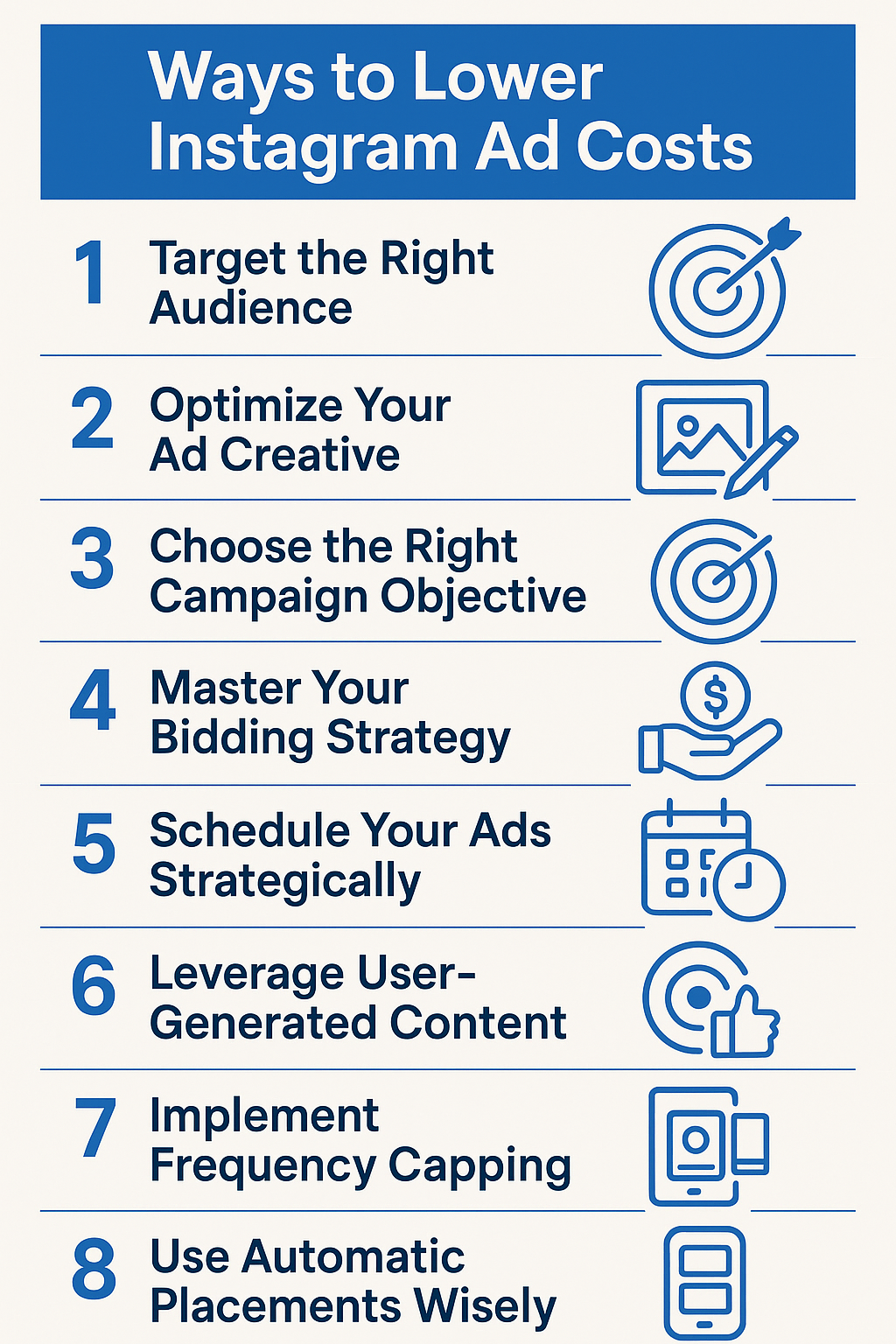
How to Minimize Instagram Ad Costs: 8 Proven Strategies
1. Target the Right Audience
Precise audience targeting is your first line of defense against wasted ad spend. Instead of casting a wide net, focus on specific demographics, interests, and behaviors that align with your ideal customer.
Create custom audiences using your existing customer data, website visitors, or email subscribers. These warm audiences typically convert at higher rates and lower costs than cold audiences.
Lookalike audiences can help you find new customers who share characteristics with your best existing customers. Start with a 1-2% lookalike audience for better precision and lower costs.
2. Optimize Your Ad Creative
High-quality, engaging creative content directly impacts your ad costs. Instagram rewards ads that keep users on the platform longer with lower prices and better placement.
Use bright, eye-catching visuals that stop users mid-scroll. Video content typically performs better than static images, but both can be effective when done right.
Test different creative formats including carousel ads, story ads, and reels. Each format has different cost structures and audience engagement patterns.
3. Choose the Right Campaign Objective
Your campaign objective significantly impacts your ad costs. Awareness campaigns typically cost less than conversion campaigns, but they may not drive immediate sales.
For e-commerce businesses, consider starting with traffic or engagement objectives before moving to purchase objectives. This approach can help you build audience data at lower costs.
Traffic campaigns often provide better cost-per-click rates than conversion campaigns, especially for new advertisers without much pixel data.
4. Master Your Bidding Strategy
Instagram offers several bidding strategies, each with different cost implications. Automatic bidding works well for beginners, but manual bidding can offer more control as you gain experience.
Start with cost cap bidding to maintain control over your maximum costs per result. This strategy helps prevent runaway spending while still allowing for optimization.
Consider using bid cap bidding for campaigns where you have strict cost requirements. However, this strategy may limit your reach if your bid is too low.
5. Schedule Your Ads Strategically
Ad costs fluctuate throughout the day and week based on competition and user activity. Running ads during off-peak hours can significantly reduce your costs.
Use Instagram's ad scheduling feature to run ads when your audience is most active but competition is lower. This sweet spot varies by industry and target audience.
Test different time slots to find when your audience engages most cost-effectively. Weekend mornings and weekday evenings often provide good value.
6. Leverage User-Generated Content
User-generated content (UGC) often outperforms brand-created content while costing less to produce. Encourage customers to share photos and videos featuring your products.
Create hashtag campaigns that motivate customers to create content for you. This strategy builds a library of authentic creative assets while reducing production costs.
Repost customer content (with permission) in your ads. UGC typically has higher engagement rates and lower costs than traditional advertising creative.
7. Implement Frequency Capping
High ad frequency leads to ad fatigue and increased costs. When users see your ads too often, they're more likely to ignore or hide them, driving up your costs.
Set frequency caps to limit how often individual users see your ads. A frequency of 1-3 times per week is typically optimal for most campaigns.
Monitor your frequency metrics regularly and refresh your creative when frequency exceeds 3-4 impressions per user.
8. Use Automatic Placements Wisely
Instagram offers ads across multiple placements including feed, stories, reels, and explore. Using automatic placements can help reduce costs by finding the most efficient placement for your budget.
However, monitor performance by placement and exclude underperforming placements. Stories ads often cost less than feed ads but may have different conversion rates.
Test individual placements to understand which ones work best for your specific goals and audience.
Advanced Cost Optimization Techniques
A/B Testing for Lower Costs
Continuous testing is essential for maintaining low ad costs. Test different audiences, creative formats, ad copy, and bidding strategies to find your optimal combination.
Start with single-variable tests to isolate what impacts your costs most. Test audience sizes, creative styles, and call-to-action buttons systematically.
Use Instagram's built-in A/B testing features or create manual split tests. Aim to test at least one element every week to continually improve your performance.
Retargeting for Better ROI
Retargeting campaigns typically have lower costs and higher conversion rates than prospecting campaigns. Create retargeting audiences based on website visitors, video viewers, and past purchasers.
Set up a retargeting funnel that nurtures potential customers through multiple touchpoints. This approach spreads your costs while increasing conversion likelihood. Exclude recent purchasers from your retargeting campaigns to avoid wasting money on customers who don't need to see your ads.
Seasonal Optimization
Instagram ad costs fluctuate seasonally, with higher costs during peak shopping periods like Black Friday and holiday seasons. Plan your campaigns accordingly to take advantage of lower-cost periods.
Increase your budget during low-competition periods and scale back during expensive times. This strategy helps maintain consistent cost-per-result throughout the year.
Consider running awareness campaigns during expensive periods and conversion campaigns during cheaper times.
Monitoring and Measuring Success
Key Metrics to Track
Monitor your cost per result, click-through rate, and return on ad spend (ROAS) regularly. These metrics help you identify when costs are creeping up and need attention.
Track your frequency and relevance score to ensure your ads remain engaging. High relevance scores typically correlate with lower costs.
Set up automated alerts for when your costs exceed predetermined thresholds. This proactive approach helps you catch issues before they become expensive problems.
Common Mistakes That Increase Costs
Targeting Too Broadly
One of the biggest mistakes advertisers make is targeting audiences that are too broad. While larger audiences might seem appealing, they often result in higher costs and lower conversion rates.
Focus on specific interests, behaviors, and demographics rather than trying to reach everyone. Narrow targeting typically leads to better engagement and lower costs.
Start with smaller, highly targeted audiences and expand gradually based on performance data.
Ignoring Ad Fatigue
Ad fatigue occurs when your audience becomes tired of seeing the same ads repeatedly. This leads to declining performance and increasing costs over time.
Refresh your creative regularly, ideally every 3-7 days depending on your budget and audience size. Keep a library of creative assets ready for quick swaps.
Monitor your frequency metrics and performance indicators to identify when fatigue is setting in.
Poor Campaign Structure
Mixing different objectives, audiences, and creative types in the same campaign can lead to optimization confusion and higher costs.
Create separate campaigns for different objectives and audiences. This structure allows Instagram's algorithm to optimize more effectively.
Use clear naming conventions for your campaigns to track performance across different strategies and time periods.
Admetrics for Cost Optimization
For direct-to-consumer brands, Instagram remains one of the most powerful platforms for building awareness, driving engagement, and generating sales. But as competition heats up and ad costs continue to rise, smart DTC marketers are searching for ways to squeeze more profit from every campaign. This is where Admetrics comes in—a platform purpose-built to bring clarity, control, and efficiency to paid advertising.
Admetrics offers DTC brands an all-in-one analytics and optimization solution, making it possible to understand the real impact of every Instagram ad dollar. Instead of juggling multiple reporting tools or relying on limited native metrics, marketers can bring all their campaign data into a single, intuitive dashboard. This centralization alone is a major step toward identifying waste and reallocating budget to high-performing campaigns.
But what truly sets Admetrics apart is its focus on actionable, profit-driven insights. For Instagram marketers, this means you’re not just optimizing for clicks or impressions—you’re optimizing for what actually matters: profit. Admetrics uses advanced attribution models and profit-centric KPIs like POAS (Profit on Ad Spend) to show exactly which ads are driving real value. You can see which campaigns, creatives, and audiences are truly worth the investment and which are simply draining your budget.
Another area where Admetrics shines is its automation and experimentation capabilities. Instagram ads can burn through budget quickly, especially if underperforming campaigns aren’t paused in time. Admetrics allows you to set automated rules that instantly pause or adjust campaigns that fall below your desired profitability thresholds. No more wasted spend on ads that aren’t converting. On top of that, Admetrics’ Quantify engine lets you test creative variations and targeting strategies faster than traditional A/B testing, thanks to its Bayesian experimentation engine. This means you can iterate quickly, find winning combinations sooner, and cut losses before they snowball.
Perhaps the most powerful advantage comes from Admetrics’ server-to-server integrations. As privacy changes have made Instagram’s native tracking less reliable, Admetrics steps in by feeding enriched, high-quality conversion data directly back to Meta. This gives Instagram’s algorithms the data they need to optimize delivery and bidding more effectively, which can significantly lower your cost per acquisition and boost your overall return on ad spend.
For DTC marketers, every ad dollar must be accounted for. Admetrics offers the transparency and automation needed to ensure you’re never spending blindly. With unified analytics, profit-focused attribution, automated optimization, and smarter data activation, you can confidently cut Instagram ad costs without sacrificing growth. The platform empowers you to pause what’s not working, double down on what is, and continuously improve your campaigns in a rapidly changing ad landscape.
Ready to make every Instagram ad dollar count? Test Admetrics today and unlock the insights and automation you need to optimize spend, reduce wasted budget, and scale your DTC brand profitably.
FAQ Section
How to minimize Instagram ad costs without losing reach?
Focus on improving your ad quality score through better targeting and engaging creative content. Use automatic placements to find the most cost-effective spots for your ads. Additionally, implement A/B testing to optimize your campaigns continuously while maintaining reach.
What's the best time to run Instagram ads for lower costs?
Generally, weekday mornings (6-9 AM) and late evenings (8-11 PM) offer lower competition and costs. However, optimal timing varies by industry and target audience. Test different scheduling options to find when your specific audience engages most cost-effectively.
Should I use automatic or manual bidding to reduce costs?
Start with automatic bidding if you're new to Instagram advertising, as it requires less management. Once you have sufficient data, switch to cost cap bidding for better control over your maximum costs per result. Manual bidding works best when you have clear cost targets and enough experience to optimize effectively.
How often should I refresh my Instagram ad creative?
Refresh your creative every 3-7 days to prevent ad fatigue and maintain low costs. Monitor your frequency metrics and replace ads when frequency exceeds 3-4 impressions per user. Keep a library of creative assets ready for quick swaps to maintain campaign performance.
What audience size works best for minimizing Instagram ad costs?
Aim for audiences between 100,000 to 1 million people for optimal cost efficiency. Audiences smaller than 100,000 may have limited reach, while those larger than 2 million often lack precision. Test different audience sizes to find the sweet spot for your specific business and objectives.