If you're leading growth or performance marketing in a DTC or ecommerce brand, chances are you've asked, "How much are YouTube ads?"—not just for budgeting, but to understand how the platform aligns with KPIs like ROAS, CAC, and LTV. In a climate of rising media costs and fragmenting attribution models, understanding YouTube ad pricing isn't optional. It's essential to scaling profitably.
YouTube continues to gain traction as a high-impact platform for full-funnel advertising. It provides reach, refined targeting, and a variety of buying options tailored to your goals. But how do you translate costs into results? This guide clears the noise and equips you with actionable insight into YouTube ad pricing in 2026—from auction mechanics to strategic deployment.
Why Decision-Makers Should Care About YouTube Ad Pricing
Top-performing marketing leaders see YouTube not as a cost center, but as a performance lever. Here's why they care about cost:
- Platform diversification: As Meta CPMs soar, alternatives like YouTube become critical.
- Creative utility: Video offers branding and performance outcomes when smartly deployed.
- Incrementality: YouTube ads often fill upper- and mid-funnel touchpoints ignored by gated or siloed platforms.
Tactical teams benefit too. Understanding how much YouTube ads cost enables:
- A/B testing with intent: Knowing cost variance between formats makes tests more controlled.
- Informed forecasting: Real CPV insights allow for more accurate spend simulations.
- Cross-channel alignment: Compare results with TikTok and Meta to sharpen budget allocation.
Whether you're managing media mix or optimizations, this question is foundational—not a footnote.

The Building Blocks of YouTube Ad Costs
Key Pricing Models
YouTube ads operate within Google’s auction ecosystem. Costs depend on the objective you choose:
- CPV (Cost-Per-View): Common for skippable in-stream ads, ideal for awareness campaigns.
- CPM (Cost-Per-Thousand Impressions): Often used for bumper ads and reach-focused buys.
- CPA (Cost-Per-Acquisition): Useful for direct response where action matters most.
- Target ROAS: Allows performance optimization via smart bidding—but requires ample conversion data.
Typical Cost Ranges
- $0.10 to $0.30 per view for standard targeting.
- $3 to $20+ CPM, depending on competition and seasonality.
- Costs may spike beyond $1 per view when targeting narrow, high-value audiences.
Avoid These Common Pitfalls
- Broad targeting for cheap views: Lower CPVs don’t always equal strong ROAS.
- Under-tested creatives: Weak videos drive low engagement, increasing cost-per-result.
- Ignoring attribution delays: YouTube’s impact may lag, requiring smarter attribution methods.
Early-stage testing across formats and bid types can reveal your account’s cost-performance sweet spot.
When to Investigate YouTube Ads Prices
Timing your ad cost analysis is as critical as knowing the numbers themselves. Seasonal demand and competitive activity influence CPMs and CPVs. Here’s why:
- Q4 pricing spikes: Holiday-season CPCs and CPMs often double, distorting learnings.
- Low-competition seasons: Consider testing in Q1 or June/July—costs trend lower.
- Align with launch windows: Ads perform better when synced with product interest peaks.
Proactive inquiry avoids reactive spend. Integrate cost planning with creative timelines, product launches, and sales events. When you ask early, you gain agility—the ability to calibrate quickly based on benchmark shifts. Pricing is influenced by bidding strategy, ad format, audience targeting, video quality, and seasonality. Here's more info on the cost o Instagram ads.
Why 'How Much Are YouTube Ads' Unlocks Strategic Opportunity
Reframing the question helps unlock a more holistic ROI mindset. Brands that win on YouTube aren’t chasing cheap CPVs—they’re building competence in how and where to drive performance.
- Creative sequencing: Delivering ads in a structured funnel can increase lift and reduce wasted impressions.
- Audience layering: Mix behavioral, demographic, and engagement signals for higher relevance.
- Performance optimization: Use true incrementality measurement, not last-touch attribution.
At the organizational level, this approach elevates media teams from tactical ad buyers to profit centers. By decoding YouTube’s role in the marketing stack, you shift from cost anxiety to strategic clarity.
How Admetrics Answers the Real Cost Behind 'How Much Are YouTube Ads'
Admetrics removes the guesswork from questions like "how much are YouTube ads" by providing:
- Incrementality testing: Understand the true lift driven by your YouTube spend.
- Advanced attribution: Capture multi-touch journeys, avoid bias from oversimplified models.
- Cross-channel benchmarking: Compare YouTube performance alongside Meta, TikTok, and more.
With Admetrics, you don’t just track spend—you evaluate impact. Our unified dashboard helps you budget smarter, test sharper, and scale faster.
Take control of your YouTube ad ROI. Start your free trial or book a demo.
Conclusion
If you're still asking "how much are YouTube ads," you're not wrong—but it’s time to dig deeper. The question reflects a larger need: confidence in your media mix, clarity in your attribution, and precision in your planning. YouTube can be a high-leverage channel when approached strategically.
For DTC marketers ready to mature their paid strategy, YouTube offers versatility, performance, and scale. But unlocking its full power means looking beyond CPMs. It means understanding how cost drives value—and using tools like Admetrics to bridge the gap between spend and ROI.
FAQ: How Much Are YouTube Ads?
1. How much do YouTube ads actually cost on average?
While costs fluctuate based on real-time auction dynamics, e-commerce and DTC brands can expect the following baseline ranges for YouTube ad pricing:
- CPV (Cost-Per-View): $0.10 to $0.30 for standard targeting.
- CPM (Cost-Per-Thousand Impressions): $3.00 to $20.00+, heavily dependent on seasonality and competition.
- Keep in mind that these are averages. Costs can easily spike beyond $1.00 per view if you are targeting highly narrow, competitive, or high-value audiences.
2. What are the primary bidding models available on YouTube?
YouTube operates within Google’s auction ecosystem, allowing you to align your costs directly with your specific campaign objectives. The core pricing models include:
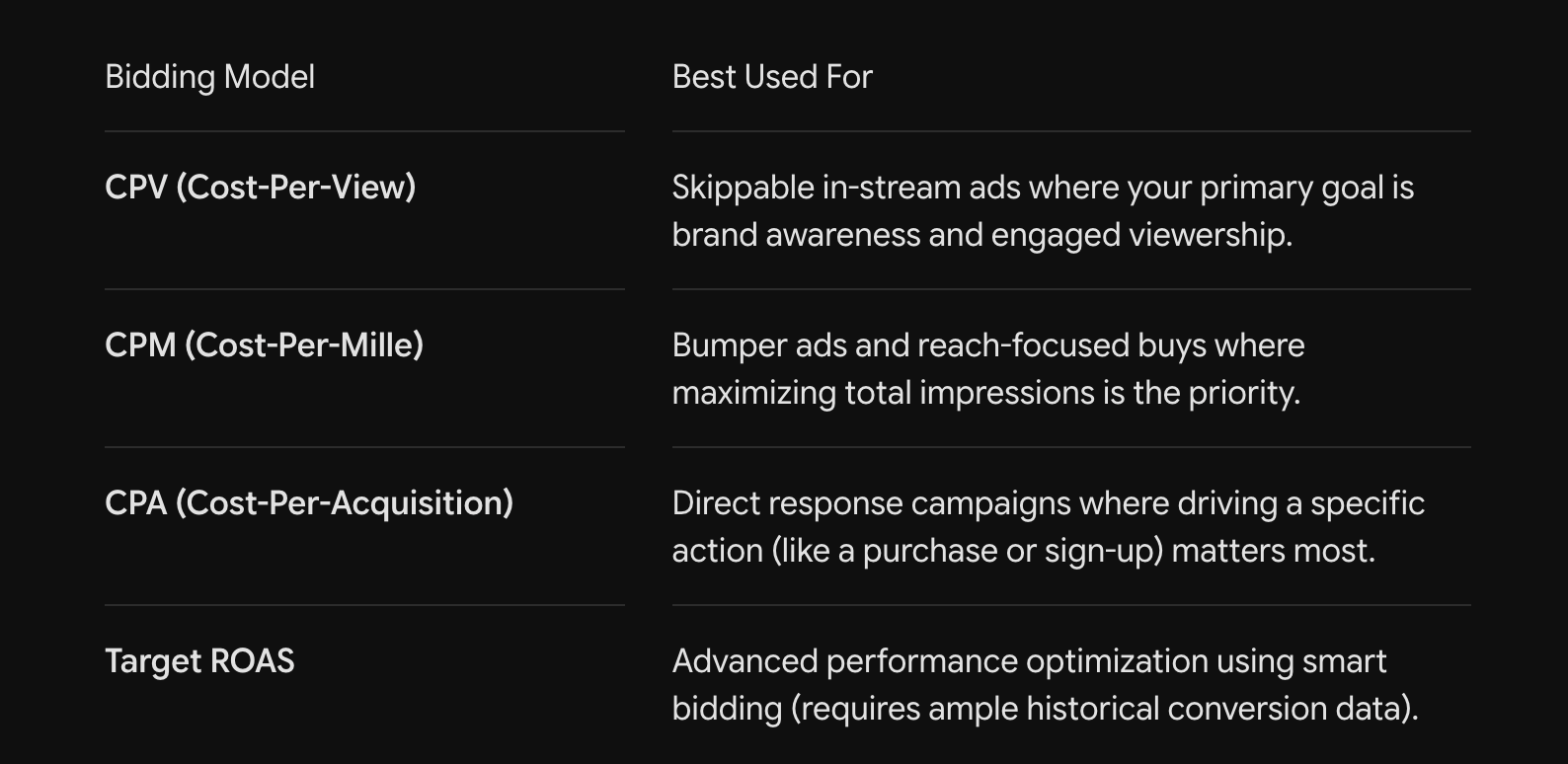
3. Why is asking "How much are YouTube ads?" the wrong question for marketing leaders?
Typing "how much do ads cost" is a search for a sticker price, but sophisticated CMOs and Growth Leads know that cost is irrelevant without context. The real question is: Does this spend drive incremental revenue? Leaders must evaluate YouTube ad costs through the lens of predictability and strategic fit—looking at how CPV and CPM translate into Return on Ad Spend (ROAS), Customer Acquisition Cost (CAC), and overall Customer Lifetime Value (LTV).
4. What are the most common pitfalls that inflate YouTube ad costs?
Many brands bleed budget on YouTube by making easily avoidable strategic errors. To keep costs efficient, avoid these common traps:
- Broad Targeting: Chasing cheap CPVs by targeting massive audiences often yields terrible ROAS because the intent is too low.
- Under-Tested Creatives: Weak video hooks lead to low engagement and high skip rates, which penalizes your ad in the auction and drives up your cost-per-result.
- Ignoring Attribution Delays: YouTube is rarely a "click-and-buy-instantly" platform. Relying on last-click attribution will make the platform look artificially expensive because it ignores delayed, mid-funnel impact.
5. How does YouTube ad pricing compare to Meta and TikTok?
As advertising costs soar across the board, platform diversification is critical. Generally, YouTube's CPCs and CPMs are often higher than TikTok and comparable to Meta. However, YouTube frequently delivers far superior mid-funnel and upper-funnel performance. Because YouTube is an intent-driven, long-form video platform, the attention you purchase is often stickier than a rapid scroll on a social feed.
6. How heavily does seasonality impact YouTube CPVs and CPMs?
Timing your campaigns is just as important as your audience targeting. Seasonal demand drastically shifts auction competition:
- Q4 Holiday Spikes: CPCs and CPMs often double between October and December, which can severely distort your baseline learnings.
- Low-Competition Windows: Q1 (January–March) and the middle of summer (June/July) typically see lower competition and cheaper rates, making them the ideal times to run cost-efficient creative tests.
7. What factors natively drive up the cost of an individual YouTube ad?
Your final price in the Google auction is influenced by a combination of several dynamic variables:
- Ad Format: Skippable in-stream, bumper, and discovery ads all carry different baseline cost structures.
- Audience Precision: Targeting highly specific, high-intent niches naturally commands higher bids than targeting general demographics.
- Industry Competition: Your specific sector's demand dictates the floor price of the auction.
- Video Quality: The algorithm rewards highly engaging content. Poor engagement signals lead to higher costs.
8. How can tactical teams use YouTube pricing data to improve performance?
For media buyers and performance marketers, understanding the nuances of CPV and CPM allows for much sharper execution. It enables:
- Controlled A/B Testing: Knowing the baseline cost variance between formats allows for cleaner creative tests.
- Accurate Forecasting: Real CPV insights allow teams to run precise spend simulations before launching massive budgets.
- Cross-Channel Alignment: By comparing YouTube CPVs against TikTok and Meta CPMs, teams can dynamically shift budgets to the most efficient platform for that specific week.
9. How do top-performing brands unlock strategic ROI on YouTube?
Brands that win on YouTube do not chase the cheapest views; they build competence in driving full-funnel performance. They achieve this through:
- Creative Sequencing: Serving ads in a structured, logical order to move a user down the funnel, reducing wasted impressions.
- Audience Layering: Mixing behavioral data, demographics, and engagement signals to ensure hyper-relevance.
- Performance Optimization: Measuring success based on true business incrementality rather than flawed, last-touch attribution models.
10. How do platforms like Admetrics solve the "attribution gap" for YouTube ads?
Because YouTube's impact on a purchase often lags behind the initial view, native platform reporting frequently misrepresents the true cost-per-acquisition. Advanced platforms like Admetrics remove this guesswork by providing incrementality testing to uncover true lift, advanced multi-touch attribution to capture complex buyer journeys, and cross-channel benchmarking to fairly compare YouTube's ROI against the rest of your media mix.