Are you leaving revenue on the table with your current email strategy? For direct-to-consumer (DTC) brands, email is a massive revenue driver. However, many brands struggle to maintain growth as subscriber lists decay and deliverability drops. This is where looking at email marketing audit examples becomes essential.
By auditing your current setup, you can find leaks in your funnel, boost engagement, and drive profitable DTC growth. In this guide, we will explore practical email marketing audit examples, share up-to-date 2026 benchmarks, and give you a data-driven playbook to scale your revenue.
Why Your DTC Brand Needs an Email Marketing Audit in 2026
The email landscape changes fast. If you set up your automated flows two years ago and left them alone, you are likely losing money. In 2026, privacy updates, stricter spam filters, and artificial intelligence play huge roles in email performance.
Moreover, recent data from Klaviyo shows that automated email flows generate nearly 41% of total email revenue from just 5.3% of total sends. If your flows are broken or outdated, you miss out on this high-margin revenue. Therefore, reviewing email marketing audit examples helps you understand exactly what to look for. Regular audits protect your sender reputation, improve list hygiene, and ensure your messaging stays highly relevant.
Practical Email Marketing Audit Examples for DTC Brands
To understand how an audit works, you need to see it in action. Let's break down four specific email marketing audit examples that you can apply to your DTC business today.
Example 1: The Deliverability and Infrastructure Audit
Before you worry about subject lines, you must ensure your emails actually reach the inbox. A deliverability audit focuses on the technical side of your email program.
- What to check: Verify your SPF, DKIM, and DMARC records. Check your domain alignment and IP warmup status.
- The DTC scenario: A popular skincare brand noticed their open rates dropped from 22% to 12% over three months. By running a deliverability audit, they discovered their emails were hitting Gmail's spam folder due to a misconfigured DMARC record.
- The fix: They updated their DNS settings and removed inactive subscribers. Within 30 days, their inbox placement recovered, directly lifting their revenue.
Example 2: The Subscriber List Health Audit
Your email metrics depend entirely on the quality of your list. According to Brevo's 2026 data, the top 10% of senders achieve a 44% open rate, while the average sits at roughly 20.7%. The secret to reaching that top tier is ruthless list hygiene.
- What to check: Analyze bounce rates, spam complaints, and unsubscribe trends. Segment your audience by engagement recency.
- The DTC scenario: An apparel brand had 100,000 subscribers but a low 1.5% click-through rate. An audit revealed that 40% of their list had not opened an email in over 180 days.
- The fix: They created a sunset flow to remove unengaged users. Consequently, their platform costs decreased, and their engagement metrics skyrocketed.
Example 3: The Automation and Workflow Audit
Automated emails are the lifeblood of profitable DTC growth. Therefore, auditing your core flows is crucial for maximizing ROI.
- What to check: Test trigger accuracy, check the timing between messages, and click every link to ensure nothing is broken.
- The DTC scenario: A supplement company reviewed their abandoned cart sequence during their audit. They found that a 10% discount code in the second email had expired six months prior.
- The fix: They updated the promo code, integrated dynamic AI product recommendations, and shortened the delay between the first and second email. As a result, abandoned cart recovery increased by 35%.
Example 4: The Content and Design Audit
Your emails must look great and drive action. A design audit ensures your campaigns render perfectly across all devices and email clients.
- What to check: Review mobile responsiveness, dark mode compatibility, load times, and call-to-action (CTA) clarity.
- The DTC scenario: A home goods retailer noticed high open rates but terrible conversion rates. The audit showed their beautiful, image-heavy emails were over 2MB, causing slow load times and clipping in Gmail.
- The fix: They compressed images, switched to a text-to-image ratio of 60/40, and made their CTA buttons larger. Conversions quickly jumped back to industry standards.
2026 Data and Benchmarks to Guide Your Audit
When you look at email marketing audit examples, you need context. How do your numbers compare to the rest of the industry? Here are crucial 2026 benchmarks for ecommerce and DTC brands:
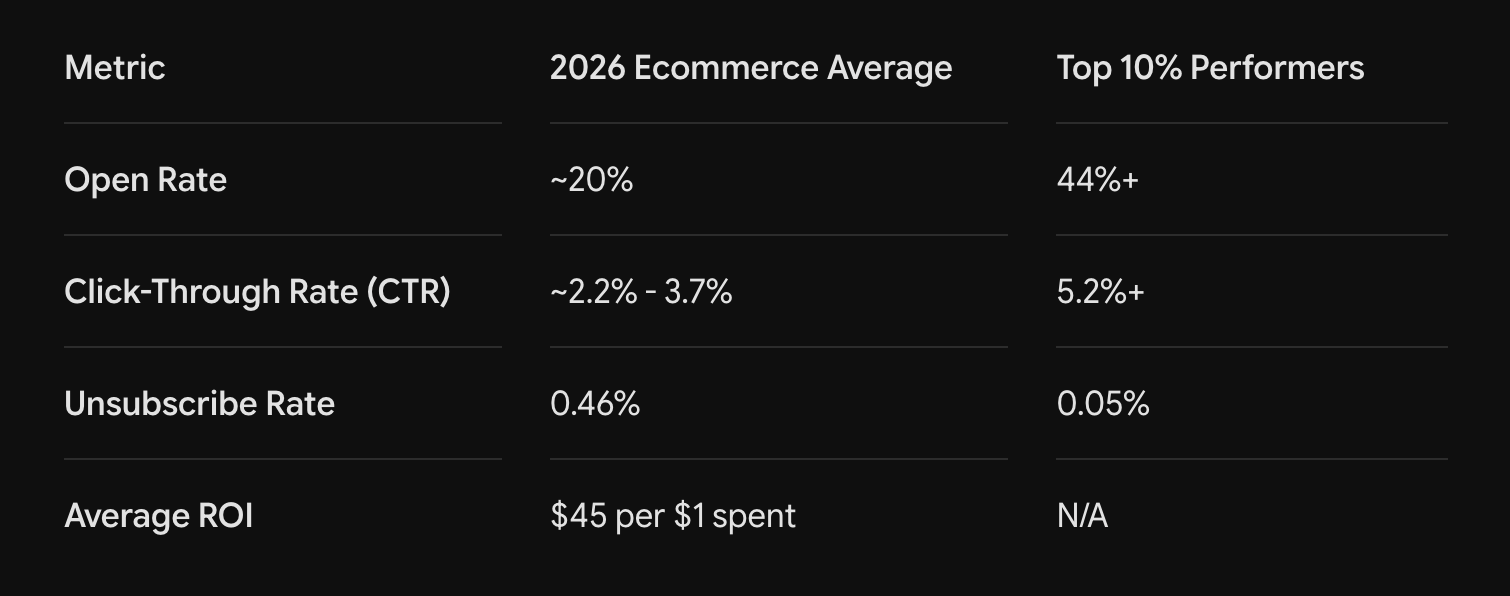
If your DTC brand falls below these benchmarks, it is definitely time to conduct a comprehensive audit.
How to Run Your Own Email Marketing Audit
Ready to take action? Use this straightforward checklist to audit your own email program.
- Define your goals: Determine what you want to improve, such as reducing bounce rates or increasing revenue per recipient.
- Analyze the data: Pull reports on your recent campaigns. Look at opens, clicks, conversions, and unsubscribe rates.
- Clean your list: Segment out inactive subscribers and verify your technical setup.
- Review your flows: Walk through your welcome series, abandoned cart, and post-purchase flows as if you were a customer.
- Test your designs: Send test emails to various devices, including Apple Mail, Gmail, and Outlook. Make sure dark mode formatting looks good.
Turn Your Audit into Profitable DTC Growth
Conducting an audit is only the first step. The real magic happens when you implement the changes. By studying these email marketing audit examples, you can identify the exact bottlenecks holding your brand back.
Remember, email marketing is not a "set it and forget it" channel. Consistent auditing keeps your list healthy, your deliverability high, and your automations printing money. Start your audit today, apply the 2026 data standards, and watch your profitable DTC growth accelerate.
Using Amdetrics.io to track your email marketing Campaigns
To drive profitable growth using Admetrics.io, you need to transition from relying on fragmented, platform-reported data to using it as a unified "mission control" for your e-commerce operations. Start by connecting your ad platforms and Shopify store to calculate your true Marketing Efficiency Ratio (MER) and Customer Acquisition Cost (CAC) across the entire customer journey, cutting through the attribution noise.
You can instantly recover lost signals from privacy updates like iOS 14 by enabling its Server-to-Server Data Pushback, which sends enriched conversion data directly back to Meta, Google, and TikTok to optimize their bidding algorithms. Finally, run your budget allocation through its AI-driven Marketing Mix Modeling (MMM) and use the Bayesian experimentation engine to test creatives and landing pages; this allows you to stop guessing which ads work and start aggressively scaling the specific campaigns that deliver verified, incremental profit. Book a demo and start your free trial here.
Frequently Asked Questions
What is an email marketing audit?
An email marketing audit is a comprehensive review of your brand's entire email setup. It involves analyzing your technical deliverability, list hygiene, automated workflows, and email design to uncover hidden bottlenecks and find new opportunities to scale profitable direct-to-consumer (DTC) growth.
How often should a DTC brand audit its email program?
You should conduct a thorough audit at least every six months. Because privacy regulations, spam filters, and consumer behaviors shift rapidly, a "set it and forget it" approach leads to list decay and lost automated revenue.
What are the most important areas to check during an audit?
Based on the playbook, a high-impact audit should cover four primary pillars:
- Deliverability and infrastructure: Verifying your SPF, DKIM, and DMARC records so your emails avoid the spam folder.
- Subscriber list health: Identifying and scrubbing unengaged users to protect your sender reputation and boost open rates.
- Automation workflows: Testing the timing, triggers, and links in your core flows (like welcome series and abandoned carts) to ensure they are driving revenue.
- Content and design: Checking mobile responsiveness, load times, and call-to-action visibility across different devices and email clients.
What are the standard email marketing benchmarks for 2026?
For standard ecommerce and DTC brands, average open rates hover around 20%, while the top 10% of senders achieve 44% or higher. Average click-through rates range from 2.2% to 3.7%, and an ideal unsubscribe rate is below 0.46%. If your metrics fall below these averages, an audit is strongly recommended.
How does an audit directly impact revenue?
Automated email flows often account for up to 41% of total email revenue despite making up a small fraction of total sends. By fixing broken links, updating expired discount codes, and ensuring your messages actually reach the primary inbox, an audit directly plugs leaks in your sales funnel and immediately lifts your return on investment.