In performance-driven e-commerce, every decision counts. You're constantly pushed to scale faster, convert quicker, and stretch every advertising euro. Yet one of the most powerful growth levers doesn’t live in your ad account. It lives in your balance sheet: the cash conversion cycle.
The cash conversion cycle (CCC) is more than a finance KPI. It’s a strategic signal for how quickly your business turns capital into cash. And for DTC brands spending heavily on Meta, TikTok, or Google Ads, CCC directly impacts how fast you can reinvest and outpace the competition.
When you align your paid media engine with your capital flow, you minimize lag, optimize deployment, and become more agile in campaign execution. That’s why mastering the cash conversion cycle isn’t accounting hygiene—it’s a performance edge.
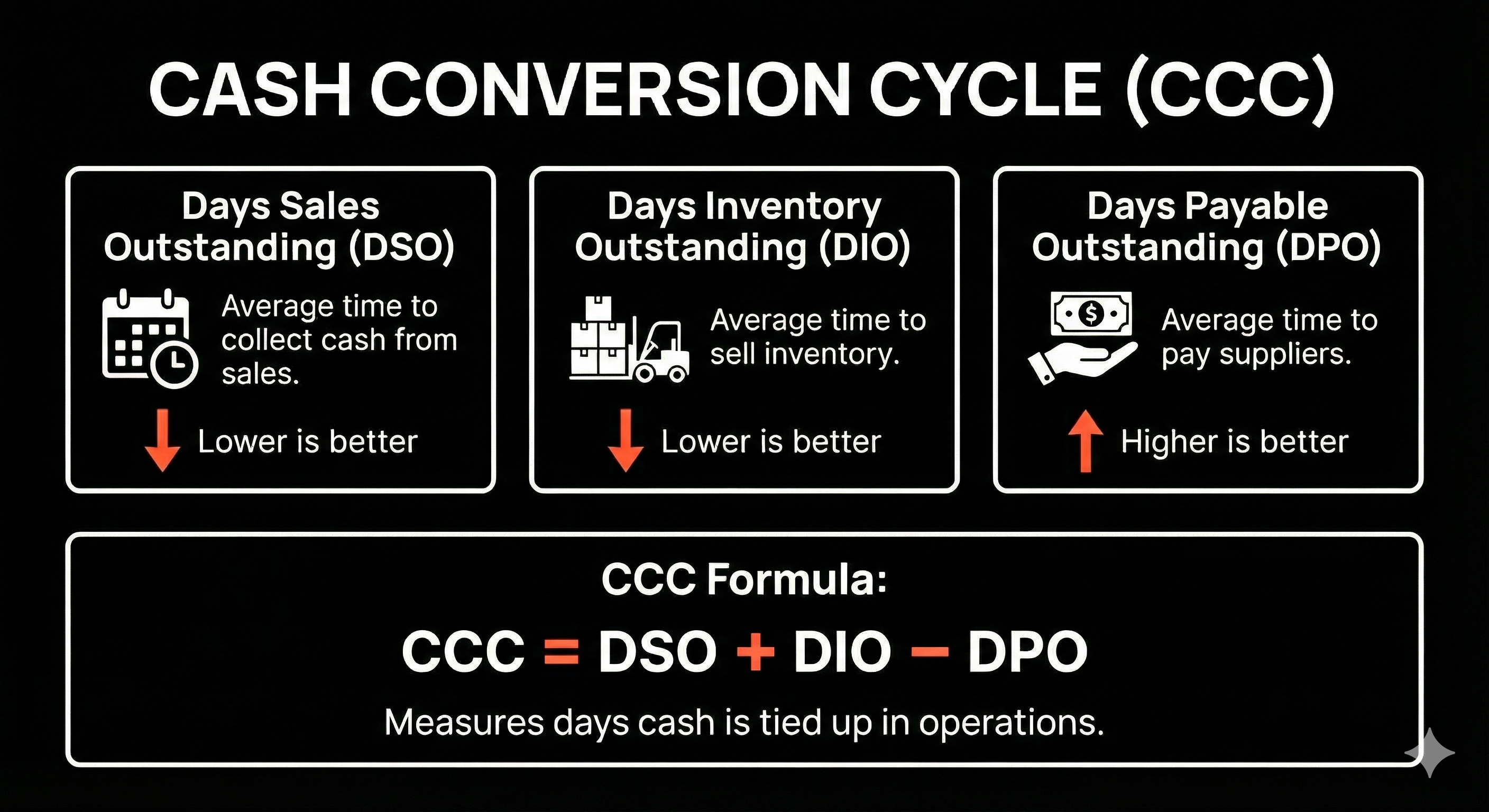
What Is the Cash Conversion Cycle and Why It Matters in E-commerce
The cash conversion cycle measures how long it takes to turn investment into liquid revenue. It starts when you pay for inventory and ends when a customer’s payment lands in your account. Discover an in-depth article about cash conversion cycle and how to optimize for best results in e-commerce.
For ecommerce and DTC brands, CCC provides real-time insights into operational efficiency:
- Short CCC: You recover cash quickly and can reinvest faster.
- Long CCC: Your capital is tied up in stock or unpaid orders.
A low CCC means more flexibility for:
- Scaling paid acquisition
- Launching new SKUs
- Responding to shifting platform algorithms
Understanding your CCC allows marketers and decision-makers to time campaigns with capital availability. That synchronization drives speed, scale, and ROI.
Who Should Track the Cash Conversion Cycle?
If you influence budgets, campaigns, or inventory, the cash conversion cycle should be on your dashboard.
Consider:
- CMOs and Heads of Growth can plan big launches with confidence, knowing when cash is cycling back in.
- Performance Marketers align ad creatives and budgets with liquidity windows, boosting returns.
- Media Buyers use CCC insights to shift spend toward high-velocity SKUs and platforms.
In a world where CAC is volatile and real-time optimization is key, a strong CCC enables:
- Faster budget reallocation
- Smarter SKU prioritization
- Timely discounting strategies
It turns the financial back-end into a front-line growth tool.
How to Optimize Your Cash Conversion Cycle
1. Connect Your Data Systems
Start with visibility. Pull clean, real-time data from:
- Inventory management
- Accounts receivable
- Accounts payable
These silos need to talk. Removing latency here reduces cash drag.
2. Map CCC to Paid Media Cycles
Overlay your cash cycle with your media spend rhythm. Launching a campaign? Know when capital returns to keep fueling growth.
- Spike periods: Sync big initiatives with CCC peaks.
- Slow return: Rework campaigns or SKU mixes.
3. Extend Payables Without Risk
Optimizing CCC doesn’t mean deferring supplier payments recklessly. But strategic negotiations can create breathing room without harming relationships.
4. Shorten Inventory and Receivable Cycles
- Streamline fulfillment processes
- Tighten return and refund loops
- Improve last-mile delivery tracking
Every day shaved off the cycle brings working capital into play faster.
Best Times to Review and Refine Your Cash Conversion Cycle
Cash Conversion Cycle Optimization at High-Leverage Moments: Accelerating Working Capital Velocity
Cash Conversion Cycle (CCC) optimization delivers exponentially greater financial impact when implemented strategically during high-leverage moments—periods when the time-value of cash and operational efficiency directly influence survival and growth. The CCC, measured as the days between paying suppliers and collecting customer payments, represents the lifeblood of e-commerce operations; every day of improvement compounds into significant working capital relief, reduced financing costs, and accelerated reinvestment capacity.
These high-leverage optimization windows emerge during predictable business inflection points: rapid scaling phases when cash burn accelerates dramatically, post-acquisition integrations where operational synergies unlock, seasonal demand spikes requiring inventory pre-positioning, or during fundraising cycles when investor metrics demand demonstration of capital efficiency.
During Black Friday and Cyber Monday, for example, a single-day improvement in inventory turnover or a 2% acceleration in customer payment collection can free millions in working capital that would otherwise remain trapped in logistics, warehousing, and payment processing delays. Similarly, reducing Days Sales Outstanding (DSO) by just 3 days during a Q4 peak—when transaction volumes surge 300-400%—generates exponential cash flow improvements compared to identical optimizations during baseline periods.
The financial leverage operates through compounding velocity: a brand processing $50 million in quarterly revenue that reduces its CCC from 45 to 42 days instantly frees $4.1 million in permanent working capital without requiring additional sales or cost reductions. The strategic mathematics become even more compelling when considering financing costs; every day of CCC reduction saves operational capital that would otherwise be financed at 8-12% annually, effectively generating 8-12% guaranteed "returns" on process optimization investments. Furthermore, CCC improvements during high-growth moments prevent the cash crunch that typically strangles scaling ventures—many high-potential e-commerce companies fail not from unprofitable unit economics but from cash flow mismanagement during rapid expansion.
Before Scaling Paid Spend
If you’re planning a major campaign, assess how much liquidity you’ll need and when it re-enters your system.
During Platform Volatility
Ad costs fluctuate fast. Tight CCCs let you pivot budgets quickly across platforms or creatives.
After Big Campaigns
Post-campaign audits often uncover:
- Inventory bottlenecks
- Delayed receivables
- Return/refund pain points
Fixing these feeds smoother future cycles.
Quarterly Planning
Sync your CCC review with your marketing calendar. Use it to forecast liquidity requirements and investment pacing.
Why High-Growth Ecommerce Brands Can't Ignore CCC
A healthy cash conversion cycle is the difference between reactive and proactive growth. Advanced brands employ predictive CCC modeling using historical data and forward-looking demand forecasting to identify upcoming high-leverage moments, then concentrate optimization efforts on Days Inventory Outstanding (DIO), Days Sales Outstanding (DSO), and Days Payable Outstanding (DPO) simultaneously.
For instance, negotiating 15-day extended payment terms with suppliers (increasing DPO) while simultaneously improving inventory turnover by 20% (decreasing DIO) and accelerating collection cycles through early-pay discounts (decreasing DSO) during a known demand spike creates a trifecta effect that can reduce CCC by 20+ days in a single quarter.
Treating CCC like a strategic metric empowers you to:
- Reduce dependency on outside capital
- Build more accurate campaign forecasts
- Unlock faster test-to-scale loops
For CMOs, this means tighter alignment between liquidity and marketing strategy. For growth teams, CCC clarity enhances decision-making agility across vendors, creatives, and platforms.
When brands view CCC as a performance multiplier, they:
- Boost sustainable ROAS
- Compress budgeting feedback loops
- Future-proof against market shifts
How Admetrics Enhances Cash Conversion Cycle Efficiency
At Admetrics, we help brands maximize every marketing dollar by improving the cash conversion cycle.
Our platform leverages AI and deep attribution models to:
- Identify which campaigns truly accelerate revenue
- Reduce decision latency and capital waste
- Match media spend velocity with business liquidity
The result? Brands reinvest cash faster, improve ROAS, and gain strategic clarity across the board.
The technological enablement comes through integrated platform intelligence—systems like Admetrics that connect marketing performance, inventory management, and financial metrics reveal which campaigns drive fastest-converting, highest-margin customers whose rapid repayment cycles improve overall CCC metrics.
Ready to unlock performance through smarter data? Book a free demo today.
Cash Conversion Cycle FAQs: Quick Insights for E-commerce Leaders
What is the cash conversion cycle?
The cash conversion cycle (CCC) measures how quickly a business turns spent cash into collected revenue.
How do you calculate the cash conversion cycle?
CCC = Days Inventory Outstanding (DIO) + Days Sales Outstanding (DSO) – Days Payables Outstanding (DPO).
Why is the cash conversion cycle important?
It reveals how efficiently you turn capital into growth-ready liquidity.
What does a negative CCC mean?
You’re getting paid before you pay suppliers—ideal for cash flow.
How does the CCC impact ecommerce brands?
It affects liquidity, marketing reinvestment, inventory strategy, and vendor terms.
How can I improve my cash conversion cycle?
Negotiate payment terms, optimize fulfillment, reduce returns, and act on inventory insights.
Can a long CCC hurt marketing performance?
Yes. Delayed cash slows campaign reinvestment, testing, and scaling.
What tools help reduce the CCC?
Forecasting software, real-time dashboards, and AI-powered attribution like Admetrics.
Why should marketers care about the CCC?
It determines how quickly you can transform ad spend back into performance fuel.
Does a long CCC indicate weak financial health?
Not always, but it may signal inefficiencies and risk under fast growth conditions.
How do returns and refunds affect the CCC?
They delay final cash collection and can unexpectedly stretch your cycle. Learn more about ltv and its importance for marketing.