In a world where milliseconds matter and consumer attention is fleeting, A/B testing has become an indispensable part of the DTC and ecommerce toolkit. Whether you're testing email subject lines or homepage hero banners, A/B testing lets you optimize iteratively rather than guess wildly. But despite the advances in experimentation tools, the real competitive advantage lies not in the tools themselves—but in the analytics that make sense of them.
That’s where Admetrics comes in.
The Power of A/B Testing in Ecommerce
Testing variations of your site, product pages, or emails can lead to massive ROI lifts. Even subtle tweaks—a new CTA, image swap, or shipping message—can shift conversions by double digits. For ecommerce brands operating with tight margins and high CACs, that boost isn’t a luxury; it’s survival.
What Makes a Great A/B Testing Tool for Storefronts?
Effective A/B testing platforms for ecommerce share a few key features:
- Speed of deployment (no engineering bottlenecks)
- Visual editing or code flexibility
- Audience targeting (by traffic source, device, cart value, etc.)
- Statistical confidence calculators
- Performance on high-converting pages (no latency)
The ideal platform integrates tightly with your stack and doesn’t degrade performance.
Why Email A/B Testing Still Drives Conversions
Email is still a top-performing channel for DTC brands, especially those with strong LTVs. Testing the timing, tone, subject lines, and CTAs of your emails can dramatically increase open rates and purchases. For many, it’s the low-hanging fruit that keeps giving.
Why You Need Analytics Even With Great A/B Tools
Most A/B testing tools are excellent at “what worked”—but terrible at answering “why.” That’s where analytics tools like Admetrics add unmatched value. A test may show lift, but analytics reveal incrementality, attribution, and predictive impact.
Best A/B Testing Tools for Storefronts
Convert.com
Perfect for privacy-sensitive ecommerce brands. It’s fast, cookieless, and built with GDPR in mind. It also integrates seamlessly with Google Tag Manager and BigCommerce.
VWO (Visual Website Optimizer)
Great for multivariate testing and includes heatmaps and session recordings. Works well for mid-market ecommerce operations.
Shopify App Store Options
Tools like Neat A/B Testing, Dexter, and A/B Tasty offer plug-and-play simplicity. Dexter stands out for enabling product price testing—critical for margin optimization.
Dynamic Yield
A leader in real-time personalization, not just testing. Ideal for enterprise brands looking to blend experimentation with tailored shopping experiences.
Best Email A/B Testing Tools
Klaviyo
Natively designed for ecommerce with deep integrations into Shopify, WooCommerce, and BigCommerce. Its automated flows make A/B testing subject lines, send times, and layouts a breeze.
Mailchimp
Still widely used among SMBs. Offers intuitive A/B functionality but lacks advanced targeting.
Omnisend
Gains traction among DTC brands for multi-channel capabilities. You can test emails, SMS, and even push notifications in one interface.
PostPilot
A disruptor in physical A/B testing—think direct mail postcards with trackable QR codes. Excellent for reactivating churned users.
Key Metrics Every A/B Test Should Measure
- Conversion Rate
- Average Order Value
- Cart Abandonment Rate
- Lifetime Value (LTV)
- Customer Acquisition Cost (CAC)
- Incremental Revenue
Where A/B Testing Tools Fall Short
Even best-in-class platforms won’t tell you if the test actually increased revenue over time or cannibalized another channel. They also struggle with multi-touch attribution and media mix modeling.
How Admetrics Analytics Complements A/B Tools
Admetrics bridges these gaps. It delivers analytics designed specifically for DTC—measuring not just what wins a test but what drives profitable, sustainable growth. By ingesting first-party data, pixel data, and media spend, it gives brands a full-funnel, privacy-compliant view of performance.
Understanding Incrementality with Admetrics
Let’s say a product page redesign boosts conversion by 12% in your A/B tool. Admetrics goes deeper to ask: Would those users have converted anyway? It tracks incrementality—the holy grail of ecommerce analytics.
Admetrics for Paid Media Attribution
If you’re running paid ads on Meta, TikTok, and Google, you know the reporting is... generous. Admetrics uses statistical models and real-time tracking to uncover true return on ad spend (ROAS)—not just last-click illusions.
Predictive Insights: Forecast Before You Launch
Testing doesn’t need to be reactive. With Admetrics’ AI-driven predictive models, you can simulate outcomes before launching a campaign, saving time and money.
Combining A/B Testing + Predictive Analytics
The best brands don’t test blindly. They combine the real-world feedback of A/B testing with the foresight of predictive analytics. That’s how you test smarter, faster, and with purpose.
Data-Led Growth vs. Test-and-Hope
Hope is not a strategy. Data-led growth—powered by tools like Admetrics—ensures every test you run fits into a strategic roadmap, not just a random wishlist.
Privacy & Compliance Considerations in A/B Testing
With iOS restrictions and GDPR rules, cookieless tracking is now essential. Convert.com and Admetrics both lead in compliant, future-proof data handling.
Segmentation and Personalization: Testing Deeper
Segmenting tests by behavior, traffic source, or LTV tier offers more nuance than traditional A/B/n formats. Don’t just test what works—test for whom it works.
Real-World Case Study: Scaling Revenue with Admetrics
Heimplanet, a premium outdoor gear brand based in Hamburg, faced a challenge common to many DTC brands: long, multi-touchpoint customer journeys and high average order values (around €230, with tents reaching four-figure prices). Their sales cycles often span 7–14 days—or even longer—making it difficult to properly attribute conversions.
By integrating Admetrics, Heimplanet gained visibility into their extended decision timelines, leveraging the platform’s conversion paths and time-to-conversion reports with attribution windows up to 120 days. This allowed them to pinpoint where prospects first engaged—via ads, organic search, or in-store visits—and understand which media channels truly drove incremental purchases.
For example, Admetrics highlighted early high-touchpoint exposure (impressions, CTR, “thumbstop” rate) as crucial drivers in awareness-stage engagement. By complementing A/B tests—like those around homepage banner variations or email subject lines—with this deep analytics, Heimplanet could optimize not just conversions, but the quality and timing of media exposures that fueled long-term, profitable growth.
Tips to Increase A/B Test Velocity and Quality
- Use ICE (Impact, Confidence, Effort) scoring to prioritize tests
- Run tests in parallel (where safe)
- Automate test deployment via integrations
Choosing the Right Tool Stack for Your Brand
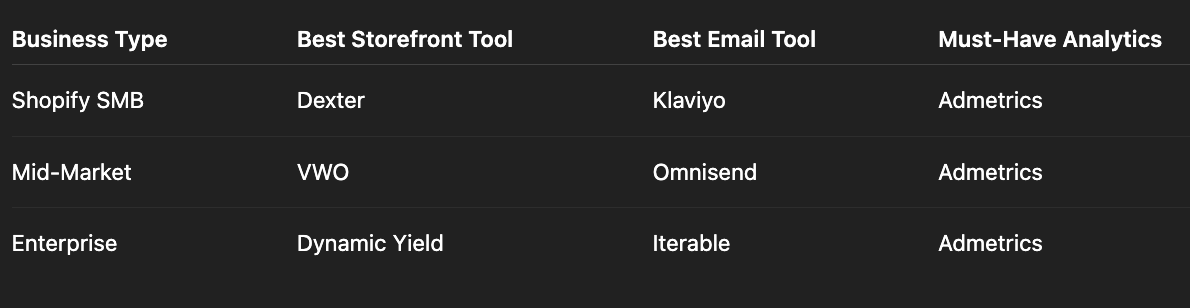
Future of A/B Testing in Ecommerce
Expect greater AI personalization, predictive experiments, and multi-channel testing. But none of it will matter without accurate analytics.
Conclusion: Don’t Just Test—Measure What Matters
A/B testing will always be foundational. But if you're not layering in analytics from a tool like Admetrics, you’re testing in the dark. Use data not just to win tests—but to build brands.
FAQs
What is the difference between A/B testing and multivariate testing?
A/B testing compares two versions of a single variable, while multivariate testing examines combinations of variables to see which performs best.
Why is analytics still necessary if I use an A/B testing tool?
Analytics reveals the deeper story behind test outcomes—like attribution, incrementality, and long-term revenue impact.
What is the best A/B testing tool for Shopify?
For most DTC brands, Dexter or Neat A/B Testing are great options due to their native integration and simplicity.
Can I run A/B tests on email and website simultaneously?
Yes—and you should. Cohesive testing across the customer journey ensures unified messaging and optimized conversions.
How does Admetrics track incrementality?
It uses statistical modeling and historical data to isolate the true impact of a campaign, beyond just last-click conversions.
Is Google Optimize still available?
No, it was sunset by Google in 2023. Google Optimize alternatives include VWO, Convert.com, and Dynamic Yield.