Your Meta ad performance just improved by 5%, and you didn't change a thing. This isn't luck, it's Meta's Generative Ads Recommendation Model (GEM) working behind the scenes.
Meta has dominated performance marketing for e-commerce brands for years. However, rising customer acquisition costs, ad fatigue, and increasing competition threaten profitability. Traditional targeting methods no longer deliver the efficiency they once did.
Enter GEM: Meta's revolutionary AI system that fundamentally reshapes how ads connect shoppers with brands. This isn't just another algorithm update, it's a foundation model that transforms the entire advertising delivery system.
This guide explains what GEM means for e-commerce brands, how it works, and most importantly, how to leverage it for maximum ROI. Understanding GEM now gives you a competitive advantage as Meta's advertising ecosystem evolves.
What Is Meta's GEM Model and Why It Matters
Understanding the Central Brain
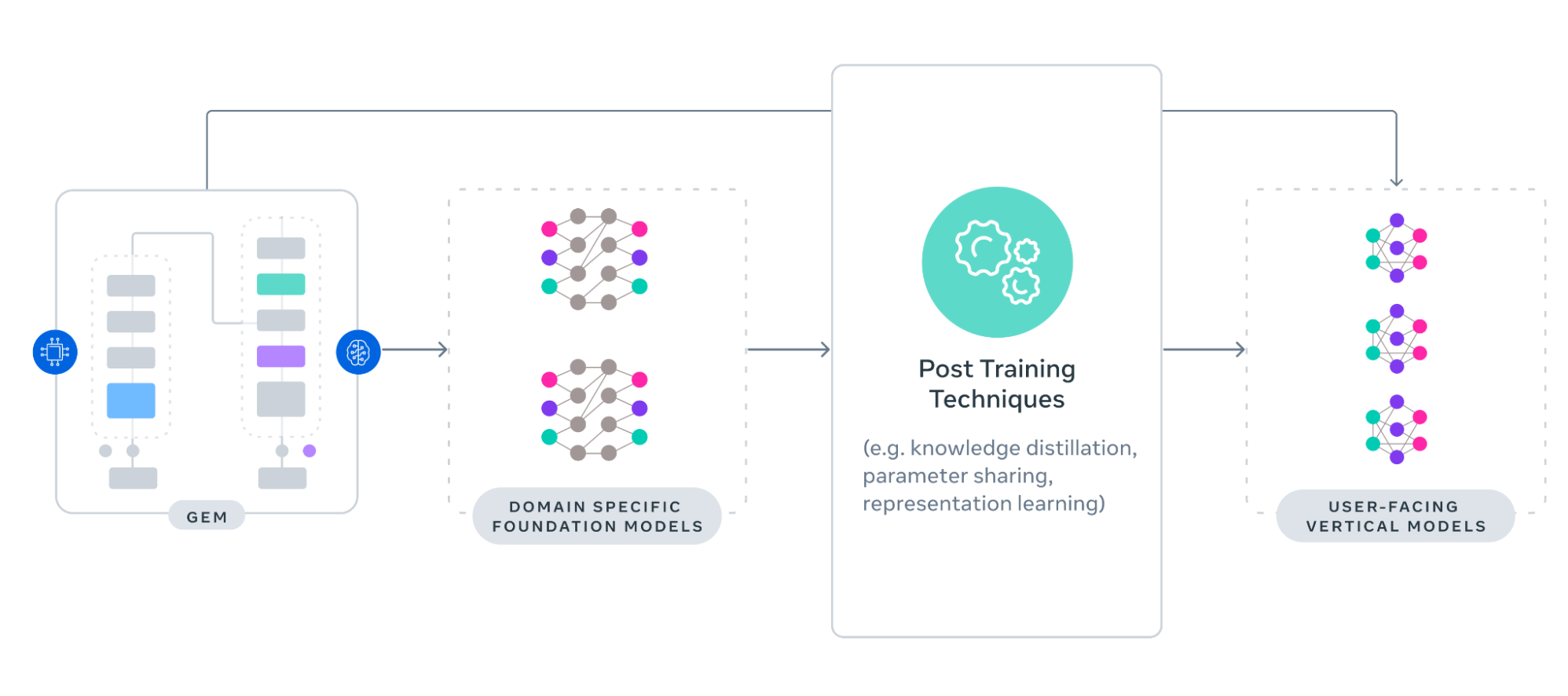
Meta's GEM represents the platform's "central brain" for advertising. Think of it like ChatGPT, but instead of being trained on text, GEM learns from billions of user behaviors and ad interactions across Facebook and Instagram.
This generative AI model fundamentally changes how Meta predicts conversions and matches products with interested shoppers. Unlike previous systems that operated in silos, GEM creates unified intelligence across Meta's entire ecosystem.
Core Capabilities and Goals
GEM delivers three transformative capabilities:
Better Conversion Prediction: The system identifies high-intent shoppers with remarkable accuracy by analyzing behavioral patterns invisible to human marketers.
Cross-Platform Learning: Knowledge gained from Instagram automatically improves Facebook performance, and vice versa. This interconnected learning accelerates optimization dramatically.
Faster Model Updates: When GEM discovers what works in one campaign, it rapidly shares that knowledge across the entire advertising system.
According to Meta's internal testing, GEM delivered a 5% increase in Instagram conversions and 3% improvement in Facebook conversions. At Meta's scale, these percentages represent billions in additional e-commerce revenue.
Why Foundation Models Change Everything
Foundation models differ fundamentally from traditional machine learning. Instead of learning narrow tasks separately, they develop broad understanding that transfers across contexts.
For advertisers, this means Meta's system genuinely understands product-market fit, purchase intent, and creative resonance. Consequently, your campaigns benefit from insights Meta gathered across millions of other advertisers.
Visual Concept: Imagine a diagram showing GEM at the center, with arrows connecting user behavior data, creative performance, conversion signals, and cross-platform insights all feeding into one unified intelligence system.
How GEM Changes the Game for E-commerce Brands
1. Smarter Personalization Without Manual Targeting
Traditional Meta advertising required extensive manual targeting. You'd specify demographics, interests, behaviors, and hope your selections matched actual buyers. This approach became increasingly inefficient as Apple's privacy changes limited available data.
GEM makes broad targeting genuinely intelligent. The system analyzes thousands of signals to identify purchase intent that manual targeting could never capture. Therefore, campaigns with minimal targeting restrictions often outperform heavily segmented approaches.
Advantage+ Shopping Campaigns benefit most from GEM's capabilities. These automated campaigns leverage GEM's intent modeling to find customers across the entire Meta ecosystem without manual audience creation.
Dynamic Ads also receive major improvements. GEM better predicts which products to show which users, dramatically improving product catalog performance.
For DTC brands, this shift means spending less time on audience configuration and more time on creative excellence. Moreover, you'll likely see better results with simpler campaign structures.
2. Creative Matching at Scale
GEM analyzes creative formats, visual elements, and messaging against user intent profiles. The system develops sophisticated understanding of which creative styles resonate with different user segments.
This goes far beyond basic demographic matching. GEM recognizes patterns like:
- Visual aesthetic preferences (minimalist vs. bold)
- Messaging tone alignment (educational vs. entertaining)
- Format preferences (static images vs. video vs. carousels)
- Content style affinity (polished vs. authentic UGC)
E-commerce Advantage: Brands using authentic, UGC-style content typically see better performance because GEM recognizes that most users prefer relatable content over polished advertising. Here's more about AI generated ugc for videos in e-commerce.
The system becomes increasingly "taste-aware" as it processes more data. It learns which visual tones and messaging approaches work for different intent levels and purchase stages.
Strategic Implication: Feed Meta multiple creative variations spanning different styles, hooks, and formats. Let GEM discover the optimal pairings rather than guessing which creative fits which audience.
3. Cross-Platform Learning and Optimization
Previously, Facebook and Instagram operated as separate optimization ecosystems. A high-performing Instagram Reel provided no learning value for Facebook Feed campaigns.
GEM connects these platforms intelligently. When it discovers that certain creative elements drive conversions on Instagram, it applies those insights to improve Facebook delivery and vice versa.
Practical Impact: Your Instagram Reels performance directly enhances your Facebook Feed results. This interconnected learning drives more consistent ROAS across all placements.
Furthermore, GEM optimizes budget allocation between platforms automatically. Instead of manually splitting budgets, the system flows resources toward whichever platform delivers better results for each user segment.
This cross-platform intelligence particularly benefits brands with diverse product catalogs. GEM learns which products perform better on each platform and adjusts presentation accordingly.
Practical Implications for E-commerce Marketers
Data Quality Becomes Critical
GEM's performance depends entirely on signal quality. The better data you provide, the smarter its predictions become. Therefore, technical infrastructure becomes a competitive advantage.
Strengthen your Conversion API implementation. Server-side tracking captures conversion data that browser-based pixels miss. This complete dataset helps GEM identify true conversion patterns.
Ensure you're tracking all valuable actions, not just purchases. Add-to-cart events, product views, and even email sign-ups provide learning signals that improve optimization.
Additionally, implement proper event matching. Pass customer information parameters (email, phone) when possible to help Meta connect on-platform behavior with conversion outcomes.
Data Hygiene Checklist:
- Conversion API properly configured with all events
- Event matching quality score above 6.0
- Product catalog regularly updated with accurate pricing and availability
- Customer value data passed for optimizing toward high-value buyers
Creative Diversity Drives Performance
GEM needs variety to identify optimal creative-user pairings. Brands that test only minor variations miss significant performance opportunities.
Feed the system diverse creative approaches:
- Multiple video hooks and opening frames
- Different visual styles (lifestyle, product-focused, UGC)
- Varied messaging angles (problem-focused, aspiration-driven, educational)
- Format diversity (static, video, carousel, collection ads)
Implementation Strategy: Rather than testing one variable at a time, launch campaigns with 5-10 significantly different creatives. Let GEM's machine learning identify patterns faster than sequential A/B testing ever could.
Refresh creative frequently—every 2-3 weeks minimum. GEM continuously learns, so feeding it fresh content maintains optimization momentum.
Creative Production Tip: Learn more about how to create UGC for TikTok videos.
Embrace Advantage+ Shopping Campaigns
Advantage+ Shopping Campaigns (ASC) represent the purest expression of GEM-powered advertising. These campaigns give the AI maximum flexibility to optimize delivery.
ASC campaigns benefit most from GEM because they:
- Use minimal targeting restrictions, allowing GEM full audience exploration
- Automatically test creative variations across placements
- Optimize budgets dynamically based on real-time performance
- Learn across both acquisition and retargeting simultaneously
Migration Strategy: If you're currently using traditional campaign structures, gradually test ASC alongside existing campaigns. Compare ROAS over 7-14 day periods, accounting for GEM's learning phase.
Many advertisers report 15-30% ROAS improvements after switching to ASC. However, results vary significantly based on creative quality and data infrastructure.
Adopt Full-Funnel Creative Strategies
GEM optimizes across the entire customer journey—awareness, consideration, and conversion. Therefore, your creative strategy should address all funnel stages.
Top-of-Funnel Creative: Focus on stopping scrolls and building interest. Educational content, entertainment, and aspirational storytelling work best here.
Mid-Funnel Creative: Demonstrate product benefits, share testimonials, and address common objections. This content builds confidence and consideration.
Bottom-Funnel Creative: Clear calls-to-action, special offers, and urgency signals convert interested shoppers into buyers.
GEM learns which users need which type of content at which stage. By providing full-funnel creative, you enable more sophisticated optimization.
Measurement Evolution and Attribution
GEM's holistic learning changes how attribution works. The system optimizes toward true incremental conversions, not just last-click attribution.
Expect to see attribution shifts as GEM matures. Conversions may appear in unexpected places as the AI identifies non-obvious conversion paths.
Measurement Best Practices:
- Use Meta's Conversion Lift studies to measure true incrementality
- Compare holdout group performance against exposed audiences
- Track blended ROAS across all channels, not just platform-reported metrics
- Implement tools like Admetrics for multi-touch attribution that accounts for GEM's complexity
Don't rely exclusively on last-click attribution. GEM considers the entire customer journey, so your measurement approach should too.
What GEM Signals for E-commerce Advertising's Future
From Recommendation Systems to Intent Engines
Meta is fundamentally transforming from showing ads based on past behavior to predicting future intent. GEM represents the first major step in this evolution.
Foundation models enable understanding that goes beyond correlation. The system develops genuine comprehension of why certain users convert, not just that they convert.
This intelligence will become increasingly multimodal. GEM already processes images and user behavior; future versions will likely analyze video content, audio, and text comprehensively.
The Shift from Manual Hacking to Creative Intelligence
Traditional Meta advertising success required manual optimization expertise. You needed to know which targeting combinations, bid strategies, and campaign structures worked best.
GEM makes much of that tactical knowledge obsolete. The AI handles optimization complexity automatically. Consequently, competitive advantage shifts toward areas AI can't replicate:
Brand storytelling and positioning remain uniquely human. How you frame your product and connect emotionally with customers determines long-term success.
Creative quality and authenticity matter more than ever. GEM can match products with interested users, but only compelling creative converts interest into purchases.
Data integrity and technical excellence create the foundation for GEM's intelligence. Brands with superior tracking and clean signals gain systematic advantages.
AI-Powered Shopping Experiences on the Horizon
GEM's capabilities extend beyond ad delivery. Meta is likely building toward AI shopping assistants that understand products, answer questions, and guide purchase decisions.
Imagine conversational shopping experiences powered by GEM's product understanding. Users could describe what they want, and AI would surface relevant products from across Meta's advertising ecosystem.
Additionally, GEM may soon power automated creative generation. The system could test countless creative variations, learning what resonates and automatically producing optimized ads.
These developments remain speculative, but GEM's foundation makes them technically feasible. E-commerce brands should prepare for increasingly AI-mediated shopping experiences.
From Campaign Management to Creative Intelligence
The New Competitive Landscape
GEM signals the beginning of advertising's AI-first era. Success no longer depends primarily on tactical campaign management skills. Instead, three factors determine competitive advantage:
Embracing automation intelligently: Brands that leverage tools like Advantage+ Shopping Campaigns and trust GEM's optimization outperform those clinging to manual control.
Investing in creative excellence: With targeting and optimization automated, creative quality becomes the primary performance differentiator. Authentic storytelling wins. Learn more about META's creative fatigue and similarity score.
Building data infrastructure: Clean signals and comprehensive tracking create systematic advantages. Technical excellence compounds over time as GEM learns from better data.
Strategic Recommendations
Start testing GEM-optimized campaign structures immediately. The sooner you begin, the more learning advantage you accumulate as the system evolves.
Audit your technical infrastructure quarterly. Ensure your Conversion API implementation, event matching, and catalog feeds maintain highest quality standards.
Shift creative investment toward diversity and quality. Test boldly different approaches rather than minor variations. Feed GEM the variety it needs for optimal learning.
Most importantly, measure incrementality, not just efficiency. GEM optimizes for real business impact, so your measurement approach should track actual revenue lift.
The Future Is Creative-First
In Meta's statement, "In the GEM era, creative is the targeting—and data is the fuel." This perfectly captures the paradigm shift.
Your audience targeting matters less when AI finds interested buyers automatically. Your creative becomes the primary signal that determines who sees your ads and whether they convert.
Therefore, invest heavily in creative production capabilities. Build systems for rapid testing, authentic content creation, and performance-driven iteration.
Brands that excel at creative storytelling while maintaining technical excellence will dominate e-commerce advertising for years to come.
Real-World Application: DTC Skincare Brand Case Study
The Setup
Consider a DTC skincare brand launching a new retinol serum. Traditional approaches would require extensive audience segmentation, manual bid management, and sequential creative testing.
The GEM-Powered Approach
Diverse Creative Portfolio: The brand creates 10 distinct video ads spanning multiple angles:
- Educational content explaining retinol benefits
- Before/after transformation testimonials
- Dermatologist endorsement videos
- Ingredient transparency and sourcing stories
- Lifestyle integration showing product use
Strong Data Infrastructure: Their Conversion API tracks not just purchases but product views, add-to-cart events, and email captures. Event matching quality exceeds 7.0, giving GEM excellent signal quality.
Broad Audience Strategy: Instead of 15 segmented ad sets, they launch two Advantage+ Shopping Campaigns—one for cold acquisition, one for retention. GEM handles all audience discovery and budget allocation.
The Results
Within two weeks, GEM identifies patterns invisible to human marketers:
- Educational content performs best for first-time buyers
- Transformation testimonials work exceptionally well for lapsed customers
- Instagram Reels drive awareness while Facebook Feed converts consideration
- Certain demographics prefer ingredient transparency content
The AI automatically adjusts delivery, increasing budget to top-performing creative-audience combinations. Overall ROAS improves by 28% compared to traditional campaign structures.
Key Insight: The brand's diverse creative portfolio gave GEM sufficient variety to discover optimal pairings. Their excellent data quality enabled accurate learning. The combination created exceptional results.
Conclusion
Meta's GEM represents the most significant evolution in e-commerce advertising since the introduction of the Facebook Pixel. This generative AI model transforms ad delivery from manual targeting to intelligent intent prediction.
The implications are profound. Competitive advantage no longer comes primarily from tactical campaign management expertise. Instead, success depends on creative excellence, data quality, and willingness to embrace AI-powered automation.
Forward-thinking brands are already adapting their strategies. They're investing in diverse creative production, strengthening technical infrastructure, and testing GEM-optimized campaign structures like Advantage+ Shopping.
The opportunity is clear: brands that understand and leverage GEM's capabilities will dramatically outperform competitors still relying on outdated manual optimization approaches.
Ready to harness GEM's power for your e-commerce brand? Start by auditing your Conversion API implementation and creative diversity today. Then, connect your campaigns to Admetrics for comprehensive attribution that captures GEM's complex optimization patterns and true incremental value.
The future of e-commerce advertising is AI-first, creative-driven, and data-powered. GEM makes that future available right now.
Frequently Asked Questions: Mastering Meta's GEM for E-commerce
Based on the insights from the article, here are 10 in-depth FAQs designed to help e-commerce brands and performance marketers navigate Meta’s new AI-driven advertising landscape.
1. What exactly is Meta's GEM, and how does it differ from past algorithms?
GEM (Generative Ads Recommendation Model) is Meta’s new "central brain" for advertising. Unlike traditional machine learning models that operated in silos for specific tasks, GEM is a foundation model. This means it doesn't just look at past clicks to predict future clicks; it analyzes billions of user behaviors to develop a broad, deep understanding of purchase intent, creative resonance, and product-market fit across the entire Meta ecosystem.
2. Why are my manual targeting strategies suddenly underperforming compared to broad targeting?
With Apple's privacy changes, the data required for hyper-segmented, manual targeting became severely restricted, making it inefficient and expensive. GEM solves this by bypassing traditional demographics. Instead, it analyzes thousands of invisible behavioral signals to identify true purchase intent. Because GEM is so adept at finding these patterns, broad targeting with minimal restrictions gives the AI the breathing room it needs to outperform heavily segmented, human-guessed audiences.
3. If manual targeting is obsolete, how does GEM actually find my ideal customer?
In the GEM era, your creative is your targeting. The system analyzes the visual elements, formatting, messaging tone, and aesthetic of your ad and matches it against user intent profiles. It knows if a specific user responds better to a polished product shot, a raw UGC video, or an educational carousel. By matching the style and substance of your creative to the user's current stage in the buying journey, GEM connects your product with the right buyer automatically.
4. How does GEM's "cross-platform learning" change the way Facebook and Instagram interact?
Historically, Facebook and Instagram optimization existed in vacuums—a winning Reel on Instagram provided zero data to a Facebook Feed campaign. GEM connects these platforms into a unified intelligence network. If the system learns that a specific hook drives conversions on Instagram, it instantly applies that knowledge to optimize your Facebook delivery. Furthermore, GEM dynamically shifts your budget in real-time to whichever platform is yielding the best results for each specific user segment.
5. Why is standard Pixel tracking no longer enough, and why is the Conversion API (CAPI) critical?
GEM is an incredibly powerful engine, but it runs entirely on the fuel of your data signals. Browser-based pixels miss a massive amount of conversion data due to ad blockers and privacy updates. Implementing a strong Server-side Conversion API (CAPI) captures the data that browsers miss, giving GEM the "ground truth" it needs. Without high-quality data (including mid-funnel events like add-to-carts and email sign-ups), GEM's predictions will be flawed.
6. Should I still be running traditional, sequential A/B tests for my ad creatives?
No. Traditional A/B testing (testing one minor variable at a time) is too slow for GEM. Because the AI needs variety to learn which user profiles match which creative styles, you should feed the system 5–10 significantly different creatives simultaneously. Give it completely different hooks, visual styles, and messaging angles all at once, and let GEM's machine learning identify the winning patterns faster than manual testing ever could.
7. What are Advantage+ Shopping Campaigns (ASC), and why are they recommended for GEM?
Advantage+ Shopping Campaigns (ASC) are the purest expression of GEM’s capabilities. They strip away manual constraints and give the AI maximum flexibility. ASC automatically tests creative variations across all placements, optimizes budgets dynamically based on real-time performance, and learns from both cold acquisition and retargeting audiences simultaneously. For many brands, migrating to ASC yields a 15–30% ROAS improvement because it lets the AI do exactly what it was built to do.
8. How do I need to structure my creative strategy to succeed in this AI-first environment?
You must adopt a Full-Funnel Creative Strategy. GEM understands where a user is in their buying journey and serves them the appropriate content—but only if you provide it.
- Top-of-Funnel: Provide scroll-stopping, educational, or entertaining hooks.
- Mid-Funnel: Supply testimonials and benefit-driven content to build trust.
- Bottom-Funnel: Include hard offers, urgency signals, and clear calls-to-action.
- You must also refresh this diverse portfolio every 2–3 weeks to maintain optimization momentum.
9. Why do my conversions look different, and how should I be measuring success now?
GEM optimizes toward true incremental conversions across the whole customer journey, which means last-click attribution will no longer give you an accurate picture of your performance. Conversions may happen through non-obvious paths that the AI identified. To measure success accurately, you need to look at blended ROAS, utilize Meta's Conversion Lift studies, and implement multi-touch attribution tools that account for the complexity of the AI's delivery paths.
10. Where is Meta heading with GEM in the near future?
GEM marks the shift from a "recommendation system" to a true "intent engine." In the near future, we can expect this to evolve into highly multimodal AI shopping assistants. Imagine users describing a problem or desire, and the AI instantly surfacing relevant products from across Meta's ecosystem. Additionally, GEM's foundation paves the way for automated creative generation, where the system itself tests and produces optimized ad variations on the fly.