Marketing leaders in skincare rarely struggle to generate demand. The real challenge is deciding which demand is worth paying for when Meta, Google, TikTok, Shopify, and your BI tool all tell different stories. That is why POAS for Skincare Brands has become a practical decision framework for teams who want fewer attribution debates and more profit clarity.
In skincare, a channel can look strong on ROAS while contribution margin drops. Discounts, free shipping thresholds, pick and pack costs, returns, and reships can quietly erase profits. On top of that, regimen building, sampling, bundling, and subscriptions often make first order revenue a weak proxy for business impact.
POAS for Skincare Brands ties performance back to your P and L. As a result, growth and finance can finally speak the same language. You can also compare channels more fairly, even when they influence different parts of the funnel.
What is POAS for Skincare Brands?
POAS for Skincare Brands means Profit on Ad Spend. It answers a more useful question than ROAS: how much profit do we generate for every euro spent on ads?
ROAS uses revenue as the output. POAS uses profit after the costs that actually hit your skincare P and L. Therefore, it is harder to game with promotions or product mix shifts.
What POAS includes for skincare
To make POAS real, you need to value conversions using profit inputs, not only order value. In practice, most teams include:
- COGS by SKU and bundle component
- Discounts and promo codes
- Shipping and fulfillment, including pick and pack
- Payment processing fees
- Returns, refunds, and reships
- Ad spend by channel and campaign
If your subscription program drives meaningful repeat profit, you should also connect POAS to cohort LTV. Otherwise, you risk optimizing to first order margin while missing payback.
POAS vs ROAS: why skincare teams outgrow revenue metrics
Skincare economics change quickly. For example, a cleanser may show a 4.0 ROAS during a heavy offer week. However, once you subtract free shipping, fulfillment, and refunds, the same campaign may deliver negative contribution.
POAS helps you see those gaps early. As a result, you can scale what creates contribution dollars, not just reported revenue.
Why POAS for Skincare Brands matters for profitable scale
When budgets move from seven to eight figures, small measurement errors become expensive. POAS gives you a shared, board ready metric that connects spend to profit.
Just as importantly, it lets you evaluate channels based on their real role:
- Meta may create discovery that converts later through branded search
- TikTok may drive higher CAC but also a healthier new customer mix
- Google may look efficient on last click while delivering lower incrementality
Therefore, POAS for Skincare Brands helps you allocate budget based on profit lift, not dashboard optics.
The KPI stack: how POAS fits with CAC, LTV, and conversion rate
You do not need to replace every KPI. Instead, POAS should sit at the top of the decision stack:
- Conversion rate tells you if the funnel works
- CAC tells you what you pay to acquire customers
- LTV tells you what cohorts are worth over time
- POAS tells you if ads create profit after real costs
If POAS improves while CAC rises, you may be buying better customers. Conversely, if ROAS improves while POAS drops, discounting or returns may be doing the work.
Who should use POAS for Skincare Brands
POAS is most valuable for DTC brands that already have consistent spend and want to scale without margin surprises. It also helps when attribution disagreements slow decisions.
You should prioritize POAS for Skincare Brands if you:
- Run a blended budget across Meta, Google, TikTok, and creators
- Sell bundles, routines, starter kits, or subscriptions
- Use aggressive promotions that change AOV and margin
- See high returns or reships from sensitivity, trial, or shade matching
- Need to explain marketing performance in finance and board meetings
Media buyers benefit too. POAS creates tighter feedback loops for creative testing because it penalizes “cheap” conversions that destroy margin.
How to calculate POAS for Skincare Brands
Most teams start with contribution profit, then divide by ad spend.
A simple POAS formula
You can use this baseline model:
- Profit = Net revenue minus COGS minus fulfillment minus payment fees minus discounts minus returns and refunds
- POAS = Profit divided by Ad spend
Next, segment it. You will learn more by splitting POAS by:
- New vs returning customers
- Product line or routine
- Offer type, such as no discount vs percentage off
- Channel and campaign objective
Therefore, you avoid averaging away the insight.
Benchmarks and targets: what is a good POAS?
Targets depend on gross margin, overhead, and growth goals. Still, many skincare teams start with a practical range:
- POAS below 1.0 means you lose contribution profit on ads
- POAS from 1.2 to 1.8 often supports scalable growth for many DTC models
- POAS above 2.0 usually indicates strong unit economics or strong repeat profit
If your CAC is rising due to CPM pressure, POAS gives you a clearer signal on whether the added spend still pays back.
Getting started with POAS for Skincare Brands
Start with alignment, then instrument the data, and only then change bidding. This sequence keeps the metric trusted and actionable.
Step 1: Align finance and marketing on contribution margin
First, agree on a single definition of contribution profit. Include the costs that actually move with volume. Otherwise, teams will argue about inputs instead of decisions.
A strong starting checklist includes COGS by SKU, fulfillment costs, payment fees, and returns. Then, confirm how you treat discounts and shipping subsidies.
Step 2: Connect cost inputs to the product catalog
Next, map COGS and fulfillment assumptions to SKUs and bundles. This step matters in skincare because routines and starter kits can distort revenue based reporting.
Once you have SKU level profitability, you can assign more accurate conversion values. As a result, your platform optimization becomes less biased toward low margin offers.
Step 3: Pass profit based conversion values into ad platforms
Then, operationalize POAS by sending profit weighted conversion values via pixel or server side events. That lets platforms optimize toward the value that matches your business.
To keep learning fast, structure campaigns around:
- Margin bands
- Hero routines
- Acquisition vs retention
Step 4: Add incrementality checks
Attribution does not equal incrementality. Therefore, run a lightweight cadence of tests:
- Geo split tests
- Holdout audiences
- Controlled budget pulses
You do not need perfect experiments every week. You need directional proof before you scale.
Step 5: Set channel specific POAS guardrails
Finally, define minimum POAS targets by channel and objective. Meta prospecting, TikTok discovery, and Google intent behave differently. So, one blended target often leads to over investment in the channel that claims the most credit.
When to use POAS for Skincare Brands
Timing matters because skincare demand and margin shift with seasonality and promotions.
Use POAS for Skincare Brands before big decisions, such as:
- Scaling budgets meaningfully
- Launching a new hero product
- Changing your offer strategy
- Refreshing creative or landing pages
- Shifting mix from prospecting to retention
Also, revisit POAS when intent changes. For example, winter dryness peaks, summer routine changes, and major retail events can all distort baseline behavior.
POAS for Skincare Brands as the path to defensible growth
High performing teams stop arguing about which dashboard is right. Instead, they align on the metric that matches the business model.
POAS for Skincare Brands resolves the tension between platform claims and what your P and L shows. It also improves decision quality across the funnel. Executives get a clearer narrative for the board, while marketers get a metric that makes creative testing more honest.
Most importantly, POAS helps you buy the right customers, not only the fastest conversions. In a category where routines and loyalty can drive meaningful LTV, that focus turns scaling into something you can defend with confidence.
How Admetrics can help
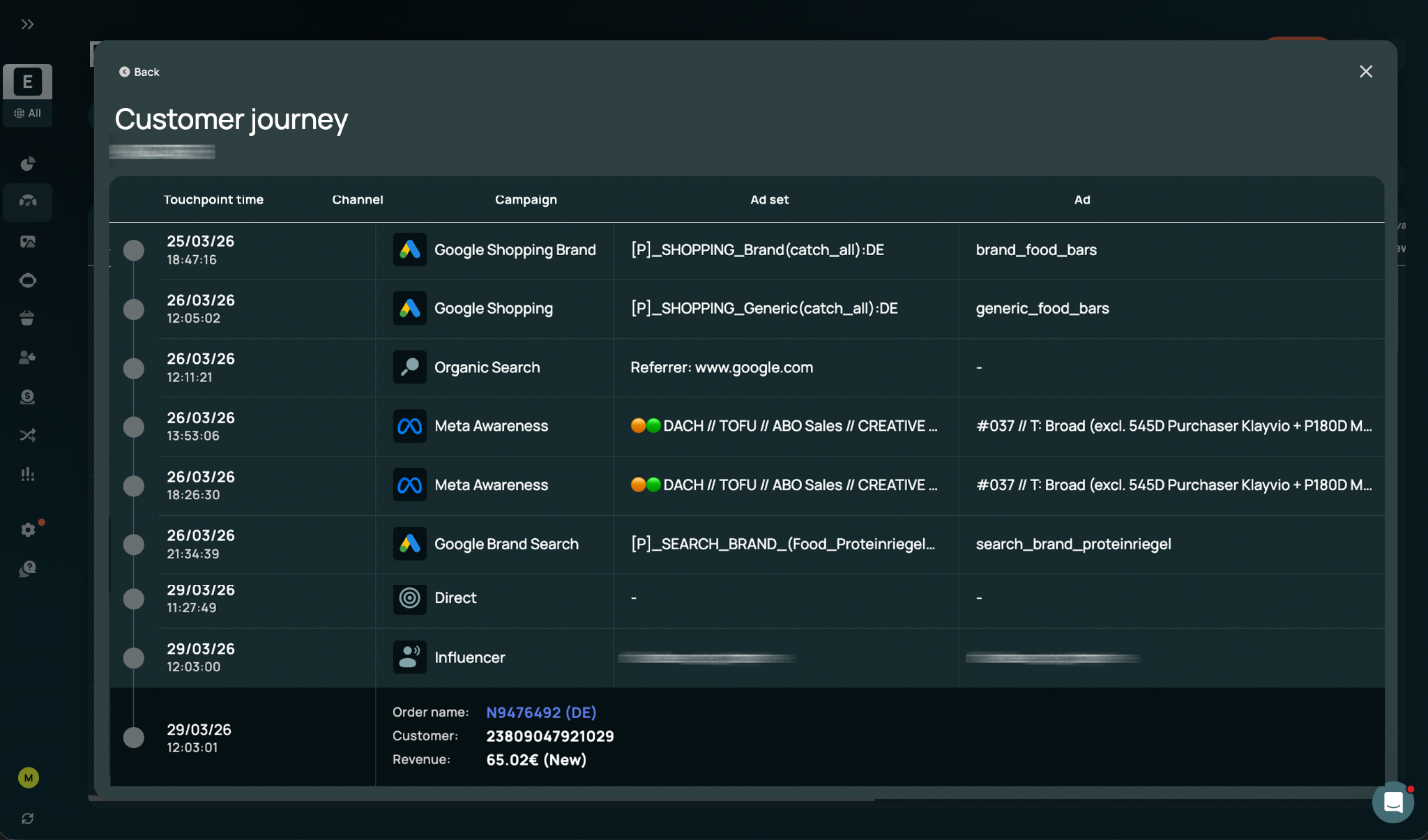
Admetrics helps teams operationalize POAS for Skincare Brands by turning cross channel journeys into decision ready profit signals. Instead of optimizing to blended ROAS that can hide discount driven growth, Admetrics aligns Meta, Google, and TikTok performance with contribution margin, product level profitability, and cohort behavior.
As a result, you can:
- See which campaigns drive incremental profit, not just attributed revenue
- Reduce reporting friction with unified measurement across platforms
- Reallocate budgets faster using profit based guardrails
- Identify cohort quality issues earlier using CAC, LTV, and payback signals
Book a demo to start a free trial or book a call.
FAQ
What does POAS for Skincare Brands mean?
POAS for Skincare Brands means Profit on Ad Spend for skincare businesses. It measures profit generated per euro spent on advertising after costs like COGS, fulfillment, fees, discounts, and returns.
Why is POAS for Skincare Brands better than ROAS?
ROAS optimizes for revenue, which can be inflated by discounting, bundles, or shipping subsidies. POAS for Skincare Brands optimizes for contribution profit, so it reflects what you can actually scale without damaging margin.
What inputs do I need to calculate POAS for Skincare Brands?
You need net sales, COGS, shipping and fulfillment, payment fees, discounts, returns and refunds, and ad spend by channel and campaign. If repeat purchases matter, you should also connect cohort LTV.
How should skincare brands handle subscriptions and repeat purchases in POAS?
Track POAS for first order contribution, then pair it with cohort LTV and payback. Also, separate new vs returning customers so you do not over credit retargeting.
What is a good POAS target for a skincare brand?
It depends on your margin and growth goals. Many brands look to scale when POAS stays above roughly 1.2 to 1.8, while stronger unit economics can support targets above 2.0.
How does POAS change budget allocation across Meta, TikTok, and Google?
Shift spend toward channels with higher incremental POAS, not the best last click ROAS. Validate with holdouts or geo tests so you can separate real profit lift from attribution noise.
How do I include returns and refunds in POAS?
Deduct returns and refunds from net sales and profit. Skincare refund rates can materially distort ROAS, so including them keeps POAS decision grade.
Can POAS be measured per product or SKU?
Yes. SKU level POAS is powerful, especially when you map bundle components and promo mechanics correctly. Otherwise, hero products can look better than they are.
How often should I monitor POAS?
Monitor daily for volatility and weekly for decisions. Also, use 7 day and 28 day views to reduce noise from promos, stockouts, and creative learning phases.
What is the biggest mistake teams make with POAS?
Relying only on platform reported conversions. POAS needs profit based conversion values, blended measurement, and periodic incrementality checks to stay trustworthy.