Open & Click Rates for Cosmetics Brands deserve a permanent place on your weekly growth dashboard. They often signal message market fit before revenue reports catch up. When engagement drops, you can lose weeks of learning time, and those weeks get expensive during a launch or a CPM spike.
For DTC cosmetics teams, email is not just retention. It also helps convert paid captured demand, which can lower blended CAC. At the same time, it can grow LTV by building routines, replenishment habits, and trust around shade selection.
However, when Open & Click Rates for Cosmetics Brands soften, the root cause rarely sits in copy alone. More often, segmentation is too broad, deliverability slips, or your email promise no longer matches your paid ads and landing pages.
Why Open & Click Rates for Cosmetics Brands belong on the exec dashboard
Open & Click Rates for Cosmetics Brands matter because they connect owned channel performance to profit. When your list engages, you rely less on constant prospecting. As a result, you often see better launch resilience and more stable forecasting.
These metrics also act like a smoke alarm. If clicks fall in your top revenue segments, you can investigate before ROAS drops or CAC rises. That makes email a leading indicator, not a lagging report.
Track engagement alongside business KPIs, not instead of them:
- Revenue per recipient
- Conversion rate from email sessions
- Repeat purchase rate
- LTV by cohort and acquisition source
- Blended CAC and paid ROAS during major sends
Open & Click Rates for Cosmetics Brands explained
Open & Click Rates for Cosmetics Brands typically refer to two engagement metrics.
Open rate estimates the share of delivered emails that subscribers opened. Historically, it helped teams gauge subject line relevance and inbox placement.
Click rate measures the share of delivered emails that generated at least one click. This is closer to commercial intent because it reflects whether the message and offer drove action.
Why cosmetics behaves differently than other categories
Cosmetics subscribers swing between discovery and replenishment. Therefore, the same person may click heavily during a new shade drop, then ignore promos until their staples run low.
Your product cadence also changes intent:
- Launches and limited drops often spike urgency
- Education content builds trust and future conversion
- Routine builders drive cross sell and higher AOV
- Replenishment flows increase repeat rate and LTV
Opens are less reliable than they used to be
Privacy changes have reduced the accuracy of open tracking. Apple Mail Privacy Protection can inflate opens, especially in iOS heavy segments.
Because of that, treat opens as directional. Then validate performance with clicks, conversion rate, and revenue per recipient.
Who should own these metrics inside a DTC cosmetics team
Open & Click Rates for Cosmetics Brands only create leverage when the right people act on them.
CMOs and VPs of Marketing should use them to link retention health to acquisition efficiency. If engagement rises, you often need less prospecting pressure to hit the same revenue target.
Heads of Growth and performance leads should treat them as an early signal. Then they should confirm impact with incrementality, cohort LTV, and revenue per recipient.
Lifecycle and CRM teams should own the operational levers day to day. Meanwhile, paid teams should use engagement trends to pressure test whether the inbox message matches the ad narrative.
Benchmarks: what “good” looks like in practice
Benchmarks vary by list quality, region, and brand maturity. Still, teams operating at scale often evaluate performance in ranges and in trends.
Use these as starting points, then prioritize lift versus your own baseline:
- Click rate typically matters more than open rate for revenue impact
- Revenue per recipient is often the most stable KPI across privacy changes
- Segment level performance matters more than account level averages
A practical benchmark framework for leaders
Instead of asking for one universal number, use a simple three tier view:
- Baseline: your trailing 8 to 12 week median by segment
- Target: a realistic lift goal, such as 10 to 20% higher clicks in high value segments
- Guardrails: limits that protect brand and deliverability, such as suppressing chronic non clickers
This approach keeps Open & Click Rates for Cosmetics Brands tied to action, not vanity.
How to improve Open & Click Rates for Cosmetics Brands (step by step)
You will move faster if you treat Open & Click Rates for Cosmetics Brands like an operating system. Start with measurement, then fix fundamentals, then scale winners.
Step 1: Segment by intent, not just demographics
Cosmetics relevance often comes from behavior and lifecycle stage. Therefore, segment based on what the shopper is trying to do right now.
Common high impact segments include:
- First time buyers vs repeat customers
- Shade explorers vs shade loyalists
- High AOV bundle buyers vs single item buyers
- Recent site browsers by category (foundation, skincare, mascara)
- Replenishment window cohorts based on typical usage
Step 2: Map every send to one commercial job
Every campaign should have one primary objective. Otherwise, you will inflate clicks that do not convert.
Examples of clear intent:
- Drive first purchase with a routine starter bundle
- Increase AOV with a limited time set
- Improve repeat rate with replenishment reminders
- Reduce returns with shade matching education
Then evaluate results against the right KPI, such as conversion rate or revenue per recipient.
Step 3: Protect deliverability with list hygiene
Deliverability issues often look like “creative fatigue.” In reality, inbox placement declines after months of emailing unengaged profiles.
Operational fixes that usually help quickly:
- Suppress chronically unengaged subscribers
- Confirm list growth sources and remove low intent capture paths
- Use double opt in where possible
- Maintain consistent sending patterns after major spikes
Step 4: Align email promise to landing page reality
High opens with low clicks often signal weak creative. High clicks with low conversion often signal a landing page mismatch.
Make the email and landing page repeat the same promise:
- Same hero product and benefit
- Same offer and terms
- Same shade or skin concern framing
- Fast load time on mobile
When you do this, clicks translate into conversion rate, not just traffic.
Step 5: Validate with incrementality, not last click
To keep Open & Click Rates for Cosmetics Brands connected to profit, test lift.
Use:
- Holdout tests for major promos
- Consistent UTMs for clean channel reporting
- Cohort level LTV to see long term impact
This prevents over emailing customers who would have purchased anyway.
Timing and cadence: what actually drives engagement
Timing influences Open & Click Rates for Cosmetics Brands, but relevance usually wins.
Many DTC cosmetics programs see strong engagement midweek mornings in local time. However, you should test this per segment because intent varies.
Prioritize lifecycle moments over “best time to send” myths
Lifecycle timing often creates larger lifts than calendar timing.
High intent moments include:
- Replenishment reminders based on expected usage
- Post purchase education 3 to 7 days after delivery
- Browse follow ups tied to the exact category viewed
- Early access for engaged subscribers during drops
After you nail relevance and timing, send time optimization can help stabilize performance across seasons.
Turning engagement into predictable, profitable growth
Open & Click Rates for Cosmetics Brands become powerful when you connect them to outcomes. Engagement should predict revenue per recipient, not just activity.
When the right segments improve, you usually see:
- Higher repeat purchase rate and higher LTV
- Better launch weeks with less paid support
- Lower blended CAC because captured demand converts more efficiently
As a result, email becomes a growth lever across the full funnel. It improves the economics of Meta, TikTok, and Google by converting more of the demand those channels create.
1. Glossier: Community-First Emails That Drive Click Intent
Glossier's email marketing strategy centers on authentic connection, user-generated content, and fostering a sense of belonging. Rather than sending standard promotional blasts, they craft emails that read like personal updates from a trusted friend. They share customer routines, behind-the-scenes glimpses, and community highlights instead of hard-selling. The payoff for open and click rates is structural.
When subscribers feel the inbox is a continuation of a community rather than a broadcast channel, click intent stays high even outside major promotional moments. Their email designs stay consistent with their website. They are clean, product-first, and frequently pair step-by-step routines with textural imagery. This means the creative promise in the subject line and the landing experience rarely diverge. For cosmetics teams, Glossier's model is a reminder that click rate is partly a creative problem and partly a relationship problem. Fixing both together compounds faster than fixing either alone.

2. Fenty Beauty: Segmented Flows Tied to Shade and Purchase Behavior
Fenty's email flows are segmented based on where a subscriber signed up, whether that was through an ad, a quiz, or a product page. Personalized follow-ups include back-in-stock alerts for a subscriber's specific shade, post-purchase content on how to layer or care for a product, and cross-sells framed as thoughtful suggestions rather than upsells. This structure directly addresses one of the most common causes of low click rates in cosmetics: relevance mismatch. When a foundation buyer receives mascara promos, clicks drop not because the creative is weak but because the intent signal is wrong.
By analyzing purchasing data and browsing behavior, Fenty can deliver more relevant messages to each group. Consumers who frequently buy complexion products may receive targeted emails about new foundation shades, while those who engage more with lip products receive recommendations based on those preferences. The result is a CRM that behaves less like a mailing list and more like a shade-aware stylist, which keeps revenue per recipient stable across campaigns.

3. ILIA Beauty: Replenishment Timing as a Click Rate Driver
ILIA Beauty, a clean cosmetics DTC brand, uses product-based replenishment email automation triggered by purchase history. For example, they send a restocking prompt to customers who previously bought their foundation, timed to arrive just as the product is likely running low. This is one of the most underused levers for click rate in cosmetics. Because the subscriber already knows the product and has demonstrated willingness to buy, the email's job is simply to reduce friction. It does not need to build interest from scratch.
The click-to-purchase conversion on these flows consistently outperforms campaign emails because intent is pre-qualified. For brands with multiple SKUs, the buying cycle varies significantly. The time it takes a customer to run out of foundation differs from how fast they go through mascara. This makes product-level timing critical to avoid misfires that suppress engagement over time. Brands that get replenishment timing right see repeat purchase rate climb and list fatigue fall simultaneously.
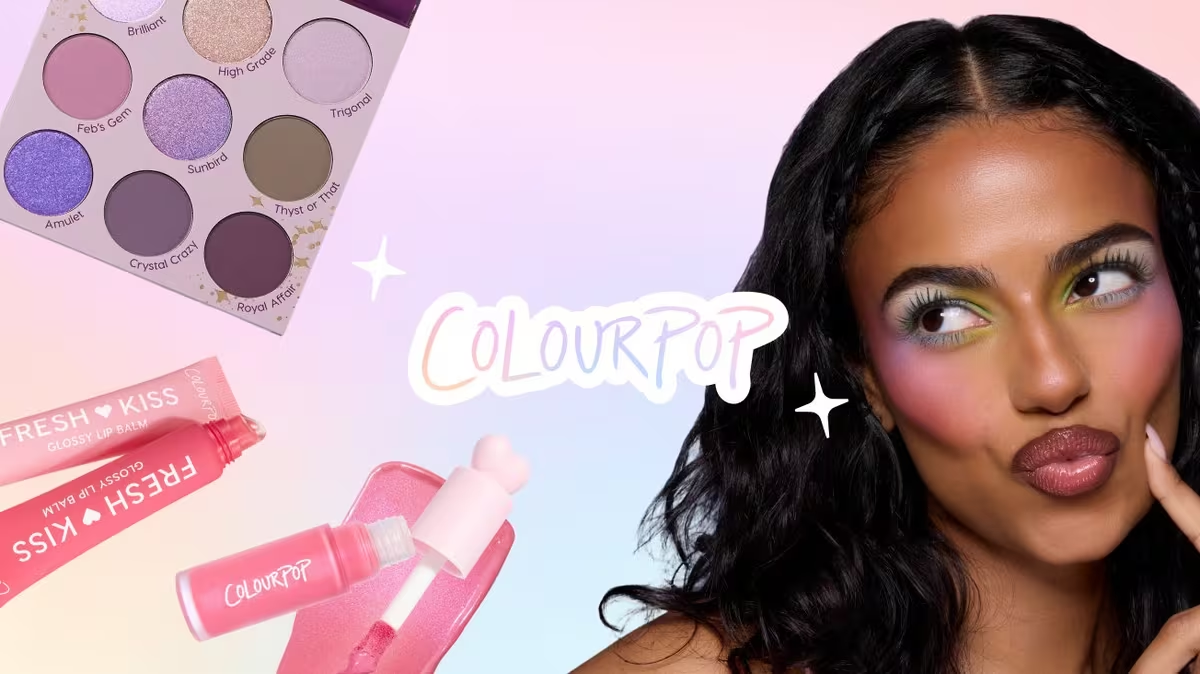
4. ColourPop: Launch Velocity and the Drop Model
ColourPop, an indie beauty brand operating in a market dominated by premium rivals, built its growth model around frequent, fast product launches and creative that emphasized quality over price. This combination generated strong return multiples across both prospecting and remarketing campaigns. In email terms, this shows up as a drop-style cadence where launches are treated as events rather than announcements.
The mechanism that lifts open and click rates here is urgency tied to genuine scarcity, such as limited shades and short windows, rather than manufactured discounts. Glossier's limited-time product drops demonstrate the same principle. Tapping into scarcity drives urgency and encourages immediate purchases, a tactic that has proven effective for brands globally. For DTC cosmetics teams running frequent SKU introductions, the key metric to watch alongside open rate is click-to-purchase conversion in the 48 hours after a launch email. If clicks are high but conversion lags, the gap is usually a landing page mismatch or a checkout experience that doesn't match the speed of the email offer.
5. Bloom & Root: Segmentation Rescue From Batch-and-Blast
Bloom & Root, a DTC skincare brand plateaued at $5.1 million in annual revenue, was running a single weekly newsletter to all 62,000 subscribers alongside a basic welcome series and a two-email cart abandonment flow. Total email revenue was $384,000 annually, which was just 7.5% of total revenue. After restructuring around behavioral segmentation, they separated VIP customers, growth-stage buyers, and lapsed segments into distinct flows.
Automated segmentation delivered a 40% email revenue lift within 90 days, with segmented campaigns converting at 4.1 times the rate of batch-and-blast sends. The open and click rate improvement was a downstream effect of relevance. It was not a direct result of subject line testing or send-time optimization. This is the pattern that repeats across cosmetics brands at this revenue stage. The ceiling on engagement isn't creative quality; it is the breadth of the segment receiving the message. Tightening who gets each email almost always moves click rate and revenue per recipient before any other variable does.
How Admetrics can help
Admetrics helps DTC teams connect paid media exposure to downstream customer behavior. That connection makes it easier to see which audiences and creatives create incremental demand, not just attributed revenue.
With those insights, you can:
- Mirror winning paid narratives inside email subject lines and creative
- Prioritize lifecycle segments that show higher incremental lift
- Reduce wasted sends to low value cohorts, which protects deliverability
- Improve blended CAC by converting more paid captured demand through owned channels
Conclusion
Open & Click Rates for Cosmetics Brands help you spot signal early. They reveal whether your message stays relevant, whether deliverability holds, and whether your promise still matches the onsite experience.
Treat them as directional metrics, especially as open tracking becomes less reliable. Then anchor decisions in clicks, conversion rate, revenue per recipient, and incrementality. When you do that, Open & Click Rates for Cosmetics Brands stop swinging unpredictably and start guiding profitable scale.
FAQ
What are Open & Click Rates for Cosmetics Brands?
Open & Click Rates for Cosmetics Brands are email engagement metrics. Open rate estimates how many delivered emails get opened, while click rate tracks how many delivered emails generate at least one click. Use them as leading indicators, then confirm impact with revenue per recipient and conversion rate.
What is a good open rate for cosmetics email?
A good open rate depends on list quality, inbox placement, and privacy factors like Apple MPP. Compare performance to your trailing 8 to 12 week baseline by segment. Then focus on trend direction instead of a single universal benchmark.
What is a good click rate for cosmetics email?
A good click rate is one that increases revenue per recipient and improves conversion rate from email sessions. Track it by message type, segment, and offer. Also check whether click gains translate into LTV lift over time.
How do I improve Open & Click Rates for Cosmetics Brands quickly?
Start with three moves. Tighten segmentation by intent, clean your list to protect deliverability, and align the email promise with the landing page. Then test one variable per send so you can scale winners fast.
Do iOS privacy changes affect Open & Click Rates for Cosmetics Brands?
Yes. Apple Mail Privacy Protection can inflate opens, so opens can mislead. Therefore, prioritize click rate, revenue per recipient, and incrementality tests when you evaluate performance.
Should we optimize for opens or clicks?
Optimize primarily for clicks and downstream conversion rate. Opens still help as a directional signal, but clicks correlate more closely with commercial intent. Treat Open & Click Rates for Cosmetics Brands like the top of a funnel that must prove out in profit.
Does send time matter for Open & Click Rates for Cosmetics Brands?
Yes, but relevance matters more. Test send time by segment and measure lift on revenue per recipient, not only opens. Use lifecycle moments like replenishment windows to drive the biggest gains.
Why are opens high but clicks low?
This often happens when the subject line over promises or when the email lacks a clear value proposition. It can also come from weak mobile design or too many CTAs. Align the message hierarchy, use one primary CTA, and ensure the offer is clear.
How do we measure success beyond Open & Click Rates for Cosmetics Brands?
Track revenue per recipient, conversion rate, repeat purchase rate, and LTV by cohort. For major promotions, add holdout testing to estimate incremental lift. Also monitor blended CAC and paid ROAS during email heavy weeks to see cross channel impact.