In 2026, "Email is dead" is a myth that has officially been buried under a mountain of profit. While social platforms grapple with algorithm shifts and rising CPMs, email has solidified itself as the #1 highest-ROI marketing channel, delivering an average of $45 for every $1 spent in the e-commerce sector.
However, the way we measure that success has fundamentally changed. Top-tier DTC brands no longer settle for "Last-Click" revenue. Instead, they are obsessed with Incrementality Email Marketing Statistics 2026—measuring only the revenue that wouldn't have happened without that specific send.

Incrementality Benchmarks for 2026
Understanding the true "lift" of your email program is the only way to justify increasing your retention budget. In a world of "zero-click" discovery, email's role as a closer is paramount.
Core Retention Benchmarks
- True Incremental Lift: High-performing DTC brands see an 18% to 26% lift in revenue when using AI-driven incrementality testing compared to standard holdout groups.
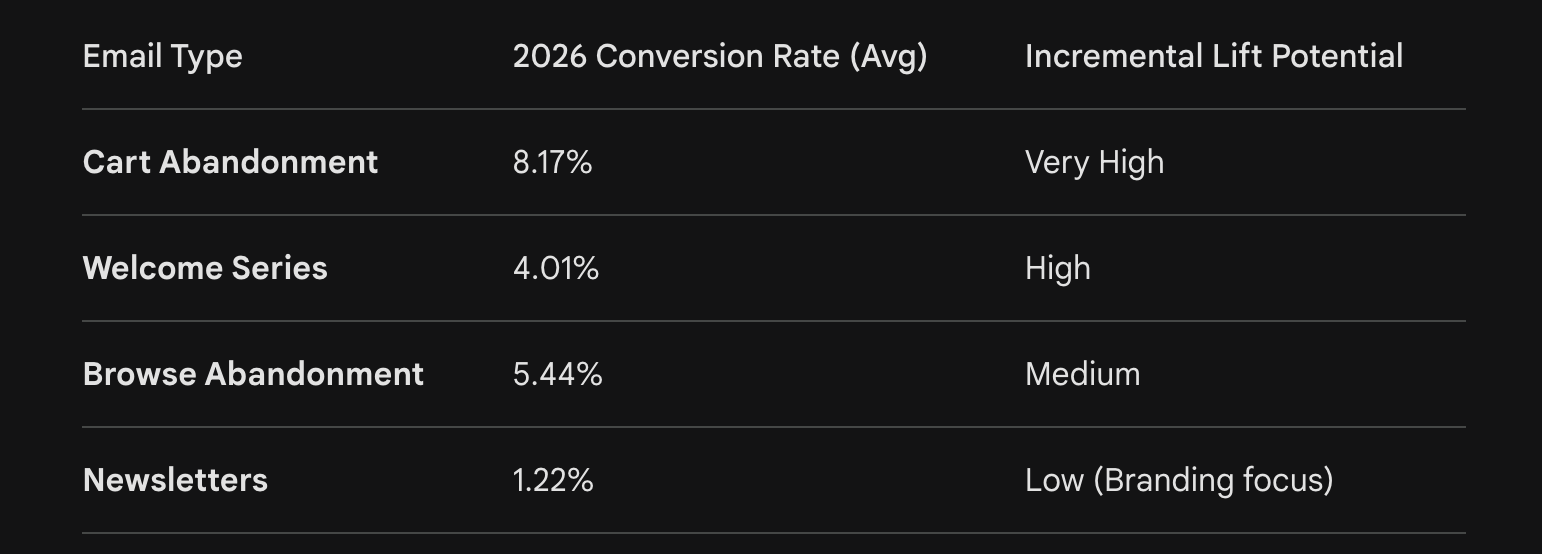
- Automation Dominance: Automated flows (Welcome, Cart Abandonment, Post-Purchase) now drive 320% more incremental revenue than manual broadcast blasts.
- The Segmentation Multiplier: Segmented campaigns based on AI-predicted intent scores generate 760% more revenue than non-segmented broadcasts.
- Predictive Send-Time Optimization: Brands utilizing AI to time their sends see a 14% lift in incremental conversions over static scheduling.
Essential KPIs: Measuring What Matters
Stop reporting on Open Rates. With Apple’s Mail Privacy Protection and AI-driven "smart inboxes" masking data, the focus has shifted to downstream behavior.
1. Revenue Per Email Sent (RPE)
This is the North Star for email efficiency. In 2026, the cross-industry average sits at $0.12 per email, but DTC brands at the top of their game are hitting $0.45+ through hyper-personalization.
2. Subscriber Lifetime Value (SLTV)
Move beyond the transaction. SLTV measures the total revenue a single email subscriber generates over their "inbox life." It is the ultimate metric for measuring the health of your list.
3. Click-to-Open Rate (CTOR)
Since many opens are now "ghost opens" triggered by privacy filters, CTOR (clicks divided by opens) is a more reliable indicator of content relevance. The 2026 benchmark for a healthy DTC brand is 12.3%.
The Incrementality System: A 3-Step Growth Framework
To truly master incrementality email marketing statistics 2026, you need a system that separates coincidence from causation.
Step 1: Establish a Permanent Holdout Group
Dedicate 5% of your list as a "Control Group" that receives no marketing emails for a 30-day period. Comparing their purchase behavior against your active list provides your baseline incrementality.
Step 2: Transition to Server-Side Identity Matching
Don't let "anonymous" browsers fool you. Use tools that provide Identity Match Accuracy (targeting 92%+) to link email clicks to cross-device purchases, even if the user isn't logged in.
Step 3: Layer in Zero-Party Data
In 2026, the best data is the data the customer gives you. Use quizzes and preference centers to gather "Zero-Party Data." Brands doing this see a 3.4x higher conversion rate on their segmented flows.
For a deeper dive into modern tracking, see our guide on Marketing Attribution Systems.
Conclusion
Success in 2026 requires moving past vanity metrics and embracing the "True Lift" of your retention efforts. By focusing on incrementality email marketing statistics 2026, you can protect your margins and ensure every send is a strategic move toward growth.
How Admetrics can help
Admetrics helps DTC teams measure how much revenue email truly adds beyond what would have happened anyway.
It unifies paid media and CRM touchpoints, then supports incrementality testing that quantifies lift, halo effects, and cannibalization across Meta, Google, TikTok, and email.
You get:
* Executive reporting on incremental ROAS and incremental profit
* Clear views of cross channel impact so teams stop double counting conversions
* Practical levers to adjust cadence, segmentation, and suppression based on measured lift
Frequently Asked Questions
What are the most important incrementality email marketing statistics for 2026?
The most critical statistics include the Incremental Lift (averaging 18-26%) and Revenue Per Email (averaging $0.12–$0.45). These metrics help brands understand the "true" value of their email efforts beyond what standard attribution models might over-report.
How does AI impact incrementality in email marketing?
AI increases incrementality by enabling hyper-personalization. By using AI to optimize subject lines and send times, brands see an average 26% increase in open rates and a 17% lift in per-send revenue, ensuring the right message reaches the right person when they are most likely to buy.
Why is last-click attribution misleading for email?
Last-click attribution often over-credits email for "organic" sales. For example, a customer might have already intended to buy, and the email was simply the last thing they clicked. Using Incrementality Email Marketing Statistics 2026 helps you identify which emails actually changed the customer's behavior.
What is a good ROI for email marketing in 2026?
For ecommerce and retail, a "good" ROI is $45 for every $1 spent. While the broader industry average is $42, top-performing DTC brands leverage automation and first-party data to push this number even higher.
What KPIs should we report with Incrementality Email Marketing Statistics 2026?
Track incremental revenue, incremental conversion rate lift, incremental contribution margin, and cost per incremental order. Also review impact on blended ROAS, CAC, and LTV.
Do privacy changes impact Incrementality Email Marketing Statistics 2026?
Yes. As tracking degrades, last click and platform attribution become more biased. Incrementality becomes more valuable because it relies on controlled comparisons, not perfect user level tracking.