Personalization in ecommerce has become more than just a buzzword—it’s a strategic necessity. With consumers expecting tailored experiences at every touchpoint, ecommerce businesses that invest in personalization are seeing dramatic increases in conversion rates, average order values, and long-term customer loyalty. In this article, we’ll explore the what, why, and how of personalization in ecommerce, with practical strategies and examples to help your store thrive.
What Is Personalization in Ecommerce?
Defining Personalization
Personalization in ecommerce refers to the process of delivering individualized experiences to online shoppers by dynamically showing content, recommendations, offers, and messaging based on user data, behaviors, and preferences.
The Evolution of Ecommerce Personalization
Personalization started with simple tactics like using a customer’s name in email marketing. Today, it encompasses advanced AI-driven recommendations, hyper-targeted marketing campaigns, and customized onsite experiences.
Why Personalization Matters in Ecommerce
The Impact on Customer Experience
Meeting Customer Expectations
Modern consumers expect online stores to “know” them—anticipating needs and offering relevant solutions. According to multiple studies, shoppers are more likely to buy from businesses that provide personalized experiences.
Building Emotional Connections
Personalization fosters a sense of value and appreciation, encouraging deeper emotional connections between brands and their customers.
Business Benefits
Increased Conversion Rates
Personalized product recommendations, emails, and offers can significantly increase the likelihood of purchase.
Higher Average Order Value (AOV)
Cross-selling and upselling based on shopper data encourages larger cart sizes.
Improved Retention and Loyalty
Satisfied customers are more likely to return and become repeat buyers, reducing acquisition costs over time.
Key Strategies for Personalization in Ecommerce
1. Personalized Product Recommendations
Onsite Product Suggestions
- “Recommended for you” carousels
- Related products on product pages
- Dynamic homepage displays based on browsing history
Email Recommendations
- Abandoned cart emails featuring personalized items
- Post-purchase emails suggesting complementary products
2. Dynamic Content and Messaging
Homepage Personalization
Show different banners, offers, or collections depending on the visitor’s segment or behavior.
Location-Based Offers
Use geolocation to present country-specific deals, shipping information, or relevant products.
3. Behavioral Targeting
Real-Time Website Changes
Adjust website layout and offers in real-time based on how users interact with your site.
Triggered Pop-ups
Display pop-ups with tailored incentives (like discounts or free shipping) when certain behaviors are detected, such as exit intent or prolonged inactivity.
4. Segmentation and Customer Profiling
Collecting Data
- Demographic information (age, gender, location)
- Purchase history
- Browsing patterns
- Engagement with marketing campaigns
Creating Segments
Develop customer segments (e.g., first-time visitors, VIPs, bargain hunters) to deliver targeted experiences.
5. AI and Machine Learning for Personalization
Predictive Analytics
Use machine learning models to anticipate what products a shopper will likely be interested in.
Automated Personalization Engines
Implement tools that automate and optimize personalization at scale, such as Shopify apps or custom AI solutions.
Implementing Personalization: Best Practices
Start With Data Collection
- Use cookies and tracking pixels to gather browsing data.
- Encourage customers to create profiles or sign up for newsletters for richer insights.
Prioritize Privacy and Transparency
- Always comply with data protection regulations (like GDPR or CCPA).
- Be transparent about how you collect and use customer data.
Test, Analyze, and Optimize
- Run A/B tests on personalized elements.
- Use analytics to track the impact on KPIs such as conversion rate, AOV, and retention.
- Continuously refine personalization tactics based on real-world performance.
Common Challenges and How to Overcome Them
Data Silos
Break down silos by integrating your ecommerce platform with CRM, email marketing, and analytics tools.
Over-Personalization
Avoid making customers feel “watched” by balancing relevance with privacy and respecting boundaries.
Resource Constraints
Start small—focus on the highest-impact personalization tactics before scaling up with more advanced tools.
Top Tools for
Top Tools for Ecommerce Personaloziton
Dynamic Yield
A leading experience optimization platform, Dynamic Yield offers real-time product recommendations, behavior-based segmentation, and automated A/B testing. Its AI models match content and promotions to each customer's preferences and predict future behaviors.
Optimizely Web Experimentation
Optimizely combines powerful A/B/multivariate testing with built-in personalization features. Its intuitive interface and experimentation engine allow ecommerce teams to deploy personalized variations and optimize performance across customer segments .
Bloomreach
Bloomreach unifies real-time customer and product data, enabling dynamic merchandising and personalized search experiences powered by AI. It crafts tailored journeys across channels based on evolving shopper behavior.
Insider
An AI-powered, omnichannel personalization platform, Insider delivers real-time content, offers, and product recommendations across web, app, email, SMS, WhatsApp, and more. It's praised for its seamless integration and scalability.
OptinMonster
Tailored for ecommerce marketing, OptinMonster excels at delivering targeted pop-ups, banners, and onsite campaigns based on user behavior (e.g. exit-intent, time on page). Its intuitive UI makes it ideal for non-technical teams.
Summary Comparison
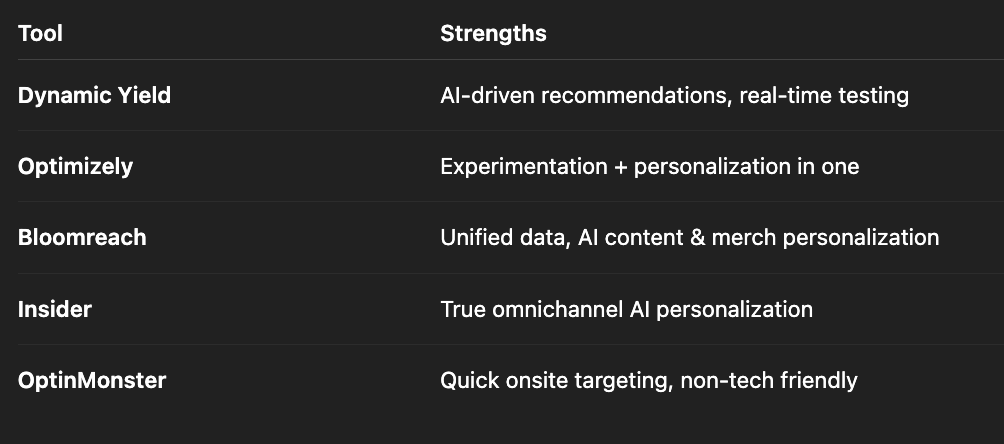
These tools represent a spectrum of personalization capabilities—from onsite targeting to full omnichannel journeys powered by AI. Test and select based on your technical maturity, budget, and immediate goals.
The Future of Personalization in Ecommerce
Hyper-Personalization and AI
Expect further advancements in machine learning, predictive analytics, and natural language processing to drive even deeper personalization.
Omnichannel Experiences
The future lies in delivering seamless, personalized experiences across web, mobile, email, social, and even physical stores.
How to use Admetrics for ecommerce personalization
Admetrics is a marketing intelligence platform tailored for Direct‑to‑Consumer (DTC) and ecommerce businesses, specializing in advanced attribution, analytics, and experiment-driven optimization. It consolidates data from paid and organic sources—ads on platforms like Meta, Google, TikTok, and marketplace channels—into customizable dashboards. Using robust multi‑touch attribution and Bayesian statistical modeling, it reveals the true ROI of each channel and campaign, eliminating guesswork and enabling smarter budget allocation.
Beyond attribution, Admetrics offers powerful features for personalization-driven ecommerce. Its real‑time data analytics engine captures user behavior as it happens—supporting dynamic product recommendations, dynamic pricing, and optimized retargeting strategies that resonate with individual shoppers.The platform’s AI assistant "Ava" further enhances this by providing 24/7 data interaction, anomaly detection, and automated reporting—helping marketing and merchandising teams translate complex data into tailored customer experiences fast.
Explore Admetrics today to see how advanced analytics, real-time insights, and AI-powered attribution can help you deliver tailored experiences, optimize your marketing spend, and accelerate growth. Start making smarter, data-driven decisions for your store now!
Conclusion
Personalization in ecommerce is no longer optional—it’s a core driver of success for modern online retailers. By leveraging customer data, AI technologies, and targeted strategies, businesses can create memorable shopping experiences that convert, delight, and retain customers for the long term. Start implementing personalization today to stay ahead in the ever-evolving ecommerce landscape.
FAQ: Personalization in Ecommerce
What is personalization in ecommerce?
Personalization in ecommerce is the process of tailoring the shopping experience to individual customers based on their preferences, behavior, purchase history, and demographics. This can include personalized product recommendations, targeted offers, and customized website content.
Why is personalization important in ecommerce?
Personalization helps ecommerce businesses increase sales, improve customer satisfaction, and foster long-term loyalty. By delivering relevant experiences, shoppers are more likely to make a purchase and return in the future.
How does ecommerce personalization work?
Ecommerce personalization uses data collected from users—such as browsing behavior, location, and purchase history—to display relevant products, messages, and offers. Advanced personalization may involve AI and machine learning to predict what each customer is likely to want.
What are some examples of ecommerce personalization?
Examples include:
- Product recommendations (“You may also like…”)
- Personalized email campaigns
- Dynamic homepage banners based on user segments
- Location-based offers and shipping information
What tools are used for personalization in ecommerce?
Popular tools include AI-powered recommendation engines, email marketing platforms with segmentation, and website personalization apps that integrate with ecommerce platforms like Shopify, WooCommerce, and Magento.
Is ecommerce personalization safe and privacy-friendly?
When done responsibly and in compliance with data privacy laws (like GDPR or CCPA), personalization is safe. Ecommerce sites should always be transparent about data collection and allow users to manage their preferences.
How can I start implementing personalization on my ecommerce store?
Start by collecting customer data (with consent), segment your audience, and use basic personalization tactics like product recommendations and personalized emails. Gradually introduce more advanced tools and techniques as your business grows.