Subscription businesses have become a cornerstone of modern ecommerce, offering brands a way to foster customer loyalty while generating predictable, recurring revenue. From meal kits to beauty boxes, the subscription model has allowed companies to carve out niches, create consistent cash flow, and deliver exceptional customer experiences. For ecommerce managers, knowing how to start a subscription business means harnessing a powerful growth opportunity that complements traditional sales models.
This guide provides a detailed roadmap to help you navigate the complexities of launching a subscription business. Whether you’re adding subscriptions to an existing ecommerce store or building one from scratch, understanding the nuances will set you up for success.
The rise of subscription-based businesses
The subscription economy has been expanding for years and is projected to keep growing. By 2028, online subscription services are expected to generate $2.3 trillion in revenue.
Much of this growth is driven by streaming platforms and ecommerce leaders, which have turned subscriptions into a routine household expense.
However, small businesses are also embracing subscriptions to offer convenience and generate predictable, recurring income. From curated boxes to monthly essentials, ecommerce companies are finding creative ways to adopt this model.
If you’re considering using a subscription approach, this guide will walk you through the benefits, challenges, and tools to successfully implement it in your business.
What is a subscription business model?
A subscription business model charges customers regularly for ongoing access to products or services. This approach has been used in industries like media, software, and groceries for years.
Today, ecommerce has revolutionized subscriptions, making them a popular choice for businesses. Examples include software licenses, streaming services, and subscription boxes.
These models provide a steady revenue stream and build customer loyalty by offering convenience and consistent value over time.
Whether you sell digital products, curated items, or consumables, subscriptions can offer opportunities to enhance customer relationships and boost sales.
Benefits of a subscription business model
Predictable income is a significant benefit of subscriptions, enabling businesses to plan inventory and growth strategies with confidence.
Subscriptions also improve cash flow, especially when customers pay upfront for long-term plans, reducing the need for heavy initial investments.
With higher customer lifetime value, subscriptions lower the reliance on costly marketing to continually attract new buyers.
Additionally, they foster loyalty by encouraging regular interactions, often leading to more significant long-term spending by customers.
Subscriptions also make upselling easier, as regular engagement provides chances to introduce premium products or services.
Types of subscription models
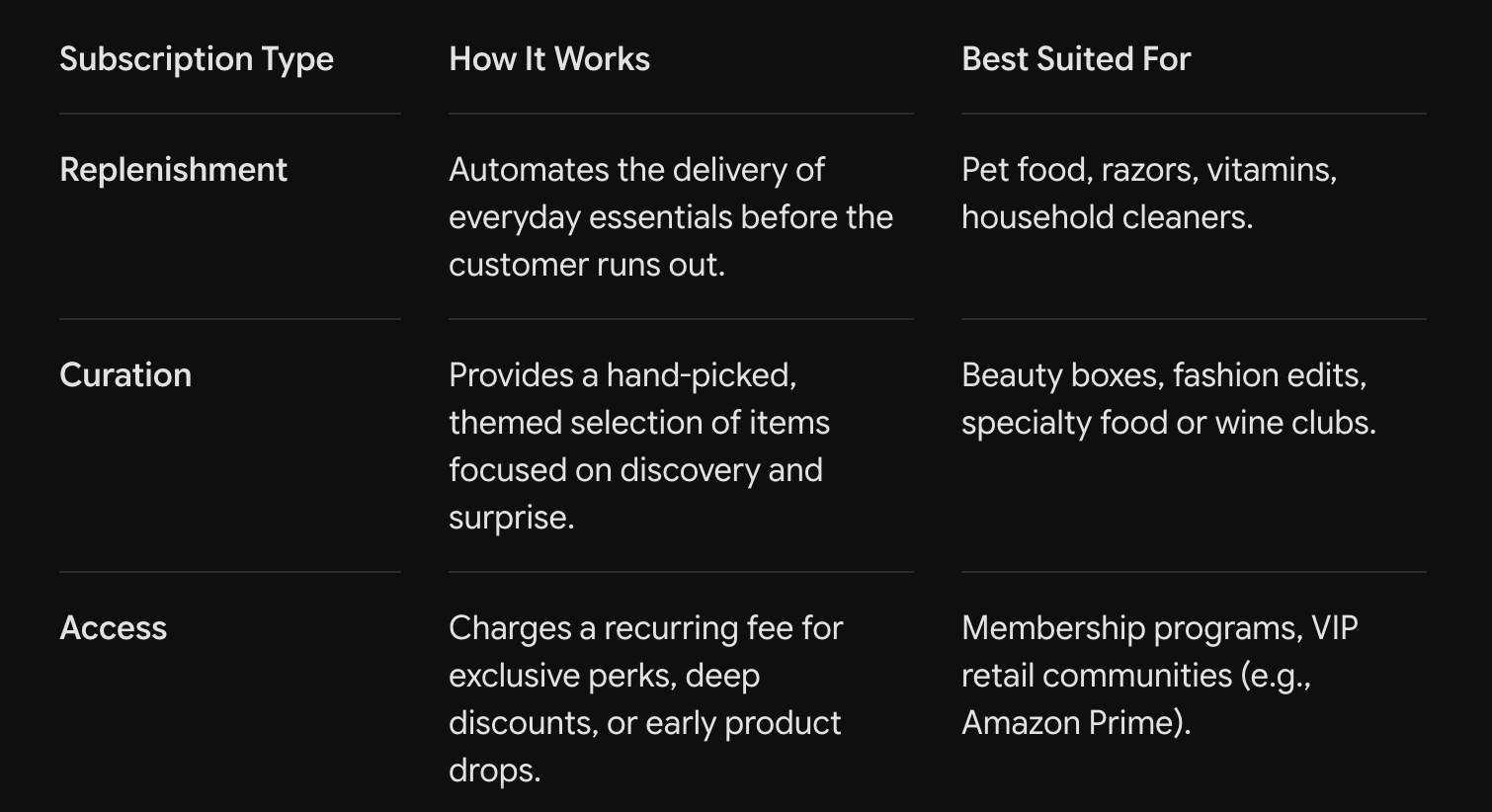
Curation subscriptions provide a tailored selection of items, such as subscription boxes, perfect for industries like beauty and fashion.
Replenishment subscriptions automate purchases of everyday essentials, ideal for items like pet food, vitamins, or household goods.
Access subscriptions offer exclusive perks or discounts for a recurring fee, seen in models like Amazon Prime or membership-based services.
Each model has its pros and cons, but all aim to balance customer convenience with business growth.
Consider your products and audience carefully when selecting the subscription model that best fits your business.
How to Decide if Subscriptions Are Right for Your Business
Start by assessing whether your product provides consistent value that encourages repeat use over time. Research your target market and competition to understand if there’s demand or if the space is already saturated. Evaluate your ability to personalize offerings, as tailored experiences can improve customer satisfaction and retention.Consider the cost of acquiring new customers versus retaining them, and develop strategies to minimize churn. Lastly, ensure you can maintain regular communication and engagement with your subscribers to foster long-term relationships.
Understanding subscription business in e-commerce
A subscription business involves customers paying a recurring fee for a product or service. This model thrives on continuous delivery of value and fosters long-term relationships with customers. Subscriptions in ecommerce can take several forms, including:
- Replenishment Subscriptions: Products delivered at regular intervals, like razors or pet food.
- Curation Subscriptions: Hand-picked or themed selections, such as beauty boxes or wine clubs.
- Access Subscriptions: Premium memberships offering exclusive perks, such as early access, discounts, or unique products.
These approaches meet specific customer needs while building a dependable revenue stream for your business.
Why start a subscription business model?
Ecommerce managers are increasingly drawn to subscription models due to their numerous advantages:
- Predictable Revenue: Subscriptions generate consistent monthly income, simplifying financial forecasting.
- Customer Retention: Long-term commitments strengthen relationships, reducing the cost of acquiring new customers.
- Scalability: With effective systems in place, scaling subscriptions is often more straightforward than traditional ecommerce.
Moreover, subscription models align with changing consumer behavior. Modern customers value convenience, personalization, and experiences, all of which can be fulfilled with a well-executed subscription strategy.
Steps to start a subscription business
To launch a subscription business, follow these critical steps:
- Define Your Niche and Value Proposition
Start by identifying a specific market gap or unmet customer need. Build a value proposition that distinguishes your brand from competitors. - Conduct Market Research
Analyze trends, competitor offerings, and target audience preferences to validate demand. Platforms like Google Trends and social media analytics are excellent starting points. - Select Your Products
Choose items with high repeat value, unique appeal, or exclusivity. Products should seamlessly integrate into the chosen subscription model. - Choose the Right Ecommerce Platform
Platforms such as Shopify, WooCommerce, or BigCommerce offer plugins and integrations to manage subscriptions effectively. - Create Subscription Plans
Offer multiple tiers with clear pricing structures to cater to diverse customer budgets. Highlight the benefits of each tier prominently. - Build and Launch Your Website
Ensure your website is mobile-friendly, easy to navigate, and optimized for conversions. Include features like customer reviews and live chat for trust-building. - Market Your Subscription Service
Use email campaigns, targeted ads, and referral programs to attract your initial customer base. Highlight special offers for early adopters.
Retention vs. acquisition in subscription business
In the world of subscriptions, retaining customers is often more profitable than acquiring new ones. Here’s how you can focus on retention:
- Personalized Communication: Send tailored emails or exclusive offers based on user behavior.
- Incentivize Loyalty: Implement rewards programs for long-term subscribers.
- Monitor Feedback: Regularly gather insights from customers to refine your offerings.
Proactively addressing customer needs minimizes churn and maximizes customer lifetime value. Learn more about how to reduce subscription churn.
Pricing strategies for subscriptions
Pricing can make or break your subscription business. Consider these best practices:
- Tiered Pricing: Offer flexible options with varying levels of service or product quantity.
- Transparent Costs: Avoid hidden fees to build trust and reduce cancellations.
- Value Over Price: Focus on delivering superior value instead of undercutting competitors.
Benchmark your pricing with industry leaders while factoring in your unique cost structure.
Analyzing subscription metrics with Admetrics
Admetrics offers a comprehensive marketing analytics platform designed to help businesses track, understand, and manage key performance indicators (KPIs) related to their subscription services. By unifying data from all sources into fully customizable dashboards, Admetrics provides a centralized view of your business metrics, enhancing data quality and expediting decision-making. Admetrics offers pivacy-compliant tracking captures all customer touchpoints, delivering deep insights into customer journeys and conversion paths This enables you to identify which tactics and channels have the most significant impact, allowing you to scale successful campaigns and optimize underperforming ones. Additionally, Admetrics' AI-driven predictive audiences analyze customer behavior to forecast purchasing intent, unlocking new custom audiences for both retargeting and prospecting, thereby enhancing customer acquisition efforts. By leveraging these features, Admetrics empowers businesses to effectively monitor and optimize their subscription KPIs, leading to improved performance and profitability.
Admetrics provides a suite of metrics tailored for businesses operating subscription models, enabling comprehensive tracking and optimization of subscription performance. Key metrics include:
- Subscriptions: The total number of orders containing at least one item linked to a subscription plan.
- Subscription Rate: The percentage of total orders that include at least one subscription item, offering insight into the adoption rate of subscription offerings.
- Subscription Conversion Rate (CVR): The proportion of website visits that culminate in orders with subscription items, reflecting the effectiveness of subscription marketing strategies.
- Recurring Orders: The count of repeat orders associated with existing subscription contracts, indicating customer retention and satisfaction levels.
- Recurring Revenue: The income generated from subscription-based sales, essential for forecasting and financial planning.
These metrics are accessible at various levels, including traffic source, campaign, ad set, and individual ad performance, through the Admetrics Dashboard. This granularity enables businesses to fine-tune their marketing strategies and enhance subscription-related outcomes.
Case studies: Successful subscription businesses
Examining real-world successes provides valuable inspiration:
- Dollar Shave Club: Pioneered replenishment subscriptions with its affordable razors and witty branding.
- HelloFresh: Perfected the meal kit delivery model by balancing convenience and variety.
- Birchbox: Capitalized on curation by introducing customers to new beauty products monthly.

Each of these brands innovated their respective niches while prioritizing customer experience.
Conclusion
Subscriptions are an excellent way to create reliable revenue and deepen customer connections. Whether you’re expanding your current business or starting fresh, this model offers significant potential for sustainable growth. Starting a subscription business in ecommerce is more than just a revenue opportunity—it’s a strategy to forge deeper connections with your customers. By carefully selecting your niche, pricing competitively, and focusing on retention, you can build a profitable subscription model that stands the test of time. Now’s the perfect moment to explore how this model could elevate your ecommerce brand. Embrace the challenge, and watch your recurring revenue grow.
E-Commerce Subscription Models: In-Depth FAQs
1. What exactly is a subscription business model in e-commerce?
A subscription business model allows customers to pay a recurring fee at regular intervals (monthly, quarterly, annually) for ongoing access to a product or service. While historically popular in software and media, e-commerce has adapted this model to deliver physical goods, digital products, and exclusive community perks. It thrives on delivering continuous value and prioritizing long-term customer relationships over single, isolated sales.
2. Why should an established e-commerce brand consider adding subscriptions?
Adding a subscription tier transforms erratic sales spikes into a stable financial foundation. The primary advantages include:
- Predictable Revenue: Consistent monthly income makes financial forecasting and inventory planning highly accurate.
- Improved Cash Flow: Upfront payments for long-term plans provide immediate capital without heavy initial investments.
- Higher Customer Lifetime Value (LTV): Recurring billing naturally extends the lifespan of a customer, reducing your reliance on expensive top-of-funnel marketing.
- Easier Upselling: Regular, guaranteed touchpoints with active subscribers create natural opportunities to introduce premium products.
3. What are the different types of e-commerce subscription models?
Selecting the right framework depends entirely on what you sell and why your customers buy it. There are three primary models:
4. How do I determine if my product is a good fit for a subscription?
Not every product works as a subscription. To assess viability, evaluate your offering against these criteria:
- Repeat Use: Does your product provide consistent value that necessitates regular replacement or ongoing engagement?
- Market Saturation: Have you researched the competition to ensure there is a clear gap or demand in your specific niche?
- Personalization: Can you tailor the ongoing experience? Subscribers expect customized offerings over time.
- Margin Viability: Can your profit margins sustain the cost of recurring shipping and dedicated retention marketing?
5. What are the foundational steps to launch a subscription service from scratch?
Launching requires a deliberate, step-by-step approach to ensure your logistics and marketing are aligned:
- Define Your Value Proposition: Identify an unmet customer need and build an offer that clearly distinguishes you from competitors.
- Select the Right Products: Choose items with high repeat value or exclusive appeal that naturally fit a recurring model.
- Choose Your Platform: Utilize robust e-commerce platforms (like Shopify or BigCommerce) that support deep subscription management integrations.
- Structure Your Plans: Create multiple, tiered pricing options to accommodate different budgets, highlighting the specific benefits of each.
- Market the Launch: Deploy targeted ads, email campaigns, and early-adopter incentives to secure your initial base.
6. Why is customer retention prioritized over acquisition in this model?
In the subscription economy, churn is the enemy of profitability. Because you often spend more to acquire a subscriber than you make on their first box, profitability relies entirely on keeping them subscribed for multiple billing cycles. Proactively addressing customer needs, incentivizing loyalty, and utilizing personalized communication will maximize your LTV and ensure the initial acquisition cost pays off exponentially over time.
7. What are the best pricing strategies for a new subscription offering?
Pricing must balance perceived customer value with your operational costs. Best practices include:
- Tiered Pricing: Offer flexible "Good, Better, Best" options (e.g., varying product quantities or delivery frequencies) to capture a wider audience.
- Total Transparency: Never hide shipping costs or cancellation fees; hidden costs destroy trust and guarantee high churn rates.
- Lead with Value: Do not simply undercut competitors on price. Focus on delivering superior convenience, exclusivity, or curation that justifies your recurring fee.
8. What can we learn from successful real-world subscription brands?
Industry leaders have built massive businesses by perfecting specific subscription models:
- Dollar Shave Club: Mastered the replenishment model by combining affordable, necessary goods with highly disruptive, witty brand messaging.
- Birchbox: Capitalized on the curation model by understanding that beauty consumers wanted a low-risk way to discover new, premium products monthly.
- HelloFresh: Refined the meal kit space by balancing extreme convenience with a wide variety of choices, keeping the recurring experience fresh.
9. How do advanced analytics platforms like Admetrics optimize subscription growth?
To scale a subscription business, you must move beyond basic Google Analytics. Admetrics unifies data from all your marketing sources to track the exact customer journey and conversion paths. By capturing privacy-compliant touchpoints, it reveals exactly which ads and channels are driving long-term subscribers versus one-off buyers. Furthermore, its AI-driven predictive audiences can forecast purchasing intent, allowing you to build highly effective prospecting campaigns.
10. What specific Key Performance Indicators (KPIs) should I track for my subscription business?
Monitoring the health of a subscription business requires tracking specialized metrics alongside standard e-commerce data: