DTC Growth Hacking
Ecommerce Growth Hacking isn’t just a buzzword—it’s a powerful, data-backed approach to scale your direct-to-consumer (DTC) brand faster, smarter, and with leaner resources. In an ecosystem where customer acquisition costs are skyrocketing and attention spans are fleeting, adopting the right growth tactics could mean the difference between exponential scale and slow decline.
Growth hacking in ecommerce is about rapid experimentation across marketing, product development, and customer journeys to identify the most efficient ways to grow a business. Unlike traditional marketing, it blends creative thinking with data-driven performance, often uncovering low-cost, high-impact tactics to supercharge growth.
Let’s break down the best-performing Ecommerce Growth Hacking strategies tailored for knowledgeable DTC operators ready to move fast and optimize every inch of their funnel.
Foundations of a Growth-Ready Ecommerce Brand
Before launching any growth hack, a solid foundation is essential. Start with product-market fit—does your audience truly need your product, or are you convincing them to want it?
Key elements:
- Niche clarity: Define exactly who you serve, then go even narrower.
- Value proposition: Your unique benefit should scream from the first fold of your site.
- Positioning: Are you premium, mass-market, or purpose-driven? Align messaging accordingly.
The Psychology Behind Ecommerce Conversions
Understanding the underlying motivations behind consumer behavior is at the heart of successful ecommerce growth hacking. Contrary to what many might believe, purchasing decisions are rarely made purely through logic. In fact, people tend to make emotional decisions first, then justify those choices with rational reasoning after the fact. That’s why smart DTC brands don’t just rely on great products—they engineer the entire customer journey to tap into deep psychological triggers that influence buying behavior.
One of the most effective tactics is loss aversion—the principle that people fear losing out more than they value gaining something. By leveraging time-sensitive offers, flash sales, or “limited stock” banners, brands create urgency that nudges customers toward faster decision-making. Another powerful psychological cue is social proof. Humans are inherently wired to follow the herd; seeing real-time purchase popups, reading verified reviews, or encountering user-generated content (UGC) on product pages builds trust and lowers perceived risk. This makes prospects feel more confident in their choices.
Additionally, the concept of cognitive ease plays a critical role. When shoppers land on a site that’s visually clean, easy to navigate, and quick to load, they subconsciously perceive it as more trustworthy and professional. Streamlined copy, intuitive user experience (UX), and clear calls-to-action reduce friction in the buyer’s journey—leading to higher conversion rates.
Growth Hacking vs Performance Marketing
Here’s the kicker: performance marketing gets you traffic, but growth hacking makes that traffic profitable. Explore this in-depth guide about e-commerce growth-hacking.
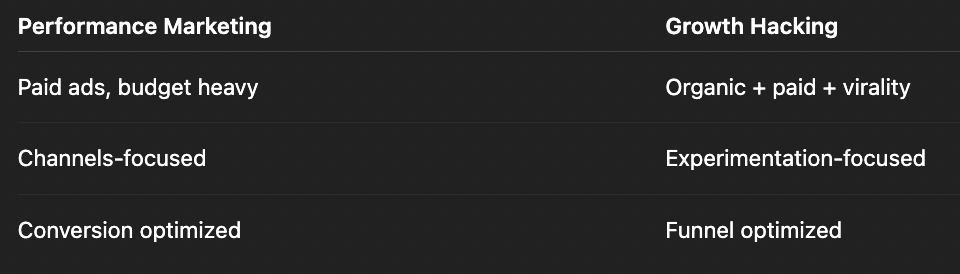
Growth hacking integrates performance marketing but goes deeper—especially in leveraging owned media and virality loops.
Building a Growth Hacking Funnel for Ecommerce
A true growth hacker doesn’t just focus on traffic—they optimize every inch of the customer journey. The ecommerce funnel, when approached strategically, becomes a dynamic roadmap for acquiring, delighting, and retaining high-value customers. Let’s break down each stage and explore how to maximize impact at every level.
Acquisition: Hook Them With Content, Partnerships, or Paid
The journey starts with getting eyeballs on your brand. Acquisition is more than just buying traffic—it's about earning attention through the right channels and messaging. Content marketing, for example, can educate and attract cold audiences through SEO-optimized blog posts, product comparison guides, and educational videos. Strategic partnerships with influencers or complementary brands can expose your store to engaged audiences with built-in trust. Paid media—whether via Meta Ads, Google Performance Max, or TikTok Spark Ads—should be performance-tested and aligned with your buyer personas. The key is to balance cost efficiency with reach and continually experiment with creatives, targeting, and placements.
Activation: Get Them to the “Aha” Moment Quickly
Once visitors land on your site, the clock is ticking. Activation is the moment a potential customer experiences the core value of your product—ideally resulting in their first purchase or deep engagement. The best brands make this frictionless. This includes offering clear and compelling value propositions above the fold, simplified checkout experiences, and intuitive product discovery tools (like quizzes or filters). First-time user offers, bundled deals, and dynamic exit-intent popups can nudge hesitant buyers over the line. The faster you can lead them to that "aha" moment, the more likely they are to convert and become long-term customers.
Retention: Keep Them Coming Back With Email, SMS, and Loyalty Perks
It’s far more profitable to retain a customer than to acquire a new one. That’s why retention is a cornerstone of ecommerce growth hacking. The moment after the first purchase is just as critical as the moment before. Set up automated email flows—such as post-purchase thank-you sequences, replenishment reminders, and personalized product suggestions. Layer in SMS marketing for time-sensitive promos and VIP offers. Additionally, loyalty programs that reward repeat purchases, referrals, or even social sharing deepen emotional commitment and encourage habitual buying. Brands that win here have lower churn rates, higher lifetime value (LTV), and thriving communities.
Referral: Build in Shareability Through Smart Incentives
Word of mouth is the original growth hack—and it still works like magic when done right. A robust referral strategy incentivizes existing customers to bring in new ones. This can include double-sided incentives (e.g., “Give $10, Get $10”), gamified sharing experiences, or post-purchase thank-you pages with one-click sharing options. Tools like ReferralCandy, Friendbuy, and even Shopify’s built-in apps make it easy to implement. The secret? Make sharing natural and rewarding. People love recommending brands that make them look smart, generous, or ahead of the trend.
Revenue: Increase Order Value with Cross-Sells, Upsells, and Subscriptions
Now that you’ve got customers in the door, it’s time to increase their value. The revenue stage focuses on extracting more from each transaction and lifecycle. Smart cross-selling strategies—such as "Complete the Look" bundles or “You might also like” carousels—can meaningfully increase average order value (AOV). Upsells, especially when framed as limited-time upgrades or exclusive add-ons, can dramatically lift cart totals. Subscription models (like subscribe-and-save) offer predictable recurring revenue and lock in long-term customers. Advanced ecommerce stores use AI-driven personalization to tailor these offers in real time, making them even more effective.
Together, these stages form the backbone of a scalable and repeatable ecommerce growth machine. When each layer is optimized—and constantly iterated upon—you turn traffic into transactions, and transactions into transformation for your brand.
Data-Driven Experimentation in Ecommerce
No more guessing. Growth hacking is deeply rooted in experimentation.
Test ideas like:
- Removing homepage carousels
- Adding post-purchase surveys
- Pricing split tests
- Micro-copy experiments (“Add to bag” vs. “Snag this now”)
The data never lies. Run structured experiments weekly. Document everything.
Zero to One: Launch Strategies for DTC Startups
When you're launching from scratch, momentum is everything. Your first 1000 customers will shape your roadmap, reviews, and referral base.
Launch hacks:
- Use pre-launch waitlists (incentivize referrals)
- Start a founder-led build-in-public campaign on Twitter/LinkedIn
- Collect UGC before launch via beta testing
Scaling from One to Ten: Growth Loops Explained
A growth loop is better than a funnel. Why? Funnels end. Loops keep cycling.
Example loops:
- Buyer gets discount → shares with friend → friend buys → cycle restarts
- Customer posts UGC → reposted by brand → follower buys → cycle continues
Create self-sustaining, shareable actions embedded into your ecommerce flow.
SEO as a Growth Hacking Channel
SEO is the silent compounding channel. It takes time but brings insane ROI when done right.
Growth tactics include:
- Topic clusters: Build around high-intent keywords like “best vegan protein 2024”.
- Product-led content: Answer buying questions in blog format, and link to PDPs.
- Schema markups: Star ratings in search results = higher CTRs.
SEO isn’t slow when done with growth hacking precision. Tools like SurferSEO and Frase help.
Paid Traffic That Fuels Sustainable Growth
Paid ads aren't bad. They’re just misunderstood. Most ecommerce brands lose because they don’t test fast enough or retarget smart enough.
What works:
- TikTok Spark Ads: Use viral UGC as native-looking content. Craete your own TikTok UGC video using AI.
- Meta Advantage+ Campaigns: Automate and optimize daily.
- Google PMax: Combine with branded search bidding for higher ROAS.
But always combine paid with retention strategies. Otherwise, you’re just renting attention.
Email Marketing Automation for Explosive ROI
Email isn’t dead—it’s your most profitable channel when automated intelligently.
Must-have flows:
- Welcome flow (story + offer)
- Cart abandonment
- Browse abandonment
- Post-purchase upsell
- Win-back series
Segment ruthlessly. Reward high LTV customers. Keep copy conversational, not corporate.
Supercharge DTC Growth: How to Use Admetrics for Data-Driven Ecommerce Hacking
Admetrics is a comprehensive analytics platform tailored for ecommerce and DTC brands, offering real-time data analysis, AI-driven insights, and advanced attribution modeling. It empowers businesses to optimize marketing strategies, ad spend, and customer acquisition by tracking key performance indicators (KPIs) such as customer lifetime value (LTV), conversion rates, return on ad spend (ROAS), and acquisition costs (CAC) across multiple marketing channels.
For DTC brands aiming to scale rapidly, Admetrics serves as a pivotal tool in growth hacking strategies. By consolidating data from various sources, it provides a unified view of marketing performance, enabling brands to make informed decisions swiftly. The platform's real-time analytics facilitate immediate reactions to changing customer behaviors and market trends, allowing for agile adjustments in campaigns.
Moreover, Admetrics' AI capabilities assist in predictive customer analytics, helping brands anticipate customer needs and personalize experiences effectively. This level of insight and adaptability is crucial for DTC brands seeking to optimize their growth trajectories and stay ahead in a competitive market. Explore Amdterics and start your free trial today.
Ecommerce Growth Hacking
If you're in ecommerce and not growth hacking, you're simply leaving money on the table. The DTC battlefield is more competitive than ever—but also more rewarding for those who build fast, learn faster, and iterate relentlessly.
Start small. Test weekly. Fail often. Scale what sticks. Because in this game, velocity beats perfection.
FAQs About Ecommerce Growth Hacking
What is Ecommerce Growth Hacking?
It's a strategy-led approach using low-cost, data-driven experiments to scale ecommerce brands rapidly through creative marketing, funnel optimization, and product improvements.
How is growth hacking different from traditional ecommerce marketing?
Growth hacking emphasizes speed, testing, and cross-channel synergy, while traditional marketing often sticks to fixed channels and static campaigns.
What tools are essential for ecommerce growth hacking?
Some top tools include Admetrics for analytics, Klaviyo for email, Hotjar for heatmaps, and Shopify apps like Refersion for referrals.
Is growth hacking suitable for new ecommerce stores?
Absolutely! In fact, it’s one of the best strategies for startups looking to scale without massive budgets.
How do I know if my growth hack is working?
Track key KPIs like CAC, LTV, AOV, and repeat purchase rate. The best growth hacks improve multiple metrics over time.
Can growth hacking help with retention too?
Yes, retention is a core part of growth hacking. Think win-back emails, loyalty programs, and personalized post-purchase experiences.