The Best Influencer Marketing Platforms: 18 Must-Have Tools for Explosive Brand Growth
Influencer marketing platforms have become the backbone of digital growth for direct-to-consumer (DTC) and e-commerce brands. Whether you’re launching your first influencer campaign or scaling a global program, the right platform can be a game-changer. In this definitive guide, discover what sets the best influencer marketing platforms apart in 2026, how they fuel DTC success, and which solutions you should consider to drive scalable, measurable results.
Introduction to Influencer Marketing Platforms
The term "influencer marketing platforms" refers to digital tools and software that help brands discover, manage, and measure influencer collaborations at scale. For e-commerce and DTC brands, these platforms are more than just time-savers—they are catalysts for revenue growth, brand awareness, and deeper customer loyalty. In an era where authentic voices drive purchase decisions, investing in influencer marketing platforms is not just a trend, but a business imperative.
Influencer Marketing Platforms: The Heartbeat of DTC & E-commerce Success
Why have influencer marketing platforms become essential for DTC and e-commerce brands? The answer is rooted in the changing nature of online shopping. Today’s consumers crave genuine, relatable recommendations over traditional ads. For brands, working with the right creators builds trust and credibility fast. However, managing dozens—or even hundreds—of influencer partnerships manually is daunting and inefficient. That’s where influencer marketing platforms enter the scene, transforming chaos into clarity and amplifying your impact.
Understanding Influencer Marketing Platforms
At their core, influencer marketing platforms are purpose-built SaaS solutions. They provide centralized dashboards for creator discovery, campaign management, outreach, tracking, and analytics. These tools automate the most labor-intensive parts of influencer marketing: searching for the right talent, negotiating contracts, monitoring content, and reporting results. Whether you’re a one-person marketing team or a fast-growing e-commerce operation, platforms offer the structure and scale needed to win in influencer marketing.

Knowing your brand’s workflow and resources will help you choose the right type.
What Makes an Influencer Marketing Platform the “Best”?
The best influencer marketing platforms share certain traits:
- Robust Discovery Tools: Advanced filters for niche, engagement, audience demographics.
- Campaign Management: Tools for briefs, content approvals, contracts, and payments.
- Integration Capabilities: Shopify, WooCommerce, and other e-commerce plugins.
- Real-Time Analytics: Performance dashboards, ROI tracking, attribution.
- Scalability: Ability to handle hundreds of collaborations efficiently.
- Compliance & Security: FTC-compliant workflows, data privacy.
Ultimately, the best platform is one that fits your brand’s size, goals, and tech stack.
Key Benefits for E-commerce & DTC Brands
Why should DTC and e-commerce brands embrace influencer marketing platforms? Here’s what you gain:
Scalable Growth:
Influencer marketing platforms empower brands to run more campaigns simultaneously, whether you’re working with five creators or five hundred. By automating tasks like creator discovery, outreach, and reporting, these platforms free up your team’s time and energy, allowing you to expand your reach and test new audiences at a pace that would be impossible with manual processes. This scalability is key for e-commerce and DTC brands looking to grow quickly and efficiently.
Increased Trust:
Partnering with influencers allows brands to tap into trusted voices that already have established relationships with their audiences. Influencer marketing platforms make it easy to identify and collaborate with creators whose credibility and values align with your brand, turning potential customers into loyal fans. This trust is especially valuable for converting fence-sitters—consumers who may be aware of your brand but need a final nudge from someone they follow and respect.
Time Savings:
Manual influencer campaigns can eat up days or even weeks as you track down contact info, negotiate terms, and chase deliverables across multiple channels. With an influencer marketing platform, all of these processes are centralized and automated. You can handle outreach, content approvals, payment, and reporting from a single dashboard, freeing up valuable time and letting your team focus on strategy and creative work instead of busywork.
Better ROI Tracking:
One of the biggest challenges in influencer marketing is connecting the dots between creator content and actual sales. Top platforms provide robust analytics and real-time reporting, allowing you to attribute sales and conversions directly to each influencer or campaign. This data-driven approach means you can see what’s working, optimize campaigns on the fly, and confidently justify your influencer marketing budget to stakeholders.
Competitive Advantage:
In the crowded e-commerce and DTC landscape, being an early adopter of best-in-class tools can give you a significant edge. Brands that invest in influencer marketing platforms are often able to launch campaigns faster, pivot more quickly, and react to market trends ahead of the competition. This proactive approach positions your brand as a leader in your space, making it easier to attract top creators and engage new audiences before your competitors do.
Evaluating Influencer Marketing Platforms: A Complete Checklist
Before committing, use this checklist:
- Does the platform offer influencer vetting (follower quality, engagement checks)?
- Are campaign setup and reporting user-friendly?
- Can you integrate with your e-commerce stack (Shopify, WooCommerce, Magento)?
- Is pricing transparent? Are there hidden fees?
- Does customer support meet your expectations?
- Is the platform scalable as your brand grows?
- Are case studies and testimonials available for your industry?
How Influencer Marketing Platforms Work
Imagine managing influencer marketing with endless spreadsheets, scattered emails, and a mess of DMs—it’s chaotic, time-consuming, and nearly impossible to scale. Now, picture the alternative: logging into a single dashboard where you can search for relevant creators by niche, location, and engagement metrics, automate your outreach and negotiations, manage contracts, briefs, and deliverables all in one place, track campaign performance in real time from clicks to sales, and pay influencers securely and compliantly. T
his streamlined approach is exactly what influencer marketing platforms offer, transforming what used to be a manual grind into an efficient, data-driven engine for growth. Influencer marketing platforms bring order to the process, empowering brands to focus on creativity and results.
Platform Integrations with Shopify, WooCommerce & More
For DTC and e-commerce brands, integration is not a luxury—it’s a necessity. The best influencer marketing platforms connect directly with Shopify, WooCommerce, BigCommerce, and more. This allows brands to:
- Attribute sales to individual influencers via trackable links and discount codes
- Sync product catalogs for seamless gifting or seeding
- Automate commission and payment workflows
These integrations turn influencer campaigns into revenue engines, not just brand awareness efforts.
Platform Pricing Models Explained
Understanding platform pricing is critical. Most influencer marketing platforms use one or a combination of:
- Monthly/Annual Subscription: Flat fee for access to features and user seats.
- Pay-As-You-Go: Only pay for campaigns or collaborations executed.
- Performance-Based Pricing: Pay based on influencer-generated sales or conversions.
- Tiered Plans: Feature sets and limits vary by plan.
Choose a pricing model that matches your campaign volume, brand maturity, and budget.
The Most Trusted Influencer Marketing Platforms in 2026
Based on user feedback, integrations, features, and support, these are the top influencer marketing platforms for DTC and e-commerce in 2026:
Upfluence: Robust Search & Shopify Power
Upfluence is a favorite for brands prioritizing robust creator search and Shopify integration. Its Chrome extension lets you analyze influencers on Instagram and YouTube instantly. For e-commerce, Upfluence’s Shopify app stands out—automating influencer gifting, syncing store data, and tracking influencer-driven sales. Brands love its comprehensive analytics and bulk outreach capabilities.
Aspire: Community Building for Fast Brands
Aspire (formerly AspireIQ) shines for fast-growing DTC brands aiming to build creator communities. Its user-friendly dashboard, creator CRM, and streamlined UGC collection make it ideal for brands focused on repeat, long-term collaborations. Aspire’s robust reporting and Shopify/Shopify Plus integrations make campaign attribution seamless.
Grin: End-to-End Creator Management
Grin has carved a niche with end-to-end workflow management. From influencer discovery to shipping products and managing affiliate links, Grin centralizes the entire process. E-commerce brands appreciate its deep Shopify integration and automated product seeding. Grin’s powerful reporting and ROI dashboard make it a top pick for scaling teams.
Influencity: Data-Driven Campaigns
Influencity stands out for its data-rich dashboards and audience analytics. Brands use it to identify genuine influencers, avoid fake followers, and optimize targeting. The campaign management suite is robust, while pricing is accessible for smaller brands. For those serious about influencer data, Influencity delivers.
CreatorIQ: Enterprise-Grade Solutions
CreatorIQ is the go-to for large e-commerce brands and agencies. Its AI-powered discovery tools, advanced reporting, and customizable workflows support complex, global campaigns. It’s trusted by enterprise teams needing security, scalability, and deep integrations with other marketing platforms.
Traackr: Influencer Discovery & Market Intelligence
Traackr offers unmatched influencer discovery tools, especially for brands entering new markets. Its analytics suite provides benchmarking and competitive insights, making it valuable for brands that want to measure not just performance, but also market trends and share of voice.
Klear: Influencer CRM & Reporting
Klear’s influencer CRM is its superpower, allowing brands to manage creator relationships just like customer relationships. With easy campaign setup, automated tracking, and detailed reporting, Klear is a strong fit for DTC teams focused on relationship-building.
Tagger by Sprout Social: All-in-One Influencer Suite
Tagger, now part of Sprout Social, brings social listening, discovery, and reporting into one streamlined platform. It’s a smart pick for brands running multi-channel campaigns and wanting to tie influencer efforts directly to broader social strategy.
Brandbassador: Ambassador Marketing for DTC
Brandbassador takes a community-driven approach. Brands can create ambassador programs, automate missions, and reward micro-influencers. DTC brands with passionate customers use Brandbassador to turn customers into advocates, not just influencers.
Impact.com: Affiliate Meets Influencer
Impact.com bridges the gap between affiliate and influencer marketing. With tracking, contracts, and payment automation, it’s ideal for brands that want to run hybrid programs, compensating creators on performance.
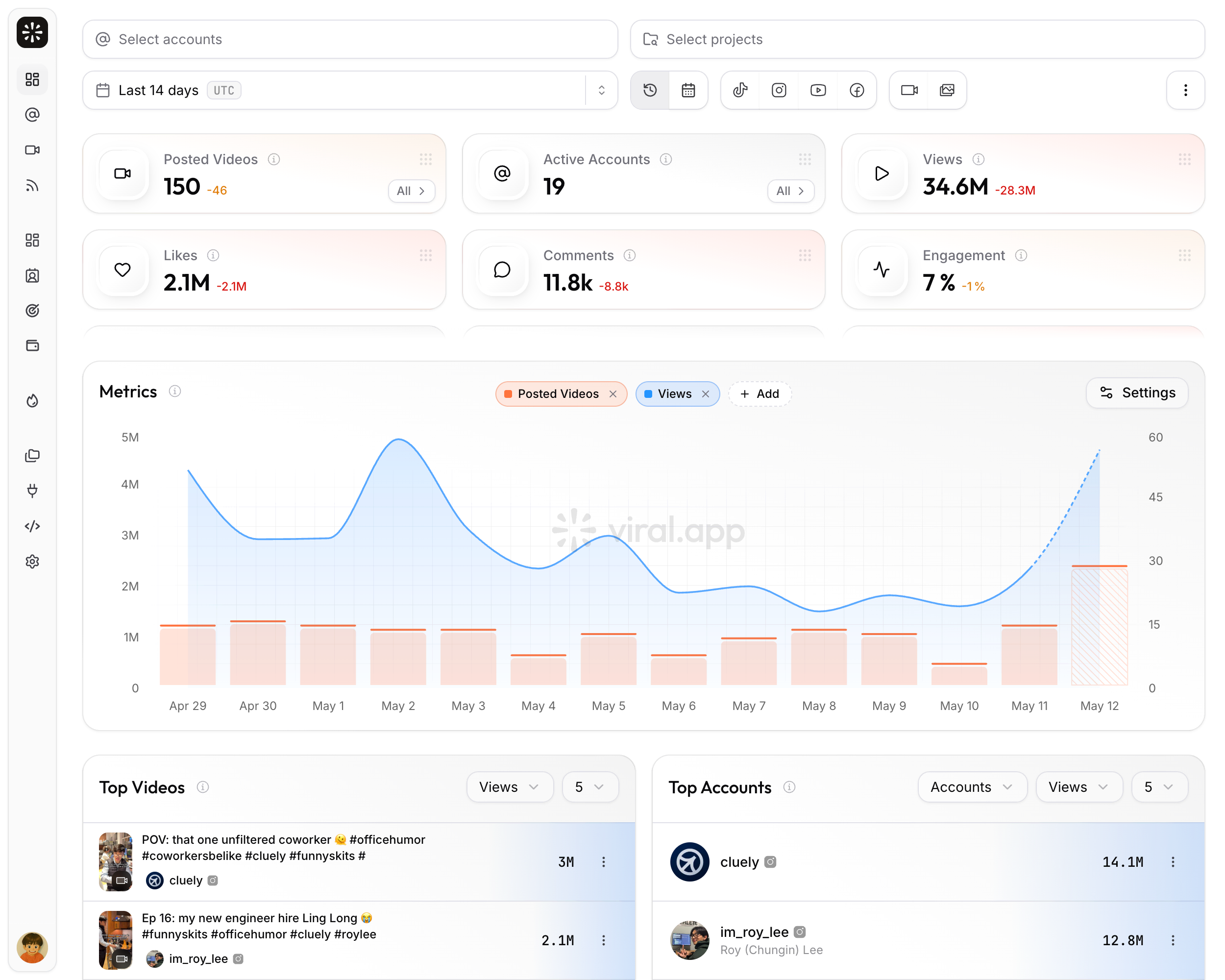
viral.app: Performance UGC Campaign Management
Best for: DTC and ecommerce teams running performance UGC programs that need campaign tracking, creator analytics, and payout workflows in one place. viral.app is a UGC campaign management platform and helps teams manage UGC creators beyond the initial discovery stage. Brands can set up campaigns, organize creator rosters, track posts and views across TikTok, Instagram Reels, YouTube Shorts, and Facebook Reels, report on campaign performance, and review performance-based payouts from one workspace.
Intellifluence: Cost-Effective Outreach
Intellifluence provides affordable access to a broad influencer pool. Its marketplace model allows brands to pitch campaigns and receive proposals from interested creators, keeping costs predictable and campaigns agile.
Refersion: Influencer & Affiliate Tracking
Refersion is a powerhouse for brands wanting to combine affiliate and influencer marketing. Shopify brands love Refersion’s seamless integration, which tracks sales, automates payouts, and attributes revenue with precision.
BrandSnob: Marketplace for Influencer Collabs
BrandSnob is a marketplace-style platform focused on quick influencer collaborations. DTC brands use it to connect with micro and nano influencers, launch campaigns rapidly, and manage payments securely.
Heepsy: Nano & Micro Influencer Search
Heepsy specializes in micro and nano influencer discovery—crucial for brands with niche audiences. Its database and robust filtering help brands connect with genuine voices that drive engagement and conversion.
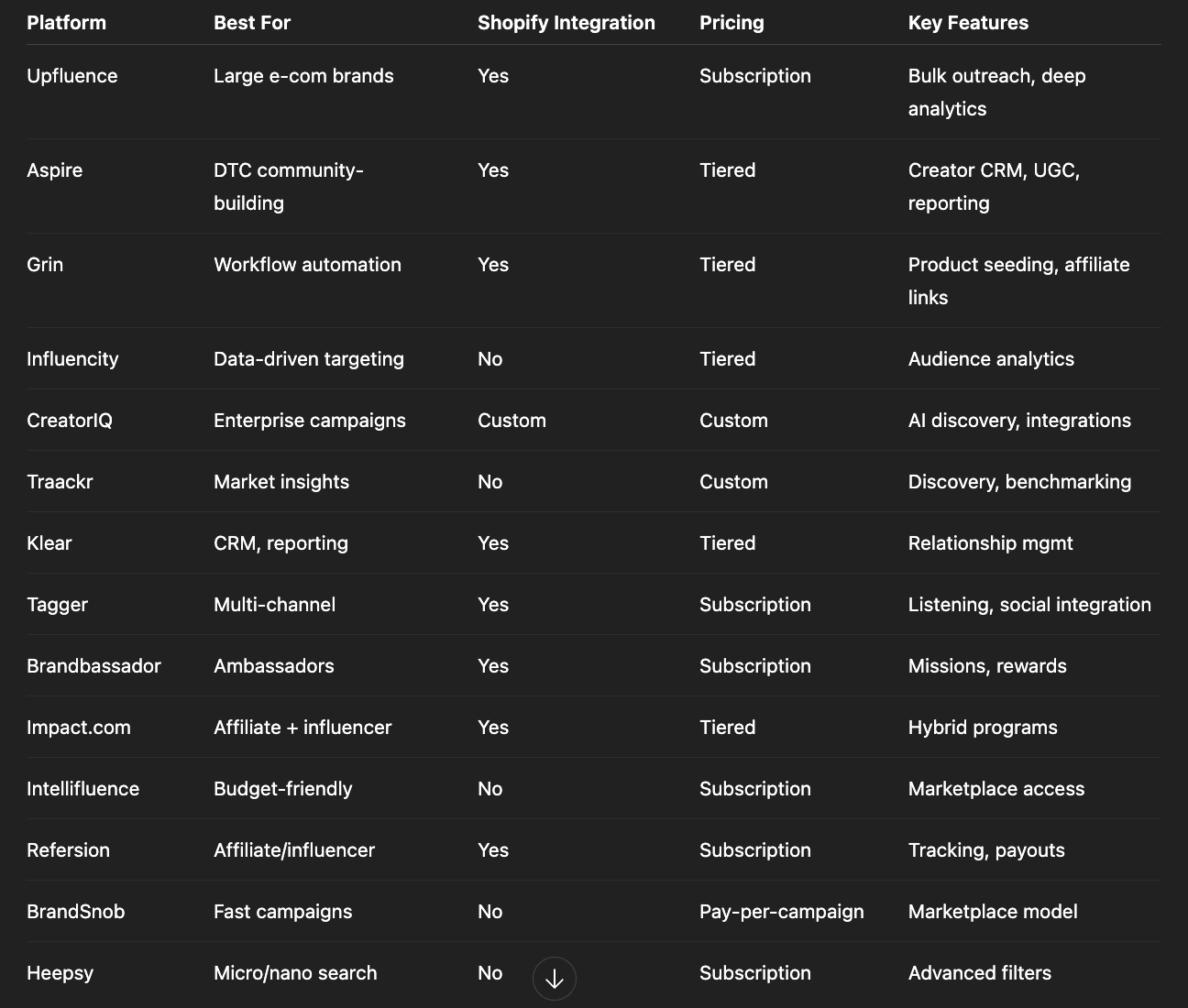
Influencer Marketing Platform Features Comparison Table
How to Choose the Right Platform for Your Brand
The selection process isn’t one-size-fits-all. Here’s how to match a platform to your needs:
- Define your influencer marketing goals (awareness, sales, UGC, community).
- Assess internal resources: Do you need automation, or will you use a managed service?
- Consider your integration needs—Shopify, email, analytics, payment tools.
- Evaluate the platform’s influencer pool for relevance and reach.
- Factor in your budget and preferred pricing model.
Test-drive platforms with demos or trials before committing, and seek out recent case studies.
The Role of Influencer Marketing Agencies
Platforms and agencies both offer value, but serve different needs. Agencies are ideal for brands lacking internal bandwidth or influencer expertise. They often use the same platforms listed here but add hands-on campaign management, creative strategy, and influencer relationship management.
For DTC and e-commerce brands with lean teams, agencies can provide instant scale. However, brands seeking ownership and control often prefer managing campaigns in-house using top influencer marketing platforms.
Common Mistakes Brands Make with Platforms
It’s easy to get lost in the tech. Here are frequent missteps:
- Over-relying on platform data without vetting influencer authenticity
- Ignoring FTC disclosure requirements
- Underutilizing integration features (like Shopify apps)
- Failing to nurture long-term creator relationships
- Skipping post-campaign analysis and optimization
Avoid these pitfalls to get the most out of your influencer investment.
Tips to Maximize ROI with Influencer Marketing Platforms
- Leverage platform analytics to optimize campaigns in real-time
- Use A/B testing with different creator types and content formats
- Integrate UGC into your website and paid ads for added value
- Establish clear, trackable KPIs from day one
- Prioritize long-term partnerships over one-off campaigns
Remember, platforms amplify strategy—they don’t replace it.
Measuring Influencer Campaign Success
Success isn’t just about likes and shares. The best influencer marketing platforms enable you to measure:
- Clicks and conversions via trackable links
- Revenue attributed to each influencer
- ROI for each campaign
- Brand lift, engagement, and customer acquisition costs
Set up analytics integrations early, and use UTM parameters for granular tracking.
Compliance & FTC Guidelines in Influencer Marketing
Transparency is non-negotiable. Platforms should help you:
- Ensure influencers use proper disclosure (#ad, #sponsored)
- Track compliance in reporting dashboards
- Automate contract and agreement workflows
Non-compliance risks fines and reputational damage. Choose platforms that prioritize legal and ethical standards.
Admetrics: The AI-Powered Analytics Engine Fueling Smarter Loyalty & Referral Programs
Admetrics is a next‑gen marketing analytics platform tailored specifically for DTC and e‑commerce brands seeking to elevate their loyalty and referral efforts through data-driven insights. The platform unifies performance data from various sources—ad platforms like Facebook, Google, TikTok, as well as Shopify and marketplace sales—into a single intuitive dashboard, making it accessible within minutes—even on privacy‑restricted environments post‑iOS 14—thanks to its server-to-server integrations. Through its proprietary PRISMA modeling and Bayesian experimentation frameworks, Admetrics surfaces which marketing channels, creatives, and customer segments are truly driving conversions and long-term value.
When integrated into loyalty and referral programs, Admetrics excels by:
- Accurately attributing referral-driven acquisitions and loyalty touchpoints—even in fragmented user journeys—so brands can optimize incentives and discounts based on real ROI.
- Applying AI‑powered customer behavior predictions and cohort analysis to identify high‑LTV referrers and flag churn‑risk segments in time to trigger pre‑emptive loyalty offers .
- Enabling continuous A/B testing of referral reward structures, gamified challenges, or surprise‑and‑delight campaigns, measuring their incremental impact on retention and CLV through its advanced experimentation engine.
By combining precise attribution, predictive analytics, and experiment-driven optimization, Admetrics empowers brands to design smarter referral and loyalty programs that don’t just reward customers—but actively scale retention, spur advocacy, and maximize profitability.
Influencer Marketing Platforms: Frequently Asked Questions
What is the best influencer marketing platform for Shopify brands?
Upfluence, Grin, Aspire, and Refersion all offer strong Shopify integrations, making campaign attribution and product gifting seamless.
How much do influencer marketing platforms cost?
Pricing varies from as low as $99/month (Intellifluence) to custom enterprise pricing (CreatorIQ). Most platforms offer demos or trials.
Do these platforms work for micro-influencer campaigns?
Yes. Heepsy, BrandSnob, and Aspire are especially strong for micro and nano influencer discovery.
Is there a platform that combines affiliate and influencer marketing?
Impact.com and Refersion are leaders in combining affiliate tracking with influencer management.
Can influencer marketing platforms guarantee ROI?
No platform can guarantee results, but robust analytics and integrations help brands closely track and optimize ROI.
Should I use an agency or platform for influencer marketing?
It depends on your in-house resources and goals. Platforms offer control and scalability, while agencies deliver hands-on expertise.
Conclusion: Building Sustainable Growth with Influencer Marketing Platforms
Influencer marketing platforms are no longer optional for DTC and e-commerce brands—they’re essential engines for scalable, authentic, and data-driven growth. The best platforms automate the tedious, connect you with the right voices, and deliver ROI clarity that transforms influencer marketing from a “nice-to-have” into a profit center. By choosing wisely and investing in relationships, brands can turn customers into advocates, drive repeat purchases, and stand out in the crowded digital marketplace.