“You can’t improve what you don’t measure.” That phrase is more relevant than ever for e-commerce brands heading into Black Friday and Cyber Monday 2026.
Last year, Cyber Monday became the largest online shopping day in history. Yet, for many DTC marketers, performance measurement felt like flying blind. Attribution gaps, conflicting platform data, and privacy restrictions left brands second-guessing where to allocate budgets.
In 2026, measurement of your Black Friday Cyber Monday actions is not a nice-to-have—it’s a survival strategy. Scaling profitably requires reliable, unified data and clear methods for understanding what truly drives results. In this guide, we’ll unpack the four core approaches to measuring BFCM marketing performance and show how these insights connect directly to discounting and offer strategies.
Why Reliable Data Is Non-Negotiable
The foundation of BFCM marketing performance is reliable data. Without it, decisions are made too late, based on guesswork or incomplete reporting. Delayed or inaccurate numbers not only waste ad spend but also erode trust between marketing, finance, and leadership teams.
Privacy changes since iOS14 have only amplified the challenge. Platforms now provide partial views of customer journeys, leaving critical touchpoints untracked. At the same time, siloed data across Shopify, Amazon, Meta, TikTok, and Google Ads makes it almost impossible to see the full picture.
To overcome these challenges, brands need a unified, frequently updated data source that consolidates all sales and marketing performance into one view. With this in place, teams can act in real time, optimize budget allocation, and avoid the spiral of reactive decision-making that costs both revenue and reputation.
Core Methods for Measuring BFCM Marketing Efficiency
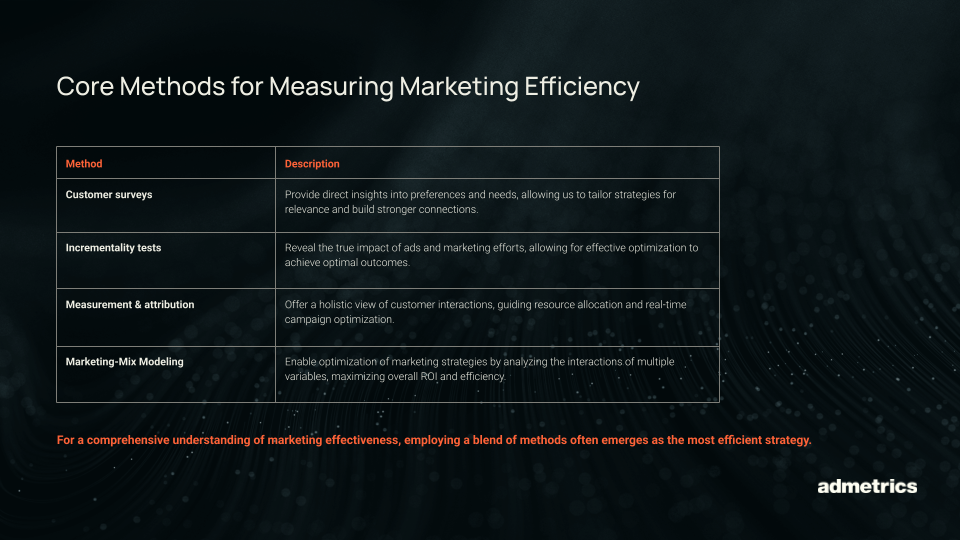
Customer Surveys: Listening to the Voice of the Customer
Customer surveys remain one of the most accessible ways to measure performance. They provide direct feedback on preferences, buying motivations, and shopping experiences. For example, post-purchase surveys during BFCM can reveal not just what customers bought but why they converted.
Surveys are cost-efficient and quick to implement, making them valuable for brands of all sizes. However, their simplicity comes with limitations. Low participation rates, response bias, and shallow insights can reduce reliability if surveys are used in isolation. The most effective strategy is to integrate survey data into broader analysis frameworks, using it to add context to quantitative results.
Incrementality Testing: Separating Signal from Noise
Incrementality is one of the most critical concepts in performance measurement. It answers the question: Would this sale have happened without this ad?
By running structured A/B tests—where one group is exposed to ads and another isn’t—brands can isolate the incremental lift driven by specific campaigns. This makes incrementality testing especially powerful during BFCM, when overlapping promotions, retargeting, and organic demand can distort results.
The advantages are clear: incrementality works across all channels, accounts for organic behavior, and provides hard numbers for optimization. But setup is not trivial. Proper experimental design, accurate control groups, and rigorous bias prevention are essential. Done right, incrementality ensures that budgets are invested only where campaigns genuinely drive additional revenue.
Attribution Modeling: Mapping the Customer Journey
If incrementality testing tells us if ads work, attribution modeling tells us which touchpoints deserve credit.
Attribution models distribute value across the steps a customer takes before converting. The simplest versions—first-touch and last-touch—assign 100% of credit to the first ad clicked or the final interaction before purchase. These can be useful for specific cases, such as prospecting campaigns (first-touch) or flash sales (last-touch).
For more complex journeys, multi-touch models provide a richer view. Linear attribution spreads credit evenly across touchpoints, while time-decay favors interactions closer to conversion. Position-based, or “U-shaped,” models highlight both the initial and final engagements, acknowledging their joint influence. The most advanced, data-driven attribution, uses machine learning to assign weights dynamically based on real behavior.
No model is perfect. Each has blind spots, particularly in accounting for offline activity or cross-channel spillover. The key is to select the model that aligns with your campaign goals, budget size, and customer journey complexity.
Marketing Mix Modeling: The Strategic Advantage
While attribution works at the micro level, Marketing Mix Modeling (MMM) zooms out. MMM uses advanced statistical methods and machine learning to quantify the contribution of each marketing channel—including offline touchpoints and untracked digital impressions—to total sales.
Its strength lies in providing a privacy-compliant, high-level view of effectiveness. Unlike attribution, MMM does not depend on cookies or user-level tracking, making it resilient against privacy restrictions such as iOS14, GDPR, and future browser updates. Instead, it identifies how each channel contributes to revenue, where diminishing returns begin, and how different budget scenarios are likely to play out.
With Admetrics’ next-generation MMM, DTC brands gain a platform built specifically for modern e-commerce challenges. The solution integrates tracking, attribution, survey data, and financial metrics into a single model. This allows teams to:
- Quantify channel impact across the full mix: paid, organic, offline, and even influencer or affiliate efforts.
- Forecast campaign performance using scenario planning to simulate different budget distributions.
- Detect saturation points to avoid overspending where incremental returns are falling.
- Optimize budget allocation dynamically, predicting the most efficient spend pattern across channels.
The trade-off is complexity: MMM requires sufficient data inputs and typically works best with brands that invest significantly in cross-channel campaigns. However, the payoff is immense. Instead of fragmented channel views, MMM delivers a unified picture of how every marketing activity contributes to growth.
For e-commerce leaders, this transforms MMM from a theoretical model into a strategic advantage: the ability to plan budgets confidently, defend spend decisions at the C-level, and scale profitably during high-stakes events like BFCM.
Real-World Example: SugarGang
The candy brand SugarGang illustrates the importance of clean measurement. Before iOS14, they relied on Facebook, Snapchat, and TikTok platform data to guide spend. After the update, attribution collapsed, and campaigns underperformed.
By integrating Admetrics’ attribution pixel and data passback, SugarGang was able to rebuild clarity across channels. The result: a 3x improvement in ROAS, faster scaling on TikTok, and restored confidence in performance data. Their story underscores a broader truth—without accurate measurement, even the best creative and offers can fail to deliver. Watch more customer stories here.
Conclusion
BFCM 2026 is not just a test of creativity or discount depth. It is a test of measurement. Brands that build unified data systems, apply incrementality and attribution wisely, and invest in MMM will scale with confidence instead of guesswork.
Measurement also ensures discounts become strategic levers rather than margin killers. By linking data to pricing strategy, e-commerce brands can win both short-term revenue and long-term loyalty.
Use advanced tools like Admetrics Data Studio to unify data, test incrementality, and measure what works so that you can scale profitably this holiday season.
FAQ: BFCM Marketing Performance
What is BFCM marketing performance?
It refers to measuring how effectively your Black Friday and Cyber Monday campaigns drive sales, ROI, and long-term customer value.
What is the best way to measure marketing performance during BFCM?
The strongest approach blends incrementality testing, attribution modeling, and MMM, providing both short-term and strategic clarity.
Why is attribution modeling important for BFCM?
It helps identify which ads and channels contribute most to conversions, ensuring budgets are allocated to the right touchpoints.
What are incrementality tests?
They measure whether sales would have occurred without specific ads, helping brands prove the real impact of campaigns.
How do discounts affect performance?
Unplanned discounts cut into margins. Performance data ensures promotions align with profitability and customer psychology, driving sustainable growth.