Attribution used to mean choosing between simple rules that miss the truth or closed models you're not allowed to check. Here's how we built a third option: a data-driven model that learns from your customer journeys, adapts to your business, and stays inspectable.
The problem with picking a model
Every attribution dropdown asks you the same question: first touch or last touch? Which window, 7 days, 30, 90? Every answer is a different truth, and none of them is measured. They're conventions.
Last click hands 100% of the credit to whoever touched the customer last, usually retargeting or brand search, the channels that harvest demand rather than create it. First touch does the opposite. Position-based splits the difference by decree. The result is the same either way: budget follows a rule, not reality.
Data-driven alternatives exist, but the ones the platforms hand you are trained on what they see, graded by themselves, and closed to inspection.
Adaptive Attribution takes a different route: it computes a weight for every touchpoint of every conversion, from signals in your own journey data, and every weight is inspectable.
The output is simple to state: for one conversion with N touchpoints, the model produces weights that always sum to exactly 100% of the order value. No credit invented, none lost, nothing double-counted.
Clean data first
Attribution is only as good as the journey it reads, and raw journey data is noisy. Before a single weight is computed, every conversion runs through a preprocessing pipeline:
- Filter the noise. Bot traffic, payment-provider redirects, self-referrals, zero-engagement bounces and internal traffic are removed before they can distort anything.
- Classify the customer. New, returning or reactivated, because the same journey means different things for each. Every rule downstream adapts to the customer type.
- Segment the journey. A long silence in the middle of a journey means a new consideration cycle started. Touchpoints before the gap belong to an old story and are dropped — with different patience for new versus returning customers.
- Resolve direct traffic. A "direct" visit usually isn't a channel, it's the echo of an earlier touchpoint. The model stitches direct sessions back to the touchpoint that actually caused them, inheriting their engagement instead of crediting a channel called "direct."
- Deduplicate. Repeated hits from the same channel within a day collapse into one touchpoint. Their engagement is merged, not lost.
What's left is the honest journey, the sequence of touchpoints that actually happened, for the customer type it actually happened to.
Five signals per touchpoint
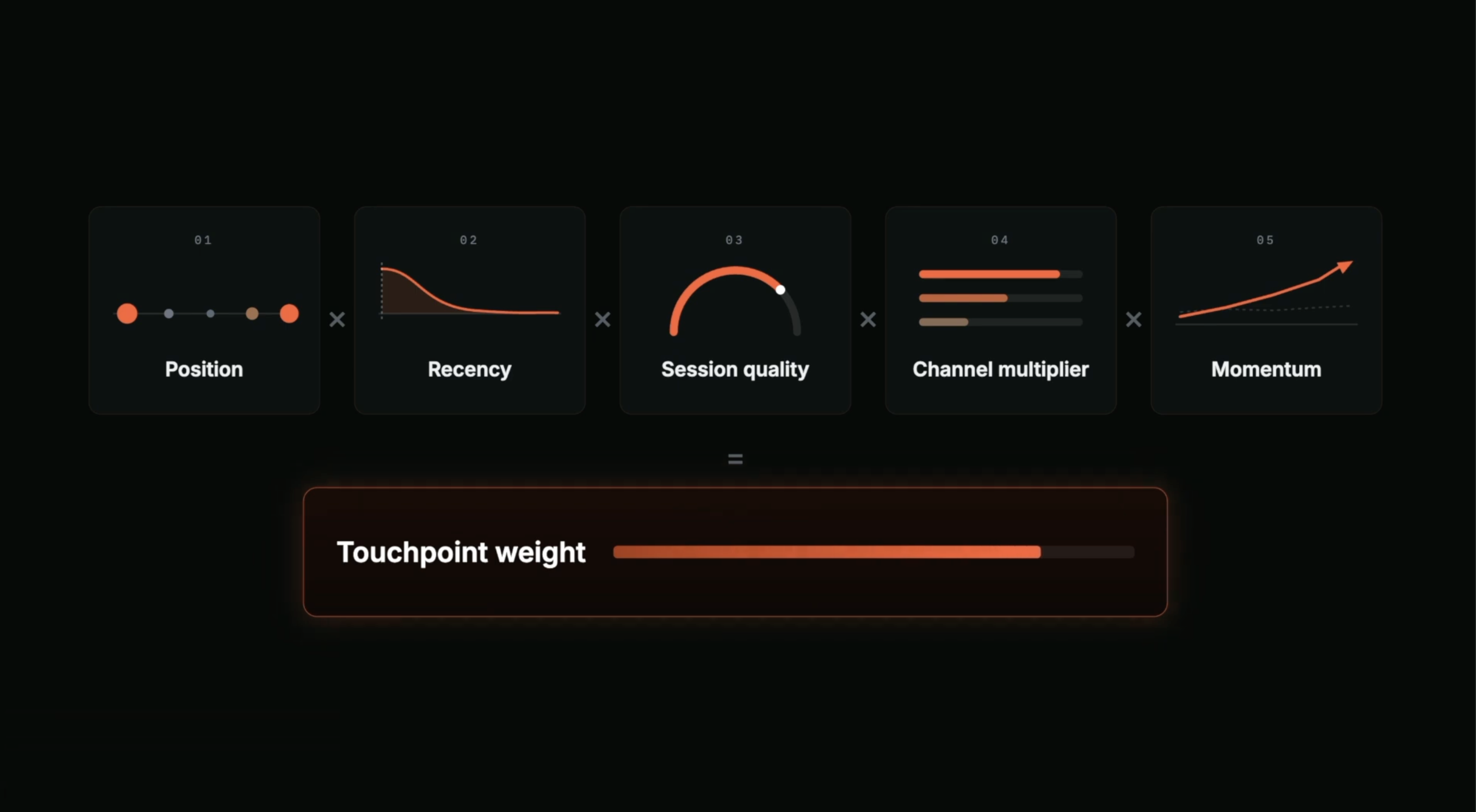
For every touchpoint in the cleaned journey, the model computes five factors and multiplies them:
Position. Where the touchpoint sits in the journey. Openers and closers carry different structural weight, and the shape differs by customer type. For a new customer, the discovery touch matters more; for a returning customer, the closing touch does.
Recency. How long before the purchase the touchpoint happened, decayed exponentially. But not with one global window: each channel type has its own memory.
This is one of the most consequential differences to rule-based models. A brand-search click works for hours. An influencer video keeps driving purchases for weeks. Applying one lookback window to both systematically buries the channels with long memory, which are usually the ones creating demand in the first place.
Quality. How engaged the session really was. Session duration, pages viewed, product-detail views, add-to-cart events, a deeply engaged session earns a multiple of what a bounce earns. A ten-second single-page visit is nearly worthless as evidence, and the model treats it that way.
Adaptive multiplier. The channel's true role for this customer and journey. Prospecting discovers. Retargeting closes. Brand search harvests demand that already exists. The model weights each channel group by its actual role, and this is where it gets interesting, because these multipliers are not fixed constants. They're learned (more on that below).
Momentum. Did the touchpoint lead anywhere? A touchpoint that triggers the next interaction shortly after gets credit for driving the journey forward. A touchpoint that re-ignites a journey after a long silence gets credit for winning the customer back.
Multiply the five factors, normalize across the journey, and every touchpoint holds its true share of the order.
Three customer types, three different mechanics
A journey is not just a sequence of touchpoints, it belongs to a person, and it matters who that person is. A first-time buyer discovering the brand, a loyal customer making their monthly order and a lapsed customer being won back after months of silence produce journeys that look superficially similar and mean completely different things.
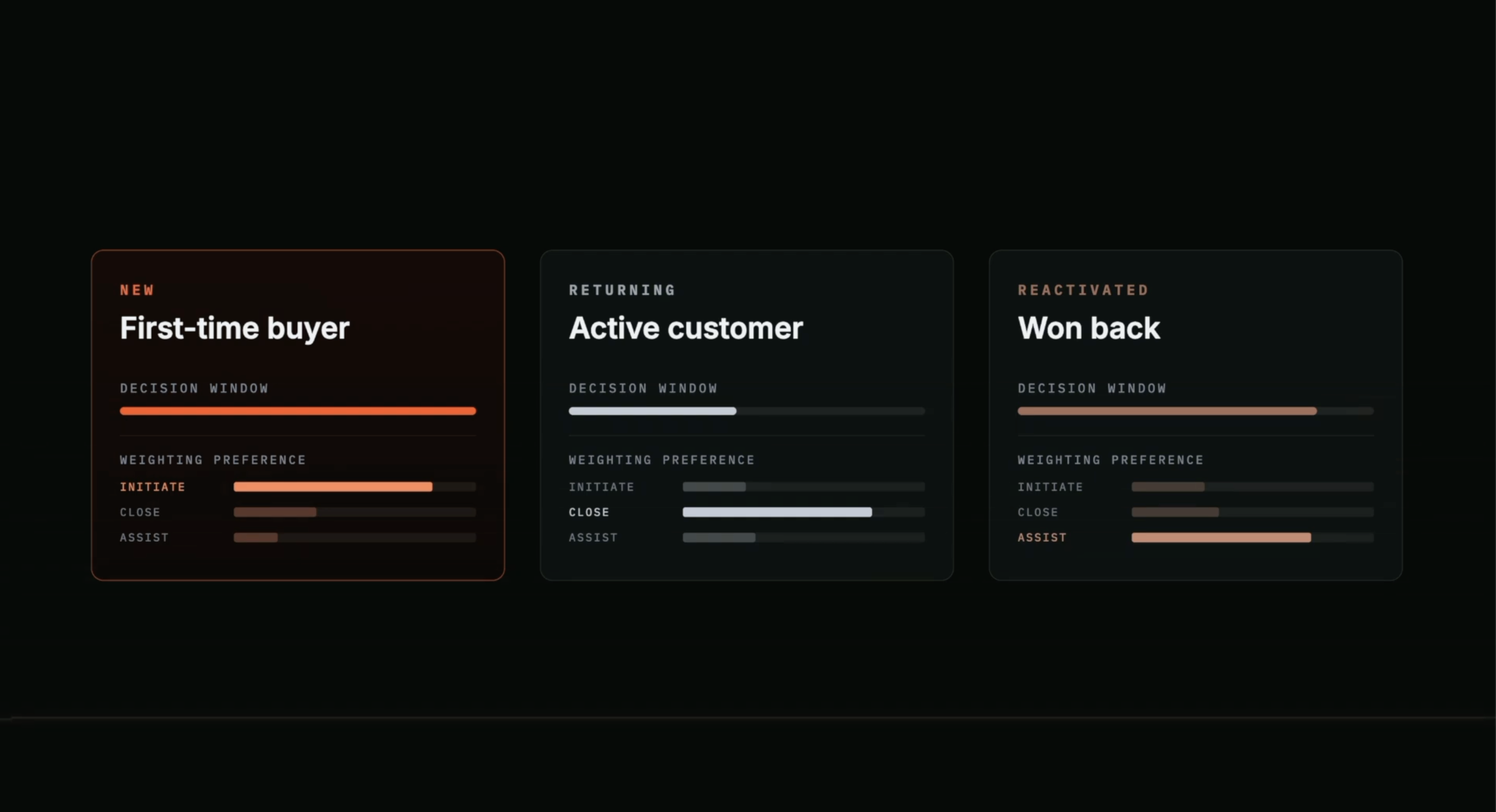
That's why the model doesn't run one set of rules. It classifies every conversion as new, returning or reactivated, and adapts the mechanics to the type:
Journey patience differs. A new customer's consideration can stretch over six weeks, so the model keeps a long memory. A returning customer's purchase cycle is short, a touchpoint from a month ago almost certainly belongs to a previous purchase, not this one.
Position emphasis differs. For new customers, the touch that found them carries the most structural weight. For returning customers, it's the touch that triggered this purchase. For reactivated customers, the touchpoint that woke them up after the silence is the hero of the journey.
Adaptive channel multipliers differ. Prospecting and influencer touches do the heavy lifting for new customers; CRM and retargeting do the real work for returning ones. Each type gets its own learned multiplier set, because a retargeting ad shown to a loyal customer and one shown to a stranger are not the same event.
No attribution windows
Here's a question you'll never answer again: "which attribution window should we use?"
Fixed windows like 7 days, 30, 90, cut journeys with a ruler. A touchpoint that truly drove the purchase but sits outside the window is lost entirely. A stale touchpoint that happens to sit inside gets counted at full force. The window doesn't know your customer; it's one number applied to every journey alike.
Adaptive Attribution doesn't need one, because two mechanisms already do the job, better:
Journeys split at real gaps. A long silence inside a journey means a new consideration cycle began. The model detects the gap and drops what came before, with the gap threshold adapted to the customer type. The journey defines its own boundary, individually, instead of inheriting a global cutoff.
Recency handles the rest. Within a journey, every touchpoint is decayed by its channel-specific half-life. Old touchpoints fade smoothly toward zero instead of falling off a cliff at day 30. Nothing relevant is amputated; nothing stale dominates.
The result: no window setting exists in the product, because no window is needed. The journey's own structure, its gaps, its recency, its customer type, decides what counts.
What that changes in practice
Take a real journey shape: a new customer discovers the brand through paid social prospecting, comes back ten days later through an engaged generic-search session, long visit, eight pages, add to cart, and converts half an hour after a final brand-search click.
Last click's answer: brand search did it, 100%. Scale brand search.
Adaptive Attribution's answer: the engaged discovery-and-consideration work dominates, the generic-search session that actually built the purchase intent earns the largest share, prospecting gets meaningful credit for starting the journey, and brand search keeps a fair but non-dominant share for closing it.
Same data. A completely different budget decision. The creative that started the fire finally gets its credit, instead of being cut next quarter because the reporting handed everything to the last touch.
The learning layer
Everything above describes the model's structure. What makes it adaptive is that the most important parameters aren't constants, but learned.
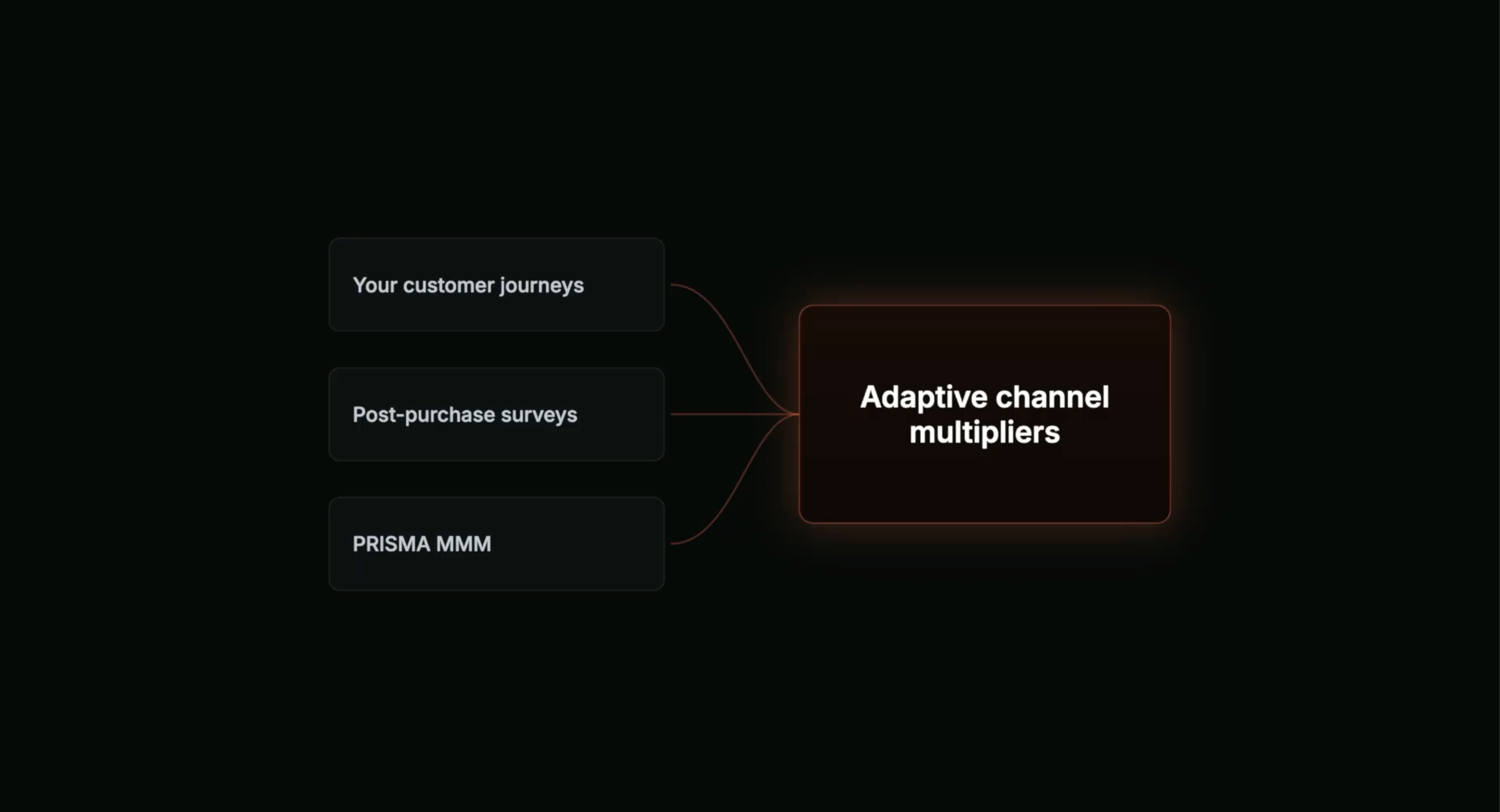
The adaptive channel multipliers, how much a prospecting touch, a retargeting touch, an influencer touch really contributes for your customers, are learned per account from your own journey data.
And they don't stand still. The model retrains on a rolling basis, so when your mix shifts - a new channel, a new season, a changed funnel - the weights follow reality instead of last year's assumptions. Parameter versions are locked with validity timestamps, so historical attribution stays immutable when the model learns something new: your last quarter doesn't silently rewrite itself.
Two additional signals can be used to calibrate the learning beyond what tracking can see. Post-purchase surveys capture what customers say drove them, validating channels that click-based tracking structurally underestimates, like TV, podcasts or word of mouth. And where PRISMA, our marketing mix model, runs alongside, its channel-level incrementality estimates feed back into the multipliers, aligning touchpoint-level attribution with what the mix model measures at the macro level. Attribution and MMM stop being two contradicting reports and start being one calibrated system.
No black box
Every weight the model produces is inspectable: which touchpoint received what share, and which of the five signals drove it. You'll never pick a model or set a window again, but you can always check what the model did.
That's the standard we hold every measurement product to: if you can't check it, you shouldn't have to trust it.
Adaptive Attribution is live now in Admetrics.